Within Nepal Cryptids
What Happened to Nepal's Famous Yeti Relics?
Monastery hands and scalps became famous as Yeti evidence, but testing, theft claims and sacred context complicate their story.
On this page
- The Pangboche hand controversy
- The Khumjung scalp and monastery tradition
- Testing, removal and ownership disputes
Page outline Jump by section
Introduction
The most famous physical “evidence” for Nepal’s Yeti legend was not a footprint in snow but a collection of relics kept in remote monasteries above the Everest region. For decades, visitors to Pangboche and Khumjung were shown objects said to be connected to the mysterious mountain creature: a preserved hand in Pangboche and a scalp-like relic in Khumjung. These artefacts became central to international Yeti investigations, attracting explorers, scientists, journalists and cryptozoologists. Yet the closer they were examined, the more complicated the story became.

Today, the relics sit at the intersection of folklore, sacred tradition, tourism, scientific testing and cultural ownership. Rather than providing clear proof of an unknown Himalayan ape, they reveal how difficult it can be to separate belief, evidence and outside curiosity in the high Himalaya.[Wikipedia]WikipediaPangboche HandPangboche Hand
The Pangboche hand controversy
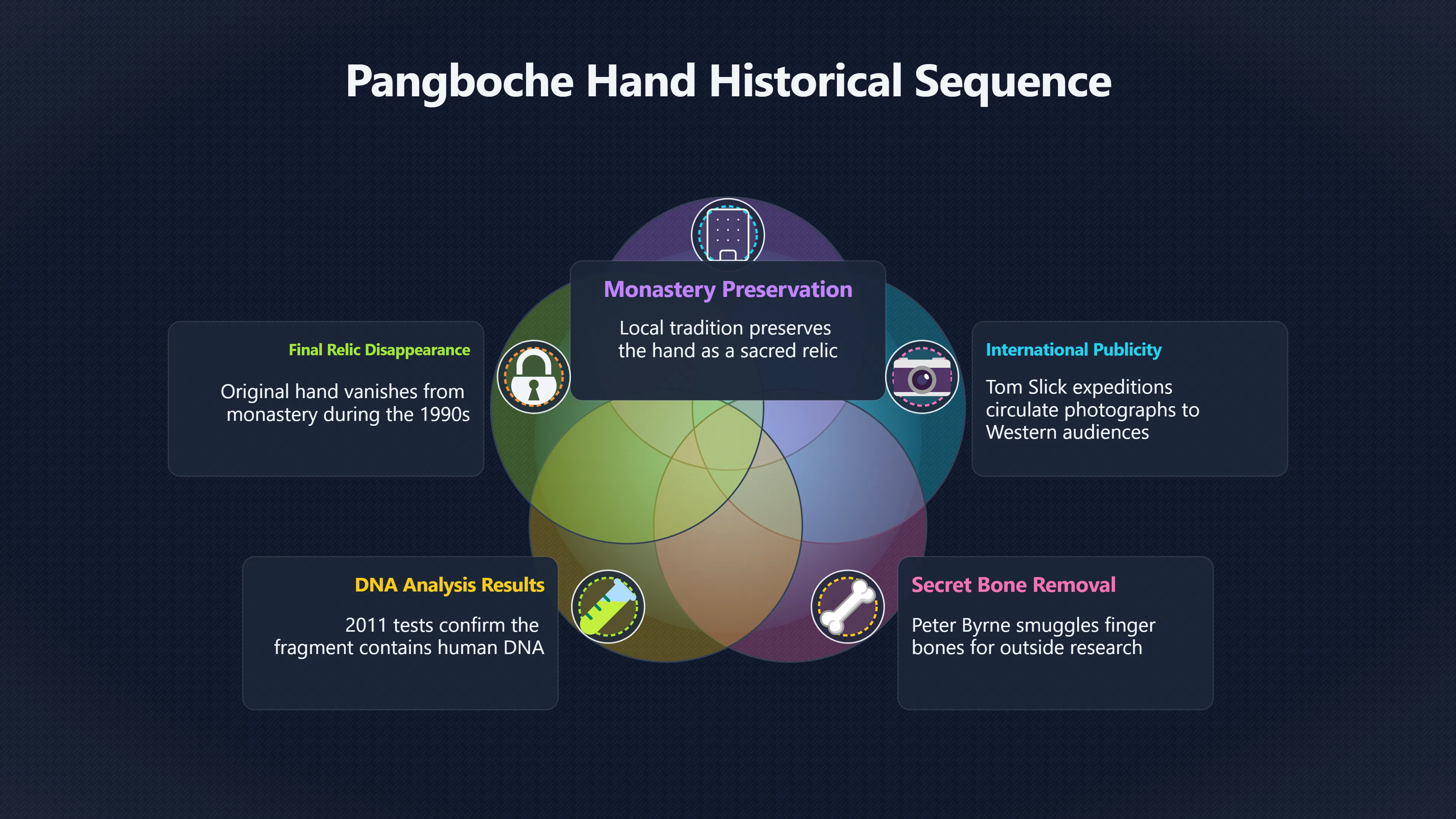
The most dramatic of the Yeti relic disputes concerns a mummified hand once kept at Pangboche Monastery in the Khumbu region. Local tradition linked the hand to stories surrounding the monastery’s founding and regarded it as a sacred object rather than a specimen awaiting laboratory analysis. According to monastery accounts, the relic had been preserved for generations and was occasionally displayed during village rituals.[Wikipedia]WikipediaPangboche HandPangboche Hand
Everything changed during the great Yeti hunts of the 1950s. American explorer Tom Slick’s expeditions helped publicise the hand internationally, and photographs of it circulated widely among Western audiences fascinated by the “Abominable Snowman”. The relic appeared unusual enough that some investigators wondered whether it might belong to an unknown primate.[Wikipedia]WikipediaPangboche HandPangboche Hand
The controversy deepened when expedition member Peter Byrne secretly removed finger bones from the hand after monks refused permission for more extensive examination. According to later accounts, the bones were smuggled out of Nepal and eventually reached researchers abroad. The episode has become one of the most notorious incidents in cryptozoology because it combined scientific curiosity with what many observers now view as the unauthorised removal of a sacred cultural object.[wikipedia.org]WikipediaPangboche HandPangboche Hand
Scientific assessments failed to support claims that the relic belonged to an unknown creature. Early examinations produced conflicting interpretations, but later DNA analysis of one surviving finger sample found human genetic material. By 2011, researchers announced that the tested finger fragment was human rather than evidence of a mysterious Himalayan species.[wikipedia.org]WikipediaPangboche HandPangboche Hand
The story became even stranger when the original hand reportedly disappeared after being stolen from the monastery in the 1990s. With the artefact itself gone, later researchers could only study surviving fragments, photographs and replicas. The loss ensured that debate about the hand would never be fully resolved through modern testing.[Trafficking Culture]traffickingculture.orgTrafficking CulturePangboche Handby D Yates — The Pangboche Hand is an alleged Yeti hand, stolen from a Nepali monastery. A finger was st…
The Khumjung scalp and monastery tradition
While Pangboche became known for its hand, nearby Khumjung Monastery became famous for a dome-shaped object often described as a Yeti scalp. Unlike the Pangboche hand, the Khumjung relic survived and remains one of the best-known Yeti attractions in Nepal. Trekkers visiting the Everest region still encounter stories surrounding the object.[Atlas Obscura]atlasobscura.comAtlas Obscura The Yeti Scalp of KhumjungAtlas ObscuraThe Yeti Scalp of KhumjungMarch 23, 2017 — 23 Mar 2017 — A small village monastery in northeast Nepal claims to have a 300-y…
The scalp gained worldwide attention when Sir Edmund Hillary investigated Yeti claims during the 1960–61 Silver Hut expedition. With local permission, the relic was taken abroad for examination by specialists. This transformed a local monastery treasure into an international scientific curiosity.[Wikipedia]Wikipedia1960–61 Silver Hut expedition1960–61 Silver Hut expedition
Researchers who examined samples from the relic did not conclude that it came from an unknown ape. Studies suggested that the material was probably derived from a known Himalayan animal, most commonly identified as a serow, a goat-antelope native to the region, or something closely related. The findings did not support the idea that the scalp represented a previously undiscovered species.[Wikipedia]WikipediaOpen source on wikipedia.org.
Yet the Khumjung relic retained cultural importance regardless of scientific conclusions. For local communities, the object was never simply a zoological specimen. It functioned as part of a monastery tradition embedded in the landscape and history of the Khumbu. As a result, scientific scepticism did not erase its symbolic value.[Wikipedia]WikipediaHimalayan TrustHimalayan Trust
An intriguing consequence of the examination was that village leaders reportedly agreed to allow the relic to travel abroad only on the condition that a school be built in Khumjung. Hillary later fulfilled that promise through what became the Himalayan Trust, linking one of the world’s most famous Yeti investigations to a lasting educational project in the Everest region.[Wikipedia]WikipediaHimalayan TrustHimalayan Trust
Testing, removal and ownership disputes
The central lesson of the Pangboche and Khumjung relics is not whether the Yeti exists but how evidence becomes contested.
Several different disputes emerged around the relics:
- Scientific disputes: Researchers disagreed over what the objects represented, especially during the mid-twentieth century when genetic testing was unavailable. Later analyses generally favoured known human or animal origins.[Wikipedia]WikipediaPangboche HandPangboche Hand
- Cultural disputes: Monks and local communities often viewed the relics as sacred possessions, while foreign investigators treated them as specimens to be sampled and tested.[Trafficking Culture]traffickingculture.orgTrafficking CulturePangboche Handby D Yates — The Pangboche Hand is an alleged Yeti hand, stolen from a Nepali monastery. A finger was st…
- Ownership disputes: The removal of bones from the Pangboche hand and the later disappearance of the original relic raised questions about who had the right to possess, study or transport such objects.[traffickingculture.org]traffickingculture.orgTrafficking CulturePangboche Handby D Yates — The Pangboche Hand is an alleged Yeti hand, stolen from a Nepali monastery. A finger was st…
- Tourism disputes: As Yeti stories became valuable attractions for trekkers, relics acquired an economic role alongside their religious and folkloric significance.[Atlas Obscura]atlasobscura.comAtlas Obscura The Yeti Scalp of KhumjungAtlas ObscuraThe Yeti Scalp of KhumjungMarch 23, 2017 — 23 Mar 2017 — A small village monastery in northeast Nepal claims to have a 300-y…
These overlapping issues explain why the relics remain controversial long after most scientists abandoned the idea that they represented an unknown ape.
Why the relics still matter
From a strict evidential perspective, neither the Pangboche hand nor the Khumjung scalp provides convincing proof of a Yeti. The available testing points toward human remains in the case of the finger sample and known Himalayan animals in the case of the scalp material.[Wikipedia]WikipediaPangboche HandPangboche Hand
Their importance lies elsewhere. The relics show how the Yeti legend moved from local monastery traditions into global popular culture. They illustrate how explorers, journalists and scientists transformed sacred objects into cryptid evidence, and how those same objects later became subjects of theft, controversy and cultural debate.[traffickingculture.org]traffickingculture.orgTrafficking CulturePangboche Handby D Yates — The Pangboche Hand is an alleged Yeti hand, stolen from a Nepali monastery. A finger was st…
In Nepal’s wider Yeti tradition, the Pangboche hand and Khumjung scalp remain powerful symbols not because they solved the mystery, but because they demonstrate how mysteries are created, interpreted and contested. The relics survive as reminders that the most interesting part of the Yeti story is often not the creature itself, but the people who believed, investigated, protected, borrowed, tested and argued about the objects said to prove it.[Wikipedia]WikipediaPangboche HandPangboche Hand
Amazon book picks
Further Reading
Books and field guides related to What Happened to Nepal's Famous Yeti Relics?. Use these as the next step if you want deeper reading beyond the article.
Nicodemos of the Holy Mountain
First published 1988. Subjects: Christian ethics, Christianity, Doctrines, Early works to 1800, Orthodox Eastern Church.
eBay marketplace picks
Marketplace Samples
Live-tested eBay searches with available results related to this page.

Endnotes
1.
Source: Wikipedia
Title: Pangboche Hand
Link:https://en.wikipedia.org/wiki/Pangboche_Hand
2.
Source: Wikipedia
Title: 1960–61 Silver Hut expedition
Link:https://en.wikipedia.org/wiki/1960%E2%80%9361_Silver_Hut_expedition
3.
Source: Wikipedia
Link:https://en.wikipedia.org/wiki/Yeti
4.
Source: Wikipedia
Link:https://en.wikipedia.org/wiki/Khumjung
5.
Source: Wikipedia
Title: Himalayan Trust
Link:https://en.wikipedia.org/wiki/Himalayan_Trust
6.
Source: traffickingculture.org
Link:https://traffickingculture.org/encyclopedia/case-studies/pangboche-hand/
Source snippet
Trafficking CulturePangboche Handby D Yates — The Pangboche Hand is an alleged Yeti hand, stolen from a Nepali monastery. A finger was st...
7.
Source: thehistoryblog.com
Link:https://www.thehistoryblog.com/archives/14196
Source snippet
The History BlogYeti finger turns out to be human after all29 Dec 2011 — The original hand was stolen in 1999 after a 1991 episode of Uns...
8.
Source: atlasobscura.com
Title: Atlas Obscura The Yeti Scalp of Khumjung
Link:https://www.atlasobscura.com/places/the-yeti-scalp-of-khumjung-khumjung-nepal
Source snippet
Atlas ObscuraThe Yeti Scalp of KhumjungMarch 23, 2017 — 23 Mar 2017 — A small village monastery in northeast Nepal claims to have a 300-y...
Published: March 23, 2017
9.
Source: abandonedspaces.com
Title: yeti scalp
Link:https://www.abandonedspaces.com/public/yeti-scalp.html
Additional References
10.
Source: cryptozoonews.com
Title: pangboche dna2
Link:https://www.cryptozoonews.com/pangboche-dna2/
Source snippet
Osman Hill, who had studied the returned fragment from Nepal, concluded the artifact was a human hand, perhaps with affinities to...Read...
11.
Source: returnthehand.com
Link:https://www.returnthehand.com/index.php/component/content/category/2-uncategorised
Source snippet
Return the HandIn the 1950's a Yeti tracker/scientist called Peter Byrne went on an expedition to Nepal.... And so ends the saga of the...
12.
Source: youtube.com
Title: Scientist Takes Sample from Supposed Yeti Hand
Link:https://www.youtube.com/watch?v=JeoSa3QE6vU
Source snippet
He Put a Yeti Hand WHERE?!? Jimmy Stewart a Cryptid Smuggler???...
13.
Source: reddit.com
Link:https://www.reddit.com/r/Cryptozoology/comments/1b0x3yo/apparently_the_yeti_scalp_is_just_a_ceremonial/
14.
Source: facebook.com
Link:https://www.facebook.com/ourancientnepal/posts/pangboche-handmummified-hand-may-be-of-yetilost-imageit-is-an-artifact-from-a-bu/405387900388895/
15.
Source: explorehimalaya.com
Link:https://explorehimalaya.com/yeti-myth-mystery-sacred-legends-himalaya/
16.
Source: facebook.com
Link:https://www.facebook.com/trekkinginnepalofficial/posts/the-legendary-yeti-scalp-of-khumjung-villageyetiyetiscalpkhumjungvillagetrekking/1271256115107231/
17.
Source: facebook.com
Link:https://www.facebook.com/groups/1702950456599867/posts/3799465306948361/
18.
Source: facebook.com
Link:https://www.facebook.com/trekkinginnepalofficial/posts/yeti-scalpthe-khumjung-yeti-scalp-is-a-famous-relic-housed-in-the-khumjung-monas/1191908716375305/
19.
Source: facebook.com
Link:https://www.facebook.com/groups/167944043787264/posts/1666247410623579/
Topic Tree