Cryptids of Guinea's Waters
Guinea’s cryptid record is not a crowded catalogue of named monsters. It is a smaller, more revealing set of stories clustered around water, mangrove country, strange carcasses and serpent imagery. The best-known Guinea-linked mystery animal is the Conakry Monster, a decomposed sea carcass photographed after washing ashore in 2007.
Page outline Jump by section
Introduction
That makes Guinea interesting in a different way from countries with a celebrity lake monster. Its legends grow out of real habitats: Atlantic surf, mangrove channels, river headwaters, forested mountains and wildlife that can be startling even when fully known to science. Guinea is the source region for major West African rivers, while Mount Nimba is internationally recognised for unusual endemic wildlife, including the viviparous toad and tool-using chimpanzees. Those landscapes give local monster stories their texture: serpents in wet places, odd bodies from the sea, rare animals in difficult terrain, and a constant blur between what is sacred, what is seen, and what is simply hard to identify.[FAOHome]fao.orgHome Appeal to safeguard the ecosystems and water resourcesHome Appeal to safeguard the ecosystems and water resources
The Conakry Monster: Guinea’s modern sea-carcass mystery
The Conakry Monster is the clearest modern “cryptid” case attached to Guinea. In May 2007, a large, badly decayed carcass reportedly washed up on the Guinean coast and was circulated online as a possible sea monster. Descriptions emphasised an armoured-looking back, a huge mouth, a long tail, hair or fur, and “four paws”, giving the object the look of a crocodile, lizard, mammal and marine animal all at once. Darren Naish’s Tetrapod Zoology write-up, which became one of the more careful sceptical discussions of the case, notes that the carcass was dubbed the “Conakry Monster” and that press and online commentary quickly offered exotic guesses, including giant reptile, monster turtle, mammoth and mosasaur-like creature.[scienceblogs.com]scienceblogs.comconakry monster tubercle technologyconakry monster tubercle technology
The case became memorable because the photographs seemed to invite the wrong mental category. A decomposed whale or large marine mammal does not always look like a whale once scavengers, surf, bloating, skin loss and collagen exposure have done their work. The “fur” seen on many globster-type carcasses is often not hair at all, but fibrous connective tissue. The black or plated-looking areas may be exposed, altered or inverted parts of a decomposed body rather than armour. That is why many sea-monster carcasses look more dramatic in photographs than they do under anatomical examination.[Chicago Journals]journals.uchicago.eduOpen source on uchicago.edu.
The best explanation for the Conakry Monster is therefore not an unknown reptile, but a decomposed whale or other large marine mammal, probably lying in a misleading position and stripped of obvious identifying features. This does not make the story worthless. It makes it a textbook example of how a real object can become a monster report through decay, distance, limited biological expertise and viral image-sharing. The wider globster record supports that sceptical reading: biochemical and molecular work on the Chilean Blob and comparisons with other “sea monsters” found that several famous blobs were decomposed whale tissue rather than unknown animals.[ResearchGate]researchgate.netOpen source on researchgate.net.
Guinea’s coast also makes this kind of report plausible without needing a new species. The Gulf of Guinea and adjacent Atlantic waters are used by whales and dolphins, although cetacean knowledge in parts of the region remains patchy and often depends on opportunistic sightings, strandings or fisheries bycatch. When a large carcass enters a warm, scavenger-rich coastal system, it can change quickly and wash up far from where the animal died. In that setting, a strange beach body can be completely real and still not be a cryptid.[springer.com]link.springer.comCetaceans of São Tomé and Príncipe | Springer Nature LinkCetaceans of São Tomé and Príncipe | Springer Nature Link
The serpent in the mangroves: Baga traditions and Ninki Nanka echoes
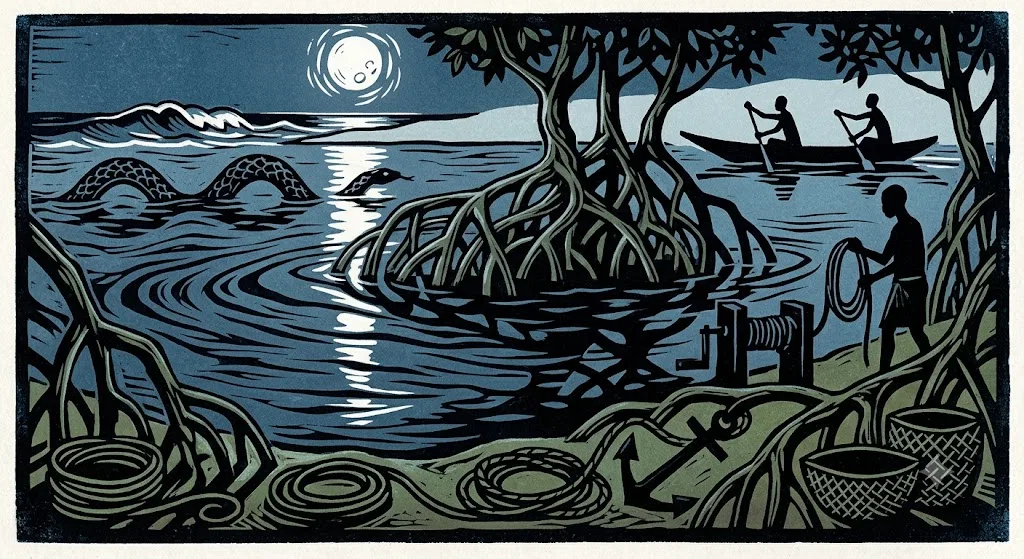
Guinea’s strongest creature tradition is not a single eyewitness monster but a cluster of serpent and water-spirit imagery along the coast. Among the Baga of coastal Guinea, museum collections preserve large serpent headdresses connected with ritual performance. The Metropolitan Museum of Art describes one Baga headdress as the physical manifestation of a powerful spiritual force, represented as a larger-than-life aquatic serpent resembling a boa constrictor. The Cleveland Museum of Art describes a nearly five-foot serpent headdress used in initiation rites and notes that the multi-coloured snake may represent the serpent-spirit Ninkinanka.[The Metropolitan Museum of Art]metmuseum.orgThe Metropolitan Museum of Arta-Mantsho-ña-Tshol (master of medicine) headdressThe Metropolitan Museum of Arta-Mantsho-ña-Tshol (master of medicine) headdress
This matters because it shows that Guinea’s serpent material is not merely an imported internet cryptid label. It is tied to coastal ritual life, performance, initiation, medicine, rain, fertility and the authority of sacred beings in wet landscapes. The serpent is not just “a big snake someone saw”; it is a figure that can move between art, social order and environmental imagination. In that sense, the Baga serpent belongs to folklore and religious tradition before it belongs to cryptozoology.[The Metropolitan Museum of Art]metmuseum.orgThe Metropolitan Museum of Arta-Mantsho-ña-Tshol (master of medicine) headdressThe Metropolitan Museum of Arta-Mantsho-ña-Tshol (master of medicine) headdress
The Ninki Nanka, better known today from Gambia and Senegal, is a wider West African river-dragon tradition that cryptozoology catalogues sometimes list as reported from Gambia, Guinea and Senegal. Modern descriptions vary wildly: giant serpent, crocodile-like beast, dragon, swamp creature or river spirit. The most publicised modern cryptozoological moment came in 2006, when the Centre for Fortean Zoology searched for the creature in The Gambia and attracted press coverage. That expedition belongs more to the pop-cultural afterlife of the legend than to Guinea’s own evidence base, but it helps explain why “Ninki Nanka” now appears in English-language monster lists.[Cryptid Archives]cryptidarchives.fandom.comCryptid Archives Ninki nanka | Encyclopaedia of CryptozoologyCryptid Archives Ninki nanka | Encyclopaedia of Cryptozoology
For Guinea, the careful reading is this: the serpent tradition is culturally significant, but not evidence for an undiscovered dragon. The Baga material is best understood as a powerful local and coastal spirit tradition with real visual forms, not a zoological field report. Where later cryptid writers connect it to Ninki Nanka, they are often blending regional folklore, museum terminology, colonial-era creature collecting and modern monster-hunting curiosity.[Cleveland Museum of Art]clevelandart.orgOpen source on clevelandart.org.
Why Guinea’s landscape produces watery monster stories
Guinea is a particularly good country for water-linked animal imagination because water is one of its defining facts. The Fouta Djallon highlands are widely described as the “Water Tower of West Africa”; FAO notes that more than 1,000 rivers have their source in the Fouta Djallon highlands and Guinean ridge, including upper basins linked with the Gambia, Niger and Senegal river systems. That creates a geography of springs, headwaters, floodplains, forest streams and downstream cultural connections.[FAOHome]fao.orgHome Appeal to safeguard the ecosystems and water resourcesHome Appeal to safeguard the ecosystems and water resources
The coast adds another layer. Guinea’s Atlantic lowlands include mangrove environments where land and water interlock, visibility is poor, animals move through channels, and floating remains can be difficult to identify. The Baga, Soussou and Nalu communities of coastal Guinea have long depended on mangrove resources, while recent conservation reporting describes those mangroves as fragile systems under pressure from overharvesting, land clearing and sea-level risks. In such places, an animal may be glimpsed briefly, half-hidden by water, roots or mud; a spiritual being may also be imagined as belonging exactly there.[WACA Program]wacaprogram.orgOpen source on wacaprogram.org.
This does not mean that every serpent tale is a misidentified python or crocodile. Folklore does not work that simply. But the animal background matters. West African wetlands and forests contain real reptiles, large fish, crocodiles, pythons, manatees in some regional systems, and marine mammals offshore. A story about a dangerous water serpent may carry practical warnings about swamps, deep channels, initiation boundaries, sacred spaces or the risks of entering certain places at the wrong time. Folklore studies more broadly have argued that animal tales can encode ecological knowledge, especially predator-prey relationships and cautionary lessons about behaviour in the landscape.[arXiv]arxiv.orgOpen source on arxiv.org.

Mount Nimba and the “real strange animals” problem
One of the best ways to understand Guinea’s mystery-animal reputation is to look at the animals that are real but still sound improbable. Mount Nimba, on the borders of Guinea, Liberia and Côte d’Ivoire, is a UNESCO World Heritage site noted for dense forest, high grassland and unusual endemic species. UNESCO highlights the viviparous toad and chimpanzees that use stones as tools; both sound like folklore at first glance, yet both belong to documented natural history.[UNESCO World Heritage Centre]whc.unesco.orgOpen source on unesco.org.
The Nimba otter shrew is another example of the “real cryptid feeling” without being a cryptid. It is a small semi-aquatic mammal centred on the Mount Nimba region, and research notes that it was not discovered by science until 1951 near Mount Nimba in Guinea. Later studies describe it as range-restricted, poorly known and vulnerable to mining-related changes, especially siltation in freshwater habitat. To a non-specialist, a tiny nocturnal river mammal related to tenrecs and known from a fragmented mountain range can sound like a mystery creature; to zoologists, it is a rare, threatened species with a paper trail.[wiley.com]onlinelibrary.wiley.comj.1936 704X.2016.03213.xj.1936 704X.2016.03213.x
This distinction is useful for Guinea’s cryptid page. The country does not need invented lake monsters to be strange. Its real fauna already includes animals that are localised, elusive, nocturnal, semi-aquatic, endangered or culturally charged. Cryptid stories often grow in exactly that gap: where ordinary people know a landscape contains hard-to-see animals, but formal science has only partial coverage.[Animal Diversity Web]animaldiversity.orgOpen source on animaldiversity.org.
Big cats, forest animals and mistaken monsters
Guinea also sits in a wider West African setting where large carnivores are rare, threatened and culturally powerful. The West African lion has suffered severe range contraction, and a 2014 conservation assessment found the situation most critical in West Africa, with remaining populations highly fragmented. IUCN-linked material has noted that rumours of lion presence have persisted in Guinea’s Haut Niger area, even where confirmed records are weak or absent.[PMC]pmc.ncbi.nlm.nih.govPMCThe Lion in West Africa Is Critically EndangeredPMCThe Lion in West Africa Is Critically Endangered
Leopards are a more plausible source for some “phantom cat” style claims in parts of West Africa, but they too are under pressure. Recent regional assessment work reported by Panthera describes West African leopards as endangered and sharply reduced across the region. That makes casual “black panther” or giant-cat rumours tricky to interpret: some could be distorted memories of real big cats, some could be exaggerations, and some could reflect cultural uses of leopard and lion power rather than direct sightings.[Panthera]panthera.orgwest african leopards are now endangered theres still chance change coursewest african leopards are now endangered theres still chance change course
The difference from Britain-style phantom cat lore is important. In Guinea, a large cat story does not necessarily imply an escaped exotic animal or a purely modern urban legend. It may sit near a real but depleted carnivore range, hunting memory, amulet trade, forest fear, or older ideas about animal power. Across West Africa, lion and leopard parts have been linked with protective amulets and mystical power, a trade that conservationists warn can harm already fragile populations. That is not a Guinea-only story, but it helps explain why big cats can remain powerful in regional imagination even where sightings are scarce.[AP News]apnews.comOpen source on apnews.com.
What counts as evidence in Guinea’s monster stories?
The evidence for Guinea’s cryptids is uneven, and that is the central finding. The Conakry Monster has photographs and a clear date, but the evidence points towards a decomposed carcass rather than an unknown animal. The Baga serpent has strong cultural evidence in museum collections and scholarship, but that evidence supports a ritual and spiritual tradition rather than a biological species. Ninki Nanka material links Guinea to a broader Upper Guinea coast and Senegambian river-dragon complex, but modern cryptozoological attention has focused more heavily on The Gambia than on Guinea itself.[scienceblogs.com]scienceblogs.comconakry monster tubercle technologyconakry monster tubercle technology
A useful reader test is to ask what kind of claim is being made:
- A carcass claim asks: what animal body could decay into this shape?
- A folklore claim asks: what does the creature mean in its community?
- A sighting claim asks: who saw it, where, when, and under what conditions?
- A cryptozoological claim asks: is there repeatable evidence for an unrecognised animal?
- A conservation claim asks: could a rare known species be behind the story?
On those tests, Guinea’s material is strongest as folklore, environmental storytelling and misidentification study. It is weakest as proof of a large unknown animal. That does not make the stories uninteresting. It makes them more grounded: the strange thing is not that Guinea hides dragons, but that real coastal and forest life can generate dragon-shaped stories without needing dragons to be real.[ResearchGate]researchgate.netOpen source on researchgate.net.
How the legend changes online
Online cryptid culture tends to flatten Guinea’s creature traditions into short monster entries: “Conakry Monster”, “Ninki Nanka”, “sea beast”, “dragon”, “globster”. That format is good at preserving names, but poor at preserving context. A Baga serpent headdress becomes a “cryptid”; a decomposed whale becomes a “sea monster”; a regional cautionary being becomes a target for an expedition. The result is entertaining, but it can make Guinea look as though it has a tidy monster roster when the real pattern is more mixed.[Cryptid Wiki]cryptidz.fandom.comCryptid Wiki Conakry MonsterCryptid Wiki Conakry Monster
Tourism and popular culture have also shifted the Ninki Nanka from feared swamp being into a more shareable heritage symbol, especially in The Gambia, where the Ninki Nanka Trail has been promoted as a responsible tourism route combining folklore, river life, village visits and cultural history. That is not Guinea’s tourism product, but it shows how a once-dangerous water spirit can be repackaged as regional identity, storytelling and visitor experience.[Heyterra]heyterra.travelResponsible Tourism In The Gambia: The Ninki Nanka TrailResponsible Tourism In The Gambia: The Ninki Nanka Trail
For Guinea, the likely future of these legends is not a dramatic monster hunt but better interpretation. The country’s strongest creature page would connect the Conakry carcass with global globster science, the Baga serpent with coastal ritual art, and Mount Nimba with rare real animals that show why “unknown creature” stories can feel plausible. Guinea’s mystery-beast tradition is therefore less about one hidden monster and more about a landscape where water, decay, sacred serpents and elusive wildlife keep producing shapes the imagination wants to complete.
Amazon book picks
Further Reading
Books and field guides related to What Monsters Haunt Guinea's Waters?. Use these as the next step if you want deeper reading beyond the article.
The World of Lore: Monstrous Creatures
Fits a broad page about monsters, legends and strange sightings.
eBay marketplace picks
Marketplace Samples
Live-tested eBay searches with available results related to this page.
Endnotes
1.
Source: scienceblogs.com
Title: conakry monster tubercle technology
Link:https://scienceblogs.com/tetrapodzoology/2010/05/30/conakry-monster-tubercle-technology
2.
Source: fao.org
Title: Home Appeal to safeguard the ecosystems and water resources
Link:https://www.fao.org/africa/news-stories/news-detail/appeal-to-safeguard-the-ecosystems-and-water-resources-of-the-fouta-djallon-highlands/en
3.
Source: whc.unesco.org
Link:https://whc.unesco.org/en/list/155/
4.
Source: researchgate.net
Link:https://www.researchgate.net/publication/8508571_Microscopic_Biochemical_and_Molecular_Characteristics_of_the_Chilean_Blob_and_a_Comparison_with_the_Remains_of_Other_Sea_Monsters_Nothing_but_Whales
5.
Source: link.springer.com
Title: Cetaceans of São Tomé and Príncipe | Springer Nature Link
Link:https://link.springer.com/chapter/10.1007/978-3-031-06153
6.
Source: cambridge.org
Link:https://www.cambridge.org/core/journals/history-in-africa/article/who-and-where-were-the-baga-european-perceptions-from-1793-to-18211/EC5871A6E43E9E8A73BAD914FC6A9E06
7.
Source: arxiv.org
Link:https://arxiv.org/abs/1907.03969
8.
Source: onlinelibrary.wiley.com
Title: j.1936 704X.2016.03213.x
Link:https://onlinelibrary.wiley.com/doi/full/10.1111/j.1936-704X.2016.03213.x
9.
Source: cambridge.org
Link:https://www.cambridge.org/core/journals/oryx/article/uplisting-a-threatened-small-mammal-the-nimba-ottershrew-of-west-africa/7A0AABB8662607FCBB5C06B323B8F948
10.
Source: pmc.ncbi.nlm.nih.gov
Title: PMCThe Lion in West Africa Is Critically Endangered
Link:https://pmc.ncbi.nlm.nih.gov/articles/PMC3885426/
11.
Source: panthera.org
Title: west african leopards are now endangered theres still chance change course
Link:https://panthera.org/blog-post/west-african-leopards-are-now-endangered-theres-still-chance-change-course
12.
Source: heyterra.travel
Title: Responsible Tourism In The Gambia: The Ninki Nanka Trail
Link:https://www.heyterra.travel/journal/responsible-tourism-in-the-gambia-the-ninki-nanka-trail
13.
Source: portals.iucn.org
Link:https://portals.iucn.org/library/sites/library/files/documents/2024-006-En.pdf
14.
Source: iucn.org
Title: new iucn programme help carnivores and humans coexist across africa
Link:https://iucn.org/news/secretariat/201704/new-iucn-programme-help-carnivores-and-humans-coexist-across-africa
15.
Source: iucn.org
Link:https://iucn.org/
16.
Source: iucn.org
Link:https://iucn.org/resources/conservation-tool/iucn-red-list-threatened-species
17.
Source: iucn.org
Title: annex 1 habitat assessment rfp iucn 25 04 p01937 1
Link:https://iucn.org/sites/default/files/2025-04/annex-1-habitat-assessment_rfp-iucn-25-04-p01937-1.pdf
18.
Source: whc.unesco.org
Link:https://whc.unesco.org/en/tentativelists/6246/
19.
Source: conbio.onlinelibrary.wiley.com
Link:https://conbio.onlinelibrary.wiley.com/doi/10.1111/conl.13087
20.
Source: researchgate.net
Link:https://www.researchgate.net/publication/226282284_Conservation_Issues_in_the_Nimba_Mountains
21.
Source: researchgate.net
Link:https://www.researchgate.net/publication/227550699_A_review_of_cetacean_occurrence_in_West_African_waters_from_the_Gulf_of_Guinea_to_Angola
22.
Source: researchgate.net
Title: 259722587 The Lion in West Africa Is Critically Endangered
Link:https://www.researchgate.net/publication/259722587_The_Lion_in_West_Africa_Is_Critically_Endangered
23.
Source: researchgate.net
Link:https://www.researchgate.net/figure/Lions-from-West-Africa-1a-With-300-400-individuals-lions-from-the-W-Arly-Pendjari_fig1_279287296
24.
Source: researchgate.net
Title: 344817396 Are the Fouta Djallon Highlands Still the Water Tower of West Africa
Link:https://www.researchgate.net/publication/344817396_Are_the_Fouta_Djallon_Highlands_Still_the_Water_Tower_of_West_Africa
25.
Source: researchgate.net
Link:https://www.researchgate.net/figure/Three-major-rivers-headwaters-arise-in-Guinea-West-Africa-The-Niger-River-flows_fig2_265906338
26.
Source: researchgate.net
Link:https://www.researchgate.net/publication/352796779_Naming_the_Baga_Problems_in_the_Identity_of_a_Guinean_Cultural_Amalgamation
27.
Source: researchgate.net
Link:https://www.researchgate.net/figure/Nimba-Otter-Shrew-Micropotamogale-lamottei-captured-at-East-Nimba-and-subsequently_fig2_304455579
28.
Source: researchgate.net
Link:https://www.researchgate.net/publication/327949219_Uplisting_a_threatened_small_mammal_the_Nimba_otter-shrew_of_West_Africa
29.
Source: researchgate.net
Link:https://www.researchgate.net/publication/324955982_The_conservation_status_of_a_poorly_known_range-restricted_mammal_the_Nimba_otter-shrew_Micropotamogale_lamottei
30.
Source: ninkinanka.foundation
Link:https://ninkinanka.foundation/about-us
31.
Source: panthera.org
Link:https://panthera.org/cat/lion
32.
Source: youtube.com
Title: The Ninki Nanka | West Africa’s Swamp Dragon
Link:https://www.youtube.com/watch?v=Wru7DkEfgVU
Source snippet
10 AFRICAN CRYPTIDS EXPLAINED...
33.
Source: youtube.com
Title: 10 AFRICAN CRYPTIDS EXPLAINED
Link:https://www.youtube.com/watch?v=Um8s7pOvOAs
Source snippet
Globster...
34.
Source: youtube.com
Link:https://www.youtube.com/watch?v=zZo_Z4pL6ks
Source snippet
Dingonek: The African Jungle Walrus...
35.
Source: metmuseum.org
Title: The Metropolitan Museum of Arta-Mantsho-ña-Tshol (master of medicine) headdress
Link:https://www.metmuseum.org/art/collection/search/312304
36.
Source: clevelandart.org
Link:https://www.clevelandart.org/art/1960.37
37.
Source: journals.uchicago.edu
Link:https://www.journals.uchicago.edu/doi/10.2307/1543636
38.
Source: frontiersin.org
Link:https://www.frontiersin.org/journals/marine-science/articles/10.3389/fmars.2016.00178/full
39.
Source: cryptidarchives.fandom.com
Title: Cryptid Archives Ninki nanka | Encyclopaedia of Cryptozoology
Link:https://cryptidarchives.fandom.com/wiki/Ninki_nanka
40.
Source: theguardian.com
Link:https://www.theguardian.com/news/blog/2006/jul/14/returnofswamp
41.
Source: wacaprogram.org
Link:https://www.wacaprogram.org/article/intersecting-needs-women-and-mangroves-coastal-guinea
42.
Source: animaldiversity.org
Link:https://animaldiversity.org/accounts/Micropotamogale_lamottei/
43.
Source: apnews.com
Link:https://apnews.com/article/4a238577a3f6b91044a76386d1fece73
44.
Source: cryptidz.fandom.com
Title: Cryptid Wiki Conakry Monster
Link:https://cryptidz.fandom.com/wiki/Conakry_Monster
45.
Source: fauna-flora.org
Link:https://www.fauna-flora.org/countries/guinea/
46.
Source: cryptidz.fandom.com
Title: Ninki Nanka
Link:https://cryptidz.fandom.com/wiki/Ninki_Nanka
47.
Source: cryptidz.fandom.com
Title: Category:Africa (Western)
Link:https://cryptidz.fandom.com/wiki/Category%3AAfrica_%28Western%29
48.
Source: cryptidarchives.fandom.com
Title: New Guinea thylacine
Link:https://cryptidarchives.fandom.com/wiki/New_Guinea_thylacine
49.
Source: cryptidz.fandom.com
Link:https://cryptidz.fandom.com/wiki/Kaiaimunu
50.
Source: cryptidz.fandom.com
Link:https://cryptidz.fandom.com/wiki/Artrellia
51.
Source: cryptidz.fandom.com
Title: New Guinean Iguanodon
Link:https://cryptidz.fandom.com/wiki/New_Guinean_Iguanodon
52.
Source: cryptidz.fandom.com
Link:https://cryptidz.fandom.com/wiki/Kongamato
53.
Source: cryptidz.fandom.com
Link:https://cryptidz.fandom.com/wiki/Migo
54.
Source: cryptidz.fandom.com
Link:https://cryptidz.fandom.com/wiki/Mngwa
55.
Source: cryptidz.fandom.com
Link:https://cryptidz.fandom.com/wiki/Murray
56.
Source: cryptidz.fandom.com
Link:https://cryptidz.fandom.com/wiki/Ropen
57.
Source: cryptidz.fandom.com
Title: List of Cryptids
Link:https://cryptidz.fandom.com/wiki/List_of_Cryptids
58.
Source: itsmth.fandom.com
Title: Conakry Monster
Link:https://itsmth.fandom.com/wiki/Conakry_Monster
59.
Source: cryptidz.fandom.com
Title: Zuiyo Maru Creature
Link:https://cryptidz.fandom.com/wiki/Zuiyo-Maru_Creature
60.
Source: cryptidz.fandom.com
Title: Mokèlé mbèmbé
Link:https://cryptidz.fandom.com/wiki/Mok%C3%A8l%C3%A9-mb%C3%A8mb%C3%A9
61.
Source: itsmth.fandom.com
Title: Ninki Nanka
Link:https://itsmth.fandom.com/wiki/Ninki_Nanka
62.
Source: animals.fandom.com
Title: Nimba Otter Shrew
Link:https://animals.fandom.com/wiki/Nimba_Otter_Shrew
63.
Source: theguardian.com
Link:https://www.theguardian.com/environment/2006/jul/24/conservationandendangeredspecies.internationalnews
64.
Source: iucnredlist.org
Link:https://www.iucnredlist.org/species/pdf/254576956
65.
Source: frontiersin.org
Link:https://www.frontiersin.org/journals/marine-science/articles/10.3389/fmars.2025.1474460/full
66.
Source: Wikipedia
Title: Panthera leo leo
Link:https://en.wikipedia.org/wiki/Panthera_leo_leo
67.
Source: Wikipedia
Title: Chilean blob
Link:https://en.wikipedia.org/wiki/Chilean_blob
68.
Source: Wikipedia
Link:https://en.wikipedia.org/wiki/Globster
69.
Source: Wikipedia
Title: Nimba otter shrew
Link:https://en.wikipedia.org/wiki/Nimba_otter_shrew
70.
Source: Wikipedia
Title: Ninki Nanka
Link:https://en.wikipedia.org/wiki/Ninki_Nanka
71.
Source: abookofcreatures.com
Link:https://abookofcreatures.com/page/17/?cat=-1
72.
Source: sk.sagepub.com
Link:https://sk.sagepub.com/ency/edvol/africanreligion/chpt/baga
73.
Source: sm76626.wordpress.com
Link:https://sm76626.wordpress.com/tag/baga/
74.
Source: 1stdibs.com
Title: Baga Serpent
Link:https://www.1stdibs.com/buy/baga-serpent/
75.
Source: asianafricanart.com
Link:https://www.asianafricanart.com/product/serpent-wood-a-mantsho-nga-tshol-baga-guinea-59-109/
76.
Source: africa.bexhillcomputerrepairs.com
Link:https://africa.bexhillcomputerrepairs.com/reptiles/
77.
Source: gov.scot
Title: www.gov.scot Crocodilians
Link:https://www.gov.scot/publications/dangerous-wild-animals-species-guidance/pages/crocodilians/
78.
Source: my-gambia.com
Title: Ninki Nanka Trail
Link:https://www.my-gambia.com/trips-activities/ninki-nanka-trail-casamance/
Additional References
79.
Source: instagram.com
Link:https://www.instagram.com/p/DXJ0fg9kzV9/
80.
Source: sothebys.com
Link:https://www.sothebys.com/en/auctions/ecatalogue/2008/african-oceanic-and-pre-columbian-art-n08444/lot.58.html
81.
Source: cms.int
Link:https://www.cms.int/sites/default/files/document/cites-cms_aci2_doc.4_leopard_e.pdf
82.
Source: fivecontinentseditions.com
Link:https://www.fivecontinentseditions.com/en/p/python-spirit-on-the-baga-coast/
83.
Source: reddit.com
Link:https://www.reddit.com/r/Cryptozoology/comments/1ldtq7t/a_globster_is_an_unidentified_organic_mass_that/
84.
Source: facebook.com
Link:https://www.facebook.com/AboutGreggYan/posts/a-special-wildlife-post-for-today-have-you-ever-heard-of-the-%F0%9D%90%91%F0%9D%90%8E%F0%9D%90%8F%F0%9D%90%84%F0%9D%90%8D-locals-in-pap/24805522129036851/
85.
Source: randafricanart.com
Link:https://www.randafricanart.com/Baga_Bansonyi_serpent.html
86.
Source: joshuaproject.net
Link:https://joshuaproject.net/people_groups/21468
87.
Source: africartmarket.today
Link:https://africartmarket.today/en/artifacts/baga-snake-bansonyi-sculpture-62-inch-guinea-309722/
88.
Source: 101lasttribes.com
Link:https://www.101lasttribes.com/tribes/baga.html
Topic Tree
Follow this branch
Related pages 192
- Antigua Cryptids
- Maldives Monsters
- Malta Monsters
- Qatar Monsters
- Argentina Monsters
- +187 more in sidebar