Within Cuba Cryptids
Is the Guije Cuba's Water Goblin?
The guije is Cuba's best-known little water being, shifting between rural warning tale, goblin story and national cultural image.
On this page
- The river pool creature in Cuban folklore
- Why stories cluster around night, water and danger
- From oral tale to Cuban arts and pop culture
Page outline Jump by section
Introduction
The güije is Cuba’s most famous water-dwelling folkloric being: a small, elusive creature said to haunt rivers, ponds, pools and marshy places, especially after dark. Unlike many creatures discussed in cryptid literature, the güije is not usually presented as an undiscovered animal. It occupies a space between goblin, water spirit, cautionary tale and cultural symbol. Stories about it have circulated for generations across rural Cuba, where children were warned not to wander near deep water and travellers were told to be careful around lonely riverbanks at night. Over time, the figure became so widespread that it evolved from local folklore into one of the most recognisable characters in Cuban popular culture.[Wikipedia]WikipediaOpen source on wikipedia.org.

What makes the güije especially interesting is the way it combines folklore and alleged encounters. Many accounts describe sightings rather than purely supernatural legends. Witnesses have claimed to glimpse small dark figures darting into reeds, hear splashing noises in isolated pools, or see strange eyes watching from the water’s edge. Yet the evidence remains entirely anecdotal, and the creature is generally understood today as a folkloric tradition rather than a zoological mystery.[Wikipedia]WikipediaOpen source on wikipedia.org.
Is the Güije Cuba’s Water Goblin?
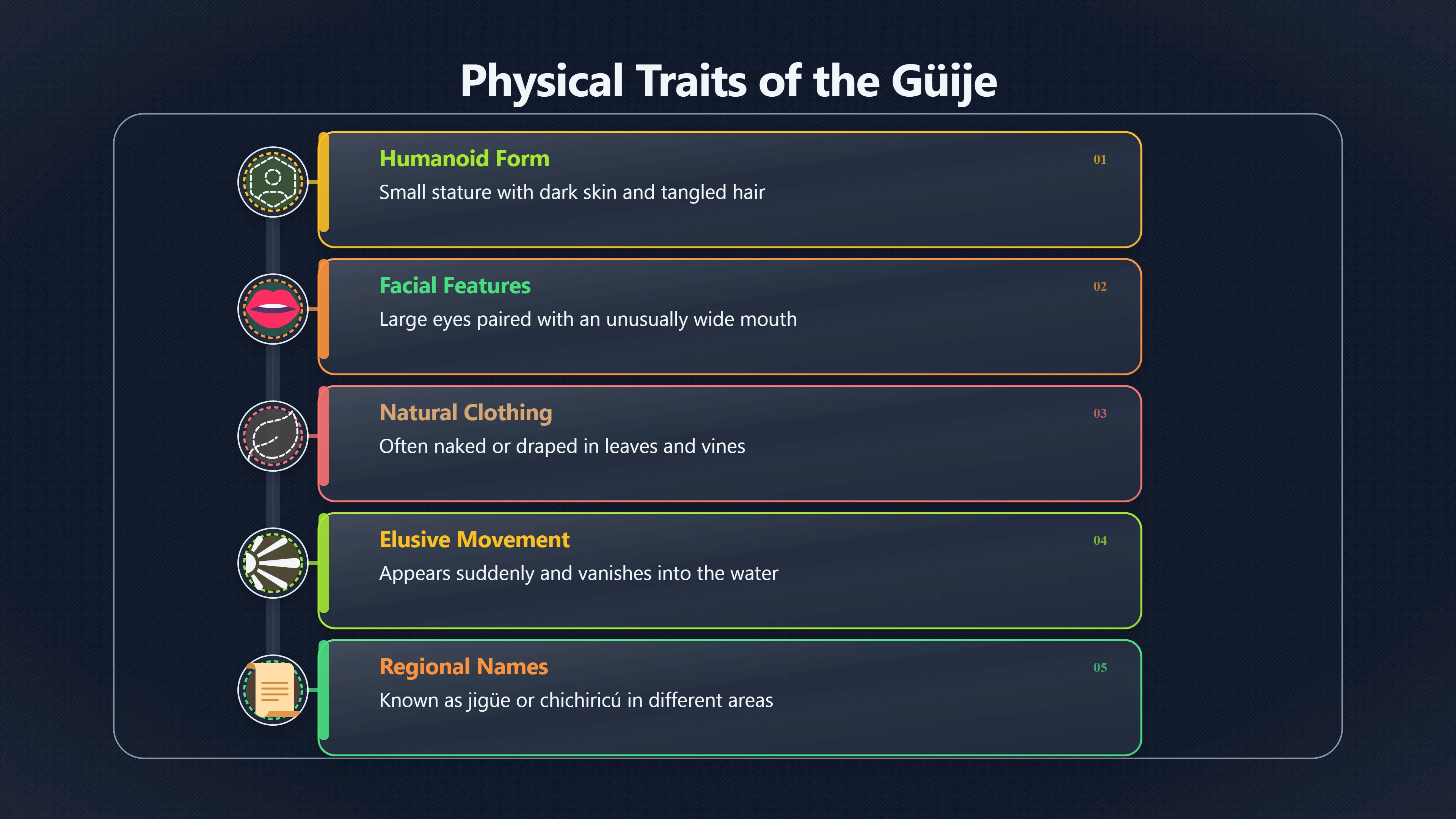
The most common description portrays the güije as a small humanoid with dark skin, tangled hair, large eyes and an unusually wide mouth. It is often naked or clothed only in leaves and vines. Different regions tell the story differently: some versions describe a playful trickster, while others present a frightening being capable of luring people into dangerous places.[Wikipedia]WikipediaOpen source on wikipedia.org.
The creature is known by several names, including güije, jigüe and chichiricú. Despite local variations, certain traits remain consistent:
- It lives near fresh water rather than the sea.
- It is most active at night.
- It is difficult to catch or approach.
- It appears suddenly and disappears just as quickly.
- It is associated with fear, mischief and hidden dangers.[Wikipedia]WikipediaOpen source on wikipedia.org.
These features place the güije within a wider family of Caribbean and Latin American “little people” traditions, but the Cuban version is strongly tied to rivers, ponds and isolated pools.
The River-Pool Creature in Cuban Folklore
The güije’s strongest association is with freshwater landscapes. Stories frequently place it beside streams hidden by vegetation, deep pools beneath overhanging trees, or muddy ponds where visibility is poor. In many rural accounts, these locations are not random. They are precisely the places where accidents can occur, where children may fall into water, and where unfamiliar sounds become difficult to identify after sunset.[Wikipedia]WikipediaOpen source on wikipedia.org.
Folklorists have long noted that Cuban mythology emerged from a mixture of cultural influences. Scholars such as Fernando Ortiz and later researchers of Afro-Cuban traditions examined how Indigenous, African and European elements blended into uniquely Cuban forms of storytelling. The güije appears to be one result of that process: a local being that absorbed different traditions while remaining firmly rooted in the Cuban countryside.[Wikipedia]WikipediaOpen source on wikipedia.org.
In oral tradition, the creature sometimes functions as a guardian of natural places. Certain versions claim it punishes people who harm animals, damage forests or disrespect rivers. Other versions depict it as unpredictable and potentially dangerous, reflecting the ambiguous nature common to many folklore spirits.[Wikipedia]WikipediaOpen source on wikipedia.org.
Why Stories Cluster Around Night, Water and Danger
The geography of reported encounters is remarkably consistent. Most stories occur:
- Near rivers and ponds.
- Around dense vegetation.
- In isolated rural areas.
- During dusk, night or early morning.
- When a witness is alone or in a small group.[Wikipedia]WikipediaOpen source on wikipedia.org.
This pattern suggests that the legend may have served practical purposes. Before modern lighting and widespread swimming education, rivers and ponds posed genuine hazards. A frightening water goblin was an effective way to discourage children from approaching dangerous places unsupervised.
The darkness itself also plays a role. At night, ordinary sounds become mysterious. Fish splash unexpectedly, birds call from unseen branches, and shadows shift in moving water. A fleeting glimpse of an animal or a person partly hidden by vegetation can easily become a story retold for decades.
Folklore scholars often view such traditions as social tools rather than literal reports. In that interpretation, the güije is not merely a monster but a way of teaching caution, respect for nature and awareness of environmental dangers.[Wikipedia]WikipediaOpen source on wikipedia.org.
What Do Reported Sightings Actually Describe?
Unlike famous lake monsters or ape-man legends, güije sightings rarely produce photographs, physical traces or sustained investigations. Instead, they tend to follow a recurring pattern:
Witnesses report seeing a small dark figure near water. The figure may appear crouched beside a pond, emerge briefly from vegetation, or vanish into the water after being noticed. Others describe hearing laughter, splashing or rustling followed by a glimpse of something moving away rapidly.[Wikipedia]WikipediaOpen source on wikipedia.org.
Many stories are second-hand accounts passed through families. A grandparent recalls seeing one while fishing; a neighbour claims one crossed a path at dusk; a child reports strange eyes near a riverbank. Such accounts form part of local oral history rather than a documented body of evidence.[Indigenous Caribbean Center]indigenouscaribbean.wordpress.comIndigenous Caribbean CenterThe Guajiro Who Killed a GüijeMay 25, 2008 — 12 Aug 2005 — One story was about the old, ornery man who once ki…
A notable feature of the tradition is that witnesses often describe the experience as brief and ambiguous. The creature is almost never observed for long enough to allow detailed identification. This is one reason the legend has survived: the lack of clarity leaves room for imagination.
Folklore, Belief and Sceptical Explanations
From a modern perspective, several explanations are commonly offered for güije encounters.
Misidentified wildlife. Cuba’s wetlands and river systems contain numerous animals that can create sudden movement or startling sounds. A fleeting observation under poor conditions can transform an ordinary animal into something extraordinary.
Visual illusion. Moonlight, reflections and dense vegetation can distort perception. Human beings are particularly prone to seeing faces and figures in uncertain conditions.
Storytelling reinforcement. Once a community already knows a legend, unusual experiences are more likely to be interpreted through that narrative. Someone who hears splashing near a famous “güije pool” may assume the creature is responsible.
Cautionary folklore. Many researchers regard the güije primarily as a cultural warning figure designed to encourage safe behaviour near water and in remote landscapes.[Wikipedia]WikipediaOpen source on wikipedia.org.
Importantly, none of these explanations diminish the importance of the legend itself. Folklore does not need to be literally true to influence behaviour, identity and memory.
Local Places Linked to the Legend
The güije is not confined to a single location. Stories appear throughout much of Cuba, particularly in rural regions where rivers, ponds and marshes form part of everyday life. Certain communities maintain specific sites associated with encounters, often known locally as a “güije pool” or a stretch of water where the creature is said to appear.[Wikipedia]WikipediaGuayacanes (CubaGuayacanes (Cuba
These locations function less like cryptozoological hotspots and more like folklore landscapes. The physical place becomes important because stories are attached to it. Visitors hear the tale, repeat it, and add new details. Over generations, the site and the legend become inseparable.
From Oral Tale to Cuban Arts and Pop Culture
One reason the güije remains so visible today is that it escaped the limits of rural folklore and entered national culture. References appear throughout Cuban literature, poetry, children’s entertainment, music, visual arts and animation. The creature has become a shorthand symbol for mystery, childhood imagination and the island’s folkloric heritage.[Wikipedia]WikipediaOpen source on wikipedia.org.
The poet Nicolás Guillén famously included a “Ballad of the Güije” in his 1934 collection West Indies Ltd., helping bring the creature into modern Cuban literature. Later writers, artists and filmmakers continued to reinterpret it for new audiences.[Wikipedia]WikipediaOpen source on wikipedia.org.
Cultural institutions in Cuba still celebrate the figure through exhibitions, festivals and educational projects. In these contexts, the güije is no longer treated as something that might be hiding in a pond. Instead, it represents a shared folklore tradition that links contemporary Cubans with older stories of rivers, forests and the unknown.[Adelante.cu]adelante.cu28445 artisans prepare gueije festival in camagueeyArtisans prepare Güije Festival in Camagüey21 Sept 2023 — The Cuban Association of Artisan Artists (ACAA) calls on the 173 mem…
Why the Güije Endures
The güije survives because it operates on several levels at once. It is a ghost story, a cautionary tale, a water spirit, a childhood memory and a cultural icon. For some people it remains a creature that grandparents insisted was real. For others it is a beloved character from literature and art.
As a result, the question “Has anyone really seen a güije?” is almost beside the point. The legend endures not because of physical evidence but because it continues to provide a memorable way of thinking about Cuba’s rivers, ponds and hidden places. Among the island’s many strange tales, the güije remains the most recognisable reminder that folklore often survives longest where mystery and landscape meet.[wikipedia.org]WikipediaOpen source on wikipedia.org.
Amazon book picks
Further Reading
Books and field guides related to Is the Guije Cuba's Water Goblin?. Use these as the next step if you want deeper reading beyond the article.
Spirits, Fairies, Leprechauns, and Goblins
Focuses specifically on goblins, spirits and related beings.
The Book of Imaginary Beings
Goblins, spirits and folkloric beings closely match the güije tradition.
The Element Encyclopedia of Magical Creatures
Includes water spirits, goblins and related folklore beings.
American Fairy Tales
Contains folklore-style trickster and magical creature traditions.
eBay marketplace picks
Marketplace Samples
Live-tested eBay searches with available results related to this page.
Endnotes
1.
Source: Wikipedia
Link:https://en.wikipedia.org/wiki/G%C3%BCijes
2.
Source: cubaplusmagazine.com
Title: The Güije, goblin of the Cuban mountains
Link:https://www.cubaplusmagazine.com/en/news/gueije-goblin-the-cuban-mountains.html
Source snippet
Covering Cuba...11 Oct 2022 — The Güijes of Cuba are the goblins that identify us within the characteristics of the Caribbean culture, a...
3.
Source: Wikipedia
Link:https://es.wikipedia.org/wiki/G%C3%BCije
4.
Source: Wikipedia
Title: Lydia Cabrera
Link:https://en.wikipedia.org/wiki/Lydia_Cabrera
Source snippet
Lydia CabreraLydia Cabrera was a Cuban independent ethnographer, writer, and literary activist. She was an authority on Santería and o...
5.
Source: Wikipedia
Title: Guayacanes (Cuba)
Link:https://es.wikipedia.org/wiki/Guayacanes_%28Cuba%29
6.
Source: adelante.cu
Title: 28445 artisans prepare gueije festival in camagueey
Link:https://www.adelante.cu/index.php/en/culture/28445-artisans-prepare-gueije-festival-in-camagueey
Source snippet
Artisans prepare Güije Festival in Camagüey21 Sept 2023 — The Cuban Association of Artisan Artists (ACAA) calls on the 173 mem...
7.
Source: indigenouscaribbean.wordpress.com
Link:https://indigenouscaribbean.wordpress.com/wp-content/uploads/2008/05/barreiroguajiro.pdf
Source snippet
Indigenous Caribbean CenterThe Guajiro Who Killed a GüijeMay 25, 2008 — 12 Aug 2005 — One story was about the old, ornery man who once ki...
Published: May 25, 2008
Additional References
8.
Source: facebook.com
Link:https://www.facebook.com/groups/historyandfolklore/posts/2079943352249686/
Source snippet
Cuban folklorist Lydia Cabrera's work on AfroFernando Ortiz, Lydia Cabrera, and Rómulo Lachatañeré are considered the founders of Afro-Cu...
9.
Source: scribd.com
Link:https://www.scribd.com/document/356232103/Lydia-Cabrera-Afro-Cuban-Tales-Cuentos-negros-de-Cuba-University-of-Nebraska-Press-2005-pdf
Source snippet
June 6, 1930, Lydia Cabrera paid her rst visit to the home of Calixta Morales, better known in the Ocha Rite by her saints name Oddeddei...
Published: June 6, 1930
10.
Source: facebook.com
Link:https://www.facebook.com/osianduo/videos/-the-g%C3%BCije-is-a-cuban-mythological-creature-which-protects-the-islands-nature-it/279542111500456/
Source snippet
It's a bit unpredictable and spiteful but gentle with the good people who...
11.
Source: academia.edu
Link:https://www.academia.edu/100886733/Bozal_Spanish_and_Text_in_Lydia_Cabreras_Cuentos_negros_de_Cuba
Source snippet
do Ortiz observes that these folktales are mostly of a Yoruba origin...
12.
Source: instagram.com
Link:https://www.instagram.com/p/CzE1lvLNqLZ/?hl=en
Source snippet
in Cuban folklore. Described as a tiny, dark-skinned being...
13.
Source: assets-us-01.kc-usercontent.com
Link:https://assets-us-01.kc-usercontent.com/f7ca9afb-82c2-002a-a423-84e111d5b498/5585d615-5e89-4ee4-ba6f-b6d1e682e4b7/978-1-4780-1873-5_601.pdf
Source snippet
kc-usercontent.com· · ELCabrera refers to her books of Afro-Cuban tales as fiction, with no claim to folkloric validi- ty.4 At best, she...
14.
Source: discovery.ucl.ac.uk
Title: Stewart Chapter Ortiz.indb
Link:https://discovery.ucl.ac.uk/id/eprint/10173488/2/Stewart_Chapter_Ortiz.indb.pdf
Source snippet
UCL DiscoveryFernando Ortizby C Stewart · 2023 — According to Ortiz (2014: 472): “Each Spaniard who arrived in Cuba, by the simple fact o...
15.
Source: therocketstar.org
Title: The Rocket Star El Güije
Link:https://therocketstar.org/5705/entertainment/el-guije/
Source snippet
El Güije - The Rocket StarEl Güije is a popular mythical creature in Cuban folklore. El Güije is a fascinating folklore of Cuban culture...
16.
Source: anthurium.miami.edu
Link:https://anthurium.miami.edu/articles/39/files/submission/proof/39-1-77-1-10-20180918.pdf
Source snippet
miami.eduCabrera, Lydia.Afro-Cuban Tales. | Anthuriumby LB Cahill · 2005 — Ortiz was not only a top Cuban anthropologist and a pioneer in...
17.
Source: api.pageplace.de
Title: de Afro-Cuban Tales
Link:https://api.pageplace.de/preview/DT0400.9780803204362_A36866541/preview-9780803204362_A36866541.pdf
Source snippet
pageplace.deAfro-Cuban Tales - Cuentos negros de CubaFernando Ortiz (Havana, 1881–1969) was an eminent Cuban ethnogra- pher who was Lydia...
Topic Tree