Within Bulgaria Monsters
Why Bulgaria's Dragons Guard Water and Storms
Bulgaria's dragons and storm monsters turn drought, hail, caves and dangerous water into memorable supernatural beasts.
On this page
- Zmei, lamya and hala roles
- Water, caves, drought and crops
- How weather becomes a monster story
Page outline Jump by section
Introduction
In Bulgarian folklore, dragons are not simply monsters waiting in caves. They are part of a larger system for explaining weather, water, drought and the dangers of the landscape. The most important figures are the zmei, the lamya and the hala: supernatural beings linked to storms, hail, rivers, lakes, caves and harvests. Rather than representing hidden animals, they turn natural forces into memorable characters. A village threatened by hail might imagine a battle in the clouds. A spring that dries up becomes the work of a water-hoarding monster. A violent whirlwind gains a supernatural face.
For readers interested in Bulgaria’s monster traditions, these creatures matter because they show how folklore transformed everyday environmental risks into stories that could be remembered, retold and understood. The result is one of the most distinctive dragon traditions in southeastern Europe.[Old News]old-news.bnr.bgdragons and lamias in bulgarian folkloreOld NewsDragons and Lamias in Bulgarian folklore31 May 2013 — The Lamia often appears in the form of a storm or hail and destroys crops…
Why Bulgaria’s Dragons Guard Water and Storms
Unlike the dragons of many western European legends, Bulgarian dragon lore is divided between protective and destructive forces. The zmei is usually portrayed as a guardian connected with a particular village, mountain or region. The lamya and hala, by contrast, are commonly associated with danger, crop destruction and environmental disruption.[Wikipedia]WikipediaSlavic dragonSlavic dragon
This division reflects the realities of rural life. For centuries, farming communities depended on predictable rainfall while fearing hailstorms, floods and drought. Folklore gave these threats a human-like drama. Instead of describing weather as an impersonal process, stories imagined powerful beings fighting for control of the landscape.
The creatures often occupy liminal places: mountain caves, deep lakes, springs, ravines and storm clouds. These were locations where water appeared, disappeared or became dangerous. The folklore effectively mapped environmental uncertainty onto the countryside.[Wikipedia]WikipediaSlavic dragonSlavic dragon
Zmei, Lamya and Hala Roles
The zmei as protector
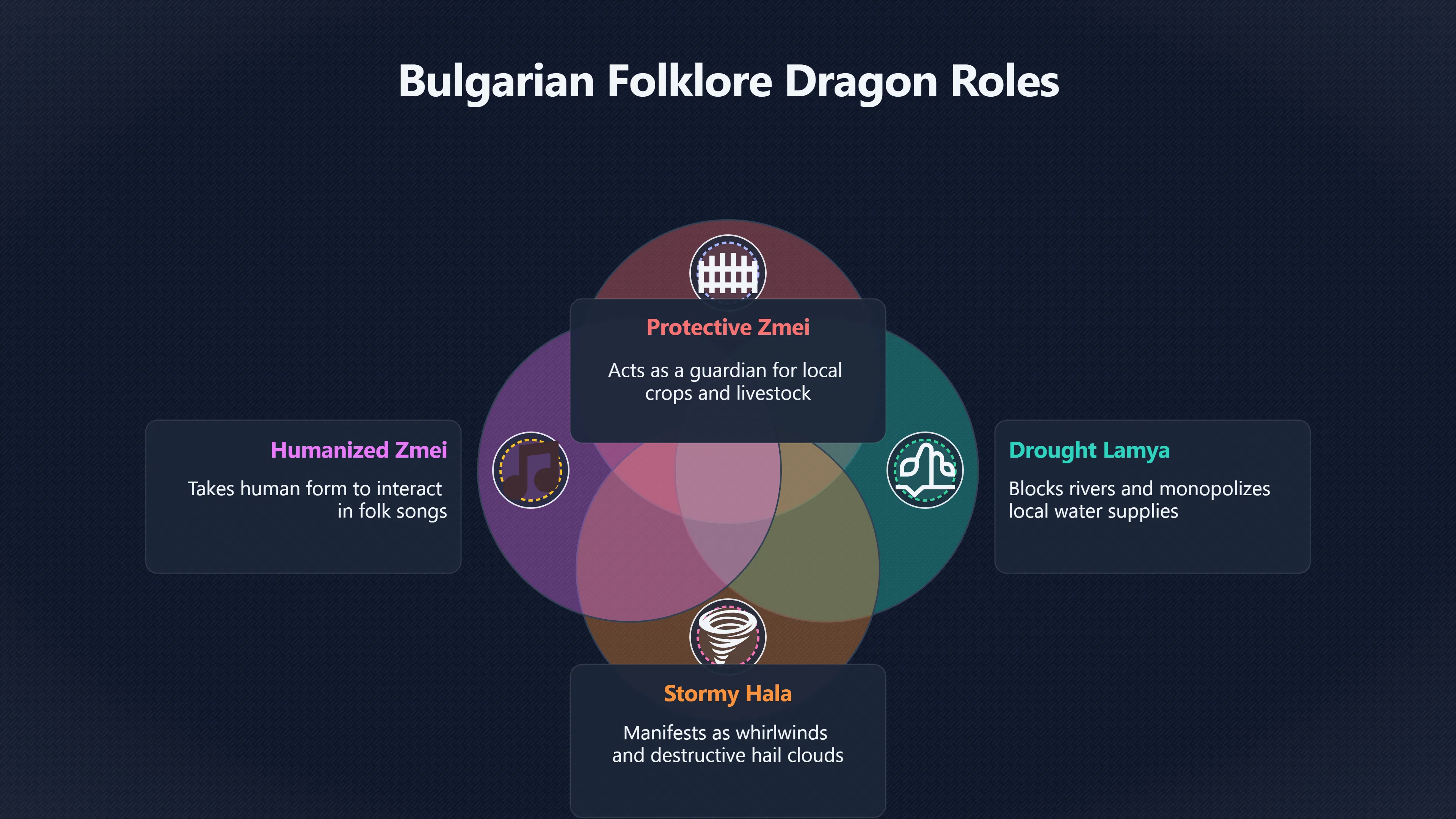
The Bulgarian zmei is unusual because it is often benevolent. Folklore describes it as a winged serpent-dragon or a partly human being with supernatural powers. In many traditions, each village has its own zmei acting as a guardian of crops, livestock and local people.[Wikipedia]WikipediaSlavic dragonSlavic dragon
The zmei’s role is not primarily to terrorise humans. Instead, it protects them from destructive weather beings. Folk tales frequently depict it battling hostile storm creatures in the sky. Thunder, lightning and violent weather could therefore be interpreted as evidence of a supernatural struggle taking place above the village.[Old News]old-news.bnr.bgdragons and lamias in bulgarian folkloreOld NewsDragons and Lamias in Bulgarian folklore31 May 2013 — The Lamia often appears in the form of a storm or hail and destroys crops…
The creature also appears in love stories and folk songs, where it can take human form and interact with people. This makes the zmei more complex than a simple monster. It is both a weather guardian and a deeply humanised supernatural figure.[Wikipedia]WikipediaSlavic dragonSlavic dragon
The lamya as drought monster
The lamya occupies the opposite side of the folklore landscape. It is typically portrayed as a multi-headed dragon-like creature covered in scales, often dwelling in lakes, caves or hidden waters. In many stories it blocks rivers, controls springs or monopolises water supplies. Communities must confront it before water can flow freely again.[Wikipedia]WikipediaSlavic dragonSlavic dragon
The lamya is also linked directly to destructive weather. Folk traditions describe it appearing through storms and hail that devastate crops. In this role it becomes a living explanation for agricultural disaster. A ruined harvest is not random bad luck; it is the work of a hostile supernatural being.[Old News]old-news.bnr.bgdragons and lamias in bulgarian folkloreOld NewsDragons and Lamias in Bulgarian folklore31 May 2013 — The Lamia often appears in the form of a storm or hail and destroys crops…
Many legends feature heroes, saints or dragon-slayers defeating a lamya. When the creature dies, rivers, milk, wine or grain symbolically flow from its body, representing the return of fertility and abundance after hardship.[Wikipedia]WikipediaSlavic dragonSlavic dragon

The hala as living storm
The hala is even more directly connected to weather. Across Bulgarian and neighbouring Balkan traditions, it is associated with hail clouds, thunderstorms, whirlwinds and destructive winds. Rather than guarding a cave or spring, the hala often exists within the storm itself.[Wikipedia]WikipediaAla (demonAla (demon
Descriptions vary by region. In some areas it resembles a dragon-like being. In others it appears as a dark cloud, dense mist or whirlwind. What remains consistent is its role as an enemy of crops and agricultural prosperity. Farmers blamed it for hailstorms that could destroy an entire season’s work in a matter of minutes.[Wikipedia]WikipediaAla (demonAla (demon
Regional traditions sometimes overlap. In parts of Bulgaria, the lamya fills the role performed elsewhere by the hala, showing how folklore adapted to local landscapes and storytelling traditions.[Wikipedia]WikipediaSlavic dragonSlavic dragon
Water, Caves, Drought and Crops
A striking feature of Bulgarian dragon lore is its obsession with water management. The stories repeatedly return to blocked springs, disappearing rivers, hidden lakes and inaccessible caves.
From a modern perspective, these legends reflect genuine environmental concerns. Mountain regions often depend on a limited number of springs. Drought can threaten entire communities, while sudden storms can wipe out crops. Folklore transformed these practical dangers into narratives about monsters controlling water resources.[Wikipedia]WikipediaSlavic dragonSlavic dragon
Several recurring themes appear again and again:
- Water-hoarding monsters: Lamyas trap or withhold water, creating drought conditions.
- Guarded springs and lakes: Dangerous waters are imagined as the homes of supernatural creatures.
- Storm battles: Violent weather becomes evidence of conflict between protective and destructive beings.
- Fertility restored through victory: Defeating the monster releases life-giving water and agricultural abundance.[Wikipedia]WikipediaSlavic dragonSlavic dragon
These motifs help explain why dragon stories became attached to specific caves, lakes and mountain landscapes throughout Bulgaria. The stories were not random fantasies. They reflected practical anxieties about survival in an agricultural society.
How Weather Becomes a Monster Story
The most revealing aspect of this folklore is the mechanism behind it. The creatures provide a narrative framework for understanding unpredictable weather.
A hailstorm arriving from dark clouds can be interpreted as a hala approaching. A prolonged drought becomes the work of a lamya withholding water. Lightning and thunder suggest a zmei fighting to protect the village. Instead of viewing weather as an abstract atmospheric process, folklore turns it into a conflict between recognisable personalities.[bnr.bg]old-news.bnr.bgdragons and lamias in bulgarian folkloreOld NewsDragons and Lamias in Bulgarian folklore31 May 2013 — The Lamia often appears in the form of a storm or hail and destroys crops…
This approach made environmental events easier to remember and discuss. It also created moral stories. Good harvests reflected protection and balance. Crop failures reflected invasion, conflict or greed. The landscape itself became populated with beings whose actions explained both fortune and disaster.
For modern readers interested in Bulgaria’s monster traditions, that is the key point. The zmei, lamya and hala are not cryptids in the modern sense of hidden animals awaiting discovery. They are weather-beasts: folklore mechanisms that transformed storms, droughts, dangerous waters and agricultural uncertainty into vivid supernatural dramas. Their enduring power comes from how effectively they turned the forces of nature into unforgettable characters.[bnr.bg]old-news.bnr.bgdragons and lamias in bulgarian folkloreOld NewsDragons and Lamias in Bulgarian folklore31 May 2013 — The Lamia often appears in the form of a storm or hail and destroys crops…
Amazon book picks
Further Reading
Books and field guides related to Why Bulgaria's Dragons Guard Water and Storms. Use these as the next step if you want deeper reading beyond the article.

The Penguin Book of Dragons
Places Bulgarian dragon traditions within wider dragon folklore.
Myths and Symbols in Pagan Europe
Explains weather, landscape and supernatural symbolism.
The Encyclopedia of Fantasy
Contains useful background on dragon traditions and motifs.
eBay marketplace picks
Marketplace Samples
Live-tested eBay searches with available results related to this page.

Endnotes
1.
Source: Wikipedia
Title: Slavic dragon
Link:https://en.wikipedia.org/wiki/Slavic_dragon
2.
Source: Wikipedia
Title: Ala (demon)
Link:https://en.wikipedia.org/wiki/Ala_%28demon%29
3.
Source: Wikipedia
Title: Bulgarian language
Link:https://en.wikipedia.org/wiki/Bulgarian_language
Source snippet
Bulgarian languageBulgarian is an Eastern South Slavic language spoken in Southeast Europe, primarily in Bulgaria. It is the language...
4.
Source: Wikipedia
Title: Samodiva (folklore)
Link:https://en.wikipedia.org/wiki/Samodiva_%28folklore%29
Source snippet
Samodiva (folklore)The samodiva samovila or vila are woodland fairies or nymphs found in South and West Slavic folklore. Vila by Andy...
5.
Source: mythsterhood.com
Title: In this
Link:https://mythsterhood.com/mythsterhood-episode-17-dragons-of-the-balkan/
Source snippet
Episode 17: Dragons of the Balkans - Mythsterhood22 Feb 2021 — In Bulgaria, the lamya is the more common name for the lamya/hala, but in...
6.
Source: old-news.bnr.bg
Title: dragons and lamias in bulgarian folklore
Link:https://old-news.bnr.bg/en/post/100200249/dragons-and-lamias-in-bulgarian-folklore
Source snippet
Old NewsDragons and Lamias in Bulgarian folklore31 May 2013 — The Lamia often appears in the form of a storm or hail and destroys crops...
Published: May 2013
Additional References
7.
Source: scribd.com
Link:https://www.scribd.com/document/601151339/Bulgarian-Myths-Legends
Source snippet
Bulgarian Myths Legends | PDF | DragonLamia often appears in the form of a storm or hail and destroys crops. Zmeys sometimes fight the La...
8.
Source: facebook.com
Link:https://www.facebook.com/groups/281886105961506/posts/1984053079078125/
Source snippet
Bulgarian dragon folklore and legendsHe often fought against the lamia when she appeared as a storm or hail to destroy crops. The zmei di...
9.
Source: reddit.com
Link:https://www.reddit.com/r/AskBulgaria/comments/1dy0szz/do_bulgarians_believe_in_dragons/
Source snippet
Do Bulgarians believe in Dragons?: r/AskBulgariaTraditional Bulgarian folklore has two "dragon like" creatures - zmeys and lamyas. Zmeys...
10.
Source: reddit.com
Link:https://www.reddit.com/r/poland/comments/cpvjuv/dragons_of_polish_folklore/
Source snippet
Dragons of Polish folklore?: r/polandAre there any notable dragons or serpentine creatures from Polish myth? Being of Polish heritage, I...
11.
Source: deny-todorova.github.io
Link:https://deny-todorova.github.io/talasumi/
Source snippet
TalasumiIn the folk legends the Lamia and Zmei are in a constant conflict. The Lamia destroys crops and the Zmei guards them. x. hali. Ha...
12.
Source: brendan-noble.com
Link:https://brendan-noble.com/zmij-zmey-dragons-of-slavic-mythology-slavic-saturday/
Source snippet
Żmij/Zmey – Dragons of Slavic Mythology – Slavic SaturdayThe Żmije are just the massive, winged, fire-breathing serpents that have been m...
13.
Source: rainbowhillmeanders.wordpress.com
Link:https://rainbowhillmeanders.wordpress.com/tag/bulgarian-mythology/
Source snippet
The Zmey battle the elements for the safety of crops and village. Mostly they battle against the...Read more...
14.
Source: facebook.com
Link:https://www.facebook.com/groups/452442841620381/posts/1675857885945531/
Source snippet
dragons, wild women, flawed heroes, vampires and demons of the...Read more...
15.
Source: goldisblood.net
Link:https://goldisblood.net/post/118888836243/dragons-and-lamias-in-bulgarian-folklore-in
Source snippet
At The Gates13 May 2015 — The Lamia often appears in the form of a storm or hail and destroys crops. Zmeys sometimes fight the Lamias to...
Published: May 2015
16.
Source: arkhistoria.com
Title: The Slavic Zmey: Dragons of Eastern Europe
Link:https://www.arkhistoria.com/post/the-slavic-zmey-dragons-of-eastern-europe
Source snippet
Ark Historia19 Sept 2025 — When Christianity spread through Eastern Europe, the Zmey was reinterpreted as a demonic force or even a repre...
Topic Tree