Creature Lore of Switzerland's Mountains and Lakes
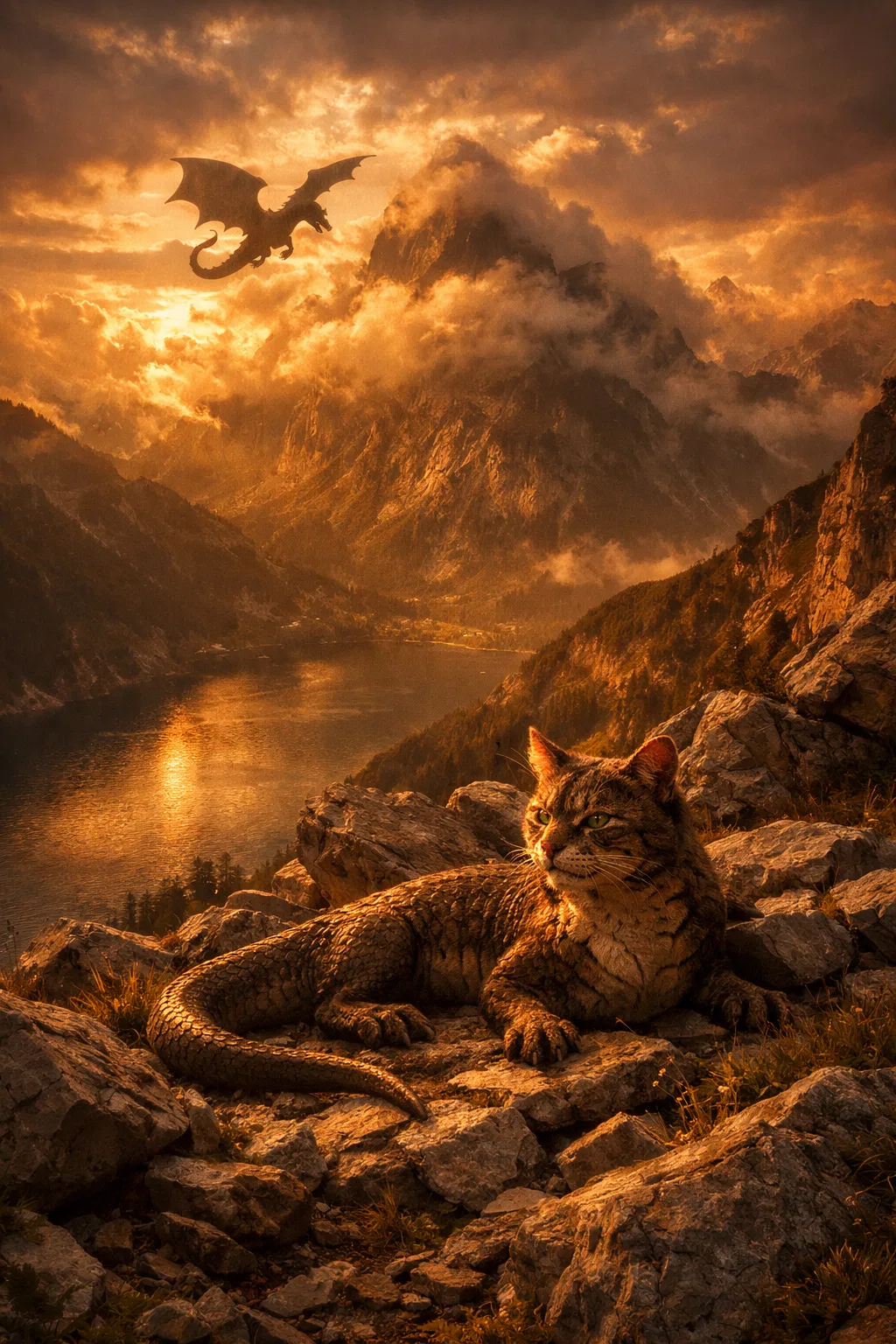
Switzerland has no single nationally famous cryptid to rival Scotland’s Loch Ness Monster. Its mystery-creature tradition is older, more scattered and more closely tied to particular mountains, lakes and valleys. The best-known figure is the Tatzelwurm or Stollenwurm, a short-legged Alpine serpent recorded in folklore and early natural-history writing.
Page outline Jump by section
Introduction
The evidence for unknown animals is weak. Most Swiss cases survive as legends, retold witness stories, old illustrations or brief media flaps rather than specimens, clear photographs or repeatable observations. Yet that thin evidence is part of what makes Switzerland interesting: its monsters show how frightening landscapes, real wildlife and changing ideas about nature can turn local tales into apparent animal mysteries.
The Tatzelwurm: Switzerland’s closest thing to a national cryptid
The Tatzelwurm is usually described as a thick-bodied serpent or lizard with a cat-like head and either two short forelegs or four small limbs. Reports sometimes add poisonous breath, a hiss or a sudden aggressive charge. Although “Tatzelwurm” has become the familiar international name, Swiss traditions, particularly in the Bernese Alps, also called it the Stollenwurm or Stollwurm. The creature belongs to a wider Alpine tradition extending into Austria, Bavaria, northern Italy and neighbouring regions rather than to Switzerland alone.[Wikipedia]WikipediaOpen source on wikipedia.org.
Its importance comes partly from the fact that Swiss naturalists wrote down stories that might otherwise have remained oral folklore. In 1680 the physician and naturalist Johann Jakob Wagner recorded accounts of unusual serpentine animals. Johann Jakob Scheuchzer later reproduced several such stories and illustrations in his 1723 work on journeys through the Swiss Alps. Scheuchzer did not simply announce that dragons were real; his writing reflects an early scientific culture in which reports of extraordinary animals could be collected while their truth remained uncertain.[wikipedia.org]WikipediaOpen source on wikipedia.org.
One often repeated account concerns two brothers said to have encountered a black-grey, cat-headed serpent near Frümsen in eastern Switzerland. The creature was reportedly more than two metres long, and its breath supposedly caused headache and dizziness. Other stories moved the animal westwards into the Bernese Oberland, where it became associated with hot, humid weather, rocky slopes and secluded valleys.[Wikipedia]WikipediaOpen source on wikipedia.org.
The early nineteenth century brought a more recognisably cryptozoological approach. The Bernese scholar Samuel Studer collected witness statements and reportedly offered money for the body of a genuine Stollenwurm. An 1811 account attributed to a schoolmaster in the Guttannen valley described a broad-headed, serpent-like creature with two small feet and a body as thick as a man’s leg. No specimen was produced, however, and the case remained testimony rather than zoological evidence.[Wikipedia]WikipediaOpen source on wikipedia.org.
What might witnesses have seen?
The Tatzelwurm’s shifting anatomy is a warning sign. It can be legless or four-legged, smooth or hairy, small enough to kill or several metres long. Such variation is typical of folklore assembled from unrelated stories rather than of reports describing one consistent species.
Known animals offer less dramatic possibilities. Adders, grass snakes, slow worms, salamanders, mustelids and other low-slung mammals can look unfamiliar when glimpsed among rocks or vegetation. Distance can hide limbs, exaggerate body length or make an animal’s face appear feline. Carcasses and skins deteriorate rapidly, while retelling encourages memorable features such as claws, poison and a cat’s head.
A purely zoological explanation does not account for every detail, but no physical evidence currently requires an undiscovered Alpine reptile. The most reasonable interpretation is that the Tatzelwurm combines real wildlife encounters with older dragon traditions and the particular unease produced by steep, enclosed mountain terrain.
Why Swiss mountains filled with dragons
Before the Tatzelwurm was treated as a possible hidden animal, Switzerland already had a rich tradition of dragons, serpents and monstrous “worms”. Mountain caves, gorges, unstable slopes and cloud-covered summits provided convincing homes for beings that were rarely seen directly. In older usage, a “worm” could mean a great serpent or dragon rather than an earthworm.
Mount Pilatus above Lucerne became the country’s strongest dragon landscape. Medieval and later stories placed both threatening and benevolent dragons in its crevices. Some guarded treasure; others possessed healing powers or dropped magical stones. The mountain’s tourism organisation still describes a medieval belief in healing dragons and has built a Dragon Path, a family attraction and other themed activities around the tradition.[PILATUS - Bergerlebnisse in Stadtnähe]pilatus.chBergerlebnisse in StadtnäheDragon pathTake the panorama gondolas and aerial cableway or the cogwheel railway to Pilatus Kulm. T…
The conversion of fear into family entertainment is a useful measure of how the legend has changed. A creature once imagined as an inhabitant of dangerous, inaccessible rock is now represented by trails, play areas, booklets and a friendly dragon mascot. The landscape remains the same, but the monster has shifted from warning to brand identity.[PILATUS - Bergerlebnisse in Stadtnähe]pilatus.chBergerlebnisse in StadtnäheDragon pathTake the panorama gondolas and aerial cableway or the cogwheel railway to Pilatus Kulm. T…
Similar tales occur around Alpine lakes. Official Swiss cultural material records dragons or winged serpents connected with the Lac Noir in Fribourg, the Muveran area and the lakes of Bretaye and Chavonnes. These are better understood as explanatory legends and moral tales than as sighting traditions: monsters punish cruelty, guard treasure or explain the appearance and mood of a lake.[House of Switzerland]houseofswitzerland.orgHouse of Switzerland Enchanted Swiss waters | House of SwitzerlandHouse of Switzerland Enchanted Swiss waters | House of Switzerland
The Aare Gorge in the Bernese Oberland has also adopted the Tatzelwurm as its resident beast. Its narrow rock walls, rushing water and historic inaccessibility provide an almost ideal monster habitat in the imagination. Local tourism uses the creature playfully, including themed stories and even a worm-shaped cake, showing how regional folklore can become part of a destination’s character without being presented as established zoology.[Haslital]haslital.swissThe Loch Ness wonder in Haslital.When a «half dragon» doesn't want to breath fire or fly over the mountains and scare people, he…
Does Lake Geneva have a monster?
Lake Geneva’s monster tradition is much less substantial than that of the Tatzelwurm. Retellings describe fishermen encountering an enormous snake or dragon with glowing eyes and great teeth. In one story, a powerful disturbance in the water preceded the appearance of a huge head. In another, a creature supposedly lifted a fishing boat, spilling its catch before disappearing. The reports are said to range along the lake from Thonon to Villeneuve. Association pour la sauvegarde du Léman[asleman.org]asleman.orgAssociation pour la sauvegarde du Léman N°31: Le monstre lémaniqueAssociation pour la sauvegarde du Léman N°31: Le monstre lémanique
These accounts are vivid but frustratingly vague. The Association for the Safeguarding of Lake Geneva presents them as folklore, openly questions their reliability and traces its summary to a modern book of regional legends. There is no well-established sequence of dated sightings, no securely identified contemporary newspaper file and no body, sonar record or persuasive photograph. Association pour la sauvegarde du Léman[asleman.org]asleman.orgAssociation pour la sauvegarde du Léman N°31: Le monstre lémaniqueAssociation pour la sauvegarde du Léman N°31: Le monstre lémanique
Lake Geneva nevertheless supplies exactly the conditions from which monster stories grow. It is vast, deep and capable of producing long wakes, eddies and unusual surface movement. It also experiences seiches: oscillations in which water moves back and forth within an enclosed basin. Such effects do not explain a specific alleged sighting automatically, but they can create unexplained waves or disturbances when no obvious boat is nearby. Association pour la sauvegarde du Léman[asleman.org]asleman.orgOpen source on asleman.org.
Animals and debris supply further possibilities. Swimming birds seen head-on, lines of waterfowl, fish breaking the surface, floating timber and boat wakes can briefly resemble humps, necks or an undulating body. A witness already familiar with dragon or serpent stories may then interpret an unclear movement through that cultural pattern.
Older Swiss traditions also blurred ordinary animals and monsters. A sixth-century reference to giant fish in Lake Geneva has been interpreted in modern retellings as referring to very large catfish, while later tales added winged serpents and dragons. That progression demonstrates how a striking but natural animal can become part of a much less natural bestiary.[House of Switzerland]houseofswitzerland.orgHouse of Switzerland Enchanted Swiss waters | House of SwitzerlandHouse of Switzerland Enchanted Swiss waters | House of Switzerland

Phantom cats and real returning predators
Modern monster scares in Switzerland are more likely to involve large mammals than dragons. In 2012 police in western Switzerland warned walkers after reports of a black animal resembling a panther. As in similar European cases, the sighting raised several possibilities: an escaped exotic cat, a large domestic cat, a dog, poor size judgement or a genuine but fleeting unidentified animal. No enduring Swiss population of black leopards was established.[Korea Herald]koreaherald.comOpen source on koreaherald.com.
Large-cat reports are persuasive because Switzerland does have a native wild felid: the Eurasian lynx. Lynx are secretive, powerfully built and difficult to judge at a distance, although their short tails and patterned coats differ markedly from the long-tailed black “panther” commonly described in phantom-cat reports. Switzerland’s lynx are scientifically monitored through methods such as camera trapping and individual coat-pattern identification, illustrating the kind of repeatable evidence missing from most mystery-cat claims.[Kora]kora.chWeingarth et al 2012 First estimation of Eurasian lynx abundance and densityWeingarth et al 2012 First estimation of Eurasian lynx abundance and density
The return of genuine large carnivores has complicated the boundary between folklore and wildlife news. Brown bears were regarded as extinct in Switzerland after the last recorded shooting in 1904, but wandering males began entering again from Italy in 2005. Wolves and other predators have likewise reappeared or expanded their presence. A distant shape that might once have been dismissed as impossible can therefore sometimes be a real, known animal moving through the Alps.[Kora]kora.chOpen source on kora.ch.
This does not validate panther tales, but it provides an important lesson. The best response to an extraordinary animal report is neither instant belief nor automatic ridicule. Tracks, hair, droppings, camera images and genetic material can distinguish an escaped exotic, a native predator, a dog or a mistaken impression. Modern wildlife monitoring turns some “mystery beasts” into identifiable individuals; legends flourish where that evidence never appears.
Folklore, eyewitness claim or cryptid report?
Swiss creature stories become clearer when separated into different kinds of evidence.
- Folklore traditions include treasure-guarding dragons, magical stones, lake spirits and monsters that punish wrongdoing. Their primary role is cultural and symbolic.
- Recorded witness claims include historical Stollenwurm encounters and the stories attributed to Lake Geneva fishermen. These describe alleged events but often lack independent confirmation.
- Natural-history collections such as Scheuchzer’s writings preserve reports in an early scholarly setting. Their inclusion shows that a story circulated, not that the animal existed.
- Modern media flaps include panther warnings and other short-lived animal scares. These may concern misidentification, an escapee or a real native species.
- Cryptozoological reinterpretations occur when later writers combine old dragons, serpents and local names into the idea of one surviving unknown animal.
The Tatzelwurm sits across several of these categories. It began within a landscape of dragon and serpent beliefs, acquired eyewitness-style narratives and was later discussed as though it might be an undiscovered species. Lake Geneva’s monster followed a different path: scattered regional tales were gathered into a loose lake-monster identity, partly under the influence of the worldwide fame of “Nessie”.
That distinction matters because a centuries-old legend is not a centuries-long run of biological observations. A story may survive continuously even when reports do not. Repetition can create the appearance of a documented case history from material that was originally moral, entertaining or symbolic.
How Switzerland’s monsters survive today
Swiss monster lore now lives most visibly through tourism, museums, children’s stories and popular culture. Mount Pilatus openly markets itself as a dragon mountain, offering a Dragon Path, interactive attractions, themed rides and family activities. The Aare Gorge associates its dramatic scenery with the Tatzelwurm. Lake Geneva organisations retell the lake monster with humour rather than presenting it as a zoological discovery.[PILATUS - Bergerlebnisse in Stadtnähe]pilatus.chBergerlebnisse in StadtnäheDragon pathTake the panorama gondolas and aerial cableway or the cogwheel railway to Pilatus Kulm. T…
Museums and archives preserve the more serious historical side. Scheuchzer’s illustrated Alpine journeys show how early scholars negotiated the uncertain border between testimony, natural history and marvel. The Swiss National Museum has also examined Swiss figures active in international cryptozoology, including Lucerne-born Bigfoot investigator René Dahinden and geologist François de Loys, whose disputed photograph of an alleged South American ape was rejected by prominent zoologists as a misidentified known monkey or a deception.[worc.ox.ac.uk]worc.ox.ac.ukA Book of Ice and Fireester College, Oxford29 Aug 2017 — The Ouresiphoites Helveticus is an account of nine journeys through the Swiss Alps made by the Swi…
Switzerland also has an institutional connection to the history of cryptozoology through the collections of Bernard Heuvelmans, often described as a founding figure of the modern field. His archive was left to the natural-history institution now known as Naturéum in Lausanne. This does not make Switzerland unusually rich in undiscovered animals, but it gives the country an important role in preserving the documents, debates and cultural history surrounding their pursuit.[Swiss National Museum Blog]blog.nationalmuseum.chSwiss National Museum Blog Swiss monster hunters – Swiss National MuseumSwiss National Museum Blog Swiss monster hunters – Swiss National Museum
What the evidence supports
No Swiss cryptid is backed by the combination of physical remains, clear imagery, repeat observations and genetic evidence needed to establish a new large animal. The Tatzelwurm has the deepest documentary tradition, but its descriptions vary and its evidence ends with stories and illustrations. The Lake Geneva monster is even less secure, resting mainly on collected folklore rather than a traceable modern sighting record. Panther reports are biologically possible in the limited sense that exotic animals can escape, but individual scares have not demonstrated a breeding population.
What Switzerland does possess is a particularly clear record of how monsters develop. Real snakes, fish and predators meet dangerous terrain, oral storytelling and early natural history. Later collectors turn separate tales into a recognisable creature. Tourism then softens the beast into a mascot, while cryptozoology reverses the process and asks whether the mascot began with a real animal.
The result is not evidence of a hidden Alpine menagerie. It is something more revealing about people: a landscape of deep water, broken rock, fog and sudden animal movement repeatedly encourages the same thought — that something just beyond clear sight may be larger, stranger and older than expected.
Amazon book picks
Further Reading
Books and field guides related to What Creatures Haunt Switzerland's Mountains and Lakes?. Use these as the next step if you want deeper reading beyond the article.
Field Guide to Lake Monsters, Sea Serpents, and Other Mystery...
Matches Switzerland's mix of lake and mountain monster lore.

Endnotes
1.
Source: Wikipedia
Link:https://en.wikipedia.org/wiki/Tatzelwurm
2.
Source: worc.ox.ac.uk
Title: A Book of Ice and Fire
Link:https://www.worc.ox.ac.uk/research/collections/blog/a-book-of-ice-and-fire
Source snippet
ester College, Oxford29 Aug 2017 — The Ouresiphoites Helveticus is an account of nine journeys through the Swiss Alps made by the Swi...
3.
Source: Wikipedia
Title: Johann Jakob Scheuchzer
Link:https://en.wikipedia.org/wiki/Johann_Jakob_Scheuchzer
4.
Source: pilatus.ch
Link:https://pilatus.ch/en/activities/dragon-path
Source snippet
Bergerlebnisse in StadtnäheDragon pathTake the panorama gondolas and aerial cableway or the cogwheel railway to Pilatus Kulm. T...
5.
Source: pilatus.ch
Link:https://pilatus.ch/en/activities/dragon-world
Source snippet
Bergerlebnisse in StadtnäheDragon WorldDiscover Dragon World on Mount Pilatus – a thrilling attraction for the whole family tha...
6.
Source: pilatus.ch
Link:https://pilatus.ch/en/map
Source snippet
Bergerlebnisse in StadtnäheMapThere are many legends and myths surrounding Mount Pilatus. In the Middle Ages, people believed t...
7.
Source: pilatus.ch
Link:https://pilatus.ch/en/activities/pilu-land
Source snippet
Bergerlebnisse in StadtnähePilu LandWelcome to Pilu Land at Krienseregg. This is the home of the friendly Pilatus dragon called...
8.
Source: haslital.swiss
Link:https://haslital.swiss/en/news/detail/the-loch-ness-wonder-in-haslital.html
Source snippet
The Loch Ness wonder in Haslital.When a «half dragon» doesn't want to breath fire or fly over the mountains and scare people, he...
9.
Source: haslital.swiss
Title: Mein Haslital
Link:https://haslital.swiss/files/websites/haslital.swiss/Brosch%C3%BCren/Mein%20Haslital.pdf?version=0c55d27dc23ca038
10.
Source: kora.ch
Title: Weingarth et al 2012 First estimation of Eurasian lynx abundance and density
Link:https://kora.ch/wp-content/uploads/2021/03/Weingarth_et_al_2012_First_estimation_of_Eurasian_lynx_abundance_and_density.pdf
11.
Source: kora.ch
Link:https://www.kora.ch/en/20-years-bear/history-in-switzerland
12.
Source: Wikipedia
Title: Swiss folklore
Link:https://en.wikipedia.org/wiki/Swiss_folklore
13.
Source: Wikipedia
Link:https://en.wikipedia.org/wiki/Seiche
14.
Source: pilatus.ch
Link:https://pilatus.ch/en/activities/dragonchallenge
15.
Source: cdn.pilatus.ch
Link:https://cdn.pilatus.ch/content-media/documents/Sales/2026_Sagenb%C3%BCchlein_EN.pdf
16.
Source: pilatus.ch
Title: Activities Experience stylish relaxation on the legendary Dragon Mountain
Link:https://pilatus.ch/en/activities
17.
Source: pilatus.ch
Link:https://pilatus.ch/en
18.
Source: pilatus.ch
Link:https://pilatus.ch/aktivitaeten/drachenweg
19.
Source: pilatus.ch
Link:https://pilatus.ch/en/railway-cableways
20.
Source: kora.ch
Link:https://www.kora.ch/malme/05_library/5_1_publications/L/Linnell_et_al_1998_Monitoring_methods_for_European_carnivores.pdf
21.
Source: archive.org
Link:https://archive.org/stream/Cryptozoology_201608/Cryptozoology_djvu.txt
22.
Source: houseofswitzerland.org
Title: House of Switzerland Enchanted Swiss waters | House of Switzerland
Link:https://houseofswitzerland.org/swissstories/history/enchanted-swiss-waters
23.
Source: asleman.org
Title: Association pour la sauvegarde du Léman N°31: Le monstre lémanique
Link:https://asleman.org/en/60_secondes/n31-le-monstre-lemanique/
24.
Source: asleman.org
Link:https://asleman.org/en/60_secondes/n26-les-seiches-du-leman/
25.
Source: koreaherald.com
Link:https://www.koreaherald.com/article/10363260
26.
Source: blog.nationalmuseum.ch
Title: Swiss National Museum Blog Swiss monster hunters – Swiss National Museum
Link:https://blog.nationalmuseum.ch/en/2025/03/swiss-monster-hunters/
27.
Source: luzern.com
Link:https://www.luzern.com/en/highlights/hopping/mountains/big-6-mountains/mount-pilatus
28.
Source: luzern.com
Link:https://www.luzern.com/en/poi/pilatus
29.
Source: cryptidz.fandom.com
Link:https://cryptidz.fandom.com/wiki/Switzerland
30.
Source: asleman.org
Link:https://asleman.org/en/60_secondes/n9-lorigine-du-leman-contes-et-legendes/
31.
Source: eileenmuellerauthor.com
Title: The Tatzelwurm
Link:https://www.eileenmuellerauthor.com/writing/the-tatzelwurm-swiss-alpine-dragon/
Additional References
32.
Source: youtube.com
Title: 10 Legendary Tales of Switzerland: Myths from the Alps
Link:https://www.youtube.com/watch?v=J4kC23as6EU
Source snippet
A Man In A Gas Mask Terrorized A Swiss Village For 10 Years: The Hunt For Le Loyon...
33.
Source: youtube.com
Title: The Terrifying Legend of the Tatzelwurm: Alpine’s Forgotten Monster
Link:https://www.youtube.com/watch?v=tyqcllIO3q8
Source snippet
10 Legendary Tales of Switzerland: Myths from the Alps...
34.
Source: usgs.gov
Link:https://www.usgs.gov/media/images/seiche-lake-genevajpg
35.
Source: instagram.com
Link:https://www.instagram.com/reel/DZFwUQ2O3Ye/
36.
Source: luzern.com
Link:https://www.luzern.com/en/package/an-evening-of-storytelling-with-a-lidobus-ride-weggis
37.
Source: luzern.com
Link:https://www.luzern.com/en/the-region/excursions/by-boat
38.
Source: facebook.com
Link:https://www.facebook.com/swissinfo/posts/creatures-like-the-yeti-in-the-himalayas-the-loch-ness-monster-in-scotland-and-b/1143856894456843/
39.
Source: luzern.com
Link:https://www.luzern.com/en/poi/dragon-path
40.
Source: facebook.com
Link:https://www.facebook.com/groups/1464145827194143/posts/3933243876950980/
41.
Source: facebook.com
Link:https://www.facebook.com/theguardian/posts/larger-than-any-dog-let-alone-a-house-cat-the-beast-swaggered-through-the-dartmo/1374518404706409/
Topic Tree
Follow this branch
Related pages 192
- Antigua Cryptids
- Maldives Monsters
- Malta Monsters
- Qatar Monsters
- Argentina Monsters
- +187 more in sidebar