Where Are the Marshall Islands' Monsters?
The Marshall Islands does not have a well-documented modern “cryptid” in the Loch Ness or Bigfoot sense: there is no famous ongoing case built around repeated newspaper sightings, blurry photographs, tourism campaigns, or organised monster hunts. Its mystery-creature tradition is older, more oceanic, and more clearly rooted in folklore.
Page outline Jump by section
What kind of monsters belong to the Marshall Islands?
The most useful answer is: sea-centred legendary beings, rather than a single national cryptid. The Marshall Islands are an atoll nation in the central Pacific, with life historically shaped by canoes, fishing, reef passages, turtles, birds, weather, and the open ocean. That geography matters. A monster tradition in a mountain country might gather around forests or caves; in the Marshall Islands, the natural stage is the lagoon edge, the reef, the turtle ground, the fishing place, and the route between atolls.
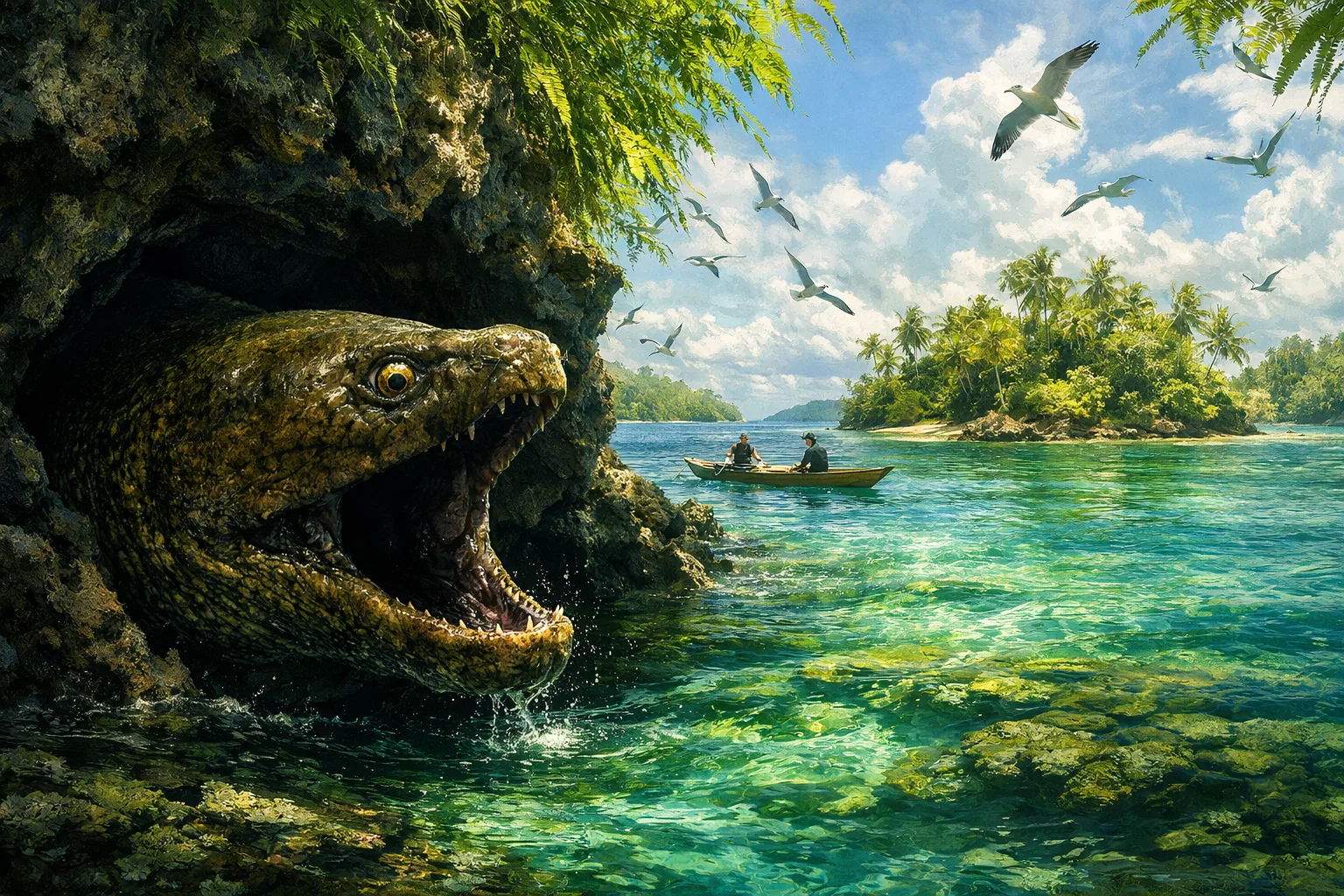
One of the clearest examples is the great Mother Eel in the Marshallese story of Pejwak. In the Digital Micronesia version of the legend, the precious quality called “aao” is kept in the throat of the Mother Eel near Jemo. She lives in a deep ocean cave, is described as a large sea monster, and is “the mother of fish, giant eels, and human beings”; she is also dangerous because she eats both fish and people. The tale does not read like a modern sighting report. It is not someone saying, “I saw an unknown animal last Tuesday.” It is a mythic story about origin, status, danger, and supernatural power, with the creature placed in a recognisable Marshallese seascape.[marshall.csu.edu.au]marshall.csu.edu.auJane Downing & Dirk H.R. Spennemann, Marshallese Legends and TraditionsJane Downing & Dirk H.R. Spennemann, Marshallese Legends and Traditions
The same story also contains giants. An enormous giant is sent to Jemo, and the narrative imagines him wading through the Pacific, trying to squeeze between atolls such as Jaluit, Ailinglaplap, Namu, Kwajalein, Rongelap, Likiep, and Jemo. That is wonderful monster geography: the creature is impossibly large, but the comedy and drama depend on real island distances and names. The “evidence” here is not zoological; it is cultural memory mapped onto a known ocean world.[marshall.csu.edu.au]marshall.csu.edu.auJane Downing & Dirk H.R. Spennemann, Marshallese Legends and TraditionsJane Downing & Dirk H.R. Spennemann, Marshallese Legends and Traditions
The Mother Eel: the closest thing to a Marshallese sea monster
The Mother Eel deserves special attention because she is the most cryptid-like figure in the accessible Marshallese material: huge, aquatic, dangerous, cave-dwelling, and linked to ordinary marine animals. She is not merely a big eel. She is a mother-being, a source-being, and a threshold guardian. The aao can only be obtained by approaching her mouth, which turns the sea cave into a place of both treasure and mortal danger.[marshall.csu.edu.au]marshall.csu.edu.auJane Downing & Dirk H.R. Spennemann, Marshallese Legends and TraditionsJane Downing & Dirk H.R. Spennemann, Marshallese Legends and Traditions
For a cryptid-minded reader, the obvious question is whether a story like this could preserve memory of a real animal. The careful answer is: perhaps it borrows its force from real marine encounters, but it should not be treated as evidence for an unknown species. The Marshall Islands’ marine biodiversity is rich, and large animals such as sharks, rays, turtles, deep-sea fish, and eels are part of the ecological background. The Convention on Biological Diversity country profile lists 1,059 fish species, 728 crustaceans, 126 starfishes, 40 sponges, 106 bird species, and 37 mammal species for the Marshall Islands.[Convention on Biological Diversity]cbd.intConvention on Biological Diversity Main DetailsConvention on Biological Diversity Main Details
That ecological abundance helps explain why sea-monster imagery feels natural in Marshallese storytelling. A dangerous eel in a reef hole or cave is not a random imported dragon. It grows out of a world where reefs conceal life, where a hand put into the wrong crevice can be bitten, where deep water begins suddenly beyond the reef, and where food, danger, beauty, and taboo are often the same place.

Giants, birds, and the monster geography of atolls
Marshallese legends also use giant bodies to explain or dramatise the landscape. In the story of Letao’s younger brother Ben, also called Toletoleben or “big-mountain Ben”, the hero is a massive champion whose strength is exaggerated to landscape-changing scale. He throws sling stones from Arno towards Aur, breaking land apart and creating a reef from the splash and falling stones. Later, at Bikar Atoll, he is attacked by huge numbers of seabirds until the weight of the dead birds sinks the canoe.[marshall.csu.edu.au]marshall.csu.edu.auJane Downing & Dirk H.R. Spennemann, Marshallese Legends and TraditionsJane Downing & Dirk H.R. Spennemann, Marshallese Legends and Traditions
This is not a hidden-hominid tradition in the style of ape-men or wild men. Ben is a mythic strongman, a heroic or dangerous figure in a world of chiefs, warfare, land rights, canoes, and atoll rivalries. Yet he still belongs in a country-level monster survey because the story shows how Marshallese tradition makes size, strength, animals, and geography interact. The monster element is not simply “a giant existed”; it is that giant-scale action explains why places are broken, reefed, feared, or remembered.
The Bikar bird episode is especially interesting because it is grounded in a real environmental pattern. The northern Marshall Islands include important seabird habitats, and UNESCO’s tentative listing for the Northern Marshall Islands Atolls describes Bikar and Bokak as internationally significant habitats for sea and migratory shore birds. The same listing notes that several northern atolls were historically important “pantry areas” because of birds, turtles, and eggs.[UNESCO World Heritage Centre]whc.unesco.orgWorld Heritage Centre Northern Marshall Islands AtollsUNESCO World Heritage CentreNorthern Marshall Islands Atolls - UNESCO World Heritage Centre…
That does not prove that Ben was a real giant attacked by birds. It shows something subtler and more useful: the legendary image of overwhelming bird life at a remote atoll fits the ecological character of the place. In other words, the story’s strangeness is built on an environmental truth.
Are there modern Marshall Islands cryptid sightings?
So far, the public record is thin. Unlike Scotland’s Loch Ness, the United States’ Bigfoot regions, or parts of the Caribbean with giant-octopus-style sea monster traditions, the Marshall Islands do not appear to have a widely circulated modern cryptid case with recurring named witnesses, a stable creature description, and a long newspaper trail. Searches for Marshall Islands sea serpents, lake monsters, phantom cats, ape-like creatures, winged monsters, and modern mystery beasts mostly lead back to folklore collections, general Pacific sea-monster material, or unrelated cryptid lists rather than a robust local sighting file.
That absence matters. It means the Marshall Islands page should not pretend there is a famous national monster if the evidence does not support one. The better focus is on the boundary between folklore and cryptozoology. Marshallese stories contain beings that look “monster-like” to outside readers — giant eels, giants, demons, ghostly beings, strange births, undersea kingdoms, flying women, and impossible animals — but they usually belong to oral literature, moral teaching, genealogy, humour, land memory, or cosmology rather than modern animal mystery claims. Daniel A. Kelin II’s published collection, for example, is described as preserving 50 stories recorded from 18 storytellers on eight islands and atolls, including origin stories, demons, tricksters, disobedient children, wronged spouses, foolish suitors, and reunited families.[Google Books]books.google.comBooks Marshall Islands Legends and StoriesKelinIn Marshall Island Legends and Stories, Daniel A. Kelin II preserves the qualities of oral storytelling in 50 stories recorded from…
This does not make the material less interesting. It makes it more specific. A reader expecting “the Marshallese Nessie” may be disappointed; a reader interested in how island cultures turn the sea into story will find much richer ground.
Why the sea keeps producing monsters here
The Marshall Islands are made of low coral atolls and islands spread across an immense ocean area. Official and reference summaries commonly describe the country as 29 atolls and five islands, arranged in two chains, Ratak and Ralik. That layout means that land is narrow, reefs are central, and the horizon is not background scenery but part of everyday orientation.[State Department]2009-2017.state.govDepartment Marshall Islands (10/05State DepartmentMarshall Islands (10/05) - State.govOfficial currency: U.S. dollar. GEOGRAPHY AND PEOPLE The Marshall Islands is comprise…
In that setting, sea monsters are not decorative fantasy. They compress real fears and skills into memorable form:
Reef danger. A reef can feed a community, wreck a canoe, cut skin, hide eels, and mark the line between lagoon safety and ocean force.
Deep water. A “deep cave in the ocean” is an ideal monster home because it is physically plausible as a frightening unknown space, even when the creature itself is mythic.
Animal abundance. Turtles, birds, sharks, fish, giant clams, rays, and eels are not exotic background animals; they are part of the lived seascape. UNESCO’s northern-atolls description highlights green turtle nesting, seabird habitats, turtle feeding grounds, giant clams, and distinctive reef systems.[UNESCO World Heritage Centre]whc.unesco.orgWorld Heritage Centre Northern Marshall Islands AtollsUNESCO World Heritage CentreNorthern Marshall Islands Atolls - UNESCO World Heritage Centre…
Navigation and wave knowledge. Marshallese navigation is famous for sophisticated reading of wave patterns. A modern paper on the “dilep” describes traditional Marshallese navigation as involving wave patterns shaped by reflection and refraction around islands, even while noting that the precise mechanism remains debated.[arXiv]arxiv.orgOpen source on arxiv.org.
For monster traditions, this matters because it changes how we read the stories. The ocean is not an empty void where fantasy can be projected. It is a technical, social, spiritual, and ecological space. A giant eel, a canoe-threatening bird swarm, or a giant wading between atolls is a story-form fitted to a navigation culture.
Likely explanations: folklore first, misidentification second
The Marshall Islands’ creature traditions are best sorted into three broad categories.[relief.unboundmedicine.com]relief.unboundmedicine.comMarshall IslandsMarshall Islands
First are mythic and moral beings. The Mother Eel, Letao-related stories, Ben the giant, demons, ghosts, and other impossible figures mainly belong here. Their job is not to document zoology. They explain status, danger, power, cleverness, kinship, place, and proper behaviour.
Second are real animals made larger by story. Eels, sharks, turtles, seabirds, fish, and giant clams all have real ecological presence in the Marshall Islands. In a storytelling setting, they can become ancestral, monstrous, protective, comic, or terrifying. This is not the same as a hoax. It is how folklore often works: ordinary animals are made symbolically huge because their real-world importance is already huge.
Third are possible misidentifications or sea-monster triggers. Across the world, sea-monster reports have often been linked to glimpses of known animals, floating carcasses, oarfish, whales, sharks, squid, logs, weed, nets, or unusual wave action. The Natural History Museum’s discussion of sea monsters notes that real animals such as giant squid and oarfish have helped inspire fantastic marine creatures in wider maritime folklore.[Natural History Museum]nhm.ac.ukOpen source on nhm.ac.uk.
For the Marshall Islands specifically, there is no need to force a single sceptical explanation onto every story. The Mother Eel is not simply a misidentified moray eel; Ben is not a mismeasured tall man; the bird attack is not just an ornithology note. These are legends. Still, their force depends on real environmental materials: biting reef creatures, remote bird islands, dangerous passages, and the immense scale of the Pacific.
How conservation changes the way these stories read today
Modern conservation gives the older creature stories a new afterlife. The animals that once helped populate legend — turtles, seabirds, sharks, reef fish, giant clams — are now discussed in the language of protected areas, biodiversity baselines, climate stress, and fisheries management. In 2025, the Marshall Islands announced its first national marine sanctuary around the remote northern atolls of Bikar and Bokak, covering 48,000 square kilometres and protecting areas described as sheltering the country’s largest green turtle nesting colony and deep-sea sharks.[ICRI]icriforum.orgOpen source on icriforum.org.
That sanctuary is not a cryptid story, but it matters for a cryptid-country page because it shows why the Marshallese “monster” imagination is so marine. The same ICRI report says the 2023 National Geographic Pristine Seas and Marshall Islands Marine Resources Authority expedition studied marine life from lagoons and reefs to depths of 2,340 metres, using scuba surveys, dropped cameras, seabird counts, environmental DNA, and a submersible. It reported healthy coral, giant clam and reef fish populations, vulnerable species such as large groupers and Napoleon wrasse, shark mating, little-known deep-sea communities, and potentially new fish and invertebrate species.[ICRI]icriforum.orgOpen source on icriforum.org.
This is where an evidence-aware monster page can be most satisfying. The old legends do not prove hidden monsters. But the real ocean is strange enough without pretending. Remote atolls, deep-sea cameras, shark nurseries, turtle colonies, and unknown invertebrates are the modern factual counterpart to older stories about dangerous beings at the reef edge.
What a careful reader should take away
The Marshall Islands’ creature lore is not built around a single famous cryptid. It is a sea-and-atoll folklore tradition where monsters are woven into place, status, danger, and environmental knowledge. The strongest named figure for a mystery-beast reader is the Mother Eel near Jemo: a cave-dwelling sea monster, mother of fish and giant eels, dangerous to humans, and guardian of a supernatural quality. Giants such as Toletoleben show another pattern, where monstrous scale explains conflict, landscape, and the memory of named atolls.[marshall.csu.edu.au]marshall.csu.edu.auJane Downing & Dirk H.R. Spennemann, Marshallese Legends and TraditionsJane Downing & Dirk H.R. Spennemann, Marshallese Legends and Traditions
The evidence is therefore cultural rather than zoological. There is no strong public case for an undiscovered Marshallese monster animal. What exists is a vivid body of oral tradition preserved in modern collections and set against one of the richest marine environments in the Pacific. Read that way, the Marshall Islands are not a weak cryptid country. They are a reminder that some monster traditions are not failed animal reports at all. They are maps of how people live with the sea.
Amazon book picks
Further Reading
Books and field guides related to Where Are the Marshall Islands' Monsters?. Use these as the next step if you want deeper reading beyond the article.
Polynesian Mythology and Ancient Traditional History of the N...
First published 2005.
Marshall Islands Legends and Stories
Covers the legends that underpin the islands' monster traditions.
eBay marketplace picks
Marketplace Samples
Live-tested eBay searches with available results related to this page.
Endnotes
1.
Source: marshall.csu.edu.au
Title: Marshallese Legends and Traditions
Link:https://marshall.csu.edu.au/Marshalls/html/legends/le-int-0.html
Source snippet
Digital MicronesiaBefore the RiPalle (the Europeans) came to the Marshall Islands, the knowledge that the Marshallese people possessed w...
2.
Source: books.google.com
Title: Books Marshall Islands Legends and Stories
Link:https://books.google.com/books/about/Marshall_Islands_Legends_and_Stories.html?id=oTM7edNmLOIC
Source snippet
KelinIn Marshall Island Legends and Stories, Daniel A. Kelin II preserves the qualities of oral storytelling in 50 stories recorded from...
3.
Source: marshall.csu.edu.au
Title: Jane Downing & Dirk H.R. Spennemann, Marshallese Legends and Traditions
Link:https://marshall.csu.edu.au/Marshalls/html/legends/le-1-4.html
4.
Source: marshall.csu.edu.au
Title: Jane Downing & Dirk H.R. Spennemann, Marshallese Legends and Traditions
Link:https://marshall.csu.edu.au/Marshalls/html/legends/le-3-6.html
5.
Source: whc.unesco.org
Title: World Heritage Centre Northern Marshall Islands Atolls
Link:https://whc.unesco.org/en/tentativelists/2064/
Source snippet
UNESCO World Heritage CentreNorthern Marshall Islands Atolls - UNESCO World Heritage Centre...
6.
Source: 2009-2017.state.gov
Title: Department Marshall Islands (10/05)
Link:https://2009-2017.state.gov/outofdate/bgn/marshallislands/55252.htm
Source snippet
State DepartmentMarshall Islands (10/05) - State.govOfficial currency: U.S. dollar. GEOGRAPHY AND PEOPLE The Marshall Islands is comprise...
7.
Source: arxiv.org
Link:https://arxiv.org/abs/1802.09151
8.
Source: icriforum.org
Link:https://icriforum.org/marshall-islands-creates-first-marine-sanctuary/
9.
Source: marshall.csu.edu.au
Title: csu.edu.au Letao and the Great Mother Turtle
Link:https://marshall.csu.edu.au/Marshalls/html/legends/frame-le-3-1.html
10.
Source: marshall.csu.edu.au
Title: csu.edu.au Marshallese Legends and Traditions
Link:https://marshall.csu.edu.au/Marshalls/html/legends/le-2-4.html
11.
Source: 2009-2017.state.gov
Link:https://2009-2017.state.gov/outofdate/bgn/marshallislands/144559.htm
12.
Source: books.google.com
Title: Marshall Islands Legends and Stories
Link:https://books.google.com/books/about/Marshall_Islands_Legends_and_Stories.html?id=RGFywPZj8h0C
13.
Source: cbd.int
Title: Convention on Biological Diversity Main Details
Link:https://www.cbd.int/countries/profile/?country=mh
14.
Source: nhm.ac.uk
Link:https://www.nhm.ac.uk/discover/sea-monsters-inspiration-serpents-mermaids-the-kraken.html
15.
Source: jstor.org
Link:https://www.jstor.org/stable/537231
16.
Source: relief.unboundmedicine.com
Title: Marshall Islands
Link:https://relief.unboundmedicine.com/relief/view/The-World-Factbook/563190/all/Marshall_Islands
17.
Source: ebsco.com
Link:https://www.ebsco.com/research-starters/geography-and-cartography/marshall-islands
18.
Source: Wikipedia
Title: Marshall Islands
Link:https://en.wikipedia.org/wiki/Marshall_Islands
19.
Source: dfat.gov.au
Link:https://www.dfat.gov.au/geo/republic-of-marshall-islands/republic-of-the-marshall-islands-country-brief
20.
Source: register-iri.com
Title: The Marshall Islands
Link:https://www.register-iri.com/info-center/the-marshall-islands/
21.
Source: worldbooktour.wordpress.com
Title: marshall islands
Link:https://worldbooktour.wordpress.com/2017/01/28/marshall-islands/
22.
Source: datazone.birdlife.org
Title: marshall islands
Link:https://datazone.birdlife.org/country/factsheet/marshall-islands
Additional References
23.
Source: besspress.com
Link:https://besspress.com/products/marshall-island-legends-pb
Source snippet
Bess PressMarshall Island Legends and StoriesIn Marshall Island Legends and Stories, Daniel A. Kelin II preserves the qualities of oral s...
24.
Source: youtube.com
Link:https://www.youtube.com/watch?v=HZQt3_bX75M
Source snippet
Ancient Marshallese Legend - A Tale of Color - Animation...
25.
Source: youtube.com
Title: Season 4 Ep 110 Marshallese Tv: Marshallese Oral Storytelling
Link:https://www.youtube.com/watch?v=OaUsjiDZ5w8
Source snippet
Legend of Two Brother Who Don't Obey Each Other, Jaluit...
26.
Source: youtube.com
Title: Ancient Marshallese Legend
Link:https://www.youtube.com/watch?v=TGEXiOLz8Vo
Source snippet
Season 4 Ep 110 Marshallese Tv: Marshallese Oral Storytelling...
27.
Source: youtube.com
Title: Legend of Lijanbaru and Her Sons, Aur
Link:https://www.youtube.com/watch?v=5FMFx_G5qJg
Source snippet
Legend of Four Sisters Who Came from Namu to Some Atolls in Ratak Chain, Marshall Islands...
28.
Source: history.co.uk
Link:https://www.history.co.uk/articles/native-american-myths-and-legends
29.
Source: facebook.com
Link:https://www.facebook.com/ForrestGalante/videos/6-deadly-sea-monsters-that-actually-exist/813643121660991/
30.
Source: history.co.uk
Link:https://www.history.co.uk/articles/strange-sea-serpent-sightings-from-history
31.
Source: mistories.org
Link:https://mistories.org/tales-Laneab-text.php
32.
Source: a-z-animals.com
Link:https://a-z-animals.com/animals/location/oceania/marshall-islands/
Topic Tree
Follow this branch
Related pages 192
- Antigua Cryptids
- Maldives Monsters
- Malta Monsters
- Qatar Monsters
- Argentina Monsters
- +187 more in sidebar