Within Tonga Monsters
The Real Giants That Once Lived in Tonga
Fossils and subfossils reveal that Tonga once supported giant iguanas and enormous fruit pigeons before human settlement transformed the islands.
On this page
- The giant iguana of prehistoric Tonga
- The enormous fruit pigeon and vanished forests
- What extinct fauna can and cannot explain about later legends
Page outline Jump by section
Introduction
When people hear about mysterious creatures in Tonga, it is easy to imagine sea monsters, lost reptiles or animals that somehow escaped scientific notice. Yet some of the most remarkable “giants” connected with Tonga were completely real. Fossils and subfossil remains show that the islands once supported oversized reptiles and birds that disappeared long before modern science arrived. These extinct animals reveal a very different Tonga: one with richer forests, larger fruit-bearing trees, and ecological relationships that no longer exist today.
For readers interested in cryptids and mystery animals, this lost world matters because it demonstrates an important point. Extraordinary animals genuinely lived in Tonga’s past. At the same time, their existence does not automatically support modern monster claims. Instead, the fossil record provides a valuable reality check, showing both how unusual island ecosystems can become and how quickly they can change after human settlement.[PNAS]pnas.orgRapid prehistoric extinction of iguanas and birds in Polynesiaby DW Steadman · 2002 · Cited by 135 — The Tongoleleka archaeological s…
The Real Giants That Once Lived in Tonga
The giant iguana of prehistoric Tonga
One of the most impressive animals known from prehistoric Tonga is the giant iguana Brachylophus gibbonsi. Unlike the small and medium-sized lizards familiar across many Pacific islands today, this species reached roughly 1.2 metres in length. Fossil remains have been recovered from several Tongan islands, including Tongatapu and islands within the Ha’apai group.[Wikipedia]WikipediaBrachylophus gibbonsiSeptember 30, 2010 — Brachylophus gibbonsi is an extinct species of large (~1.2 m long) iguanid lizard from Tonga in the South Pacific Oc…
The giant iguana belonged to the same broader lineage as the iguanas that survive today in Fiji. Its existence surprised scientists because modern Pacific iguanas are already unusual, being separated by vast distances from their closest relatives in the Americas. The discovery of a giant Tongan species revealed that these reptiles were once more diverse and widespread than previously understood.[researchgate.net]researchgate.netResearch Gate South Pacific Iguanas: Human Impacts and a New SpeciesSouth Pacific Iguanas: Human Impacts and a New SpeciesMarch 1, 2004 — Extinct large-bodied Brachylophus species are known to…
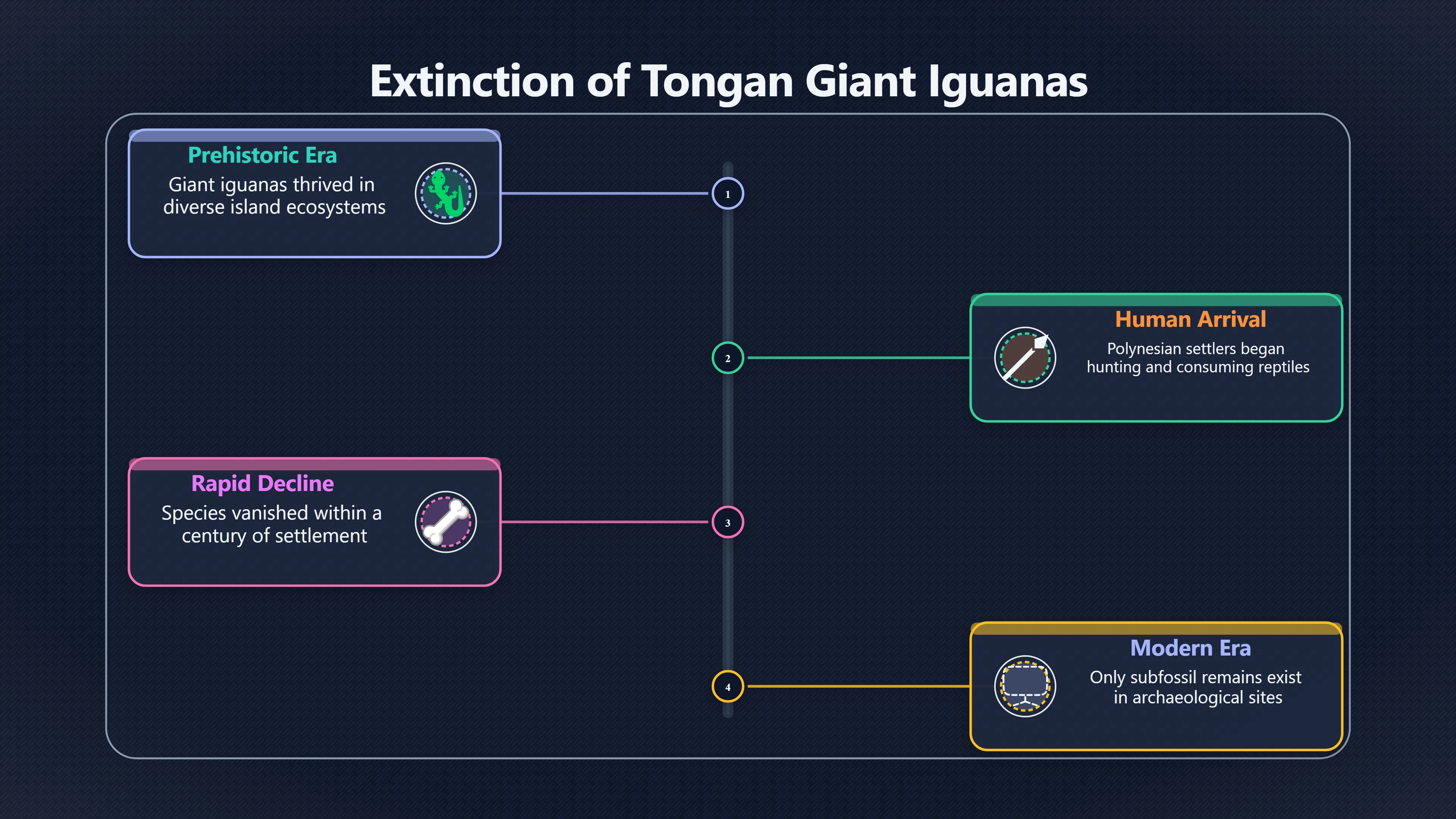
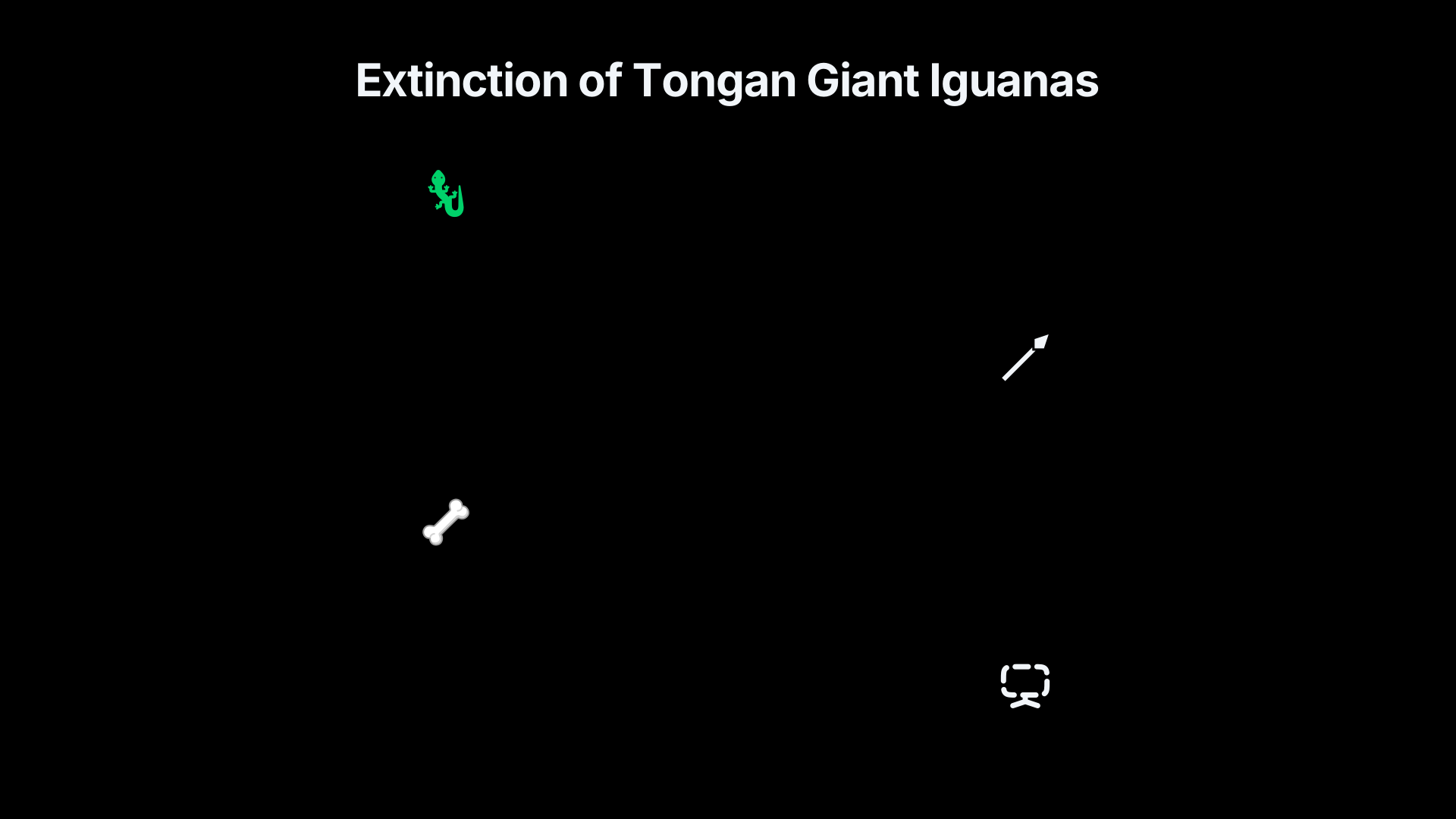
Archaeological evidence suggests that the giant iguana survived into the period of early human settlement. Bones from archaeological sites indicate that people hunted and consumed these reptiles. Researchers conclude that the species probably disappeared very soon after Polynesian colonisation, perhaps within a century of permanent settlement.[pnas.org]pnas.orgRapid prehistoric extinction of iguanas and birds in Polynesiaby DW Steadman · 2002 · Cited by 135 — The Tongoleleka archaeological s…
This is a useful reminder that Tonga’s reputation for unusual reptiles is not based solely on folklore. Large reptiles genuinely inhabited the islands, although the known giant iguana vanished thousands of years ago and is not regarded by zoologists as a surviving hidden species.[Wikipedia]WikipediaBrachylophus gibbonsiSeptember 30, 2010 — Brachylophus gibbonsi is an extinct species of large (~1.2 m long) iguanid lizard from Tonga in the South Pacific Oc…
The enormous fruit pigeon and vanished forests
If the giant iguana ruled the reptile world of prehistoric Tonga, the skies and forest canopy were once home to equally impressive birds.
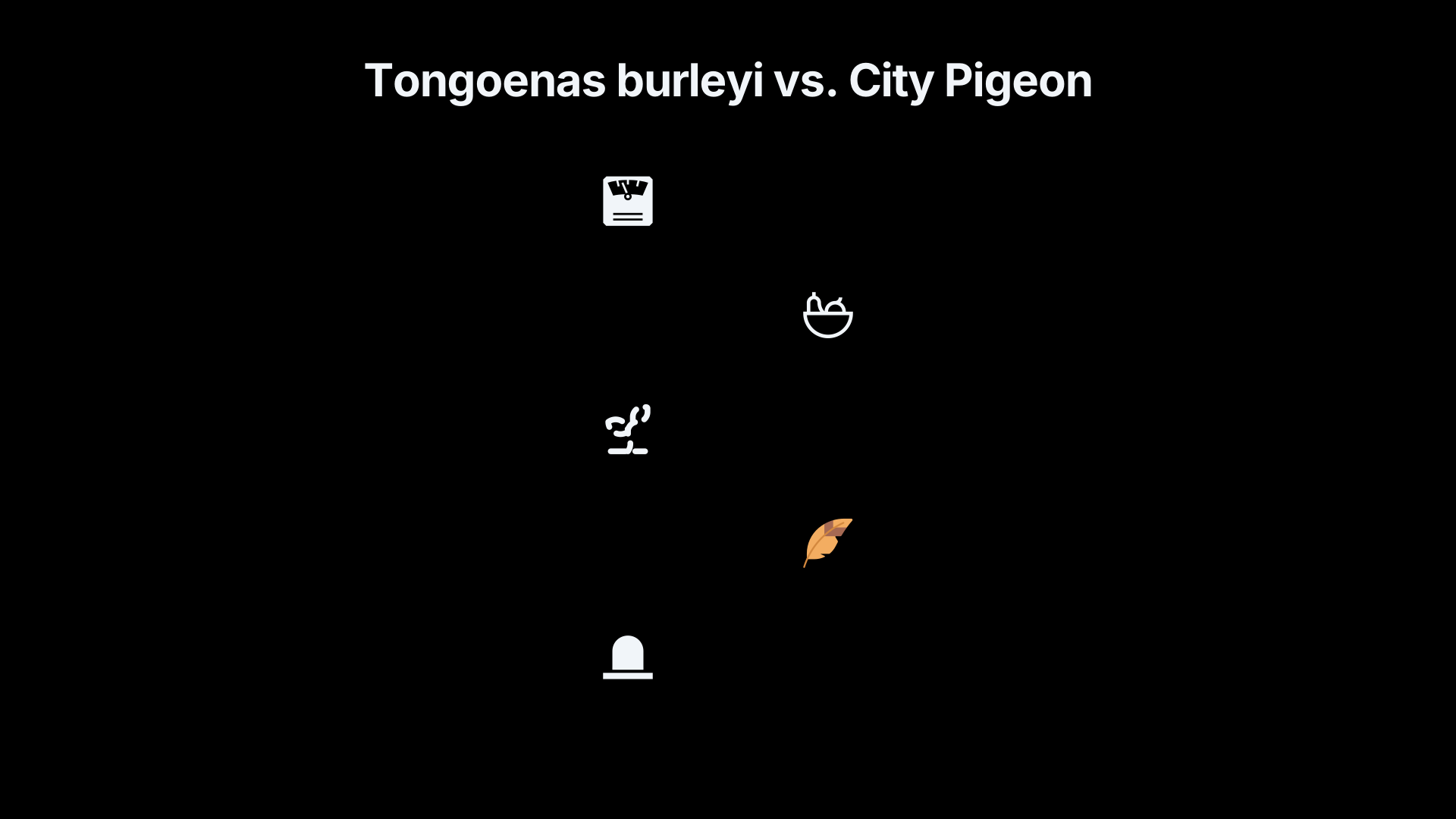
In 2020, researchers described Tongoenas burleyi, often called the Tongan giant pigeon. Fossils discovered on ‘Eua and other islands revealed a bird about 51 centimetres long and substantially heavier than ordinary pigeons. Scientists estimate that it weighed at least five times as much as a typical city pigeon while still retaining the ability to fly.[sci.news]sci.newsBreaking Science News Meet Tongoenas burleyi, Extinct Giant Pigeon from TongaBreaking Science NewsMeet Tongoenas burleyi, Extinct Giant Pigeon from TongaJuly 23, 2020 — 23 Jul 2020 — This canopy-dwelling species wa…
Its size hints at the kind of forests that once covered much of Tonga. The bird was adapted to feeding on large fruits in the forest canopy. Researchers noted that some native trees produced fruits far larger than those eaten by most living pigeons. The giant pigeon may have acted as a major seed disperser, swallowing large fruits and carrying seeds between forest patches.[Florida Museum]floridamuseum.ufl.edugiant fruit gulping pigeon eaten into extinctiongiant fruit gulping pigeon eaten into extinction
The disappearance of Tongoenas burleyi therefore represented more than the loss of a single species. It removed an ecological role that modern birds may not fully replace. A forest evolved around large fruit-eating birds can change dramatically once those birds vanish.[Florida Museum]floridamuseum.ufl.edugiant fruit gulping pigeon eaten into extinctiongiant fruit gulping pigeon eaten into extinction
Nor was this the only large pigeon known from Tonga’s past. Fossil evidence points to several extinct or locally extinct pigeon species, including large imperial pigeons and an extinct tooth-billed pigeon related to the rare living species now confined to Samoa. Together they suggest that prehistoric Tonga supported a much richer bird community than the islands do today.[wiley.com]zslpublications.onlinelibrary.wiley.comj.1469 7998.2005.00010.xj.1469 7998.2005.00010.x
A Lost Ecosystem, Not Just Lost Species
The extinct giants make more sense when viewed as part of a broader ecosystem.
Archaeological and palaeontological studies indicate that Tonga once hosted numerous bird species, including rails, pigeons, parrots and other land birds that were either reduced or eliminated after human arrival. Excavations have recovered hundreds of bird remains, revealing an avifauna substantially different from the modern one.[OUCI]ouci.dntb.gov.uaPrehistoric avifaunas from the Kingdom of TongaA total of 741 identifiable bones revealed 24 avian taxa, among which terrestrial bird…
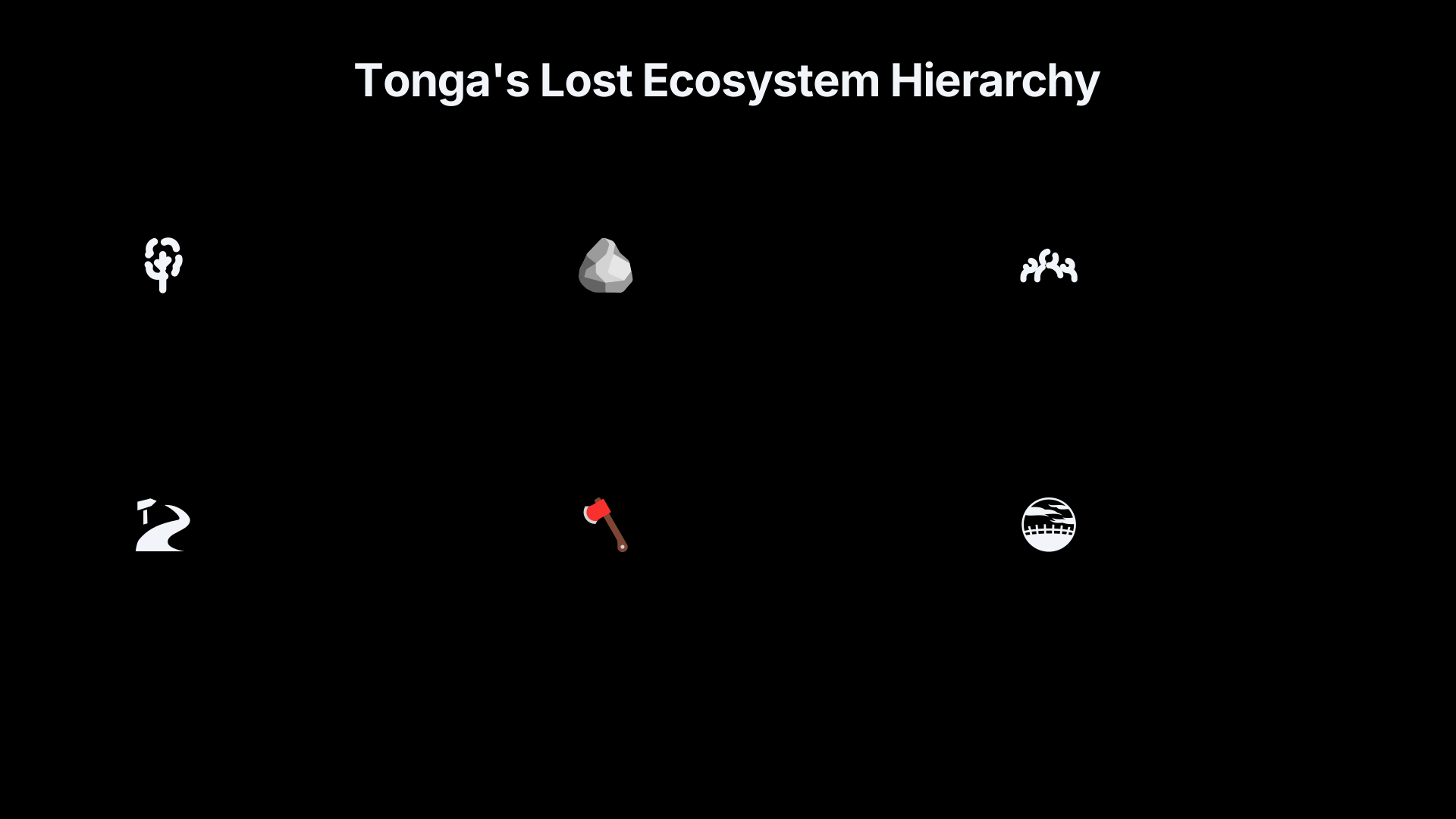
The pattern seen across Tonga resembles what happened on many Pacific islands. Human settlement brought habitat clearance, hunting pressure and introduced animals such as rats. Species that had evolved without mammalian predators often proved especially vulnerable. Large birds and reptiles were among the first casualties because they reproduced slowly and were attractive food sources.[pnas.org]pnas.orgRapid prehistoric extinction of iguanas and birds in Polynesiaby DW Steadman · 2002 · Cited by 135 — The Tongoleleka archaeological s…
Historical reconstructions suggest that parts of prehistoric Tonga would have looked noticeably different from the landscapes familiar today. Dense forests supported large fruit-eaters, giant reptiles occupied ecological niches now vacant, and a wider variety of native birds moved through the canopy.[Wikipedia]WikipediaHistory of TongaHistory of Tonga
What Extinct Fauna Can and Cannot Explain About Later Legends
For anyone interested in mystery-animal traditions, Tonga’s extinct giants occupy an intriguing middle ground between folklore and zoology.
They can explain why stories of unusually large animals sometimes feel plausible. Tonga really did contain oversized reptiles and birds in the past. Modern researchers did not invent these creatures; their bones have been recovered and studied. The fossil record demonstrates that island evolution can produce animals that seem almost mythical from a modern perspective.[wikipedia.org]WikipediaBrachylophus gibbonsiSeptember 30, 2010 — Brachylophus gibbonsi is an extinct species of large (~1.2 m long) iguanid lizard from Tonga in the South Pacific Oc…
However, extinct giants do not provide evidence that modern monster reports are accurate. The giant iguana and giant pigeon disappeared thousands of years before European scientific exploration. No credible evidence suggests that surviving populations of either species remain hidden in modern Tonga.[wikipedia.org]WikipediaBrachylophus gibbonsiSeptember 30, 2010 — Brachylophus gibbonsi is an extinct species of large (~1.2 m long) iguanid lizard from Tonga in the South Pacific Oc…
What these animals do offer is context. When evaluating stories about unusual creatures in Tonga, it helps to remember that the islands have a genuine history of remarkable wildlife. The lesson from the fossil record is not that every legend is true. Rather, it is that Tonga’s past was strange enough without inventing anything. Giant iguanas walked its forests, enormous pigeons swallowed fruit the size of tennis balls, and entire ecological worlds vanished before written history could record them.[wikipedia.org]WikipediaOpen source on wikipedia.org.
Amazon book picks
Further Reading
Books and field guides related to The Real Giants That Once Lived in Tonga. Use these as the next step if you want deeper reading beyond the article.
The Song Of The Dodo
Directly addresses the forces shaping island giants and extinctions.
eBay marketplace picks
Marketplace Samples
Live-tested eBay searches with available results related to this page.


Endnotes
1.
Source: pnas.org
Link:https://www.pnas.org/doi/10.1073/pnas.072079299
Source snippet
Rapid prehistoric extinction of iguanas and birds in Polynesiaby DW Steadman · 2002 · Cited by 135 — The Tongoleleka archaeological s...
2.
Source: ouci.dntb.gov.ua
Link:https://ouci.dntb.gov.ua/works/9Qe3BBp9/
Source snippet
Prehistoric avifaunas from the Kingdom of TongaA total of 741 identifiable bones revealed 24 avian taxa, among which terrestrial bird...
3.
Source: Wikipedia
Title: Brachylophus gibbonsi
Link:https://en.wikipedia.org/wiki/Brachylophus_gibbonsi
Source snippet
September 30, 2010 — Brachylophus gibbonsi is an extinct species of large (~1.2 m long) iguanid lizard from Tonga in the South Pacific Oc...
Published: September 30, 2010
4.
Source: Wikipedia
Link:https://en.wikipedia.org/wiki/Brachylophus
5.
Source: researchgate.net
Title: Research Gate South Pacific Iguanas: Human Impacts and a New Species
Link:https://www.researchgate.net/publication/240776448_South_Pacific_Iguanas_Human_Impacts_and_a_New_Species
Source snippet
South Pacific Iguanas: Human Impacts and a New SpeciesMarch 1, 2004 — Extinct large-bodied Brachylophus species are known to...
Published: March 1, 2004
6.
Source: sci.news
Title: Breaking Science News Meet Tongoenas burleyi, Extinct Giant Pigeon from Tonga
Link:https://www.sci.news/paleontology/tongoenas-burleyi-08669.html
Source snippet
Breaking Science NewsMeet Tongoenas burleyi, Extinct Giant Pigeon from TongaJuly 23, 2020 — 23 Jul 2020 — This canopy-dwelling species wa...
Published: July 23, 2020
7.
Source: Wikipedia
Link:https://en.wikipedia.org/wiki/Tongoenas
8.
Source: researchgate.net
Link:https://www.researchgate.net/publication/230084677_An_extinct_species_of_tooth-billed_pigeon_Didunculus_from_the_Kingdom_of_Tonga_and_the_concept_of_endemism_in_insular_landbirds
9.
Source: Wikipedia
Title: List of Late Quaternary prehistoric bird species
Link:https://en.wikipedia.org/wiki/List_of_Late_Quaternary_prehistoric_bird_species
10.
Source: Wikipedia
Title: History of Tonga
Link:https://en.wikipedia.org/wiki/History_of_Tonga
11.
Source: recentlyextinctspecies.com
Link:https://recentlyextinctspecies.com/sauria-geckoes-iguanas-lizards-skinks/brachylophus-gibbonsi
Source snippet
Extinct Plants & Animals DatabaseBrachylophus gibbonsi (Tongan (giant) iguana)Known only from sub-fossil remains dated to within a centur...
12.
Source: floridamuseum.ufl.edu
Title: giant fruit gulping pigeon eaten into extinction
Link:https://www.floridamuseum.ufl.edu/science/giant-fruit-gulping-pigeon-eaten-into-extinction/
13.
Source: zslpublications.onlinelibrary.wiley.com
Title: j.1469 7998.2005.00010.x
Link:https://zslpublications.onlinelibrary.wiley.com/doi/abs/10.1111/j.1469-7998.2005.00010.x
14.
Source: sciifii.fandom.com
Title: Brachylophus gibbonsi
Link:https://sciifii.fandom.com/wiki/Brachylophus_gibbonsi
Additional References
15.
Source: lifesciences.byu.edu
Title: iguanas walked to tonga says new byu coauthored study
Link:https://lifesciences.byu.edu/iguanas-walked-to-tonga-says-new-byu-coauthored-study
Source snippet
Life SciencesIguanas walked to Tonga, says new BYU-coauthored study15 Jan 2010 — Iguanas may have simply walked to Fiji and Tonga when th...
16.
Source: academia.edu
Link:https://www.academia.edu/1566475/Prehistoric_Butchery_and_Consumption_of_Birds_in_the_Kingdom_of_Tonga_South_Pacific
17.
Source: facebook.com
Link:https://www.facebook.com/ABCPacific/videos/iguana-sailors-separated-by-the-massive-pacific-ocean-how-south-americas-iguanas/1821089148681489/
18.
Source: linkedin.com
Link:https://www.linkedin.com/pulse/rewilding-tonga-case-tofua-kao-rhys-lemoine
19.
Source: reddit.com
Link:https://www.reddit.com/r/pleistocene/comments/1ptyw3f/somewhere_on_tonga_during_the_late_pleistocene_a/
20.
Source: pipap.sprep.org
Title: giant tongan fruit gulping pigeon eaten extinction
Link:https://pipap.sprep.org/news/giant-tongan-fruit-gulping-pigeon-eaten-extinction
21.
Source: youtube.com
Link:https://www.youtube.com/watch?v=7Zi73KD2EdU
22.
Source: youtube.com
Link:https://www.youtube.com/watch?v=GKqQ7nlsu4c
23.
Source: youtube.com
Link:https://www.youtube.com/watch?v=ISRO5SQp0b0
24.
Source: youtube.com
Link:https://www.youtube.com/watch?v=QfPhsEeqAho
Topic Tree