Within Ireland Monsters
Why Are Ireland's Monsters So Often Aquatic?
Ireland's monster stories often begin where real otters, eels, lampreys, seals and Atlantic waters meet folklore.
On this page
- Loughs, bogs and dangerous thresholds
- Real animals behind strange sightings
- From folklore archive to cryptid culture
Page outline Jump by section
Introduction
Ireland’s monster stories return to water again and again. While other countries often place mysterious beasts in forests or mountains, Irish legends are more likely to emerge from dark lakes, tidal estuaries, peat-stained rivers and the Atlantic coast. The pattern is not accidental. Many famous Irish “monsters” can be understood as a meeting point between folklore and real wildlife: otters glimpsed at dusk, unusually large eels, seals appearing far inland, lampreys with strange prehistoric features, or unfamiliar marine animals seen briefly in rough seas. The result is a rich tradition in which genuine encounters with animals blend with older beliefs about dangerous waters, sacred places and unseen beings. Rather than proving the existence of hidden creatures, these stories reveal how Ireland’s landscapes shape the way people interpret what they see.[RTE.ie]rte.ieRTÉ Archives | Society | Lough Ree Monsterthe monster may have been a giant eel, or 'horse eel' a mythological serpent with the body of a…
Why Water Became Ireland’s Natural Monster Habitat
For centuries, Irish communities depended on lakes, rivers and coastal waters for travel, fishing and survival. These environments were both essential and dangerous. Deep loughs could swallow boats, sudden currents could drown swimmers and Atlantic storms could transform familiar coastlines into threatening places.
Folklore repeatedly treated water as a threshold between the ordinary world and something less predictable. The National Folklore Collection preserves thousands of stories gathered across Ireland in which lakes, wells and rivers become settings for supernatural encounters. These traditions were already deeply rooted long before modern cryptozoology introduced ideas of lake monsters and mystery animals.[University College Dublin]ucd.ieUniversity College DublinNational Folklore CollectionDating from 1937-39, this remarkable collection is the outcome of an innovative proj…
This helps explain why reports of strange aquatic creatures often gained local credibility. A dark shape in a lough was not viewed in a cultural vacuum. Witnesses already lived within a landscape of stories where unusual water creatures were expected possibilities.
Loughs, Bogs and Dangerous Thresholds
Irish monster traditions often cluster around waters that appear mysterious even in daylight.
Large lakes such as Lough Ree, Lough Derg and Glenade Lough combine depth, changing weather and limited visibility. Peat-stained water can conceal animals until they surface unexpectedly. Mist, wave patterns and floating vegetation can also create misleading impressions of moving creatures.
Bogs contribute another layer. Peatlands preserve ancient remains and strange objects for centuries, creating a landscape already associated with hidden things emerging from beneath the surface. In folklore, bog pools and isolated lakes often became places where ordinary natural explanations gave way to tales of monsters and supernatural beings.
The setting matters because many reported creatures are described only briefly: a hump, a wake, a dark body or an unfamiliar head. Such limited observations leave plenty of room for interpretation and storytelling.[RTE.ie]rte.ieRTÉ Archives | Society | Lough Ree Monsterthe monster may have been a giant eel, or 'horse eel' a mythological serpent with the body of a…
Real Animals Behind Strange Sightings
Otters and the Water-Hound Tradition
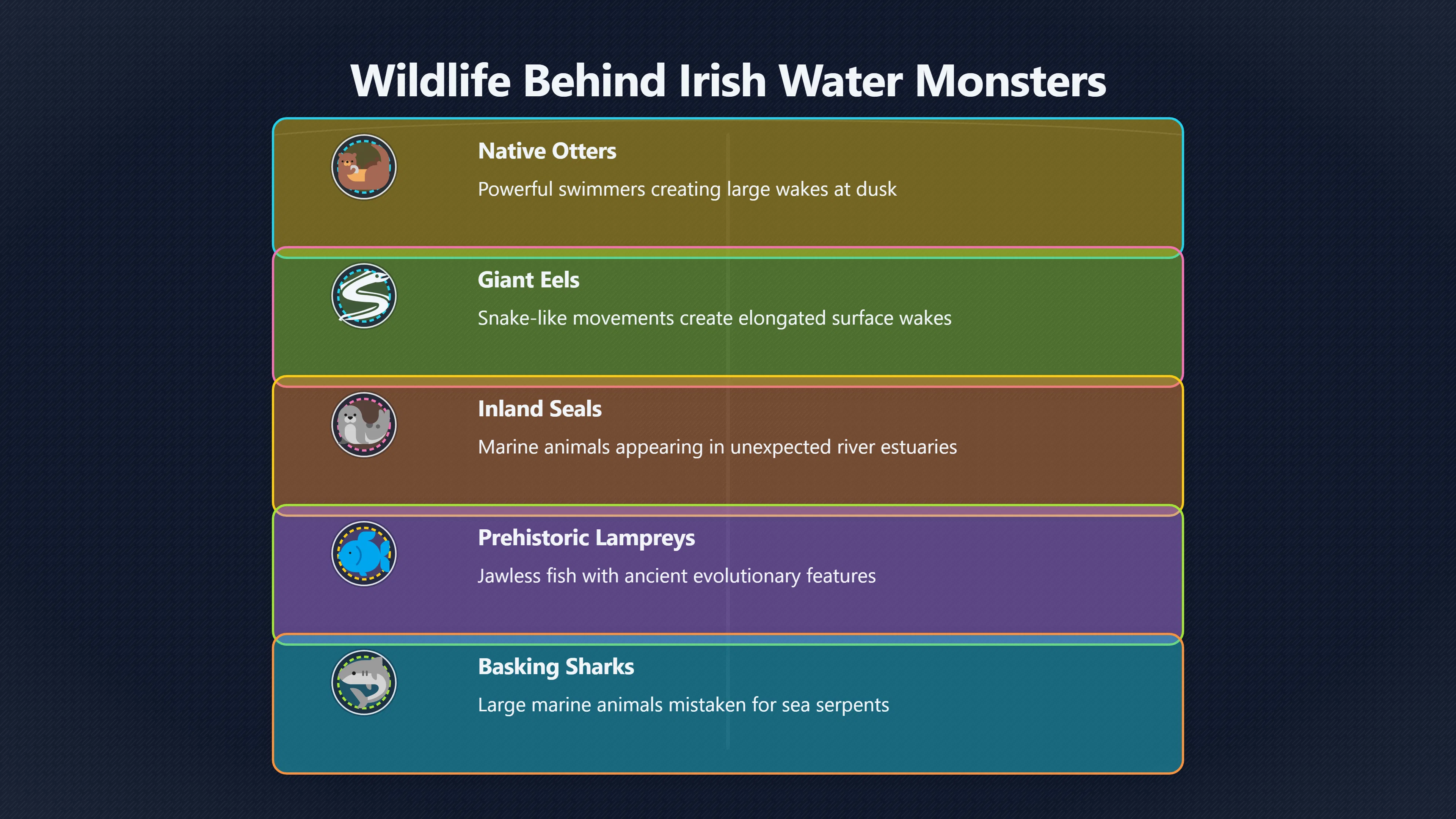
The most important wildlife influence on Irish water-monster stories is probably the otter.
Ireland’s native otter remains widespread and is a powerful swimmer capable of moving silently through rivers, lakes and coastal waters. Seen unexpectedly, particularly at dawn or dusk, an otter can appear surprisingly large. Its long body creates unusual wakes, and multiple otters travelling together may be mistaken for a single larger creature. Ireland’s wildlife authorities note that otters remain an important part of the country’s freshwater ecosystems.[Wikipedia]WikipediaOpen source on wikipedia.org.
The famous Dobhar Cú legend illustrates this process. The creature is often translated as a “water hound” or “king otter” and combines features of a dog, otter and fish. Local traditions from Glenade Lough describe a dangerous aquatic beast linked to the death of Grace Connolly, while a carved gravestone helped preserve the story for generations.[Dúchas]duchas.ieDúchasThe Dobhar Cú · Ahanlish · The Schools' CollectionThis is a collection of folklore compiled by schoolchildren in Ireland in the 1930s…
The legend is far more dramatic than any real otter encounter, but the underlying animal influence is difficult to miss. A familiar creature became enlarged by folklore into something monstrous.
Giant Eels and Serpent Reports
Eels may be the most overlooked source of Irish monster sightings.
Irish lakes and rivers have long supported eel populations, and large specimens can appear remarkably snake-like when viewed near the surface. Their movements create elongated wakes that can look far larger than the animal itself.
Lough Ree’s monster tradition offers a notable example. An RTÉ examination of local reports highlighted suggestions that sightings may have involved unusually large eels or the traditional “horse eel”, a folklore creature combining real fish with mythical serpent imagery.[RTE.ie]rte.ieRTÉ Archives | Society | Lough Ree Monsterthe monster may have been a giant eel, or 'horse eel' a mythological serpent with the body of a…
Because eels spend much of their lives hidden beneath the water, they possess the same quality shared by many legendary beasts: people know they exist but rarely see them clearly.
Lampreys and Prehistoric Impressions
Lampreys are among Ireland’s most unusual native fish. Their jawless mouths and ancient evolutionary history give them an appearance that can seem almost prehistoric.
Although lampreys are not usually large enough to generate monster reports on their own, they contribute to the broader sense that Irish waters contain unfamiliar creatures. Historical observers who encountered lampreys unexpectedly may have interpreted them through existing folklore frameworks, especially before modern biological knowledge became widespread.
Seals in Unexpected Places
Seals regularly travel along Irish coasts and occasionally enter estuaries, rivers and inland waterways.
A seal observed far from the sea can look deeply out of place. At a distance, only its head and part of its back may be visible, creating the classic profile reported in many lake-monster traditions around the world.
This explanation has been proposed for some Irish sightings, including reports associated with Donegal’s Lough Eske. Commentators suggested that a seal moving inland from Donegal Bay could account for a creature later promoted as a local lake monster.[Wikipedia]WikipediaLough EskeLough Eske
The Dobhar Cú as a Wildlife-Folklore Hybrid
Among Irish water beasts, the Dobhar Cú stands out because it sits directly between folklore and animal observation.
Unlike some lake monsters that resemble giant reptiles, the Dobhar Cú remains recognisably mammalian. Descriptions repeatedly return to fur, a long body, powerful swimming ability and otter-like behaviour. Even the name itself is closely connected with Irish words associated with otters and water hounds.[Wikipedia]WikipediaOpen source on wikipedia.org.
The famous Glenade tradition preserved in the folklore archives describes creatures that were “half animal and half fish”, feared by local residents and associated with a specific lakeside tragedy. The story gained permanence through oral tradition, a distinctive gravestone and repeated retellings.[Dúchas]duchas.ieDúchasThe Dobhar Cú · Ahanlish · The Schools' CollectionThis is a collection of folklore compiled by schoolchildren in Ireland in the 1930s…
What makes the Dobhar Cú particularly revealing is that it demonstrates how a real animal can become transformed without losing all connection to its biological roots. The creature remains recognisably aquatic, recognisably mammalian and recognisably Irish.
From Lake Monsters to Sea Serpents
Ireland’s Atlantic coastline naturally generated a different category of monster report.
Open ocean sightings tend to produce descriptions of long serpentine bodies rather than furry water hounds. Before modern marine biology, witnesses sometimes encountered unfamiliar animals such as basking sharks, large fish, dolphins or whales under unusual conditions. A partially submerged animal could easily appear far larger than it really was.
Sea-serpent reports were common throughout the nineteenth and early twentieth centuries across the North Atlantic. Irish coastal sightings formed part of this wider pattern. Most lacked physical evidence, but they reflected genuine encounters with marine wildlife in an era when much of the ocean remained poorly understood.
The Atlantic environment encourages exaggeration because observers usually see only fragments of an animal at considerable distance. A sequence of waves, several dolphins surfacing in line or sections of a basking shark can all create the illusion of a single giant creature.
From Folklore Archive to Cryptid Culture
Modern Irish monster culture did not emerge from nowhere. It inherited material already preserved in folklore collections, local histories and newspaper archives.
The National Folklore Collection contains accounts recorded decades before cryptozoology became popular. These records demonstrate that stories such as the Dobhar Cú were part of genuine local tradition rather than inventions created for tourism or the internet age.[University College Dublin]ucd.ieUniversity College DublinNational Folklore CollectionDating from 1937-39, this remarkable collection is the outcome of an innovative proj…
At the same time, modern media changed how the stories were interpreted. A dangerous water spirit became a cryptid. A local legend became “Ireland’s Loch Ness Monster”. Lough Ree sightings, for example, increasingly entered popular culture through newspaper coverage, television reports and comparisons with Scottish lake-monster traditions.[RTE.ie]rte.ieRTÉ Archives | Society | Lough Ree Monsterthe monster may have been a giant eel, or 'horse eel' a mythological serpent with the body of a…
This shift did not replace the older folklore. Instead, the two traditions merged. Modern monster hunters often discuss creatures that began as folklore figures, while folklore enthusiasts continue to preserve stories that later acquired a cryptozoological reputation.
Why the Wildlife Explanation Often Fits Best
Most Irish water-monster reports share a common feature: the evidence consists of brief sightings, local traditions or anecdotal testimony rather than physical proof.
That does not mean witnesses were dishonest. Quite the opposite. A person who sees an otter unexpectedly, a large eel near the surface, a seal in an inland lake or an unfamiliar marine animal offshore may accurately report a strange experience while still misidentifying the animal involved.
The enduring appeal of Irish water monsters comes from this uncertainty. Real wildlife provides the raw material. Folklore supplies meaning. Lakes, rivers and Atlantic waters provide the stage. Together they create stories that remain compelling even when the most likely explanation is not a hidden monster, but an ordinary creature seen under extraordinary circumstances.[rte.ie]rte.ieRTÉ Archives | Society | Lough Ree Monsterthe monster may have been a giant eel, or 'horse eel' a mythological serpent with the body of a…
Amazon book picks
Further Reading
Books and field guides related to Why Are Ireland's Monsters So Often Aquatic?. Use these as the next step if you want deeper reading beyond the article.
The Mammoth Book of Celtic Myths and Legends
Provides broader Celtic water-creature context.
eBay marketplace picks
Marketplace Samples
Live-tested eBay searches with available results related to this page.
Endnotes
1.
Source: rte.ie
Link:https://www.rte.ie/archives/2016/0701/799606-lough-ree-monster/
Source snippet
RTÉ Archives | Society | Lough Ree Monsterthe monster may have been a giant eel, or 'horse eel' a mythological serpent with the body of a...
2.
Source: Wikipedia
Link:https://en.wikipedia.org/wiki/Dobhar-ch%C3%BA
3.
Source: Wikipedia
Title: Lough Eske
Link:https://en.wikipedia.org/wiki/Lough_Eske
4.
Source: Wikipedia
Title: Lough Ree
Link:https://en.wikipedia.org/wiki/Lough_Ree
Source snippet
Lough ReeIn Irish legends, it was on this island that Queen Maeve was killed. The Viking Turgesius controlled a ringfort on the shores...
5.
Source: ucd.ie
Link:https://www.ucd.ie/irishfolklore/en/
Source snippet
University College DublinNational Folklore CollectionDating from 1937-39, this remarkable collection is the outcome of an innovative proj...
6.
Source: duchas.ie
Link:https://www.duchas.ie/en/cbes/4602723/4598437/4626430
Source snippet
DúchasThe Dobhar Cú · Ahanlish · The Schools' CollectionThis is a collection of folklore compiled by schoolchildren in Ireland in the 1930s...
Additional References
7.
Source: dickraynor.co.uk
Link:https://www.dickraynor.co.uk/l_ree.htm
Source snippet
Lough Ree MonsterLough Ree may be the most recognized amongst Irish 'monster-haunts' what we saw was not a pike or otter, or any other fi...
8.
Source: ucdculturalheritagecollections.com
Link:https://ucdculturalheritagecollections.com/national-folklore-collection/
Source snippet
National Folklore CollectionA large selection of books, manuscripts, audio recordings, videos and photographs, drawings and paintings dea...
9.
Source: youtube.com
Link:https://www.youtube.com/watch?v=sFKEdz6gz-Q
10.
Source: strangeandtwisted.com
Title: Described as a giant serpent-like creature, it haunts folklore and freshwater
Link:https://strangeandtwisted.com/blogs/stories/unveiling-the-depths-irelands-enigmatic-lough-ree-monster?srsltid=AfmBOorYLhSyPSUIKqiQ5IBf9PRa9QQDfVzeNvMvVQrFQUlwuXuBehKa
Source snippet
Unveiling the Depths: Ireland's Enigmatic Lough Ree Monster30 Sept 2025 — The Lough Ree Monster is a legendary Irish lake cryptid...
11.
Source: strangeandtwisted.com
Link:https://strangeandtwisted.com/blogs/stories/the-dobhar-chu-irelands-terrifying-water-hound-of-legend-and-terror?srsltid=AfmBOopgUdFXUmbbFTeRsXj00NwEGOW0c9OGvxsLMBbSvgKo1adiLRPq
Source snippet
Dobhar-chú | Irish Water Monster & Folklore Legend30 Sept 2025 — It's described as a terrifying, dog-like or otter-like monster said...
12.
Source: firesidehorror.co.uk
Link:https://www.firesidehorror.co.uk/blog-2/irish-folklore-the-monstrous-dobhar-ch
Source snippet
Irish Folklore - The Monstrous Dobhar-chú17 Apr 2025 — A terrifying beastie said to occupy the lakes, and rivers throughout Ireland...
13.
Source: facebook.com
Link:https://www.facebook.com/retrobiteirishmythology/posts/the-dobhar-ch%C3%BA-irelands-forgotten-water-horrordeep-in-irelands-lakes-and-rivers-/1511741013729120/
Source snippet
The Dobhar-Chú — Ireland's Forgotten Water Horror Deep...This monster hound is known for its speed, aggression and appetite for human flesh...
14.
Source: reddit.com
Title: The Dobhar-Chu: r/Cryptozoologyr/Cryptozoology
Link:https://www.reddit.com/r/Cryptozoology/comments/1axyn0w/the_dobharchu/
Source snippet
Dobhar-chú | The Monster Otters of Ireland. youtu... TIL about the Dobhar-chú (King Otter), a creature in Irish folklore.Read more...
15.
Source: facebook.com
Link:https://www.facebook.com/LeprechaunMuseum/posts/yes-otters-are-very-cute-but-in-glenade-lough-coleitrim-local-tradition-holds-a-/1312652904229290/
Source snippet
holds a story of a very different kind of otter. The Dobhar-chú...
16.
Source: blackbeastsandboogeymen.com
Link:https://blackbeastsandboogeymen.com/2026/04/20/monster-monday-the-dobhar-chu-irelands-water-hound/
Source snippet
Monster Monday: The Dobhar-Chú — Ireland's Water Hound20 Apr 2026 — Myths, monsters and more in fiction, TV, and cinema...
Topic Tree