Cryptids of The Gambia's Waters
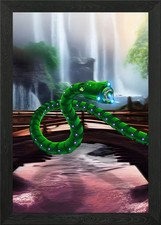
The Gambia’s best-known mystery-creature tradition is the Ninki Nanka: a river-and-swamp dragon of Gambian and wider Senegambian folklore, usually described as reptilian, dangerous, and linked to the quiet creeks, forests and wetlands of the River Gambia.
Page outline Jump by section
Introduction
The Gambia’s best-known mystery-creature tradition is the Ninki Nanka: a river-and-swamp dragon of Gambian and wider Senegambian folklore, usually described as reptilian, dangerous, and linked to the quiet creeks, forests and wetlands of the River Gambia. It is not supported by zoological evidence as an undiscovered animal, but it is well documented as a living folk tradition, a modern cryptozoological case, and now a cultural-tourism emblem. A second, much narrower Gambian mystery-beast story is “Gambo”, a reported unidentified sea carcass found at Bungalow Beach in 1983. Together, these two cases show the difference between a deep-rooted oral legend and a single modern cryptid claim: one belongs mainly to folklore, land, water and cultural memory; the other to the familiar “strange thing washed ashore” genre of cryptozoology.
The Ninki Nanka is Gambia’s signature monster
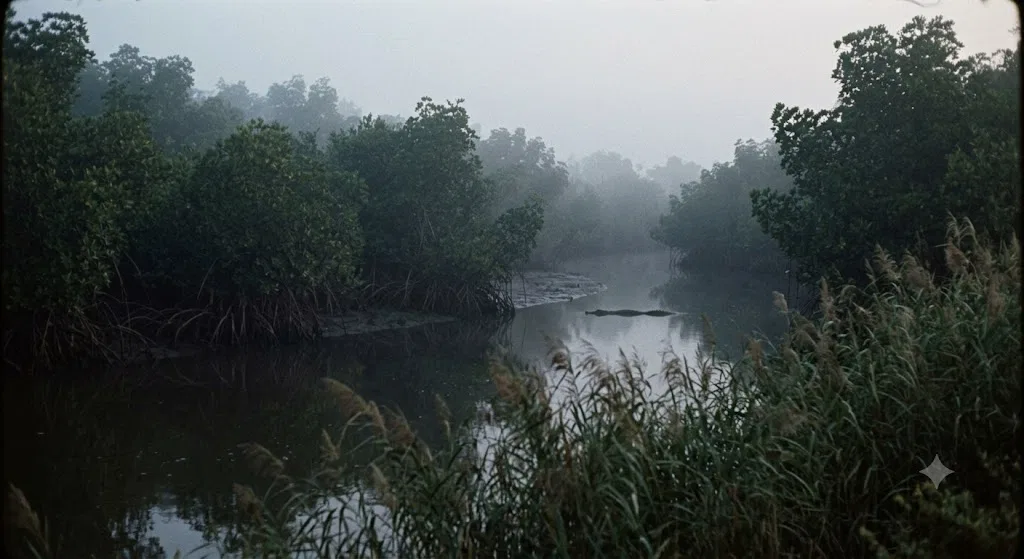
The Ninki Nanka is usually placed in the riverine world: mangrove creeks, swamps, quiet waters and thick bush around the River Gambia. Modern tourism material from the Ninki Nanka Encounters Foundation calls it a “mythical dragon” said to live in the quieter creeks of the river, with descriptions ranging from a big snake or dragon to a composite creature part crocodile, part horse and part giraffe. The same source preserves one of the most memorable rules of the legend: seeing it directly may bring death, but seeing it in a mirror is safe; some versions also treat its scales as lucky objects.[Ninki Nanka Encounters]ninkinanka.foundationNinki Nanka Encounters Ninki Nanka Trail — Ninki Nanka EncountersNinki Nanka Encounters Ninki Nanka Trail — Ninki Nanka Encounters
That mixture of fear and fortune matters. The Ninki Nanka is not just a Loch Ness-style animal report moved to West Africa. It sits in a wider spiritual landscape in which unusual trees, rocks, swamps and waters could be associated with powerful beings. Historian Assan Sarr’s work on the Gambia River Basin describes the Ninki Nanka as one of the most feared spirits of the lower Gambia, a sea or water spirit with dragon-like attributes, associated with swamps, rivers, hills and creeks rather than a single lake or tourist viewpoint.[dokumen.pub]dokumen.pub9781580465694, 2016033865 - DOKUMEN.PUB…
The creature’s form is wonderfully unstable, which is one reason it has lasted. In one telling it is a great serpent; in another it is a dragon; in another it carries features of familiar animals found in or imagined around Gambian waters. That flexibility is normal for oral folklore. It lets a story travel between families, villages, guides, children, outsiders and visitors without needing one official drawing.
Where reports and stories cluster
The centre of gravity is the River Gambia and its wetlands, especially the lower river and the creeks that make the landscape feel half-visible: water, reeds, mangrove, mud, shade, bird calls and crocodile habitat. The modern Ninki Nanka Trail makes that association explicit by building a responsible tourism route around river-based and overland experiences along the River Gambia, linking villages, natural sites and cultural heritage.[www.amenet.eu]amenet.euOpen source on amenet.eu.
The ecological setting helps explain why the legend feels locally plausible even when the creature itself is not confirmed. The Gambia’s biodiversity strategy emphasises the national importance of wildlife, habitats and ecosystems, while also noting pressure on forests, natural habitats and wild mammals.[Convention on Biological Diversity]cbd.intConvention on Biological Diversity CBD Strategy and Action PlanConvention on Biological Diversity CBD Strategy and Action Plan Older herpetological work on western Gambian crocodile pools records crocodiles at visitor-accessible sites including Abuko and sacred pools, and notes that crocodiles were among the few large animals tourists could reliably see in the country.[thebhs.org]thebhs.orgOpen source on thebhs.org.
That does not mean the Ninki Nanka is “really” a crocodile. It means the folklore grew in a landscape where crocodiles, large reptiles, dangerous water, hidden channels and restricted places were part of everyday environmental knowledge. A story about a deadly creature in the swamp can serve many functions at once: warning children away from dangerous water, marking spiritually sensitive places, explaining illness or misfortune, and turning a difficult landscape into a memorable narrative.
What the older sources actually say
One of the strongest historical anchors is not a monster sighting but a colonial-era description of belief. Sarr quotes a 1906 commissioner’s report describing a Mandinka myth called “ninki nanko”, imagined as a gigantic crowned serpent living in the thickest bush. In that account, seeing the body brought dangerous sickness, while seeing the eyes or crown meant instant death. The passage is valuable because it shows the story was not merely a recent invention for tourists or television. It was already being recorded in the early twentieth century as part of local belief.[dokumen.pub]dokumen.pub9781580465694, 2016033865 - DOKUMEN.PUB…
Sarr’s wider argument also helps keep the story in context. Spirits in Senegambian societies were not just decorative characters; they could be understood as owners or powers of particular places, especially wild or marginal places. People settling land, farming, fishing or moving through difficult terrain had to reckon with those powers through religious leaders, hunters or other specialists.[Cambridge University Press & Assessment]resolve.cambridge.orgUniversity Press & Assessment The Power of the Wild Spirits (Chapter 3University Press & Assessment The Power of the Wild Spirits (Chapter 3
This is why a purely “is it a real animal?” approach misses much of the point. The Ninki Nanka belongs partly to creature folklore, but also to land, authority, fear, health, farming, water and movement. In some interpretations, spirits such as the Ninki Nanka could be linked to drought, famine or poor harvests, not because anyone had found a dragon skeleton, but because environmental disaster needed moral and spiritual explanation as well as practical explanation.[dokumen.pub]dokumen.pub9781580465694, 2016033865 - DOKUMEN.PUB…
The 2006 dragon hunt turned folklore into news
The Ninki Nanka became internationally visible in 2006 when British cryptozoologists associated with the Centre for Fortean Zoology travelled to The Gambia to investigate the legend. The episode was covered in the British press, with The Independent summarising the creature as a horned marsh-dweller from Gambia, reportedly 9 metres long, with a crocodile-like body, giraffe-like neck, horse-like head and three horns.[The Independent]independent.co.ukOpen source on independent.co.uk.
This media moment changed the story’s audience. Inside The Gambia and Senegambia, the Ninki Nanka could be an inherited warning, a spirit, a children’s fear, a river legend or a cultural memory. Outside the region, it was often reframed as an “African dragon” or “Gambian Nessie”, the sort of creature cryptozoology readers could compare with lake monsters and sea serpents elsewhere.
That reframing is useful but risky. It can bring attention to Gambian folklore, but it can also flatten the story into a hunt for a large reptile. The best reading keeps both layers visible: there are modern witness-style claims and cryptozoological retellings, but the older and richer material is folklore rooted in water, spirit, landscape and social memory.
What could explain Ninki Nanka sightings?
There is no good physical evidence for a real Ninki Nanka species. No body, bones, clear photograph, trackway, tissue sample or repeatable zoological observation has established an unknown dragon-like animal in The Gambia. The more plausible explanations are layered rather than single.
Crocodiles and large reptiles are the obvious natural comparison. The Gambia has real crocodile traditions and crocodile sites, including sacred pools, and crocodiles are visually powerful enough to seed or reinforce monster imagery. But a crocodile does not explain every Ninki Nanka feature, especially the mirror motif, death-by-sight idea, crowned serpent form and dragon-like spiritual role.[thebhs.org]thebhs.orgOpen source on thebhs.org.
Misidentification in difficult habitat is also plausible. Mangrove creeks, dusk, heat haze, partial views, floating logs, surfacing reptiles, large fish, manatees or decomposing animals can all produce strange impressions. The Ninki Nanka’s reported habitats are exactly the sort of places where brief, obscured sightings become memorable.
Folkloric warning and place-making may be the strongest explanation for the tradition as a whole. A frightening swamp creature teaches caution around deep water, dangerous animals and spiritually marked places. It also makes the landscape legible: this creek is not merely a creek; it is a place with a story, a power and a rule.
Tourism and popular culture have reshaped the legend without creating it from scratch. The Ninki Nanka Trail explicitly treats the story as intangible heritage and uses it as a route theme, while also presenting both benevolent and dangerous versions of the dragon.[Ninki Nanka Encounters]ninkinanka.foundationNinki Nanka Encounters Ninki Nanka Trail — Ninki Nanka EncountersNinki Nanka Encounters Ninki Nanka Trail — Ninki Nanka Encounters That is a modern afterlife, not proof of the creature, but it shows how folklore can move from fireside warning to cultural product.

The Ninki Nanka Trail changed the monster’s public role
The most striking modern development is that the Ninki Nanka is no longer only a frightening thing in the bush. It has become a way to draw visitors inland from the coastal resort strip and towards river communities. Leeds Beckett University describes the Ninki Nanka Trail as a community-based tourism initiative intended to spread tourism benefits along the River Gambia and beyond the coast.[Leeds Beckett University]leedsbeckett.ac.ukOpen source on leedsbeckett.ac.uk.
A presentation on the trail frames the oral legend as a mysterious dragon of the River Gambia with supernatural powers, multiple good and bad interpretations, and deep integration into local culture and traditions. It also stresses that responsible use of the Ninki Nanka theme should not treat the creature as “just a funny name”, but as intangible heritage with meaning for many people.[www.amenet.eu]amenet.euOpen source on amenet.eu.
That is a useful model for monster tourism. Instead of pretending a dragon has been scientifically confirmed, the trail can turn the legend into a route through real places, crafts, guiding, storytelling, river journeys and local encounters. The risk, as with any folklore tourism, is simplification: a frightening and complex spirit can become a logo. The opportunity is preservation: stories that might otherwise be dismissed as old-fashioned can gain new public life when handled with local involvement and care.
Gambo, the beached “sea serpent” of Bungalow Beach
The other Gambian cryptid case is much more modern and much thinner. “Gambo” is the name later given in cryptozoological circles to an alleged large, unidentified marine carcass found at Bungalow Beach in June 1983. Zoologist Darren Naish summarises the case as a carcass reportedly examined by Owen Burnham, first reported in a letter to BBC Wildlife, then discussed in later cryptozoological literature. Naish notes that Burnham claimed to know where the body was buried, but that no excavation had recovered it.[Tetrapod Zoology]darrennaish.blogspot.comOpen source on blogspot.com.
The reported details are vivid: a long body, beak-like jaws, flippers, a tail and a superficial resemblance to something between a dolphin and a reptile. Karl Shuker, who wrote extensively about the case, gives Burnham’s account of finding the carcass below Bungalow Beach Hotel on 12 June 1983, measuring it, and seeing local men remove the head.[ShukerNature]karlshuker.blogspot.comOpen source on blogspot.com.
Gambo is intriguing, but its evidential weaknesses are severe. There are no photographs, no preserved tissue, no skull, no verified bones and no specimen. Naish stresses that the drawings were not made at the carcass itself but after Burnham returned to the UK, and he treats the account as anecdotal despite not dismissing the witness outright.[Tetrapod Zoology]darrennaish.blogspot.comOpen source on blogspot.com.
The most cautious explanation is that Gambo was probably a misidentified or decomposing marine animal, perhaps a cetacean, fish or other known sea creature altered by damage, bloating, scavenging or partial decay. The case remains “unresolved” only in the weak sense that the original material was lost. It is not strong evidence for a surviving prehistoric reptile or an unknown Gambian sea monster.
Why Gambia’s monster stories feel different from lake-monster lore
The Gambia does not have a large catalogue of nationally famous cryptids. Its mystery-creature identity is concentrated around one major folkloric being, the Ninki Nanka, and one modern carcass case, Gambo. That makes the country different from places where dozens of newspaper flaps, lake sightings or phantom-cat reports accumulate over decades.
The Ninki Nanka is the deeper story because it belongs to a living cultural and environmental world. It is about water that can kill, bush that can hide things, spirits that mark places, and communities that pass warnings through memorable images. Gambo, by contrast, is a single lost-carcass case that became important mainly because cryptozoologists love the possibility of a physical specimen that disappeared before science could examine it.
Both stories are worth keeping, but for different reasons. The Ninki Nanka helps readers understand Gambian monster folklore as folklore: adaptive, moral, local, frightening and flexible. Gambo helps readers understand the limits of cryptozoological evidence: a dramatic account can remain fascinating while still falling short of proof.
The evidence-aware verdict
The Ninki Nanka should be presented as Gambia’s central legendary creature, not as a confirmed hidden animal. Its roots are older than modern tourism, and historical writing places it within lower Gambian beliefs about dangerous spirits, wild places and water. Its modern life includes media attention, cryptozoological expeditions and a responsible-tourism trail that uses the dragon as a cultural thread along the River Gambia.[dokumen.pub]dokumen.pub9781580465694, 2016033865 - DOKUMEN.PUB…[Ninki Nanka Encounters]ninkinanka.foundationNinki Nanka Encounters Ninki Nanka Trail — Ninki Nanka EncountersNinki Nanka Encounters Ninki Nanka Trail — Ninki Nanka Encounters
Gambo should be treated as a separate, low-evidence sea-carcass mystery. It is a good story, and it has a named witness tradition, but without photographs, samples or recovered remains, it cannot carry much zoological weight. The most likely reading is a known marine animal seen under confusing conditions, with later retellings making it more monster-like.[Tetrapod Zoology]darrennaish.blogspot.comOpen source on blogspot.com.
The strongest conclusion is also the most interesting one: The Gambia’s monster tradition is not thin because there is no proven dragon. It is rich because the Ninki Nanka shows how a creature can guard a landscape in memory, fear and storytelling long after any literal hunt for scales, bones or footprints has failed.

eBay marketplace picks
Marketplace Samples
Live-tested eBay searches with available results related to this page.
Endnotes
1.
Source: dokumen.pub
Link:https://dokumen.pub/islam-power-and-dependency-in-the-gambia-river-basin-the-politics-of-land-control-17901940-9781580465694-2016033865.html
Source snippet
9781580465694, 2016033865 - DOKUMEN.PUB...
2.
Source: amenet.eu
Link:https://www.amenet.eu/documents/conferences/C2020_04_Lucy-McCombes-Responsible-development-CBT-in-The-Gambia-Ninki-Nanka-Trail.pdf
3.
Source: thebhs.org
Link:https://www.thebhs.org/publications/the-herpetological-bulletin/issue-number-47-spring-1994/2508-hb047-04/file
4.
Source: resolve.cambridge.org
Title: University Press & Assessment The Power of the Wild Spirits (Chapter 3)
Link:https://resolve.cambridge.org/core/services/aop-cambridge-core/content/view/AB4AAAD4DE388EDACB3308F65F63C575/9781782048701c3_p84-110_CBO.pdf/power_of_the_wild_spirits.pdf
5.
Source: youtube.com
Title: The Ninki Nanka | West Africa’s Swamp Dragon
Link:https://www.youtube.com/watch?v=Wru7DkEfgVU
Source snippet
Ninki Nanka: The African Nessie | African Mythology | Mythlok | Podcast...
6.
Source: ninkinanka.foundation
Title: Ninki Nanka Encounters Ninki Nanka Trail — Ninki Nanka Encounters
Link:https://ninkinanka.foundation/ninki-nanka-trail
7.
Source: cbd.int
Title: Convention on Biological Diversity CBD Strategy and Action Plan
Link:https://www.cbd.int/doc/world/gm/gm-nbsap-v2-en.pdf
8.
Source: independent.co.uk
Link:https://www.independent.co.uk/news/science/the-monster-detectives-on-the-trail-of-the-ninkinanka-6095664.html
9.
Source: leedsbeckett.ac.uk
Link:https://www.leedsbeckett.ac.uk/research/events-tourism-and-hospitality-management-research/ninki-nanka-trail-development/
10.
Source: darrennaish.blogspot.com
Link:https://darrennaish.blogspot.com/2006/02/gambo-rides-again-beaked-beast-of.html
11.
Source: karlshuker.blogspot.com
Link:https://karlshuker.blogspot.com/2019/05/gambo-gambian-sea-serpent-or-how-very.html
Additional References
12.
Source: youtube.com
Title: Ninki Nanka: The African Nessie | African Mythology | Mythlok | Podcast
Link:https://www.youtube.com/watch?v=Q5httIzu0gU
Source snippet
The Ninki Nanka Trail: Gambia & Casamance | My Gambia | My Magazine...
13.
Source: youtube.com
Title: Gambo: A Living Marine Reptile?
Link:https://www.youtube.com/watch?v=HMARGPjGCP8
Source snippet
3 More Sea Monster Carcasses and Their Explanations...
14.
Source: youtube.com
Title: The Ninki Nanka Trail: Gambia & Casamance | My Gambia | My Magazine
Link:https://www.youtube.com/watch?v=dSXixkXwGec
Source snippet
Gambo: A Living Marine Reptile?...
15.
Source: youtube.com
Title: 3 More Sea Monster Carcasses and Their Explanations
Link:https://www.youtube.com/watch?v=kTikeTomelY
Topic Tree
Follow this branch
Related pages 192
- Antigua Cryptids
- Maldives Monsters
- Malta Monsters
- Qatar Monsters
- Argentina Monsters
- +187 more in sidebar