Within Sudan Cryptids
Who Were the Hidden People of the Nile?
Stories of aquatic people and invisible river beings present the Nile as a social and spiritual world rather than an empty waterway.
On this page
- The fisherman and the girl from the river
- Offerings, fertility and respect for the Nile
- Why River Folk are folklore rather than zoological cryptids
Page outline Jump by section
Introduction
Stories about Sudan’s “river folk” are not really tales of hidden animals lurking in the Nile. They are something older and more revealing: traditions that treat the river as a populated world with its own inhabitants, powers and social rules. Along stretches of the Sudanese and Nubian Nile, people told stories of beautiful river girls, invisible communities beneath the water and supernatural beings who could reward respect or punish arrogance. These traditions helped explain a river that gave life through water and fertile soil while also bringing drowning, floods and sudden loss. Rather than belonging to cryptozoology in the strict sense, the river folk occupy the borderland between folklore, religion and everyday experience. They show how many Sudanese communities understood the Nile not as an empty landscape feature but as a living presence woven into family life, farming, fishing and belief.[jstor.org]jstor.orgANGELS OF THE NILEJuly 11, 1919 — by JW CROWFOOT · 1919 · Cited by 10 — J. W. CROWFOOT. It is said that in the days of Abdullahi a f…

Who Were the Hidden People of the Nile?
One of the most frequently repeated Nile traditions was recorded by the administrator and folklorist J. W. Crowfoot in 1919. According to the story, a fisherman casting his net into the river caught not a fish but a young girl. When questioned, she claimed to belong to people who lived within the Nile itself. Crowfoot presented the tale as part of a wider body of northern Sudanese beliefs concerning beings dwelling in the river and interacting with human communities.[jstor.org]jstor.orgANGELS OF THE NILEJuly 11, 1919 — by JW CROWFOOT · 1919 · Cited by 10 — J. W. CROWFOOT. It is said that in the days of Abdullahi a f…
The importance of the story is not that listeners believed a literal underwater civilisation had been discovered. Instead, the tale reflects a common idea that the Nile possessed hidden societies parallel to the human one. The river could contain families, rulers, spirits and communities beyond ordinary sight. Such beliefs appeared in various forms across Nile folklore, where the boundary between the human world and the river world could occasionally open through dreams, encounters or unusual events.[JSTOR]jstor.orgANGELS OF THE NILEJuly 11, 1919 — by JW CROWFOOT · 1919 · Cited by 10 — J. W. CROWFOOT. It is said that in the days of Abdullahi a f…
Unlike monster legends that focus on a dangerous beast, these narratives often portray river beings as social creatures. They marry, form families, make bargains and maintain relationships with humans. The mystery lies not in their appearance but in their hidden existence beneath or within the waters of the Nile.[JSTOR]jstor.orgANGELS OF THE NILEJuly 11, 1919 — by JW CROWFOOT · 1919 · Cited by 10 — J. W. CROWFOOT. It is said that in the days of Abdullahi a f…
The Fisherman and the Girl from the River
Crowfoot’s account of the fisherman and the river girl survives because it captures several themes that appear repeatedly in Sudanese Nile folklore. The river girl is neither a fish nor a monster. She is recognisably human yet belongs to another realm. Her presence suggests that the Nile contains a society operating according to its own rules.[JSTOR]jstor.orgANGELS OF THE NILEJuly 11, 1919 — by JW CROWFOOT · 1919 · Cited by 10 — J. W. CROWFOOT. It is said that in the days of Abdullahi a f…
For communities living beside the river, such stories carried practical lessons. Fishermen depended on the Nile for survival, but they also knew its dangers. A person could disappear into the water without explanation. Floods could destroy crops while creating future fertility. The idea of hidden river people gave a human shape to these unpredictable forces. The river was not random; it was inhabited and responsive.[andariya.com]andariya.comthe nile river in sudanese culture history rituals poetry and national identityThe Nile River in Sudanese Culture: History, Rituals…26 Feb 2026 — In Sudanese folklore, it is said, “The Nile is our father,”…
Many folkloric traditions around the world imagine lakes and rivers populated by supernatural communities. The Sudanese versions are distinctive because they emerge from a civilisation whose settlements, agriculture and transport were tied directly to the Nile. The river was not merely scenery. It was the centre of life, making stories about hidden Nile inhabitants particularly meaningful.[andariya.com]andariya.comthe nile river in sudanese culture history rituals poetry and national identityThe Nile River in Sudanese Culture: History, Rituals…26 Feb 2026 — In Sudanese folklore, it is said, “The Nile is our father,”…
Offerings, Fertility and Respect for the Nile
The river folk cannot be separated from broader beliefs about the Nile’s spiritual power. Historical studies of the central Nile region describe traditions linking the river to fertility, prosperity and divine favour. The Nile’s annual flooding determined whether crops succeeded or failed, making it natural for communities to imagine reciprocal relationships between people and river powers.[De Gruyter Brill]degruyterbrill.comoverwhether some aspects of religious practices of the ancient central SudaneseNile…Read more…
Some legends and historical traditions speak of gifts or offerings intended to secure the river’s goodwill. Over time these stories blended folklore, local memory and interpretations of ancient practices. Whether historically accurate or not, the tales reveal a widespread belief that the Nile deserved respect and that neglecting its powers could bring disaster.[De Gruyter Brill]degruyterbrill.comoverwhether some aspects of religious practices of the ancient central SudaneseNile…Read more…
Within this framework, hidden river beings functioned as representatives of the Nile itself. Encounters with them often carried moral messages:
- Respect the river and its dangers.
- Honour community customs connected with water and fertility.
- Avoid arrogance when dealing with forces beyond human control.
- Recognise that life-giving resources deserve gratitude rather than exploitation.
These themes appear repeatedly in discussions of Sudanese river traditions and help explain why stories of river people endured long after their literal truth ceased to matter.[andariya.com]andariya.comthe nile river in sudanese culture history rituals poetry and national identityThe Nile River in Sudanese Culture: History, Rituals…26 Feb 2026 — In Sudanese folklore, it is said, “The Nile is our father,”…
Why the Nile Needed Inhabitants
To modern readers, invisible river communities may seem unusual, but they emerge naturally from the environment of the Nile Valley.
The river was both generous and dangerous. It fed farms, supplied fish, enabled travel and supported entire settlements. At the same time, it could drown swimmers, sweep away boats and reshape the landscape through floods. A purely mechanical explanation of the river offered little emotional comfort. Folklore transformed the Nile into a social space whose actions could be understood through stories.[Andariya]andariya.comthe nile river in sudanese culture history rituals poetry and national identityThe Nile River in Sudanese Culture: History, Rituals…26 Feb 2026 — In Sudanese folklore, it is said, “The Nile is our father,”…
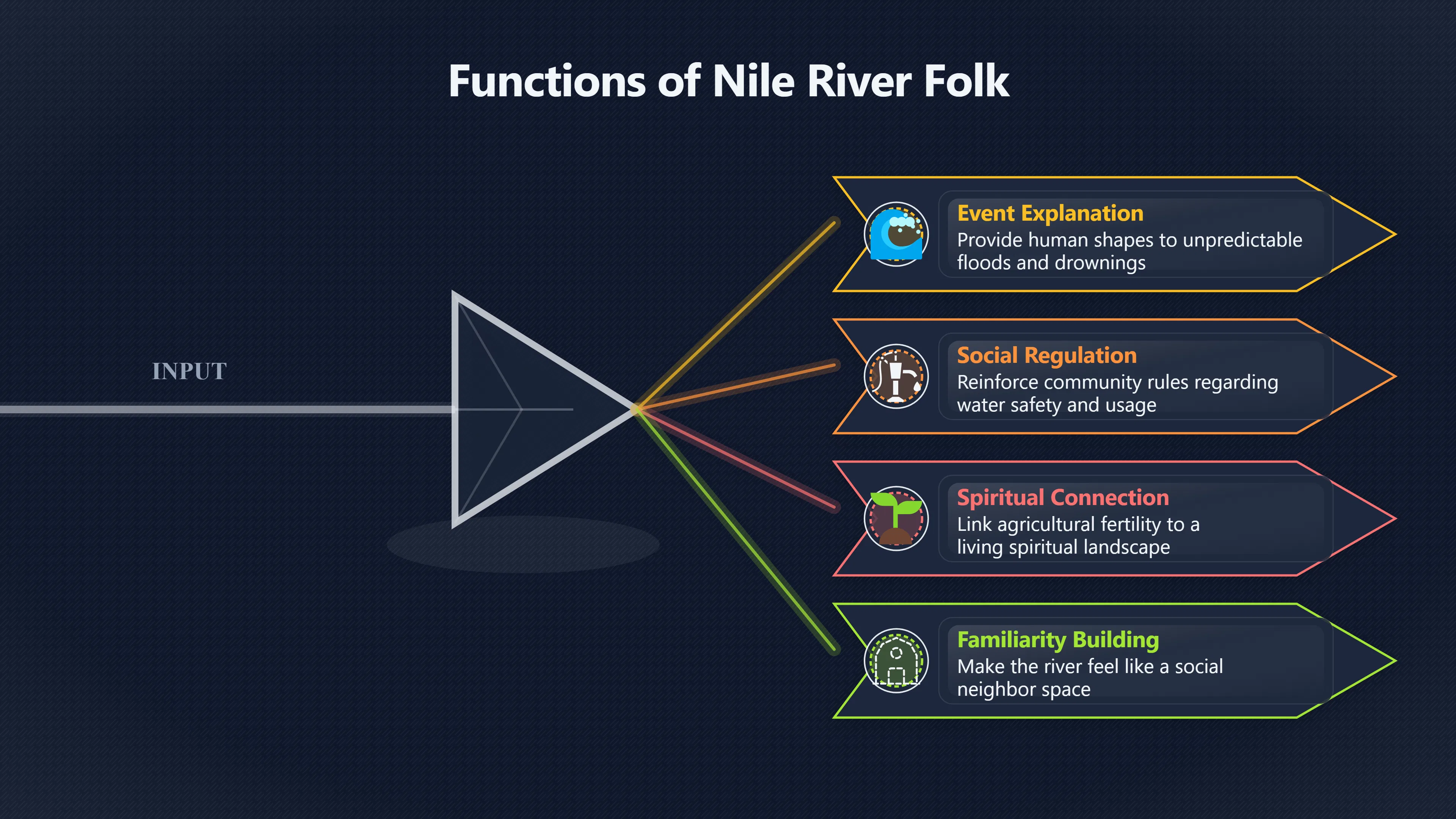
The hidden people of the Nile therefore served several functions at once:
- They explained unexpected events.
- They reinforced social rules around water use and safety.
- They connected fertility and agriculture to a living spiritual landscape.
- They made the river feel familiar without making it harmless.
In this sense, the river folk acted less like supernatural monsters and more like neighbours from another realm.[jstor.org]jstor.orgANGELS OF THE NILEJuly 11, 1919 — by JW CROWFOOT · 1919 · Cited by 10 — J. W. CROWFOOT. It is said that in the days of Abdullahi a f…
Why River Folk Are Folklore Rather Than Zoological Cryptids
From a cryptid perspective, the river folk occupy an unusual category. They are associated with hidden beings, mysterious encounters and unexplained stories, yet they do not behave like reports of unknown animals.
Cryptid traditions usually involve attempts to identify a physical creature: a giant snake, an undiscovered ape or a lake monster. The Nile river folk are different. Their defining characteristics are social and symbolic rather than biological. They speak, marry, form communities and interact with humans according to folkloric logic. There are no consistent physical descriptions, no tracks, no bodies and no serious zoological investigations suggesting an unknown species.[JSTOR]jstor.orgANGELS OF THE NILEJuly 11, 1919 — by JW CROWFOOT · 1919 · Cited by 10 — J. W. CROWFOOT. It is said that in the days of Abdullahi a f…
Modern researchers therefore treat these stories as part of Sudan’s rich river folklore rather than evidence for hidden aquatic humans. Their value lies in what they reveal about the relationship between Nile communities and the river that sustained them. The legends preserve a worldview in which water was never just water. It was a realm inhabited by unseen neighbours whose presence reminded people to approach the Nile with respect, caution and wonder.[andariya.com]andariya.comthe nile river in sudanese culture history rituals poetry and national identityThe Nile River in Sudanese Culture: History, Rituals…26 Feb 2026 — In Sudanese folklore, it is said, “The Nile is our father,”…

Amazon book picks
Further Reading
Books and field guides related to Who Were the Hidden People of the Nile?. Use these as the next step if you want deeper reading beyond the article.
African Myths of Origin
Strong fit for stories of river beings and supernatural communities.
Women Who Run with the Wolves
Explores symbolic narratives and traditional storytelling.
The Hero with a Thousand Faces
Examines recurring folklore themes found in river-spirit stories.
Mythology
Rating: 2.5/5 from 14 Google Books ratings
Useful introduction to how cultures populate landscapes with supernatural beings.
eBay marketplace picks
Marketplace Samples
Live-tested eBay searches with available results related to this page.




Endnotes
1.
Source: jstor.org
Link:https://www.jstor.org/stable/41715821
Source snippet
ANGELS OF THE NILEJuly 11, 1919 — by JW CROWFOOT · 1919 · Cited by 10 — J. W. CROWFOOT. It is said that in the days of Abdullahi a f...
Published: July 11, 1919
2.
Source: andariya.com
Title: the nile river in sudanese culture history rituals poetry and national identity
Link:https://andariya.com/post/the-nile-river-in-sudanese-culture-history-rituals-poetry-and-national-identity
Source snippet
The Nile River in Sudanese Culture: History, Rituals...26 Feb 2026 — In Sudanese folklore, it is said, “The Nile is our father,”...
3.
Source: sudanarchive.net
Link:https://www.sudanarchive.net/?a=d&d=SNRV19190000-01.1.188
Source snippet
W. CROWFOOT. It is said that in the days of Abdullahi a fisherman was casting his net into the river and caught a girl about ten...Read...
4.
Source: aquamuse.substack.com
Title: The Myths and Rituals of the Nile
Link:https://aquamuse.substack.com/p/the-myths-and-rituals-of-the-nile
Source snippet
It is seen as the source of life and giving, having sustained civilizations throughout...Read more...
5.
Source: sudanmemory.org
Link:https://www.sudanmemory.org/%21image/SNR-0000045/12/
6.
Source: womensliteracysudan.blog
Title: Women’s literacy in Sudan Angels of The Nile
Link:https://womensliteracysudan.blog/2022/01/26/angels-of-the-nile/
Source snippet
Women's literacy in SudanAngels of The Nile - Women's literacy in Sudan26 Jan 2022 — Crowfoot's fascinating account of folklore, poetry a...
7.
Source: degruyterbrill.com
Link:https://www.degruyterbrill.com/document/doi/10.1515/9781580466271-016/html?srsltid=AfmBOoqJl09O_78iTpbzAToa0hkUODdA_TN1xjJw-DXsh7yF7QdB0AAr
Source snippet
overwhether some aspects of religious practices of the ancient central SudaneseNile...Read more...
8.
Source: degruyterbrill.com
Link:https://www.degruyterbrill.com/document/doi/10.1515/9781580466271-016/html?srsltid=AfmBOoqgRLlWJWLBSLOJy0aapohTg8ewZE4tS2BycVVIofSQwyng0pVH
Source snippet
itness account to east and that a woman, Aluo, was sacrificed to the river...
Additional References
9.
Source: youtube.com
Title: Fatma Al Samha
Link:https://www.youtube.com/watch?v=pAqG0U66uZs
Source snippet
Apedemak: The Forgotten Nubian Lion God Who Gave Kings Their Power...
10.
Source: youtube.com
Title: The Story of Ariche: The Monster Who Ate the World
Link:https://www.youtube.com/watch?v=cqukTBJh6Ts
Source snippet
Fatma Al Samha - The Beautiful Girl and The Monster. (Folklore from Sudan)...
11.
Source: folktalesfromsudan.org
Link:https://www.folktalesfromsudan.org/
12.
Source: facebook.com
Link:https://www.facebook.com/groups/275114380263865/posts/873079847133979/
13.
Source: researchgate.net
Link:https://www.researchgate.net/publication/378170147_Pagan_Tribes_of_the_Nilotic_Sudan
14.
Source: instagram.com
Link:https://www.instagram.com/p/DSb_FSAjoHq/
15.
Source: youtube.com
Title: WHAT IS [THE LAU]({{ ‘the-lau-456ede/’ | relative_url }})
Link:https://www.youtube.com/watch?v=5K2kvy-yFLA
Source snippet
The Story of Ariche: The Monster Who Ate the World...
16.
Source: youtube.com
Link:https://www.youtube.com/watch?v=zkSQ_ud6hnE
17.
Source: youtube.com
Title: Meet the [Aman Doger]({{ ‘aman-doger/’ | relative_url }})
Link:https://www.youtube.com/watch?v=zk28eAPGrWU
Source snippet
WHAT IS THE LAU - TalesofTim's Cryptid Files...
18.
Source: epub.ub.uni-muenchen.de
Title: the prehistory of the central sudanese nile valley 8248
Link:https://epub.ub.uni-muenchen.de/8248/1/the_prehistory_of_the_central_sudanese_nile_valley_8248.pdf
Topic Tree