Creature Lore of Mauritania's Desert Stories
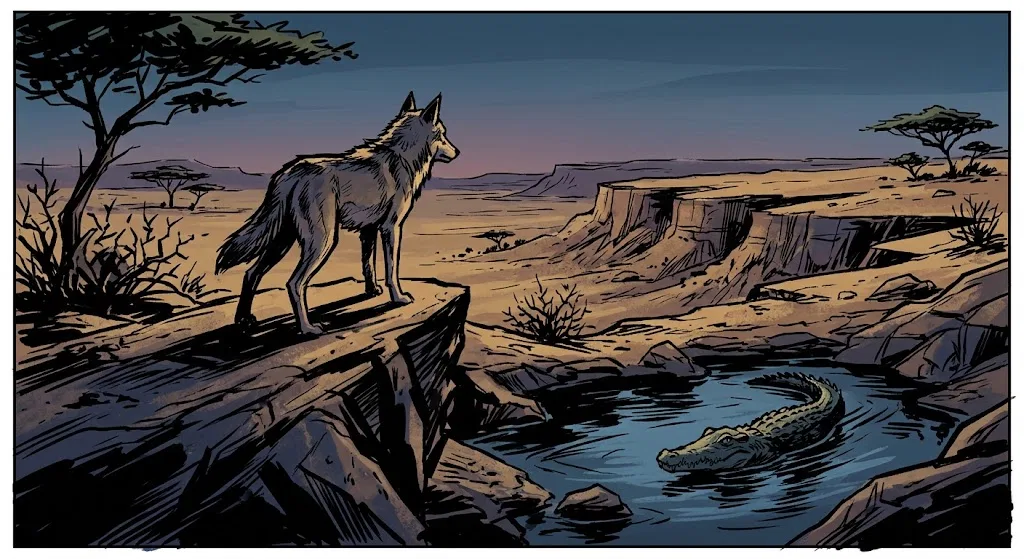
Mauritania’s best-known mystery-animal story is not a lake monster or a winged terror, but a lean desert canid usually called the adjulé: a wolf-like “bush dog” reported from the Sahara and especially associated with Mauritania. The claim is intriguing because it sits close to real zoology.
Page outline Jump by section
Introduction
The stronger Mauritanian “monster” story, however, may be the opposite of a cryptid: desert crocodiles. These are real, relict crocodile populations surviving in Saharan pools and seasonal wetlands, surrounded by folklore, water beliefs, tourism and conservation concern. Their existence helps explain why Mauritania’s creature traditions are less about impossible beasts and more about animals at the edge of survival.[PLOS]journals.plos.orgCrocodiles in the Sahara Desert: An Update of Distribution, Habitats and Population Status for Conservation Planning in Mauritania |…
The adjulé: Mauritania’s wolf-like desert dog
The adjulé is usually described as a dog-like or wolf-like animal of the Sahara. George M. Eberhart’s Mysterious Creatures gives its Mauritanian variant name as “Kelb-el-khela”, glossed as “bushdog”, and notes “Tarhsît” as a name for the female. The entry’s physical description is spare — “like a wolf” — which is important: this is not a highly elaborated monster with horns, wings or supernatural powers, but a claim about an unfamiliar wild canid seen in a difficult landscape.[National Digital Library of Ethiopia]ndl.ethernet.edu.etOpen source on edu.et.
The most zoologically interesting part of the story is its proposed explanation. Eberhart’s guide treats the adjulé as possibly an African wild dog outside its usual range, and traces the source trail back to Monod’s 1928 note on Lycaon pictus in the Sahara. The same entry suggests that earlier in the twentieth century there may have been enough gazelles in sub-desert areas for scattered packs to survive. That makes the adjulé less a “monster” in the fantasy sense than a possible memory of a predator population at the fading edge of its ecological range.[National Digital Library of Ethiopia]ndl.ethernet.edu.etOpen source on edu.et.
There is also a modern sighting tradition, but it is thin. Online cryptid summaries commonly repeat a 1992 report in western Mauritania, in which hunters allegedly saw a pack of unknown wolf-like animals hunting. That claim is widely circulated, but the accessible trail is mostly secondary cryptid material rather than a strong primary report, photograph, specimen or peer-reviewed field record.[cryptidarchives.fandom.com]cryptidarchives.fandom.comEncyclopaedia of Cryptozoology - FandomThe most recent sighting occured in 1992, when some hunters on the west coast of northern Mauritan…
Why an African wild dog explanation is plausible, but not proven
African wild dogs are real pack-hunting canids, and their behaviour makes them a natural candidate for an adjulé-like report. They are social, conspicuous when hunting, and unlike jackals or foxes in general appearance. The IUCN Canid Specialist Group notes that historical data place African wild dogs across much of sub-Saharan Africa, including some desert and mountain environments, while also stressing that the species has disappeared from much of its former range and is now virtually eradicated from North and West Africa.[Canids]canids.orgAfrican wild dog | CanidsAfrican wild dog | Canids…
That cuts both ways. It makes an old Saharan wild-dog report more believable than a completely unknown animal, but it makes a recent Mauritanian population harder to accept without evidence. A genuine remnant pack would be important zoologically, yet there are no widely accepted modern photographs, carcasses, genetic samples or conservation records confirming African wild dogs in Mauritania today. The best reading is cautious: the adjulé may preserve reports of African wild dogs, feral dogs, jackals, hyenas, or mixed memories of all of these, rather than proving an undiscovered species.
Mauritania’s known mammal fauna gives several ordinary suspects for misidentification. A 2022 PLOS ONE review of Mauritanian land mammals lists carnivores including spotted hyena and striped hyena, and the national biodiversity clearing-house describes the Atlantic coastal desert fauna as including hyena, sand fox, ratel, golden jackal and Dorcas gazelle. In poor light, at distance, or in a fast-moving hunting scene, a group of canids or scavengers could easily be remembered as something more unusual.[Semantic Scholar]pdfs.semanticscholar.orgOpen source on semanticscholar.org.
The real “monster” of the Mauritanian desert: crocodiles in Saharan pools
Mauritania’s desert crocodiles are far better documented than the adjulé, and they are strange enough without being mythical. A 2011 PLOS ONE study found crocodile presence at 78 Mauritanian localities across 10 river basins, with permanent gueltas and seasonal wetlands among the most common occupied habitats. Most localities held fewer than five observed crocodiles, though some encounters involved more than 20.[PLOS]journals.plos.orgCrocodiles in the Sahara Desert: An Update of Distribution, Habitats and Population Status for Conservation Planning in Mauritania |…
These crocodiles matter because they are relicts of a wetter Sahara. The PLOS ONE study explains that Saharan crocodiles once ranged more widely, but increased aridity and human persecution led to local extinctions; surviving populations are now known from Mauritania, Chad and Egypt. In Mauritania, the animals persist in small, fragmented pockets where water remains long enough to support them.[PLOS]journals.plos.orgCrocodiles in the Sahara Desert: An Update of Distribution, Habitats and Population Status for Conservation Planning in Mauritania |…
The Tagant Plateau and places such as Matmata are central to the story. An Oryx paper on Mauritanian crocodiles reports that they were once considered extinct in the country until rediscovery in isolated pools in south-eastern Mauritania, and that Matmata became a key site for tourism and conservation planning. The paper also describes a broader Gabou basin network, where seasonal rivers may connect pools during floods.[Universidad Complutense de Madrid]ucm.esUniversidad Complutense de MadridS0030605308007850 292..295…
This is where the “monster” feeling comes from: not from a creature being imaginary, but from a living crocodile appearing where many outsiders expect only desert. A traveller looking down into a remote guelta and seeing reptilian eyes in the water is encountering a genuine prehistoric-looking survivor, not a hoax.
Folklore, water and the crocodile as guardian
The crocodile tradition in Mauritania is not simply a tourist curiosity. The Oryx study notes the symbolic role of crocodiles for many Mauritanians, the peaceful acceptance of their presence by people in Tagant, and the growing use of some pools for crocodile-watching. It also records a local belief reported by Shine and colleagues: if crocodiles are killed, the water will disappear with them and bad luck will befall the village.[Universidad Complutense de Madrid]ucm.esUniversidad Complutense de MadridS0030605308007850 292..295…
That belief is easy to dismiss as superstition, but it has ecological intelligence inside it. In an arid landscape, crocodiles mark rare, persistent water. Protecting them can mean protecting the pools, seasonal channels and wetland fragments on which people, livestock and other wildlife also depend. The Oryx authors explicitly frame crocodiles as a possible focal species for conserving the wider hydrological network of the Tagant Plateau.[Cambridge University Press & Assessment]cambridge.orgCambridge University Press & AssessmentCrocodiles Crocodylus niloticus as a focal species for conserving water resources in Mauritanian S…
The same logic appears in modern ecotourism proposals. A Rufford Foundation project on crocodile-based ecotourism in Mauritania describes mountain rock-pools as biodiversity hotspots with natural and cultural value, including West African crocodiles, threatened species and nearby Neolithic rock engravings. The project also notes threats from overuse by herdsmen, faecal contamination by domestic animals, and water excavation or pumping.[rufford.org]rufford.orgconserving desert biodiversity through crocodile based ecotourism in mauritaniaFrederico da Costa Santarém - Conserving Desert Biodiversity through Crocodile-Based Ecotourism in Mauritania - The Rufford Foundation…
Where reports and traditions cluster
Mauritania’s creature geography follows water, prey and human movement rather than haunted ruins or isolated “monster lairs”. The main clusters are easy to understand once the landscape is put first.
Western and Saharan Mauritania: the adjulé tradition is tied broadly to the Sahara and to Mauritania’s western desert fringe in modern retellings. Its credibility depends on whether the reports are taken as late memories of African wild dogs, sightings of feral or semi-wild dogs, or misreadings of other desert carnivores.[National Digital Library of Ethiopia]ndl.ethernet.edu.etOpen source on edu.et.
Tagant, Assaba and Affolé: these southern and central mountain regions are the serious crocodile zone in the scientific literature. The PLOS ONE study focused on the mountains of Tagant, Assaba and Affolé, recording crocodile localities in river basins, gueltas and seasonal wetlands.[PLOS]journals.plos.orgCrocodiles in the Sahara Desert: An Update of Distribution, Habitats and Population Status for Conservation Planning in Mauritania |…
Matmata and the Gabou basin: Matmata is especially important because it is accessible enough to become a crocodile-watching site, yet remote enough to retain the drama of a desert pool with living crocodiles. The Oryx paper links Matmata to a larger hydrological network draining towards Gabou Lake, with conservation planning built around both crocodile movement and human water use.[Universidad Complutense de Madrid]ucm.esUniversidad Complutense de MadridS0030605308007850 292..295…
The Atlantic coastal desert: this is not a confirmed cryptid zone in the strong sense, but it is relevant to misidentification. Mauritania’s coastal desert supports hyenas, foxes, jackals, ratels, gazelles, migratory birds and monk seals, giving plenty of real animals that can feed strange-animal stories when seen briefly or unexpectedly.[mr.chm-cbd.net]mr.chm-cbd.netAtlantic Coastal Desert | Mauritania BiodiversityAtlantic Coastal Desert | Mauritania Biodiversity

Hoax, misidentification or lost animal?
The adjulé is best treated as an unresolved canid tradition with a plausible zoological core, not as a confirmed unknown species. The case for it rests on sparse descriptions, secondary cryptid references, older zoological discussion of African wild dogs in the Sahara, and repeated but weakly sourced modern claims. That is enough to make it interesting, but not enough to establish a living Mauritanian mystery animal.
The most likely explanations sit on a spectrum. At the strongest end, the adjulé could reflect historical African wild dogs ranging farther north or west than many modern readers expect. In the middle, it could be a folk label for rare encounters with wild or feral dogs in desert country. At the sceptical end, it could be a cryptozoological recycling of thin reports, made more definite with each retelling.
The crocodile material is different. Here the animals are real, observed and studied, but their cultural afterlife gives them a legendary aura. In Mauritania, the most evidence-supported “monster” story is therefore not a hidden beast waiting to be discovered. It is a known animal surviving in an improbable place, surrounded by local respect, ecological pressure and the genuine unease of seeing crocodiles in the Sahara.
How the Mauritanian creature story has changed
Older Mauritanian mystery-animal material leans towards frontier zoology: could an African wild dog, or something like it, survive in the Sahara? That question made sense in the early twentieth century, when large-mammal distributions were still being documented unevenly and the Sahara-Sahel transition held more wildlife than many areas do today. The adjulé belongs to that world of expedition notes, local names and uncertain range margins.[National Digital Library of Ethiopia]ndl.ethernet.edu.etOpen source on edu.et.
Modern Mauritanian animal mystery is more conservation-shaped. The 2022 PLOS ONE review describes major knowledge gaps in Mauritania’s land mammals and stresses the need for future surveys, especially in less explored northern and south-eastern regions. That means some uncertainty remains, but it is now handled through field surveys, distribution mapping, genetic work and national conservation assessment rather than through monster hunting.[Semantic Scholar]pdfs.semanticscholar.orgOpen source on semanticscholar.org.
The crocodile story has moved even more clearly into conservation and tourism. Scientific papers discuss isolated populations, dispersal between pools, water management and community acceptance; ecotourism projects ask whether crocodile-watching can help protect gueltas and local livelihoods. A creature once treated almost like a rumour of the desert is now a flagship for protecting rare water habitats.[plos.org]journals.plos.orgCrocodiles in the Sahara Desert: An Update of Distribution, Habitats and Population Status for Conservation Planning in Mauritania |…
What a careful reader should take away
Mauritania does not have a crowded public catalogue of famous cryptids. Its strongest country-level mystery-beast tradition is the adjulé, a wolf-like Saharan canid associated with Mauritania and often explained as a possible African wild dog or a misidentified desert carnivore. The evidence is suggestive but thin, and modern claims should be treated as folklore or unresolved eyewitness tradition rather than proof of a hidden species.[National Digital Library of Ethiopia]ndl.ethernet.edu.etOpen source on edu.et.
The richer, better-supported creature story is the Saharan crocodile. These animals are not cryptids, but they show how Mauritania can turn real zoology into legend: crocodiles survive in isolated desert waters, local belief links their fate to the fate of water itself, and conservationists now use their symbolic power to argue for protecting whole hydrological networks.[PLOS]journals.plos.orgCrocodiles in the Sahara Desert: An Update of Distribution, Habitats and Population Status for Conservation Planning in Mauritania |…
A future discovery could still change the adjulé assessment: a clear photograph, a carcass, DNA, reliable camera-trap records or repeated field observations would matter. Until then, Mauritania’s mystery-animal landscape is best understood as a meeting point between sparse desert sightings, fading memories of lost wildlife, and the very real wonder of crocodiles living where crocodiles seem impossible.
Amazon book picks
Further Reading
Books and field guides related to What Creatures Haunt Mauritania's Desert Stories?. Use these as the next step if you want deeper reading beyond the article.
The Beasts That Hide from Man
Covers mystery animals and the boundary between folklore and zoology.
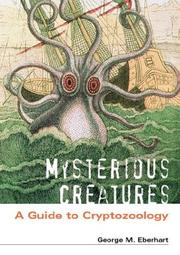
Mysterious Creatures
Includes discussion of mystery canids and African creature reports.
The Lost World of the Kalahari
Explores African wildlife, landscapes and the kinds of animal mysteries that fuel desert creature stories.
eBay marketplace picks
Marketplace Samples
Live-tested eBay searches with available results related to this page.


Endnotes
1.
Source: canids.org
Title: African wild dog | Canids
Link:https://www.canids.org/species/view/African-wild-dog
Source snippet
African wild dog | Canids...
2.
Source: journals.plos.org
Link:https://journals.plos.org/plosone/article?id=10.1371%2Fjournal.pone.0014734
Source snippet
Crocodiles in the Sahara Desert: An Update of Distribution, Habitats and Population Status for Conservation Planning in Mauritania |...
3.
Source: cryptidarchives.fandom.com
Link:https://cryptidarchives.fandom.com/wiki/Adjul%C3%A9
Source snippet
Encyclopaedia of Cryptozoology - FandomThe most recent sighting occured in 1992, when some hunters on the west coast of northern Mauritan...
4.
Source: cryptidz.fandom.com
Title: Cryptid Wiki Adjule
Link:https://cryptidz.fandom.com/wiki/Adjule
Source snippet
Cryptid WikiAdjule - Cryptid Wiki - FandomThe most recent sighting was in 1992 by hunters of a village in Western Mauritania and has not...
5.
Source: mr.chm-cbd.net
Title: Atlantic Coastal Desert | Mauritania Biodiversity
Link:https://mr.chm-cbd.net/en/ecosystems/atlantic-coastal-desert
6.
Source: cambridge.org
Link:https://www.cambridge.org/core/journals/oryx/article/crocodiles-crocodylus-niloticus-as-a-focal-species-for-conserving-water-resources-in-mauritanian-sahara/00910B09701873F01266091E6307BA6A
Source snippet
Cambridge University Press & AssessmentCrocodiles Crocodylus niloticus as a focal species for conserving water resources in Mauritanian S...
7.
Source: rufford.org
Title: conserving desert biodiversity through crocodile based ecotourism in mauritania
Link:https://www.rufford.org/projects/frederico-da-costa-santar%C3%A9m/conserving-desert-biodiversity-through-crocodile-based-ecotourism-in-mauritania/
Source snippet
Frederico da Costa Santarém - Conserving Desert Biodiversity through Crocodile-Based Ecotourism in Mauritania - The Rufford Foundation...
8.
Source: canids.org
Link:https://www.canids.org/species/view/PREKMW872861
9.
Source: canids.org
Title: Jackal and hyaena partitioning
Link:https://canids.org/CBC/19/Jackal_and_hyaena_partitioning.pdf
10.
Source: iucn.org
Link:https://iucn.org/resources/publication/african-wild-dog-status-survey-and-conservation-action-plan
11.
Source: portals.iucn.org
Link:https://portals.iucn.org/library/sites/library/files/documents/1997-052.pdf
12.
Source: portals.iucn.org
Link:https://portals.iucn.org/library/sites/library/files/documents/Rep-2007-002.pdf
13.
Source: cryptidz.fandom.com
Link:https://cryptidz.fandom.com/wiki/Malinda
14.
Source: cryptidarchives.fandom.com
Title: List of sea serpent sightings in the Southern Ocean
Link:https://cryptidarchives.fandom.com/wiki/List_of_sea_serpent_sightings_in_the_Southern_Ocean
15.
Source: itsmth.fandom.com
Link:https://itsmth.fandom.com/wiki/Adjule
16.
Source: cryptid-that-you-saw.fandom.com
Link:https://cryptid-that-you-saw.fandom.com/wiki/Adjul%C3%A9
17.
Source: cryptidarchives.fandom.com
Link:https://cryptidarchives.fandom.com/wiki/Category%3AMauritania
18.
Source: cambridge.org
Link:https://www.cambridge.org/core/journals/oryx/article/rediscovery-of-relict-populations-of-the-nile-crocodile-crocodylus-niloticus-in-southeastern-mauritania-with-observations-on-their-natural-history/3C154D44B987D0C2AF5CAFB52AFC7750
19.
Source: cambridge.org
Link:https://www.cambridge.org/core/journals/oryx/article/conserving-the-african-wild-dog-lycaon-pictus-i-diagnosing-and-treating-causes-of-decline/6EDC64464C537717458E5A91F85B77B8
20.
Source: cambridge.org
Link:https://www.cambridge.org/core/books/nile-basin/west-of-the-nile-the-western-desert-of-egypt-and-the-eastern-sahara-part-2/AC1EFCE591BF9B3EBF9906E52C7B8D0E
21.
Source: ndl.ethernet.edu.et
Link:https://ndl.ethernet.edu.et/bitstream/123456789/46979/1/George%20M.%20Eberhart.pdf
22.
Source: ucm.es
Link:https://www.ucm.es/data/cont/media/www/pag-33468/2008_Oryx_42_292.pdf
Source snippet
Universidad Complutense de MadridS0030605308007850 292..295...
23.
Source: pdfs.semanticscholar.org
Link:https://pdfs.semanticscholar.org/726a/c9e10bb2e596487b753bea2a51221aff8011.pdf
24.
Source: Wikipedia
Link:https://en.wikipedia.org/wiki/Jackal
25.
Source: Wikipedia
Title: Striped hyena
Link:https://en.wikipedia.org/wiki/Striped_hyena
26.
Source: Wikipedia
Title: African wild dog
Link:https://en.wikipedia.org/wiki/African_wild_dog
27.
Source: Wikipedia
Link:https://it.wikipedia.org/wiki/Adjul%C3%A9
28.
Source: ewt.org
Title: African Wild Dog
Link:https://ewt.org/wp-content/uploads/2022/11/26.-African-Wild-Dog-Lycaon-pictus_EN.pdf
29.
Source: exploringed.com
Link:https://exploringed.com/mauritania-where-the-sahara-meets-the-sahel/
Additional References
30.
Source: science.org
Link:https://www.science.org/content/article/museum-accepts-cryptic-collection
31.
Source: science.org
Link:https://www.science.org/content/article/pygmy-crocs-found-sahara-caves
32.
Source: youtube.com
Title: Desert crocodiles (Crocodylus suchus) in Mauritania
Link:https://www.youtube.com/watch?v=TY6AcNdPH34
Source snippet
Desert Survivors: West African Crocodiles Thriving in Saharan Oases...
33.
Source: youtube.com
Title: Crocodiles in the desert?! A journey to southern Mauritania
Link:https://www.youtube.com/watch?v=2r2zO9Hks44
Source snippet
West African crocodile (Crocodylus suchus), Mauritania...
34.
Source: youtube.com
Title: West African crocodile (Crocodylus suchus), Mauritania
Link:https://www.youtube.com/watch?v=6vW71BtmNmg
35.
Source: youtube.com
Title: West African crocodile (Crocodylus suchus)
Link:https://www.youtube.com/watch?v=jAYsowaYCV8
Source snippet
Desert crocodiles (Crocodylus suchus) in Mauritania...
36.
Source: researchgate.net
Link:https://www.researchgate.net/publication/254414245_African_Wild_Dogs_Lycaon_pictus_Can_Subsist_on_Small_Prey_Implications_for_Conservation
37.
Source: researchgate.net
Link:https://www.researchgate.net/publication/231761805_Crocodiles_Crocodylus_niloticus_as_a_focal_species_for_conserving_water_resources_in_Mauritanian_Sahara
38.
Source: researchgate.net
Link:https://www.researchgate.net/publication/248560043_High_hunting_costs_make_African_wild_dog_vulnerable_to_kleptoparasitism_by_hyaenas
39.
Source: researchgate.net
Link:https://www.researchgate.net/publication/50250815_Crocodiles_in_the_Sahara_Desert_An_Update_of_Distribution_Habitats_and_Population_Status_for_Conservation_Planning_in_Mauritania
Topic Tree
Follow this branch
Related pages 192
- Antigua Cryptids
- Maldives Monsters
- Malta Monsters
- Qatar Monsters
- Argentina Monsters
- +187 more in sidebar