The Creatures Behind Thailand's Monster Legends
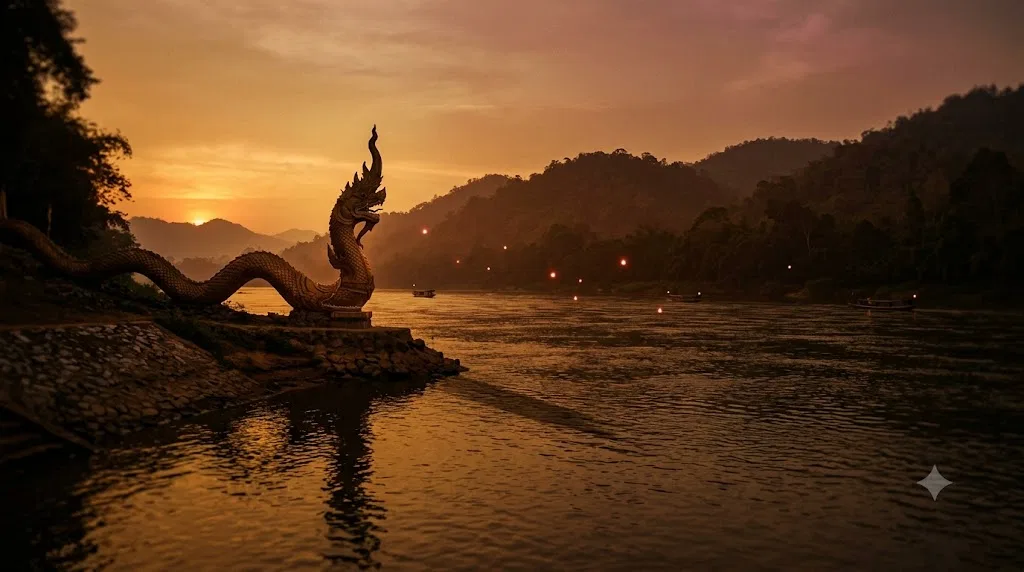
Thailand’s mystery-creature tradition is dominated not by a single flesh-and-blood “lost animal”, but by a powerful overlap of river folklore, real giant wildlife, religious imagery and modern media. The country’s best-known monster figure is the great serpent associated with the Mekong.
Page outline Jump by section
Introduction
Thailand also has jungle beings, enormous snakes, elusive cats and giant fish that can sound cryptozoological even when they are known species. The useful distinction is therefore not simply between “real” and “imaginary”. Some stories are sacred traditions, some are eyewitness claims, some are publicity, and some are ordinary animals made extraordinary by darkness, distance or rarity.
Why the Mekong serpent became Thailand’s defining monster
The great river serpent belongs to a much older religious and cultural tradition than modern cryptozoology. In Buddhist and Hindu art, serpent beings are protectors, water powers and figures connected with sacred authority. Along the Thai Mekong, they are especially associated with rivers, rain, fertility, temples and hidden underwater realms. UNESCO’s description of the Phra That Phanom cultural landscape notes regional traditions in which seven serpents protect the shrine and the Mekong is imagined as their domain.[UNESCO World Heritage Centre]whc.unesco.orgUNESCO World Heritage CentrePhra That Phanom, its related historic buildings and…"Phra That Phanom" is located within the walled compo…
This matters because the serpent is not merely treated as an unidentified animal waiting to be captured. For many believers it is a sacred being whose presence is expressed through landscape, ritual and signs. That gives the tradition a different status from a conventional lake-monster story. A zoological investigation might ask whether an unknown reptile lives in the river; local religious tradition may instead treat the being as supernatural, morally significant and capable of appearing only when it chooses.
The Mekong itself encourages monster stories. It is vast, opaque and ecologically rich, with deep channels, strong currents and some of the world’s largest freshwater fish. A brief glimpse of a surfacing animal, drifting log, current line or large fish can therefore be absorbed into an existing serpent narrative. The legend supplies the shape before the witness has time to identify what was seen.
The fireballs that turned belief into a spectacle
The most famous alleged sign of the river serpent is the annual appearance of reddish lights above the Mekong around the end of Buddhist Lent. Crowds gather particularly in Nong Khai and neighbouring provinces to watch lights said to rise silently from the water. Thailand’s tourism authorities promote the event as one of the country’s major seasonal cultural attractions, showing how a local mystery has become part festival, part pilgrimage and part visitor economy.[TAT Newsroom]tatnews.orgoctober 2025 festivals and events in thailandTAT NewsroomOctober 2025 Festivals and Events in Thailand22 Sept 2025 — Celebrate Thailand's October 2025 with Rap Bua, Naga Fireballs, b…
Accounts commonly describe glowing balls moving upwards before disappearing. The number reported varies widely, and the viewing area extends along a considerable stretch of river rather than a single fixed point. Older reports suggest that the lights were once described more generically as ghost lights; their firm branding as serpent fireballs appears to be a comparatively modern development that strengthened the connection between an ambiguous spectacle and an established religious figure.[Al Jazeera]aljazeera.comAl Jazeera Thailand's natural fireball river | NewsAl JazeeraThailand's natural fireball river | NewsOctober 10, 2003 — 10 Oct 2003 — The event is known as Naga's Fireballs and has been re…
Several explanations compete:
- Combustible river gas. Methane or phosphine produced by decaying organic matter is often proposed, including in tourism coverage. However, the precise mechanism by which gas would ignite spontaneously, rise as a stable bright ball and repeat at festival time remains poorly demonstrated.[TAT Newsroom]tatnews.orgMost famously, in Nong Khai Province, the festival… Thailand Vegetarian Festival 2025 Celebrates Spiritual…Read more…
- Flares or tracer fire. A Thai television investigation in 2002 reported that some lights coincided with shots fired from the Lao side of the river. Later sceptical analysis has likewise argued that at least part of the display may be human-made. Lao authorities have rejected suggestions that unauthorised firing explains every event, particularly during periods of tight security.[Wikipedia]WikipediaNaga fireballNaga fireball
- Misidentified ordinary lights. Distant fireworks, lanterns, boats, reflections and atmospheric effects may account for individual observations, especially when thousands of spectators are scanning a dark horizon with strong expectations.
- A mixed phenomenon. The most cautious conclusion is that “the fireballs” may not have one cause. Some reported lights could be deliberate displays, some distant human activity and others simple visual errors.
No verified specimen, biological trace or repeatable observation links the lights to an unknown animal. Their importance lies elsewhere: they show how folklore can organise an uncertain visual event, while tourism and media give that interpretation a regular date, viewing place and public audience.
Snake rocks, viral photographs and modern monster-making
Thailand’s serpent tradition has also attached itself to landscapes. At Naka Cave in Phu Langka National Park, cracked rock surfaces resemble overlapping scales, while long outcrops can look like the body of a colossal stone snake. Social-media posts have presented the formation as a petrified serpent, but park explanations describe weathering, temperature-driven cracking and erosion rather than fossilised remains.[Medium]shash-wat2206.medium.comThe Legend of the Snake Rock | Khong Long Lake, ThailandThe Legend of the Snake Rock | Khong Long Lake, Thailand
The cave is a good example of a natural formation gaining power from an existing cultural story. Without the serpent tradition, the rock might simply be an unusual geological pattern. Within north-eastern Thailand’s folklore, it can be read as physical confirmation of what people already know from stories, sculpture and ritual.
An even clearer case of modern myth-making is the widely circulated image of uniformed men holding an enormous ribbon-like “serpent”. Souvenir versions claimed that soldiers had captured a queen of the river serpents in Laos during the 1970s. The photograph was actually taken near San Diego in 1996 and shows a stranded oarfish, a real deep-water species whose long, silvery body has probably inspired sea-serpent reports in many parts of the world.[WIRED]wired.comAbsurd Creature of the Week: The 28-Foot Sea MonsterAbsurd Creature of the Week: The 28-Foot Sea Monster
The picture is not a fabricated image; the deception lies in its caption and relocation. That distinction is central to modern cryptid culture. Authentic photographs of unfamiliar animals can be made “mysterious” by changing the date, place and identity. Once the altered version enters shops, social media and tourist storytelling, the false caption may become more memorable than the correction.
The jungle being that behaves more like folklore than zoology
Thailand’s forests have their own anomalous creature tradition: a one-legged or hopping jungle being said to call out repeatedly, attack sleepers and feed from their feet. Descriptions vary sharply. Some versions make it ghostlike, while others give it a monkey-like body, a tubular mouth or the appearance of a small, agile forest animal. The story is also shared with neighbouring Laos, reflecting a regional forest tradition rather than a creature restricted by modern national borders.[Wikipedia]WikipediaKong koiKong koi
From a cryptozoological viewpoint, the inconsistent anatomy is revealing. There is no stable description comparable to that of an alleged unknown ape or cat. The being’s one-legged movement, blood-feeding behaviour and ritual precautions place it more convincingly among supernatural cautionary tales.
Such stories may nevertheless preserve practical forest anxieties. Sleeping outdoors exposes travellers to insects, snakes, rats, leeches and other animals that bite exposed skin. Strange calls carry far at night, and glimpses of monkeys or nocturnal mammals can be badly distorted by poor light. Folklore turns those risks into a memorable predator with rules: where it lives, what it sounds like and how a traveller should protect the body.
Calling the jungle being a “Thai Bigfoot” therefore misses much of its character. It is better understood as a forest spirit with occasional animal-like descriptions, not as a consistent zoological claim supported by tracks, hair, photographs or a sustained sighting record.
Real animals that keep monster stories plausible
Thailand does not need unknown giants to produce startling encounters. Its rivers and forests already contain animals large or elusive enough to look legendary.
The Mekong giant catfish is among the world’s largest freshwater fish. A specimen caught in northern Thailand in 2005 measured about 2.7 metres and weighed roughly 293 kilograms. The species is now extremely rare, and conservation groups report steep population decline linked to fishing pressure, habitat change and barriers to migration.[WWF Panda]wwf.panda.orgOpen source on panda.org.
A fish that large, surfacing briefly in muddy water, could easily produce an exaggerated account. Other Mekong giants, including large stingrays and catfish, reinforce the sense that immense hidden animals remain possible even when no unknown species is involved. The river’s real biodiversity gives serpent stories an ecological stage that feels credible.
Thailand is also home to reticulated pythons, which can reach exceptional lengths. Floods sometimes force large snakes into roads, settlements and open water, producing dramatic videos that are quickly labelled “monsters”. One widely shared 2024 clip from Pattani showed a very large python moving through floodwater with a swollen body; the animal was identifiable despite sensational claims about what it had eaten.[The Sun]thesun.co.ukOpen source on thesun.co.uk.
Elusive wild cats create a different kind of uncertainty. Small species such as the marbled cat, Asian golden cat and flat-headed cat are seldom seen, sometimes remaining undocumented in an area for decades. Camera traps have shown how a supposedly vanished animal can persist without generating frequent human sightings. The flat-headed cat, for example, was photographed again in southern Thailand after a gap of nearly three decades in confirmed national records.[People.com]people.comThe remarkable rediscovery is a collaborative success between Panthera, a global wild cat conservation group, and Thailand's Department o…
These rediscoveries are important but should not be misused. They show that rare known species can escape detection, not that every report of a black panther, giant ape or river monster is probably true. Camera traps, genetic sampling and identifiable photographs are precisely the kinds of evidence that separate zoological rediscovery from folklore.

Where Thailand’s strongest sighting clusters lie
Thailand’s creature traditions cluster around environments that naturally produce uncertainty.
The north-eastern Mekong corridor is the main centre of serpent belief, fireball watching and related festivals. Nong Khai, Bueng Kan and Nakhon Phanom combine strong religious traditions, wide river views, borderland culture and established tourism.
Caves and forested uplands provide settings for snake-shaped geology, spirit stories and ambiguous animal encounters. Dense vegetation reduces viewing distance, while darkness and echoing calls can make ordinary wildlife difficult to identify.
Southern wetlands and monsoon flood zones generate encounters with displaced pythons, crocodiles, monitor lizards and rare cats. In photographs stripped of scale or location, these animals can appear far larger or stranger than they are.
The Andaman Sea and Gulf coast offer the conditions for sea-serpent rumours: floating carcasses, whales, large fish, nets, debris and occasional deep-sea species. Yet Thailand has no comparably well-documented, long-running sea-monster case matching the fame of the Mekong serpent. Much online material simply imports general oarfish and sea-serpent lore into a Thai setting.
How to judge a Thai monster claim
Thailand’s mystery-animal stories are easiest to understand when four categories are kept separate.
Sacred folklore includes serpent guardians and jungle spirits whose meaning is religious, moral or cultural. Demanding a carcass misunderstands the tradition, but presenting it as zoological evidence is equally misleading.
Eyewitness claims are reports of unusual animals or lights. They may be sincere while still being mistaken. Useful accounts need a clear location, time, duration, viewing distance and description recorded before media retelling changes the story.
Media and tourism narratives package mysteries for an audience. Festivals, souvenir photographs and viral posts do not automatically invalidate a tradition, but they create incentives to simplify uncertainty into a recognisable monster.
Biological evidence includes identifiable remains, repeated camera-trap images, genetic material and expert examination. Thailand’s rare-cat rediscoveries and giant-fish records meet this standard. The Mekong serpent does not.
The most likely explanations for many reports are large known snakes, giant fish, rare cats, floating objects, distant lights, geological resemblance and altered captions. None removes the cultural value of the stories. It simply places the wonder in the right location: not in proof of a hidden monster, but in the way Thailand’s rivers, forests, wildlife and religious imagination continually reshape one another.
What the legend has become
Thailand’s creature lore has moved through several overlapping stages. Ancient serpent symbolism became local river tradition; ambiguous lights became an annual public spectacle; unusual rocks became viral “fossils”; and genuine animals such as oarfish, pythons and giant catfish were repeatedly recruited as visual proof.
The result is a monster tradition that is less about hunting one undiscovered species than about negotiating different kinds of truth. A serpent may be sacred without being zoological. A witness may be honest without being correct. A photograph may be genuine while its caption is false. A rare animal may seem mythical until a camera trap records it.
That mixture explains why Thailand’s monster stories endure. They are attached to places where visibility is poor, wildlife can be astonishing and older beliefs remain culturally alive. The river serpent survives not because science has confirmed it, but because landscape, ritual, tourism and real animal encounters continue to give the story new forms.
Amazon book picks
Further Reading
Books and field guides related to What Really Lurks Behind Thailand's Monster Legends?. Use these as the next step if you want deeper reading beyond the article.
The Serpent and the Rainbow
Examines how legends and extraordinary claims emerge from culture and lived experience.
The Book of Yokai
Shows how supernatural beings develop within Asian cultural landscapes.
eBay marketplace picks
Marketplace Samples
Live-tested eBay searches with available results related to this page.



Endnotes
1.
Source: whc.unesco.org
Link:https://whc.unesco.org/en/tentativelists/6183/
Source snippet
UNESCO World Heritage CentrePhra That Phanom, its related historic buildings and..."Phra That Phanom" is located within the walled compo...
2.
Source: Wikipedia
Title: Naga fireball
Link:https://en.wikipedia.org/wiki/Naga_fireball
3.
Source: shash-wat2206.medium.com
Title: The Legend of the Snake Rock | Khong Long Lake, Thailand
Link:https://shash-wat2206.medium.com/the-legend-of-the-snake-rock-khong-long-lake-thailand-9da7492b1f38?source=follow_footer———1—————————-
4.
Source: wired.com
Title: Absurd Creature of the Week: The 28-Foot Sea Monster
Link:https://www.wired.com/2014/03/absurd-creature-week-oarfish/
6.
Source: Wikipedia
Title: Kong koi
Link:https://en.wikipedia.org/wiki/Kong_koi
7.
Source: wwf.panda.org
Link:https://wwf.panda.org/wwf_offices/laos/projects/?uProjectID=9S0790
8.
Source: wwf.panda.org
Link:https://wwf.panda.org/discover/our_focus/wildlife_practice/profiles/fish_marine/giant_catfish
9.
Source: wwf.panda.org
Link:https://wwf.panda.org/es/?120600%2FWhat-a-catch=
10.
Source: wwf.panda.org
Title: wwf news
Link:https://wwf.panda.org/wwf_news/?167421%2FGovernments-take-action-to-protect-Mekong-giant=
11.
Source: people.com
Link:https://people.com/shocking-photos-reveal-rare-flat-headed-cats-have-returned-after-29-year-disappearance-11872542
Source snippet
The remarkable rediscovery is a collaborative success between Panthera, a global wild cat conservation group, and Thailand's Department o...
12.
Source: media.unesco.org
Link:https://media.unesco.org/sites/default/files/webform/mow001/56_143%252B.pdf
13.
Source: whc.unesco.org
Link:https://whc.unesco.org/en/list/479/
14.
Source: unesdoc.unesco.org
Link:https://unesdoc.unesco.org/ark%3A/48223/pf0000391069
15.
Source: unesdoc.unesco.org
Link:https://unesdoc.unesco.org/ark%3A/48223/pf0000374205
16.
Source: unesdoc.unesco.org
Link:https://unesdoc.unesco.org/ark%3A/48223/pf0000126698
17.
Source: unesdoc.unesco.org
Link:https://unesdoc.unesco.org/ark%3A/48223/pf0000233686
18.
Source: unesdoc.unesco.org
Link:https://unesdoc.unesco.org/ark%3A/48223/pf0000221077
19.
Source: unesdoc.unesco.org
Link:https://unesdoc.unesco.org/ark%3A/48223/pf0000068910
20.
Source: unesdoc.unesco.org
Link:https://unesdoc.unesco.org/ark%3A/48223/pf0000215119
21.
Source: wwf.panda.org
Link:https://wwf.panda.org/es/?21459%2FGiant-catfish-released-in-the-Mekong=
22.
Source: wwf.panda.org
Link:https://wwf.panda.org/es/?208993%2FDams-could-signal-death-knell-for-Mekong-giant-catfish-th=
23.
Source: wwf.panda.org
Link:https://wwf.panda.org/es/?204330%2FUS-Embassy-Supports-WWF-Efforts-to-Track-the-Mekong-Giant-Catfish=
24.
Source: wwf.panda.org
Link:https://wwf.panda.org/es/?254530%2FSearching-for-the-Mekong-Giant-Catfish-eDNA-reveals-fish-biodiversity-in-the-Mekong-River=
25.
Source: wwf.panda.org
Link:https://wwf.panda.org/es/?194341%2FMekong-dams-threaten-rare-giant-fish=
26.
Source: wwf.panda.org
Title: wwf news
Link:https://wwf.panda.org/wwf_news/?195618%2FMother-Mekong=
27.
Source: Wikipedia
Link:https://en.wikipedia.org/wiki/N%C4%81ga
28.
Source: Wikipedia
Link:https://en.wikipedia.org/wiki/Cryptozoology
29.
Source: Wikipedia
Title: List of lake monsters
Link:https://en.wikipedia.org/wiki/List_of_lake_monsters
30.
Source: Wikipedia
Link:https://en.wikipedia.org/wiki/Oarfish
31.
Source: Wikipedia
Title: Bukit Timah Monkey Man
Link:https://en.wikipedia.org/wiki/Bukit_Timah_Monkey_Man
32.
Source: medium.com
Link:https://medium.com/%40LoveNature/this-rationale-cryptozoologist-explains-why-mythical-creatures-could-legitimately-exist-56b722516155
33.
Source: medium.com
Title: Strange Findings: 100 Foot Giant Congo Snake?
Link:https://medium.com/%40kelseylyleke/strange-findings-100-foot-giant-congo-snake-e1ad18375b8b
34.
Source: tatnews.org
Title: october 2025 festivals and events in thailand
Link:https://www.tatnews.org/2025/09/october-2025-festivals-and-events-in-thailand/
Source snippet
TAT NewsroomOctober 2025 Festivals and Events in Thailand22 Sept 2025 — Celebrate Thailand's October 2025 with Rap Bua, Naga Fireballs, b...
Published: october 2025
35.
Source: tatnews.org
Link:https://www.tatnews.org/2025/10/have-some-faith-end-of-lent-festivals-in-thailand-take-travellers-on-a-once-a-year-spiritual-journey/
Source snippet
Most famously, in Nong Khai Province, the festival... Thailand Vegetarian Festival 2025 Celebrates Spiritual...Read more...
36.
Source: tatnews.org
Title: ok phansa or end of buddhist lent day 2023
Link:https://www.tatnews.org/2023/10/ok-phansa-or-end-of-buddhist-lent-day-2023/
Source snippet
Nong Han Reservoir. Naga Fireball World Festival, Nong Khai 29 October 2023. The Naga statues plaza by the Mekong River in Mueang Distric...
Published: October 2023
37.
Source: aljazeera.com
Title: Al Jazeera Thailand’s natural fireball river | News
Link:https://www.aljazeera.com/news/2003/10/10/thailands-natural-fireball-river
Source snippet
Al JazeeraThailand's natural fireball river | NewsOctober 10, 2003 — 10 Oct 2003 — The event is known as Naga's Fireballs and has been re...
Published: October 10, 2003
38.
Source: thesun.co.uk
Link:https://www.thesun.co.uk/news/32122635/gigantic-python-floodwater-thailand/
39.
Source: tatnews.org
Link:https://www.tatnews.org/2019/01/experience-thai-traditions-and-cultural-values-in-thailands-annual-events-and-festivals/
40.
Source: tatnews.org
Title: thailand travel mart plus ttm 2024 opens for registration
Link:https://www.tatnews.org/2024/02/thailand-travel-mart-plus-ttm-2024-opens-for-registration/
Additional References
41.
Source: skeptoid.com
Link:https://skeptoid.com/episodes/183
Source snippet
The Naga FireballsVirtually any article you read about the Naga Fireballs offers the same "scientific" explanation, which in fact...
42.
Source: youtube.com
Title: Investigating the THAI serpent PHAYA NAK in 5.04 minutes!
Link:https://www.youtube.com/watch?v=uhKX9LmXEZE
Source snippet
Thailand's mysterious Fireball Festival on the Mekong River...
43.
Source: youtube.com
Title: Mysterious serpent, Famous Monsters of Thailand, part 3
Link:https://www.youtube.com/watch?v=b179WV0QwVw
Source snippet
Investigating the THAI serpent PHAYA NAK in 5.04 minutes...
44.
Source: youtube.com
Title: The Sacred Serpent of the Mekong: Unveiling the Phaya Naga
Link:https://www.youtube.com/watch?v=vIk6dhmetKY
Source snippet
Phaya Naga: Serpents of the Mekong River...
45.
Source: academia.edu
Link:https://www.academia.edu/44839352/Giant_Petrified_Snake_at_Naka_Cave_Thailand
46.
Source: instagram.com
Link:https://www.instagram.com/reel/DMvvruUx21k/?hl=en
47.
Source: pinterest.com
Link:https://www.pinterest.com/ideas/cambodian-mythical-creatures/907605462897/
48.
Source: instagram.com
Link:https://www.instagram.com/p/DWQMDhZjSeL/
49.
Source: reddit.com
Link:https://www.reddit.com/r/laos/comments/1lv8r7m/does_anyone_elses_family_have_stories_about_the/
50.
Source: facebook.com
Link:https://www.facebook.com/10NewsSyd/videos/black-panther-folklore-fact-or-fiction/632300370751064/
Topic Tree
Follow this branch
Related pages 192
- Antigua Cryptids
- Maldives Monsters
- Malta Monsters
- Qatar Monsters
- Argentina Monsters
- +187 more in sidebar