Within Paraguay Monsters
How Did Paraguay's Seven Monsters Take Shape?
Paraguay's seven monsters form a vivid bestiary shaped by Guarani tradition, literary retelling and later influences from Europe and neighbouring countries.
On this page
- Tau, Kerana and the seven sons
- How literature fixed changing traditions
- Hybrid beasts, werewolves and cultural borrowing
Page outline Jump by section
Introduction
Paraguay’s famous “seven monsters” are often presented as a fixed set of ancient beings, but their modern form is the result of centuries of storytelling, reinterpretation and literary reshaping. Today they are usually listed as Teju Jagua, Mboi Tu’i, Monai, Jasy Jatere, Kurupi, Ao Ao and Luison, the seven cursed children of Tau and Kerana. Yet the idea that these creatures belong to one neatly organised family is itself part of the story. Oral traditions varied across regions and communities before twentieth-century writers helped standardise them into the version now taught in schools, retold in tourism materials and reproduced across popular culture.[wikipedia.org]WikipediaGuarani mythologyMarch 23, 2026 — The seven sons of Tau and Kerana are, in order of their births: Teju Jagua, god or spirit of caverns and fruits; Mbói Tu…
The seven monsters remain central to Paraguayan folklore because they combine warnings about nature, social behaviour and danger with memorable animal imagery. Their legends have not stood still. Some acquired new meanings through contact with European folklore, some became less frightening as rural life changed, and others shifted from local cautionary tales into national symbols.[asunciontimes.com]asunciontimes.comThe Asunción TimesSeven Monstrous Brothers: Exploring The Heart Of Guaraní…Aug 3, 2025 — Among the best‑known figures in Guaraní mytho…
Tau, Kerana and the Seven Sons
The best-known modern version begins with Tau, a destructive spirit associated with evil or chaos, and Kerana, a celebrated young woman whose beauty attracted him. After their union, the sky goddess Arasy cursed their offspring. The resulting seven children were born with monstrous or supernatural characteristics and became powerful figures in Guarani mythology.[wikipedia.org]WikipediaTau (mythologyMay 7, 2026 — Whichever the case, the product of Tau and Kerana's intercourse was seven children who were cursed by the goddess Arasy and…
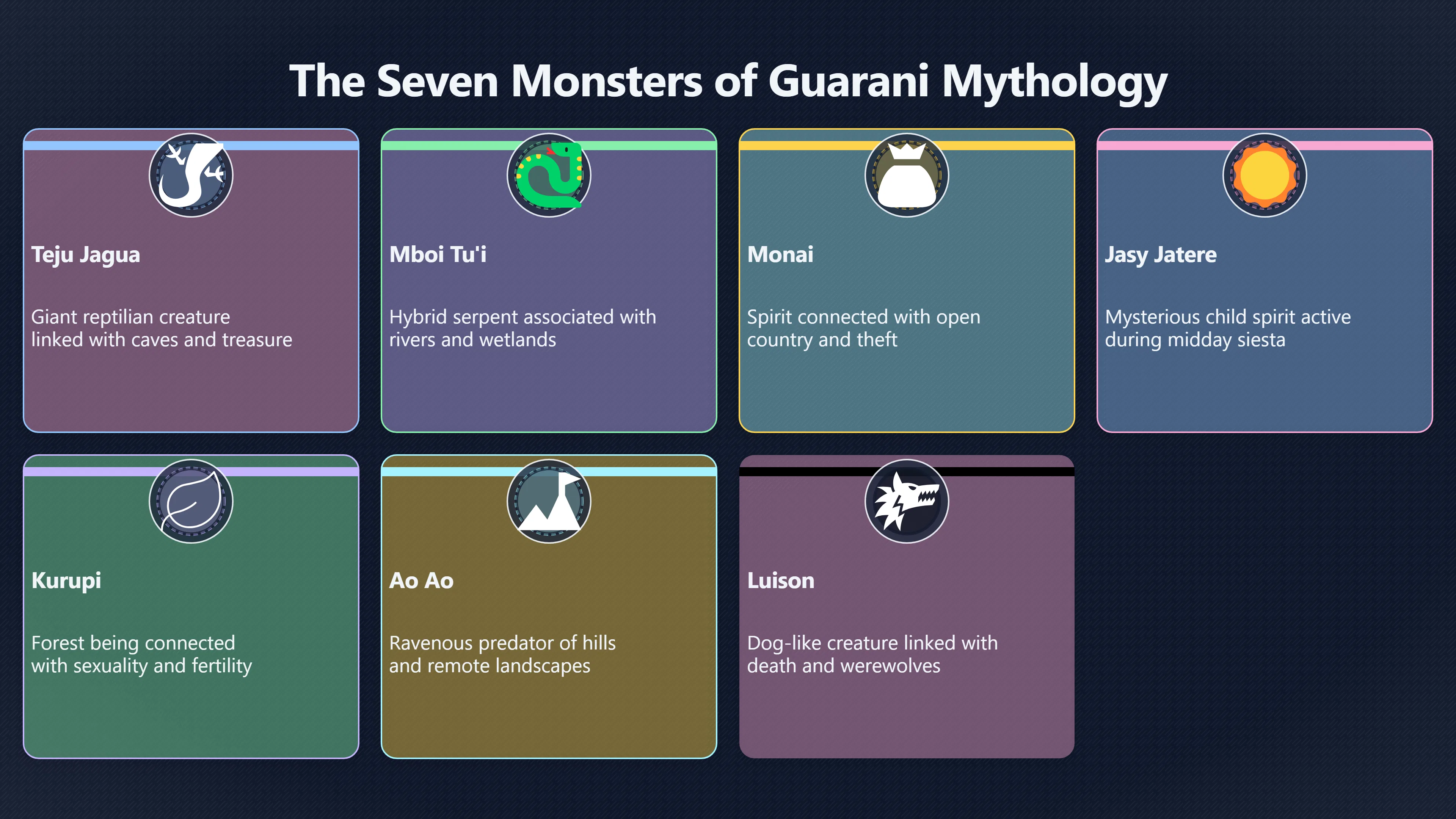
In the version most widely repeated today, the brothers appear in this order:
- Teju Jagua, a giant reptilian creature linked with caves, treasure and fruit.[Wikipedia]WikipediaTeju JaguaTeju Jagua
- Mboi Tu’i, a hybrid serpent associated with rivers, wetlands and aquatic life.
- Monai, connected with open country, theft and disorder.
- Jasy Jatere, a mysterious child spirit associated with the midday siesta.
- Kurupi, a forest being connected with sexuality and fertility.
- Ao Ao, a ravenous predator of hills and remote landscapes.
- Luison, a dog-like creature linked with death and later werewolf traditions.[Wikipedia]WikipediaGuarani mythologyMarch 23, 2026 — The seven sons of Tau and Kerana are, in order of their births: Teju Jagua, god or spirit of caverns and fruits; Mbói Tu…
What is often overlooked is that this orderly sequence reflects a literary tradition as much as an oral one. Earlier folklore was not necessarily organised into a single family tree with a universally agreed list. Different communities emphasised different beings, and some creatures were more important in one area than another.[Encyclopedia.com]encyclopedia.comcolman narcisoColmán, Narciso (1876–1954)Narciso Colmán (b. 1876; d. 1954), Paraguayan poet and anthologist. Born in poor circumstances in the interior…
How Literature Fixed Changing Traditions
One of the most important turning points came with the work of Paraguayan writer Narciso R. Colmán, known as Rosicrán. His influential mythological poem Ñande Ypykuéra (“Our Ancestors”), published in 1929, assembled Guarani traditions into a connected narrative that became enormously influential in later retellings.[portalguarani.com]portalguarani.comGuaraní PortalNUESTROS ANTEPASADOS (ÑANDE YPY KUÉRA)NUESTROS ANTEPASADOS (ÑANDE YPY KUÉRA). Poema mitológico de NARCISO R. COLMÁN. San Lo…
Colmán did not invent the creatures. Many already existed in oral tradition. However, by placing them within a single genealogical framework and presenting them as the seven sons of Tau and Kerana, he helped create what many modern Paraguayans recognise as the standard mythology. Later books, school materials and popular summaries often followed this structure closely.[fandom.com]religion.fandom.comReligion Wiki Guaraní mythologyReligion Wiki Guaraní mythology
This process illustrates a common pattern in folklore. Oral traditions tend to be flexible, with local variations and contradictions. Once a respected written account becomes widely circulated, those variations can become less visible. Readers begin to treat one version as the original even when it represents only one stage in a longer evolution.[Encyclopedia.com]encyclopedia.comcolman narcisoColmán, Narciso (1876–1954)Narciso Colmán (b. 1876; d. 1954), Paraguayan poet and anthologist. Born in poor circumstances in the interior…
As a result, the seven monsters are simultaneously ancient and modern. Their roots lie in older Guarani storytelling, but the familiar package in which they appear today owes much to twentieth-century literary organisation.[Wikipedia]WikipediaNarciso Ramón ColmánNarciso Ramón Colmán

Why the Monsters Changed
The creatures did not all change in the same way. Each absorbed different social fears, environmental concerns and outside influences.
From landscape spirits to symbolic monsters
Several figures appear to have begun as explanations for the dangers of particular environments. Teju Jagua became associated with caves and hidden places. Mboi Tu’i reflected the risks of wetlands and waterways. Ao Ao embodied the fear of becoming lost or attacked in remote terrain. Over time these place-based warnings became more elaborate monster stories.[Wikipedia]WikipediaTeju JaguaTeju Jagua
From moral lessons to national folklore
Monai and Kurupi often served social functions. Stories about theft, temptation, sexual danger or improper behaviour could be framed through supernatural characters. In modern Paraguay these figures increasingly appear in children’s books, festivals, comics and cultural education rather than as literal explanations for everyday events.[Wikipedia]WikipediaOpen source on wikipedia.org.
From feared beings to cultural icons
Many people today recognise the monsters as part of Paraguayan identity even if they do not believe the creatures exist. The legends now function as heritage symbols, appearing in literature, art, tourism campaigns and contemporary storytelling.[The Asunción Times]asunciontimes.comthe myths we carry monsters memory and paraguayan versethe myths we carry monsters memory and paraguayan verse
Hybrid Beasts, Werewolves and Cultural Borrowing
The seven monsters are often described as purely Indigenous creations, but their present forms also reveal centuries of cultural exchange.
The clearest example is Luison. In older Guarani tradition he was already a fearsome dog-like being associated with death. However, over time his legend absorbed features from European werewolf traditions brought by Spanish and other settlers. The idea that the seventh son in a family might become a monster strongly resembles the werewolf and lobizón traditions found elsewhere in South America. Modern descriptions frequently portray Luison as Paraguay’s equivalent of a werewolf rather than simply a spirit of death.[Wikipedia]WikipediaOpen source on wikipedia.org.
Jasy Jatere also shows signs of adaptation. Unlike his brothers, he is often portrayed not as a beast but as a mysterious fair-haired child who wanders during the midday heat. The image differs noticeably from many Indigenous spirit traditions and has long attracted discussion about European influence and changing cultural ideals. Modern retellings often emphasise his appearance and child-snatching role more strongly than older references did.[Myth and Folklore]mythus.fandom.comMyth and Folklore Jaci JaterêMyth and Folklore Jaci Jaterê
Even creatures with clearly Indigenous roots gained new details as stories moved between Paraguay, Argentina, Brazil and neighbouring regions. Folklore is rarely isolated; it absorbs ideas from migration, religion, literature and popular entertainment.[Wikipedia]WikipediaOpen source on wikipedia.org.

Why These Seven Survived
Many supernatural beings appear in Guarani tradition, yet these seven achieved exceptional prominence. One reason is narrative convenience. A group of seven siblings is easier to remember than dozens of unrelated spirits. Another is symbolism. Each monster occupies a distinct niche—forest, water, caves, mountains, sexuality, death or social disorder—creating a complete mythical map of dangers and taboos.[Wikipedia]WikipediaGuarani mythologyMarch 23, 2026 — The seven sons of Tau and Kerana are, in order of their births: Teju Jagua, god or spirit of caverns and fruits; Mbói Tu…
The literary influence of Ñande Ypykuéra helped preserve them as a coherent set, while schools, newspapers and later mass media repeated the same framework. As a result, the seven monsters became some of the most recognisable figures in Paraguayan folklore, surviving cultural change that caused many lesser-known legends to fade from public memory.[portalguarani.com]portalguarani.comGuaraní PortalNUESTROS ANTEPASADOS (ÑANDE YPY KUÉRA)NUESTROS ANTEPASADOS (ÑANDE YPY KUÉRA). Poema mitológico de NARCISO R. COLMÁN. San Lo…
Today, the seven monsters are best understood not as a frozen relic from the distant past but as living folklore. Their stories reveal how traditions evolve: local spirits become national symbols, oral tales become literary canon, and ancient fears adapt to new generations without disappearing entirely.[asunciontimes.com]asunciontimes.comThe Asunción TimesSeven Monstrous Brothers: Exploring The Heart Of Guaraní…Aug 3, 2025 — Among the best‑known figures in Guaraní mytho…
Amazon book picks
Further Reading
Books and field guides related to How Did Paraguay's Seven Monsters Take Shape?. Use these as the next step if you want deeper reading beyond the article.
South American Mythology
Places the seven monsters within broader South American folklore.
eBay marketplace picks
Marketplace Samples
Live-tested eBay searches with available results related to this page.

Endnotes
1.
Source: Wikipedia
Title: Guarani mythology
Link:https://en.wikipedia.org/wiki/Guarani_mythology
Source snippet
March 23, 2026 — The seven sons of Tau and Kerana are, in order of their births: Teju Jagua, god or spirit of caverns and fruits; Mbói Tu...
Published: March 23, 2026
2.
Source: encyclopedia.com
Title: colman narciso 1876 1954
Link:https://www.encyclopedia.com/humanities/encyclopedias-almanacs-transcripts-and-maps/colman-narciso
Source snippet
Colmán, Narciso (1876–1954)Narciso Colmán (b. 1876; d. 1954), Paraguayan poet and anthologist. Born in poor circumstances in the interior...
3.
Source: Wikipedia
Link:https://en.wikipedia.org/wiki/Kurupi
4.
Source: Wikipedia
Link:https://en.wikipedia.org/wiki/Luison
5.
Source: Wikipedia
Title: Tau (mythology)
Link:https://en.wikipedia.org/wiki/Tau_%28mythology%29
Source snippet
May 7, 2026 — Whichever the case, the product of Tau and Kerana's intercourse was seven children who were cursed by the goddess Arasy and...
Published: May 7, 2026
6.
Source: Wikipedia
Title: Mitología guaraní
Link:https://es.wikipedia.org/wiki/Mitolog%C3%ADa_guaran%C3%AD
7.
Source: Wikipedia
Title: Teju Jagua
Link:https://en.wikipedia.org/wiki/Teju_Jagua
8.
Source: Wikipedia
Title: Narciso Ramón Colmán
Link:https://es.wikipedia.org/wiki/Narciso_Ram%C3%B3n_Colm%C3%A1n
9.
Source: Wikipedia
Title: Narciso Rodriguez
Link:https://en.wikipedia.org/wiki/Narciso_Rodriguez
10.
Source: youtube.com
Title: Myths and Legends from BRAZILIAN FOLKLORE
Link:https://www.youtube.com/watch?v=UeqJ9BqIqBw
Source snippet
Jasy Jatere...
11.
Source: youtube.com
Title: Jasy Jatere
Link:https://www.youtube.com/watch?v=_4FRp7yO3wo
12.
Source: portalguarani.com
Link:https://www.portalguarani.com/376_narciso_ramon_colman_rosicran__/10966_nuestros_antepasados_nande_ypy_kuera__obra_de_narciso_r_colman.html
Source snippet
Guaraní PortalNUESTROS ANTEPASADOS (ÑANDE YPY KUÉRA)NUESTROS ANTEPASADOS (ÑANDE YPY KUÉRA). Poema mitológico de NARCISO R. COLMÁN. San Lo...
13.
Source: asunciontimes.com
Link:https://asunciontimes.com/culture/paraguayan-history/seven-monstrous-brothers-exploring-the-heart-of-guarani-mythology/
Source snippet
The Asunción TimesSeven Monstrous Brothers: Exploring The Heart Of Guaraní...Aug 3, 2025 — Among the best‑known figures in Guaraní mytho...
14.
Source: asunciontimes.com
Link:https://asunciontimes.com/culture/paraguayan-history/the-curse-of-tau-and-kerana-the-genesis-of-the-guarani-monsters/
Source snippet
The Asunción TimesGuaraní Legends #2, The Curse Of Tau And Kerana16 Mar 2026 — Every child born to Tau and Kerana would be a “sietemesino...
15.
Source: religion.fandom.com
Title: Religion Wiki Guaraní mythology
Link:https://religion.fandom.com/wiki/Guaran%C3%AD_mythology
16.
Source: asunciontimes.com
Title: the myths we carry monsters memory and paraguayan verse
Link:https://asunciontimes.com/culture/literature/the-myths-we-carry-monsters-memory-and-paraguayan-verse/
17.
Source: mythus.fandom.com
Title: Myth and Folklore Jaci Jaterê
Link:https://mythus.fandom.com/wiki/Jaci_Jater%C3%AA
18.
Source: lafrankie.wordpress.com
Title: guarani mythology
Link:https://lafrankie.wordpress.com/2013/12/16/guarani-mythology/
19.
Source: mythus.fandom.com
Link:https://mythus.fandom.com/wiki/Kerana
Additional References
20.
Source: youtube.com
Title: GUARANI MYTHOLOGY: The Curse of Tau and Kerana and Their Demonic Children
Link:https://www.youtube.com/watch?v=oCqkfdasiZk
Source snippet
The Half-Snake, Half-Parrot Monster of Guarani Mythology...
21.
Source: youtube.com
Title: The Half-Snake, Half-Parrot Monster of Guarani Mythology
Link:https://www.youtube.com/watch?v=nLoyv7bPFZk
Source snippet
Kurupí: The terrifying creature that lurks in the Guarani jungle...
22.
Source: youtube.com
Title: Kurupí: The terrifying creature that lurks in the Guarani jungle
Link:https://www.youtube.com/watch?v=GYNOvU-3ShA
Source snippet
Myths and Legends from BRAZILIAN FOLKLORE...
23.
Source: facebook.com
Link:https://www.facebook.com/TrompoPy/posts/7-mitos-guaran%C3%ADes-los-hijos-de-tau-y-kerana-es-una-obra-inspirada-en-los-mitos-y/3414872131898400/
24.
Source: scribd.com
Link:https://www.scribd.com/document/969554230/THE-7-MYTHS-OF-PARAGUAY
25.
Source: facebook.com
Link:https://www.facebook.com/groups/1627487000825176/posts/2119875941586277/
26.
Source: instagram.com
Link:https://www.instagram.com/p/DV8PEp1DCKz/
27.
Source: narcisorodriguezparfums.com
Link:https://www.narcisorodriguezparfums.com/en
28.
Source: perfumesociety.org
Link:https://perfumesociety.org/perfume-house/narciso-rodriguez/
29.
Source: facebook.com
Link:https://www.facebook.com/yunaxdilus/posts/tau-and-kerana-are-a-cursed-couple-from-guaran%C3%AD-mythology-they-had-7-children-an/1023129146482641/
Topic Tree