Within Denmark Monsters
Why Does Denmark Have a Death Horse?
The three-legged Helhest turns Danish fears about burial, illness, and consecrated ground into a hoofed churchyard legend.
On this page
- The three legged horse in Danish folklore
- Roskilde and Aarhus churchyard traditions
- Death omens, buried animals, and local memory
Page outline Jump by section
Introduction
Among Denmark’s strangest legendary creatures, the Helhest is not a monster lurking in forests or lakes. It is a death horse: a spectral, usually three-legged animal said to haunt churchyards, cathedral precincts, and burial grounds. Unlike many famous cryptid traditions, the Helhest belongs firmly to the world of folklore rather than eyewitness mystery-animal reports. Yet it remains one of Denmark’s most distinctive supernatural creatures because it connects death, disease, burial customs, and local church history into a single memorable image. According to Danish tradition, seeing the Helhest could foretell illness or death, while some stories claimed that every churchyard once concealed a buried horse whose restless spirit later returned as this ominous apparition.[Wikipedia]WikipediaOpen source on wikipedia.org.
The legend is especially associated with historic church centres such as Roskilde and Aarhus, where local traditions preserved specific places and stories linked to the death horse long after belief in the creature had faded. In Denmark’s folklore landscape, the Helhest demonstrates how fears about mortality often gathered around churches and graves rather than around remote wilderness.
Why Does Denmark Have a Death Horse?
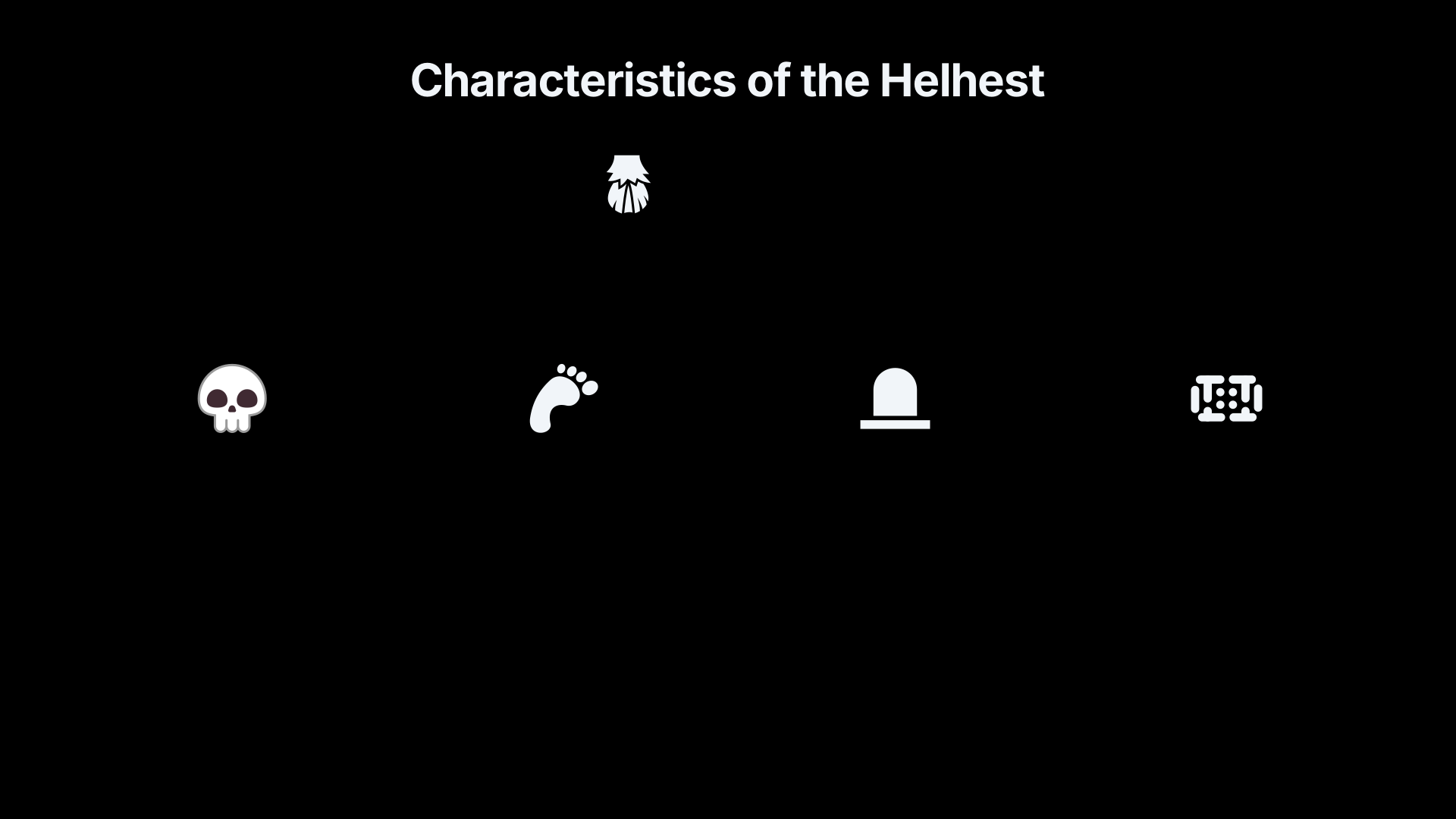
The name “Helhest” literally means “Hel horse”, linking the creature to Hel, the realm of the dead in Nordic tradition. Folklore collectors of the nineteenth century recorded the Helhest as a supernatural horse associated with death, plague, illness, and graveyards. It was commonly described as having only three legs and producing a distinctive heavy tread as it moved through churchyards at night. Anyone who saw it was thought to be in danger of dying soon, or to receive news of a death among family or neighbours.[Wikipedia]WikipediaOpen source on wikipedia.org.
The creature occupies an unusual position between pre-Christian and Christian beliefs. Some folklorists suggested that the Helhest preserved fragments of older Nordic ideas about the underworld and death spirits, while later generations reimagined it as a ghostly churchyard guardian or a servant of Death itself. The result was a figure that felt ancient yet remained rooted in the everyday landscape of Danish villages and towns.[Wikipedia]WikipediaOpen source on wikipedia.org.
For modern readers, the Helhest is less a hidden animal than a symbolic creature. It explained sudden deaths, outbreaks of disease, and the unsettling feeling that churchyards occupied a boundary between the living and the dead.
The Three-Legged Horse in Danish Folklore
The most striking feature of the Helhest is its missing leg. Folklore sources consistently describe it as three-legged, making it instantly recognisable and separating it from ordinary ghost horses. The explanation for this unusual appearance varies from story to story.
One tradition claimed that the Helhest originated from a horse buried alive in a churchyard before the first human burial took place there. According to the legend, the animal later returned as a ghostly guardian of the cemetery. In some retellings, the horse’s damaged or missing leg reflected the burial ritual itself or symbolised its unnatural state between life and death.[Wikipedia]WikipediaOpen source on wikipedia.org.
Folklore also connected the Helhest to epidemics. In parts of the old duchy of Schleswig, traditions held that during times of plague, Death or Hel rode through the countryside on a three-legged horse spreading sickness and destruction. Such stories transformed disease into something visible and understandable: instead of an invisible infection, people imagined a terrifying rider travelling the roads by night.[Wikipedia]WikipediaOpen source on wikipedia.org.
Descriptions varied, but many portrayals emphasised an emaciated appearance, glowing eyes, and an unnaturally silent or heavy gait. Later retellings often made the creature increasingly dramatic, turning it into a skeletal death horse similar to figures found elsewhere in European folklore.[Atlas Obscura]atlasobscura.comgrave of the hel horse roskildeAtlas ObscuraGrave of the Hel-Horse in Roskilde10 Jun 2024 — Danish folklore describes it as emaciated like a skeleton, with red glowing…
Roskilde and Aarhus Churchyard Traditions
What makes the Helhest particularly interesting is that the legend became attached to specific Danish locations rather than remaining a purely abstract folk belief.
Roskilde’s buried horse
At the great cathedral in Roskilde, a long-standing tradition claimed that a Helhest was buried beneath a narrow stone near the church. For generations, passers-by reportedly spat on the stone for protection. The custom was not an act of disrespect toward the cathedral but a folk precaution against the supernatural danger associated with the buried horse. The story survived well into modern times and remains one of the best-known Helhest traditions in Denmark.[Wikipedia]WikipediaOpen source on wikipedia.org.
The persistence of this local custom is important because it shows how folklore can become anchored to a physical place. Visitors could point to a specific stone and connect a legendary creature directly to the landscape around them.

The Aarhus Cathedral sighting
A famous tale linked to Aarhus Cathedral tells of a man who noticed a strange horse outside near the churchyard. When someone suggested it might be the Helhest, he went to look more closely. Witnesses said he turned pale with shock after seeing it. He refused to describe what he had seen, soon became ill, and later died.[Wikipedia]WikipediaOpen source on wikipedia.org.
From a modern perspective, the story functions as a classic death-omen narrative. The important point is not whether a ghost horse appeared, but that seeing it supposedly marked the beginning of an unavoidable fate. Similar omen legends occur throughout Europe, yet the Danish version is distinctive because the warning arrives in the form of a churchyard horse rather than a ghostly human figure.
Death Omens, Buried Animals, and Local Memory
The Helhest legend reflects several older beliefs that were once widespread across northern Europe.
One was the idea that newly established churchyards required supernatural protection. In Danish tradition, animals could be buried beneath church grounds, and later folklore imagined these buried creatures continuing to guard the cemetery after death. The Helhest became one expression of that belief.[Wikipedia]WikipediaOpen source on wikipedia.org.
Another theme was the use of omens to explain unexpected tragedy. Before modern medicine, disease outbreaks and sudden deaths often seemed mysterious. A supernatural messenger offered a way to make sense of events that otherwise felt random. The Helhest therefore served both as a warning sign and as an explanation after the fact: if someone died unexpectedly, people might remember having heard strange hoofbeats or having seen an unusual horse near the churchyard.[Wikipedia]WikipediaOpen source on wikipedia.org.
The creature also reveals how Danish folklore differs from many modern cryptid traditions. Rather than describing an undiscovered animal species, Helhest stories centre on ritual, belief, and community memory. The horse exists because people attached meaning to churches, graves, and the transition between life and death.
Is There Any Evidence Beyond Folklore?
Unlike lake monsters or mystery-animal sightings that generate periodic modern reports, the Helhest has no body of contemporary eyewitness evidence suggesting a real unknown creature. The stories come primarily from folklore collections, local traditions, antiquarian writings, and accounts recorded during the nineteenth century.[Wikipedia]WikipediaOpen source on wikipedia.org.
Sceptical interpretations are straightforward. The Helhest is generally understood as a folkloric death omen, shaped by burial customs, religious symbolism, and fears surrounding plague and mortality. Apparitions of the horse can be viewed as legend motifs rather than reports of an actual animal.[Wikipedia]WikipediaOpen source on wikipedia.org.
Yet the absence of physical evidence does not make the tradition unimportant. The Helhest remains one of Denmark’s most recognisable supernatural creatures because it captures a distinctive aspect of Danish folk culture: the idea that the most frightening beings are not found in distant wilderness, but in familiar places where the living and the dead meet.
Why the Helhest Still Matters
Today the Helhest survives as a cultural symbol rather than a feared presence. It appears in folklore collections, local history, literature, art, and discussions of Danish mythic traditions. Even twentieth-century Danish artists adopted the name “Helhesten” for a notable cultural journal, demonstrating how deeply the image remained embedded in the national imagination.[chpeamuseum.dk]chpeamuseum.dkHelhesten and the Danish avant-garde during World War IIHelhesten, named for the three-legged horse of Norse mythology associated with death and destruction, and a platform for cultural debate…
For readers exploring Denmark’s creature lore, the Helhest offers something different from a classic cryptid mystery. There is no hidden beast to hunt and no unresolved zoological puzzle. Instead, there is a vivid example of how communities transformed anxieties about death, disease, and burial into a memorable supernatural animal. The three-legged horse roaming churchyards at night remains one of the most distinctive figures in Danish folklore precisely because it reflects ordinary human fears in an extraordinary form.[Wikipedia]WikipediaOpen source on wikipedia.org.
Amazon book picks
Further Reading
Books and field guides related to Why Does Denmark Have a Death Horse?. Use these as the next step if you want deeper reading beyond the article.
The Viking Spirit
Covers concepts of Hel, death and the afterlife relevant to the Helhest.
Norse Mythology
Introduces readers to the mythological framework behind Hel-related traditions.
Gods and Myths of Northern Europe
Explains beliefs surrounding death, burial and supernatural beings.
Scandinavian Folk Belief and Legend
Most closely aligned with death omens, churchyard lore and folk belief.
eBay marketplace picks
Marketplace Samples
Live-tested eBay searches with available results related to this page.
Endnotes
1.
Source: Wikipedia
Link:https://en.wikipedia.org/wiki/Helhest
2.
Source: Wikipedia
Title: The horse in Nordic mythology
Link:https://en.wikipedia.org/wiki/The_horse_in_Nordic_mythology
3.
Source: Wikipedia
Link:https://fr.wikipedia.org/wiki/Helhest
4.
Source: chpeamuseum.dk
Title: Helhesten and the Danish avant-garde during World War II
Link:https://chpeamuseum.dk/UserFiles/Forside/Presse/Pressemeddelelse_War_Horses_1_eng.pdf
Source snippet
Helhesten, named for the three-legged horse of Norse mythology associated with death and destruction, and a platform for cultural debate...
5.
Source: helhest.com
Link:https://www.helhest.com/
Source snippet
Differentiable digital twin for ML, RL and evaluation: · Various hardware and software setups available for dual-use applications...
6.
Source: atlasobscura.com
Title: grave of the hel horse roskilde
Link:https://www.atlasobscura.com/places/grave-of-the-hel-horse-roskilde
Source snippet
Atlas ObscuraGrave of the Hel-Horse in Roskilde10 Jun 2024 — Danish folklore describes it as emaciated like a skeleton, with red glowing...
7.
Source: salvaged.work
Link:https://salvaged.work/collection/helhesten/
Source snippet
10 Dec 2020 — Helhesten was named for the three-legged horse associated with Scandinavian mythology that symbolised death and illness...
8.
Source: thegreatdevilwar.fandom.com
Title: Hel horse
Link:https://thegreatdevilwar.fandom.com/wiki/Hel_horse
Source snippet
horse | The Great Devil War Wikia - FandomIn Danish folkore, a helhest ("Hel horse") is a ghostly, three-legged horse associated with Hel...
9.
Source: mythfolks.com
Title: danish folklore
Link:https://www.mythfolks.com/danish-folklore
Source snippet
& Obscure Legends18 Jan 2025 — With its swift, silent movements, the Helhest was said to appear in cemeteries at night. Folklore said tha...
10.
Source: instagram.com
Link:https://www.instagram.com/reel/DPokS8BAopB/
Source snippet
Helhesten - hesten der varslede død / 🇬🇧: The Hel Horse: The Hel horse (Danish: Helhest) was a ghost that foretold death, disaster, and i...
Additional References
11.
Source: reddit.com
Link:https://www.reddit.com/r/Denmark/comments/qlrbh2/any_scary_danishnordic_stories_from_folklore/
Source snippet
Any scary Danish/Nordic stories from folklore?: r/DenmarkHi there people of Denmark! I am looking for inspiration for my next project in...
12.
Source: facebook.com
Link:https://www.facebook.com/groups/437314208313803/posts/628132469231975/
Source snippet
Helhest, the three-legged horse of Hel in Norse mythologyIn Danish folkore, a helhest ("Hel horse") is a ghostly, three-legged horse asso...
13.
Source: reddit.com
Link:https://www.reddit.com/r/destinyrisingmobile/comments/1o2jcpj/is_helhest_good/
Source snippet
Is Helhest good?: r/destinyrisingmobileI know the character came out 4.3 seconds ago, but I'm questioning whether I should go for her ev...
14.
Source: facebook.com
Link:https://www.facebook.com/groups/onhmfd/posts/1632357638096406/
15.
Source: youtube.com
Link:https://www.youtube.com/%40Helhest
Source snippet
HelhestHelhest. @Helhest. 6.14K subscribers•96 videos. Model horse collector...more. Model horse collector...more...more. instagram.co...
16.
Source: bavipower.com
Title: helhest the three legged horse of hel queen of the dead
Link:https://bavipower.com/blogs/bavipower-viking-blog/helhest-the-three-legged-horse-of-hel-queen-of-the-dead
Source snippet
Helhest: The Three-legged Horse of Hel Queen of the DeadMar 13, 2019 — Hel Queen of Underworld had a three-legged horse that would carry...
17.
Source: tumblr.com
Link:https://www.tumblr.com/lpbestiary/177598393879/in-danish-folklore-the-helhest-is-a-spectral
Source snippet
nd says that a man inside the cathedral once spotted the helhest outside...
18.
Source: mnbernardbooks.wordpress.com
Title: Melanie Noell Bernard Danish Church Grims
Link:https://mnbernardbooks.wordpress.com/2017/10/18/danish-church-grims/
Source snippet
Melanie Noell BernardDanish Church Grims - Melanie Noell Bernard - WordPress.com18 Oct 2017 — Danish church grims are said to be the spir...
19.
Source: facebook.com
Link:https://www.facebook.com/nordicwiccan/posts/a-helhest-hel-horse-is-a-three-legged-horse-associated-with-hel-various-danish-p/745669582443784/
Source snippet
been spotted in various locations in Denmark. ▫...Read more...
20.
Source: instagram.com
Link:https://www.instagram.com/p/CyrS3-LLpKY/?hl=en
Source snippet
Some folklore claim the Helhest is death's own horse or the messenger to alert death when someone has passed away...
Topic Tree