Creature Lore of Vanuatu's Islands
Vanuatu has no single nationally famous cryptid comparable with the Loch Ness Monster or Bigfoot. Its mystery-animal tradition is more fragmented and more interesting than that label suggests: island-specific stories of giant eels, ogres, monstrous fish and dangerous reptiles sit beside modern reports of uncollected lizards and snakes.
Page outline Jump by section
Introduction
The evidence does not support claims that an unknown giant beast has been proved to exist. Instead, Vanuatu offers a revealing mixture of oral tradition, genuine gaps in biological surveying, rare known wildlife and later internet retellings. Local stories should not automatically be treated as zoological reports, but neither should every unusual sighting be dismissed: professional herpetologists have explicitly noted that some Vanuatu reptile reports deserve investigation.[vanuatu-data.sprep.org]vanuatu-data.sprep.orgamphibians et reptiles Vanuatu INEICH 2011amphibians et reptiles Vanuatu INEICH 2011
Why Vanuatu’s creature stories are unusually local
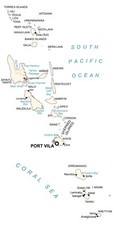
Vanuatu is an archipelago of dozens of inhabited islands, with extraordinary linguistic and cultural diversity. Creature traditions therefore do not form one neat national bestiary. A story recorded on Gaua, Malakula or the Banks Islands may belong to a particular community and landscape rather than to “Vanuatu folklore” as a single uniform body.
Field recordings collected by linguist Alexandre François illustrate this variety. His archive includes more than 1,000 recordings made in Vanuatu and the Solomon Islands, with hundreds of narratives transcribed across 21 languages. The Vanuatu material includes stories about an eel-man, a cursed eel, ogres, demons, a giant pig, a monster associated with Roua Island, a shark born among humans and a guardian of the underworld.[marama.huma-num.fr]marama.huma-num.frTraditional stories from MelanesiaTraditional stories from Melanesia
These are not all cryptids in the modern sense. Many are mythic beings, transformed humans, moral antagonists or ancestral figures. That distinction matters. A traditional monster story may explain a place, enforce rules about food or behaviour, or preserve community history without claiming that an undiscovered animal is still roaming the island.
The giant eel: folklore before cryptozoology
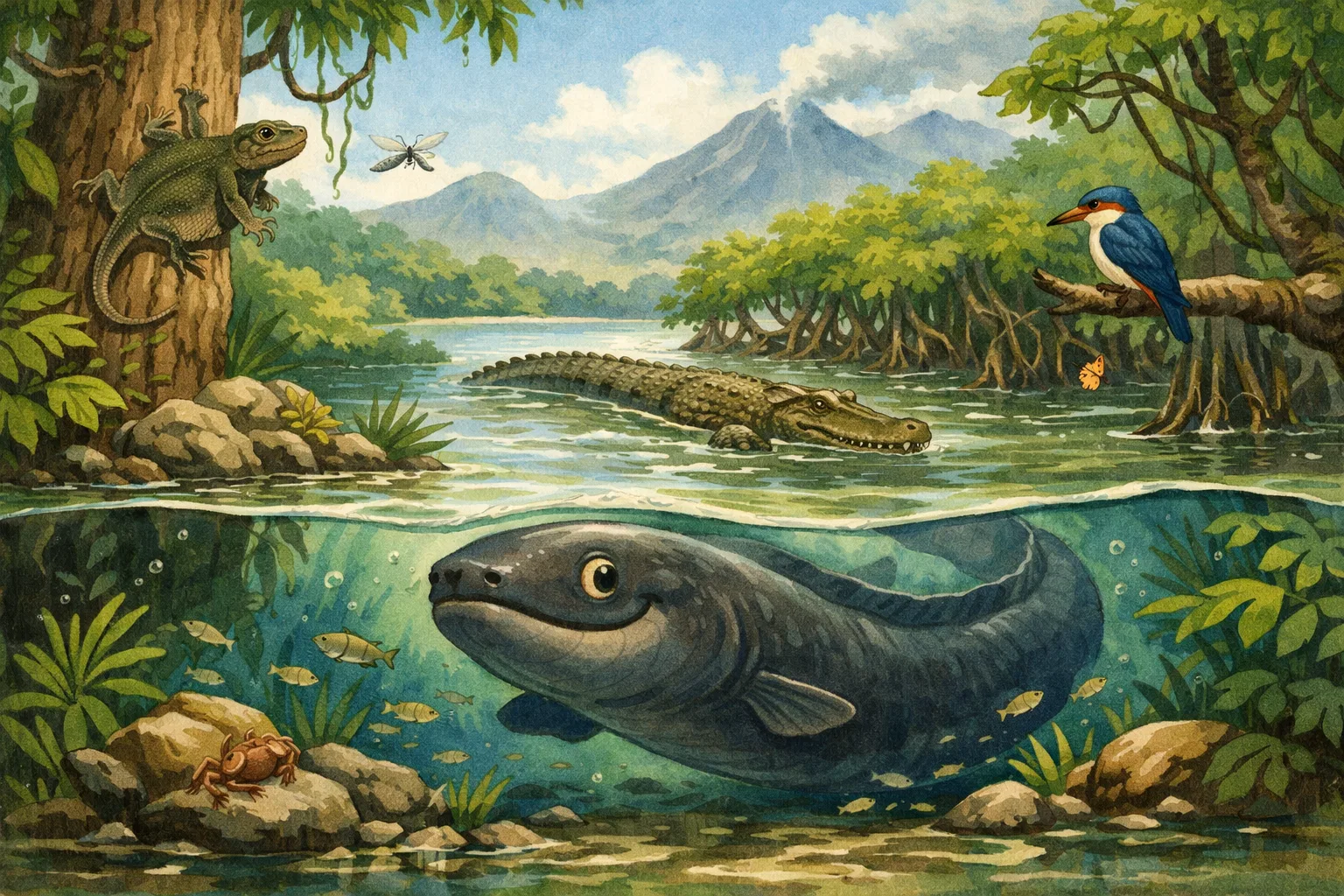
The creature most often attached to Vanuatu in modern monster lists is the Abaia, described as an enormous magical eel living in a freshwater lake. In the popular version, it regards the lake’s fish as its children. When people catch too many fish or seize the eel itself, it produces a flood or violent storm that destroys the offenders.
That story is usually presented as broadly Melanesian and assigned to Vanuatu, Fiji and the Solomon Islands. However, readily accessible modern accounts tend to repeat one another and rarely identify a particular Vanuatu island, language, storyteller or early Vanuatu source. The Abaia is therefore better treated as a regional folklore attribution than as a securely documented, island-specific Vanuatu cryptid case.[Cryptid Wiki]cryptidz.fandom.comCryptid Wiki AbaiaCryptid WikiAbaia - Cryptid Wiki - FandomThe Abaia is a huge, magical eel in Melanesian mythology. dwells at the bottom of freshwater lak…
Vanuatu’s recorded oral literature nevertheless contains strong eel imagery. François’s collection lists stories translated as “In love with an Eel Man”, “The curse of the Eel”, “The river eel” and “The revenge of the eel”. This makes the popularity of an eel guardian understandable, even though it does not prove that every online Abaia account originated in Vanuatu.[marama.huma-num.fr]marama.huma-num.frTraditional stories from MelanesiaTraditional stories from Melanesia
A naturalistic reading is possible but limited. Large freshwater eels can be impressive, secretive and long-lived, while floods may follow intense tropical rain. Such observations could supply raw material for a story. Yet the protective intelligence, supernatural storm-making and moral punishment belong to folklore, not zoological evidence.

The strongest mystery-animal reports come from Santo
The clearest scientific acknowledgement of Vanuatu cryptozoological claims appears in a detailed review of the country’s amphibians and reptiles. Herpetologist Ivan Ineich noted that several reptile species had been reported locally but had not been collected, leaving their existence unconfirmed. He warned that reports might reflect real animals, misinterpretations or folklore, while arguing that they deserved attention.[vanuatu-data.sprep.org]vanuatu-data.sprep.orgamphibians et reptiles Vanuatu INEICH 2011amphibians et reptiles Vanuatu INEICH 2011
Two reports traced to the Matantas area of Espiritu Santo are especially intriguing:
- a “flying gecko”;
- an arboreal, or tree-living, skink with a blue tail.
These animals were mentioned in a 1994 survey by Tony and Vivienne Whitaker. No specimen confirming either reported form is cited in the later review. “Flying gecko” would normally imply a gliding lizard with skin flaps rather than powered flight, but no recognised Vanuatu species matching that description has been established from the report alone. Blue-tailed skinks are common in parts of the Pacific, so colour, age, lighting or confusion with a known species could explain the second account.[vanuatu-data.sprep.org]vanuatu-data.sprep.orgamphibians et reptiles Vanuatu INEICH 2011amphibians et reptiles Vanuatu INEICH 2011
The same review records reports of unusual snakes on Malakula. Ineich suggested that these could be uncommon colour forms of the known Pacific boa, rather than a separate unknown species. He also allowed that giant skinks related to large or extinct forms elsewhere in the Pacific might once have occurred in Vanuatu, or conceivably survived there, but presented this as a possibility rather than evidence of a living population.[vanuatu-data.sprep.org]vanuatu-data.sprep.orgamphibians et reptiles Vanuatu INEICH 2011amphibians et reptiles Vanuatu INEICH 2011
This is the central Vanuatu cryptid problem in miniature. Tropical forest, rugged terrain and incomplete collecting create room for genuine zoological surprises. At the same time, a brief verbal description without a photograph, specimen, measurements or repeat observations cannot establish a new animal.
Vanua Lava’s crocodiles: a real animal that sounds legendary
Saltwater crocodiles provide Vanuatu’s best example of a seemingly improbable monster story turning out to involve a known species. Their main Vanuatu stronghold has been Vanua Lava in the northern Banks Islands, far to the east of the animal’s better-known populations in New Guinea and northern Australia.
A government-supported survey conducted in 1989 and published in 1993 described Vanua Lava as the only Vanuatu island known to have held a breeding population. Researchers visited reported habitats, interviewed villagers and distributed questionnaires. They concluded that perhaps only two or three crocodiles remained at that time and that breeding might have ceased.[library.sprep.org]library.sprep.orgOpen source on sprep.org.
The report recorded crocodiles sporadically from Malakula, Espiritu Santo and Malo, but placed the established breeding population around eastern Vanua Lava. Earlier estimates had suggested as many as 50 animals in the early 1980s, although accounts differed sharply. Cyclone Wendy in 1972, shooting and natural mortality were proposed as causes of decline.[library.sprep.org]library.sprep.orgOpen source on sprep.org.
Local tradition reportedly held that the Vanua Lava population descended from a single female accidentally introduced during the nineteenth century. The investigators found no independent confirmation of that story. Natural colonisation is biologically possible because saltwater crocodiles can travel through the sea, but the population’s exact origin remained unresolved.[library.sprep.org]library.sprep.orgOpen source on sprep.org.
Modern tourism material still identifies Vanua Lava as Vanuatu’s crocodile island and promotes guided river trips in which local guides discuss encounters and legends. Here, folklore, wildlife history and tourism overlap: the “monster” is real, but stories about its arrival, numbers and movements have grown around a sparse and difficult-to-observe population.[Vanuatu Travel]vanuatu.traveltop 10 experiences in vanuatu s outer islands from north to southTop 10 experiences in Vanuatu's outer islands19 Jun 2025 — Join a guided boat trip along the Selva river or other waterways on Vanua Lava…
Sea serpents without a Vanuatu flap
Vanuatu’s marine setting appears ideal for sea-serpent tales. Its waters contain sea kraits, true sea snakes, eels, sharks, rays and large pelagic fish. The reptile review records several sea-krait and sea-snake species, while also stressing that museum evidence and distribution data can be incomplete.[vanuatu-data.sprep.org]vanuatu-data.sprep.orgamphibians et reptiles Vanuatu INEICH 2011amphibians et reptiles Vanuatu INEICH 2011
Despite this environment, there is no well-documented, recurring Vanuatu sea-serpent flap in the accessible historical record. That absence is important. Generic websites sometimes attach regional sea-monster traditions to almost any Pacific island, but a credible country-level case needs dates, locations, witnesses and traceable reporting.
Known animals offer ample sources of confusion. Sea kraits have bold bands and move between land and water. Moray eels can appear serpentine in reefs. Oarfish, swimming groups of dolphins, whale bodies and floating debris have all contributed to sea-serpent interpretations elsewhere. The Natural History Museum notes that genuine marine animals, including oarfish and giant squid, helped shape historical sea-monster imagery.[Natural History Museum]nhm.ac.ukNatural History MuseumSea monsters and their inspiration: Serpents, mermaids…Explore the real-life inspiration behind fantastic sea mo…
Vanuatu’s deep-water biodiversity also continues to produce unfamiliar-looking animals. Researchers have documented unusual fishes from considerable depths, including a scorpionfish formally described from specimens collected near Malakula. Such discoveries show that “previously unknown to science” does not mean “giant monster”: most new species are identified through collected specimens, anatomical comparison and publication, not isolated sightings.[All About Vanuatu]allaboutvanuatu.com7 in Ichthyological Research.Read moreAll About VanuatuCreature with 'large' mouth and pointy teeth found in ocean…July 8, 2024 — The new species is known as Neomerinthe ha…
Folklore is not failed zoology
Monster narratives in Vanuatu often concern origins, forbidden behaviour, kinship, death, fishing and relationships between communities and places. Treating every eel-man, ogre or supernatural animal as a garbled eyewitness account strips the story of much of its meaning.
The recorded traditions also demonstrate how unreliable broad creature labels can be. One archive alone contains distinct ogres, demons, transformed animals, human-animal figures and named beings associated with particular islands. These categories overlap in English translation but may have very different roles in their original settings.[marama.huma-num.fr]marama.huma-num.frTraditional stories from MelanesiaTraditional stories from Melanesia
This does not prevent folklore from preserving ecological knowledge. Stories may encode warnings about dangerous rivers, overfishing, crocodile habitat, storms or unfamiliar animals. The useful approach is to ask what kind of claim is being made:
- Folklore: a traditional narrative with cultural, moral or place-based meaning.
- Witness report: a claimed observation tied to a person, time and location.
- Cryptozoological hypothesis: a proposal that the report represents an unrecognised species.
- Zoological evidence: a specimen, diagnostic photograph, DNA sample or repeatable field record.
Most Vanuatu monster material belongs firmly to the first category. The Santo reptile reports reach the second and prompted cautious scientific interest, but have not progressed to the fourth.
What the evidence supports
Vanuatu is better understood as a country of local mystery-animal traditions than as the home of one headline cryptid. Its most credible anomalous reports involve modestly sized reptiles that could conceivably have escaped scientific collection, not surviving dinosaurs or enormous lake monsters.
The current balance of evidence supports four conclusions. Giant eels, ogres and animal-human beings are well represented in the wider storytelling landscape, but they should be approached as cultural narratives. Reports of a flying gecko, a blue-tailed tree skink and unusual Malakula snakes are genuine subjects of herpetological comment, yet remain unverified. Vanua Lava’s crocodiles are known animals surrounded by uncertain migration history and changing local stories. Finally, the archipelago’s real biodiversity is strange enough to encourage misidentification without requiring a hidden population of giant monsters.
Vanuatu’s creature lore is therefore most compelling at the border between story and field observation. The mystery is not simply whether an unknown beast exists, but how island traditions, rare wildlife, incomplete surveys and later retellings transform an unusual animal into a monster—and sometimes turn an apparent monster back into an animal.
Amazon book picks
Further Reading
Books and field guides related to What Creatures Haunt Vanuatu's Islands?. Use these as the next step if you want deeper reading beyond the article.
Abominable Science!
Helps readers assess mystery-creature claims from island traditions.
Where the Spirits Ride the Wind
Relevant to Melanesian folklore and supernatural creature traditions.
Tales of the South Pacific
Offers broad cultural and regional context for island storytelling.
eBay marketplace picks
Marketplace Samples
Live-tested eBay searches with available results related to this page.
Endnotes
1.
Source: vanuatu-data.sprep.org
Title: amphibians et reptiles Vanuatu INEICH 2011
Link:https://vanuatu-data.sprep.org/system/files/amphibians%20et%20reptiles%20Vanuatu_INEICH%202011.pdf
2.
Source: marama.huma-num.fr
Title: Traditional stories from Melanesia
Link:https://marama.huma-num.fr/AFtxt_select_e.htm
3.
Source: library.sprep.org
Link:https://library.sprep.org/sites/default/files/Status%2520of%2520the%2520estuarine%2520crocodile%2520in%2520Vanuatu.%2520SPREP%2520RSS%2520no.74-Reduced.pdf
4.
Source: vanuatu.travel
Title: top 10 experiences in vanuatu s outer islands from north to south
Link:https://www.vanuatu.travel/au/blog/top-10-experiences-in-vanuatu-s-outer-islands-from-north-to-south?format=print&print=1&tmpl=component
Source snippet
Top 10 experiences in Vanuatu's outer islands19 Jun 2025 — Join a guided boat trip along the Selva river or other waterways on Vanua Lava...
5.
Source: archive.org
Title: 263840739 MythsLegends pdf djvu.txt
Link:https://archive.org/stream/263840739MythsLegendsPdf/263840739-MythsLegends-pdf_djvu.txt
6.
Source: archive.org
Link:https://archive.org/stream/LadyKrampus_gmail_WNMT/Tales_Part_01_djvu.txt
7.
Source: pipap.sprep.org
Title: dead dugong sighting fijian shore surprises villagers
Link:https://pipap.sprep.org/news/dead-dugong-sighting-fijian-shore-surprises-villagers
8.
Source: cryptidz.fandom.com
Title: Cryptid Wiki Abaia
Link:https://cryptidz.fandom.com/wiki/Abaia
Source snippet
Cryptid WikiAbaia - Cryptid Wiki - FandomThe Abaia is a huge, magical eel in Melanesian mythology. dwells at the bottom of freshwater lak...
9.
Source: Wikipedia
Link:https://en.wikipedia.org/wiki/Abaia
10.
Source: nhm.ac.uk
Link:https://www.nhm.ac.uk/discover/sea-monsters-inspiration-serpents-mermaids-the-kraken.html
Source snippet
Natural History MuseumSea monsters and their inspiration: Serpents, mermaids...Explore the real-life inspiration behind fantastic sea mo...
11.
Source: allaboutvanuatu.com
Title: 7 in Ichthyological Research.Read more
Link:https://allaboutvanuatu.com/creature-with-large-mouth-and-pointy-teeth-found-in-ocean-depths/
Source snippet
All About VanuatuCreature with 'large' mouth and pointy teeth found in ocean...July 8, 2024 — The new species is known as Neomerinthe ha...
Published: July 8, 2024
12.
Source: cryptidz.fandom.com
Title: Lake Monsters
Link:https://cryptidz.fandom.com/wiki/Lake_Monsters
13.
Source: cryptidz.fandom.com
Title: Manaia and Hei tiki
Link:https://cryptidz.fandom.com/wiki/Manaia_and_Hei-tiki
14.
Source: cryptidz.fandom.com
Title: Sea Serpents
Link:https://cryptidz.fandom.com/wiki/Sea_Serpents
Additional References
15.
Source: youtube.com
Title: Vanuatu’s Magical Heritage: Ancient Spells and Enigmatic Traditions
Link:https://www.youtube.com/watch?v=KY2Lf2E8u1U
Source snippet
Vanuatu: the secretive untouched customs and traditions of the indigenous people of the Yakel Tribe...
16.
Source: youtube.com
Link:https://www.youtube.com/watch?v=MtVhkXzCAvI
Source snippet
We Entered a REAL Tribal Village in Vanuatu...
17.
Source: youtube.com
Title: The Disappearing Village of Vanuatu – Unexplained Legends
Link:https://www.youtube.com/watch?v=FgR1ECVHhT0
Source snippet
Vanuatu's Magical Heritage: Ancient Spells and Enigmatic Traditions...
18.
Source: youtube.com
Title: We Entered a REAL Tribal Village in Vanuatu
Link:https://www.youtube.com/watch?v=_tzCqp7VnqM
Source snippet
Vanuatu's Remote Communities: How the Ni-Vans Live Fully Off the Land...
19.
Source: researchgate.net
Link:https://www.researchgate.net/publication/262917089_The_terrestrial_herpetofauna_of_Torres_and_Banks_Groups_northern_Vanuatu_with_report_of_a_new_species_for_Vanuatu
20.
Source: instagram.com
Link:https://www.instagram.com/p/DDr83PBR6ag/
21.
Source: instagram.com
Link:https://www.instagram.com/p/DPuTe7tEu9w/
22.
Source: ethnobiology.org
Link:https://ethnobiology.org/sites/default/files/pdfs/JoE/7-1/BauerRussell1987.pdf
23.
Source: reddit.com
Link:https://www.reddit.com/r/cryptids/comments/1p9gla7/abaia/
24.
Source: flickr.com
Link:https://www.flickr.com/photos/21302721%40N07/7003761482
Topic Tree
Follow this branch
Related pages 192
- Antigua Cryptids
- Maldives Monsters
- Malta Monsters
- Qatar Monsters
- Argentina Monsters
- +187 more in sidebar