Strange Creatures of Chile's Coasts and Forests
Chile’s cryptid map is less a single monster hunt than a chain of regional creature traditions. In the north, mining country gives us the glowing Alicanto, a treasure bird of the Atacama. In central and southern Chile, Mapuche-linked and rural legends include blood-drinking winged beings, flying heads, enchanted animals and suspicious livestock deaths.
Page outline Jump by section
Why Chile’s creature lore clusters around Chiloé
Chiloé, the rainy archipelago off southern Chile, is the country’s richest setting for monster folklore because its geography and history made it feel separate. Memoria Chilena, the digital cultural archive of Chile’s National Library, describes Chiloé as a cultural universe shaped by long isolation, colonial history and an intense mixture of Iberian and Indigenous Huilliche elements. That same source notes that Chiloé’s Catholic popular religion coexisted with an elaborate mythical world of forest beings, sea divinities, monsters, witchcraft and tales of the dead.[Memoria Chilena]memoriachilena.gob.clMemoria Chilena Religiosidad, mito e identidad chilotaMemoria Chilena Religiosidad, mito e identidad chilota
This helps explain why so many Chilean creature stories are not “cryptids” in the modern Bigfoot-or-Nessie sense. Many are moral, ecological or social figures. The sea is not just water; it is ruled, watched and haunted. The forest is not just woodland; it is a place where people can vanish, be tempted, be punished or meet beings beyond ordinary human society. Memoria Chilena lists the Trauco and Fiura as forest-linked myths, the Millalobo and Pincoya as sea figures, the Peuchén, Basilisco and Camahueto as mythical monsters, and the Caleuche as a ship of dead sailors.[Memoria Chilena]memoriachilena.gob.clMemoria Chilena Religiosidad, mito e identidad chilotaMemoria Chilena Religiosidad, mito e identidad chilota
For readers coming from cryptozoology, Chiloé can be confusing because the stories are not usually presented as eyewitness case files. They belong to a living folklore system. That does not make them uninteresting; it makes them richer. A Chiloé monster often answers a local question: why the sea is dangerous, why fish appear or vanish, why someone became rich, why a child was born outside marriage, why a neighbour is feared, or why a place should be approached with caution.
The sea monsters and water beings people remember first
Chile’s long Pacific coast gives its legends a strongly marine flavour, but the best-known water creatures are concentrated in Chiloé rather than scattered evenly along the whole shoreline. The Chilean tourism board’s English-language guide to Chiloé highlights three of the most visitor-facing figures: the Trauco, the Pincoya and the Caleuche. That official tourism framing matters because it shows how older local tales now function as cultural identity and travel storytelling, not only fireside superstition.[Chile Travel]chile.travelOpen source on chile.travel.
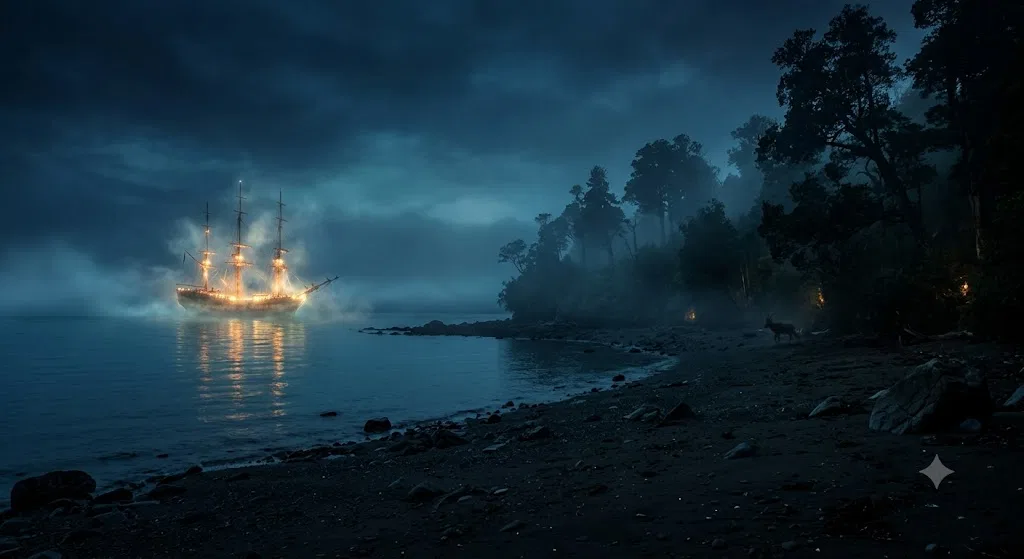
The Caleuche is the great ghost-ship legend of southern Chile. In popular Chiloé tradition it appears at night, lit up, musical, fast and elusive; when pursued, it may vanish, disguise itself or become part of the shore. Chile Travel presents it as a ghost ship of Chiloé’s southern waters, linked with sorcerers, fog, bright lights, drowned sailors and suspiciously sudden merchant wealth.[Chile Travel]chile.travelOpen source on chile.travel. Smithsonian’s historical discussion of Chiloé’s witch lore adds a sharper social angle: the Caleuche was said to carry contraband for merchants tied to the island’s magical society, which turns the ghost ship into a story about illicit wealth as much as the supernatural.[Smithsonian Magazine]smithsonianmag.comSmithsonian Magazine Into the Cave of Chile’s WitchesSmithsonian Magazine Into the Cave of Chile’s Witches
The Pincoya is less like a monster and more like an ecological spirit of abundance. Chile Travel describes her as a mermaid-like protector of Chiloé’s waters whose dance foretells fishing luck: facing the sea means abundance; turning away means scarcity.[Chile Travel]chile.travelOpen source on chile.travel. That makes the Pincoya one of the clearest examples of how Chilean creature folklore maps human dependence on a difficult environment. She is not “evidence” for a hidden aquatic species. She is a story about fish, risk, gratitude and the anxiety of coastal livelihoods.
The older Chiloé system also includes sea rulers and hybrid beings such as the Millalobo, the Pincoy, the sea horse and other marine figures. Memoria Chilena’s summary of Chiloé belief places sea divinities alongside forest beings and witchcraft, rather than treating them as isolated curiosities.[Memoria Chilena]memoriachilena.gob.clMemoria Chilena Religiosidad, mito e identidad chilotaMemoria Chilena Religiosidad, mito e identidad chilota For a public cryptid page, that distinction is useful: Chiloé’s “sea monsters” are not just alleged animals in the water. They are part of a world where the ocean has authority, hierarchy and memory.
The Trauco, the Camahueto and Chiloé’s forest-and-field creatures
The Trauco is probably the most famous land creature in Chiloé folklore. Chile Travel describes him as a short, deformed forest being who lives in hollow trees or caves, carries an axe-like staff, harms men and magically seduces women. The same tourism account states plainly that the tale has been used to explain pregnancies attributed to his spell.[Chile Travel]chile.travelOpen source on chile.travel. Read today, that aspect needs care: the Trauco is a powerful folklore figure, but the legend can also conceal or explain away sexual violence, social stigma and unequal treatment of women.
The Camahueto is stranger in a more cryptozoological direction: a calf-like creature with a horn, often imagined as bursting from the earth or water and leaving destructive channels behind. Memoria Chilena includes the Camahueto among Chiloé’s mythical monsters, alongside the Peuchén and Basilisco.[Memoria Chilena]memoriachilena.gob.clMemoria Chilena Religiosidad, mito e identidad chilotaMemoria Chilena Religiosidad, mito e identidad chilota As with many horned-beast legends, it sits halfway between animal tale, landscape explanation and magical medicine. A sudden trench, a damaged field, a landslip or a riverbank scar can become easier to remember when attached to a rampaging horned calf.
The Invunche is the darkest creature tied to the Chiloé witch complex. Smithsonian’s account of the 1880–81 Chiloé witch-trial materials describes testimony about a hidden cave near Quicaví guarded by monstrous beings, including the Invunche; the article also warns that supernatural trial testimony should not be accepted at face value, especially when extracted in a coercive legal context.[Smithsonian Magazine]smithsonianmag.comSmithsonian Magazine Into the Cave of Chile’s WitchesSmithsonian Magazine Into the Cave of Chile’s Witches This is exactly where evidence-aware monster writing matters. The Invunche is important folklore and part of the island’s witch mythology, but the historical documents do not prove a literal cave monster. They show what people feared, claimed and were pressured to say.
Chiloé’s witches turn monster lore into social history
The most unusual feature of Chile’s monster tradition is that some of it entered court history. In 1880, according to Memoria Chilena, Governor Martiniano Rodríguez brought proceedings against the powerful Chiloé witch society known as La Mayoría. The archive says the group had existed in Chiloé since the early nineteenth century, had considerable influence over the population, imitated the organisation of the Chilean state and handled disputes involving healing and accusations of witchcraft.[Memoria Chilena]memoriachilena.gob.clMemoria Chilena Juicio a los brujos de ChiloéMemoria Chilena Juicio a los brujos de Chiloé
This matters for cryptid history because Chiloé’s monsters were not merely bedtime characters. They were woven into accusations, social control, healing, fear and local power. Memoria Chilena says the 1880 trial, pursued under a charge of unlawful association, helped dismantle the organisation; later popular imagination then built a wider body of legends around Chiloé witchcraft.[Memoria Chilena]memoriachilena.gob.clMemoria Chilena Juicio a los brujos de ChiloéMemoria Chilena Juicio a los brujos de Chiloé Smithsonian’s account similarly argues that the society seems to have existed in some form, even while cautioning against literal belief in the supernatural details recorded in the trial material.[Smithsonian Magazine]smithsonianmag.comSmithsonian Magazine Into the Cave of Chile’s WitchesSmithsonian Magazine Into the Cave of Chile’s Witches
For the reader, the takeaway is simple: Chiloé gives Chile one of the rare monster traditions where folklore, alleged secret societies, courtroom testimony and later pop-culture afterlives overlap. The Caleuche, Invunche, flying witches and cave guardians are not best assessed as zoological candidates. They are a folklore system attached to real social tensions: Indigenous authority, colonial and republican power, poverty, healing, intimidation and the struggle over who had the right to judge village life.
The Alicanto: Chile’s glowing bird of mines and greed
Northern Chile contributes a very different sort of mystery creature: the Alicanto. Memoria Chilena describes it as a bird that feeds on precious metals and can guide honest miners to wealth or deceive the greedy.[Memoria Chilena]memoriachilena.gob.clMemoria Chilena DESCUBRE LOS MITOS DE CHILEMemoria Chilena DESCUBRE LOS MITOS DE CHILE That summary captures why the Alicanto belongs so naturally to the Atacama and Chile’s mining imagination. It is not a forest seducer or sea ghost; it is a creature of ore, darkness, prospecting and temptation.
The Alicanto also has a strong documentary folklore pedigree. Julio Vicuña Cifuentes, one of Chile’s early folklore scholars, published Mitos y supersticiones recogidos de la tradición oral chilena in 1915, a collection noted by Memoria Chilena for its breadth of Chilean oral beliefs and comparative material.[Memoria Chilena]memoriachilena.gob.clw3 article 97606w3 article 97606 Later retellings usually preserve the same core: the bird glows according to the metal it has eaten, leads miners towards hidden treasure, and punishes those who follow it unwisely.
As a cryptid, the Alicanto is not plausible in a biological sense. Birds do not eat enough gold or silver to shine like lanterns, and there is no zoological evidence for such a species in the Atacama. But as folklore, it is beautifully fitted to place. The Atacama is a landscape of darkness, mineral wealth, mirage-like distances and dangerous ground. The Alicanto turns the miner’s dream into an animal: follow fortune carefully, or greed may lead you over the edge.
Blood-drinkers, winged beings and the roots of the Chupacabra panic
Chile also has older blood-drinking and winged-creature traditions that make the later Chupacabra panic feel less imported than it might first appear. The Peuchén, found in Mapuche and Chiloé-related traditions, is commonly described as a winged or shapeshifting blood-drinking being. Memoria Chilena lists the Peuchén among Chiloé’s mythical monsters, and wider folklore summaries connect it with blood-sucking animal fear.[Memoria Chilena]memoriachilena.gob.clMemoria Chilena Religiosidad, mito e identidad chilotaMemoria Chilena Religiosidad, mito e identidad chilota
There is also a real animal that complicates the story: the common vampire bat. Nature’s Scientific Data describes Desmodus rotundus as a strictly blood-feeding species that feeds mainly on medium to large terrestrial mammals and some birds, while a separate Chile-based study notes that Chile has one blood-feeding bat species overlapping with other disease-relevant species and vectors.[Nature]nature.comOpen source on nature.com. This does not explain every Peuchén or Chupacabra story, but it shows why blood-drinking animal folklore can attach itself to real rural experience.
The modern Chupacabra reached Chile as part of a wider Latin American media phenomenon that began in Puerto Rico in the mid-1990s. Reports in Chile clustered especially around Calama in northern Chile around 2000, where livestock deaths were attributed by some to a blood-draining creature; later summaries of the flap state that no extraordinary animal was confirmed and that tracks and hair pointed to domestic dogs.[Wikipedia]WikipediaOpen source on wikipedia.org. That fits a common pattern in mystery-animal cases: dead livestock, poor lighting, rumour, sensational headlines and scavenger damage combine into a monster story before veterinary or field evidence catches up.

Phantom cats, pumas and misidentified wildlife
Not every Chilean “mystery beast” needs a supernatural frame. Some reports are likely to come from real carnivores seen briefly, blamed wrongly or exaggerated after livestock losses. Chile has pumas, small wild cats and domestic dogs moving through rural and edge-of-town landscapes, which gives plenty of raw material for phantom-cat stories and “unknown predator” scares.
The puma is the obvious candidate in many large-predator fears. A peer-reviewed study on pumas in Chile’s O’Higgins Region reported 51 records from 2012 to 2020, including presences, sightings and livestock attacks near human settlements.[PMC]pmc.ncbi.nlm.nih.govOpen source on nih.gov. That does not mean every strange carcass is a puma kill. It means Chile has a real large cat whose behaviour can be dragged into folklore, rumour and ranch conflict, especially where people and wildlands meet.
The guiña, or kodkod, shows the opposite problem: a real wild cat so small and elusive that it can be misread by people unfamiliar with it. A 2020 scientific report describes Leopardus guigna as the smallest felid in the Americas, found mainly in central and southern Chile and marginally in south-western Argentina; the IUCN Cat Specialist Group similarly states that the species occurs only in central and southern Chile and a narrow strip of Argentina, including Chiloé.[SciELO]scielo.clOpen source on scielo.cl. In a panic, an unusual small cat, a foetus, a scavenged carcass or a diseased domestic animal can be promoted into a monster.
Domestic dogs are often the least glamorous but most persuasive explanation for livestock flaps. The Chupacabra material above is one example; puma-conflict reporting in Patagonia also shows how predator blame can be misassigned. In a 2024 report on puma-livestock coexistence, El País cited Chilean agricultural service data from Magallanes in which, among identifiable carnivore-attack complaints since 2012, 73.2% were attributed to domestic dogs and 9.1% to pumas.[El País]elpais.comEl País Un oasis de convivencia de los pumas y la ganadería en la PatagoniaEl País Un oasis de convivencia de los pumas y la ganadería en la Patagonia That kind of evidence is not as exciting as a new beast, but it is exactly what a careful cryptid assessment needs.
Lake monsters are not Chile’s strongest cryptid tradition
Readers often expect every long, mountainous country to have a Loch Ness equivalent. Chile has lakes, Patagonia, mist and tourism, so the ingredients are there. Yet the strongest lake-monster tradition in the southern cone is usually Argentina’s Nahuelito, associated with Nahuel Huapi Lake, rather than a well-documented Chilean lake creature. Chilean social media and television sometimes recycle “monster in the lake” claims around places such as Llanquihue, but the evidence tends to be thin, recent and video-led rather than rooted in a deep archive of named cases.
That does not mean Chile lacks aquatic mystery. It means its classic water folklore points more towards Chiloé’s sea beings, ghost ships and mythic marine order than towards one enduring freshwater animal claim. The country’s geography encourages watery legends, but the cultural centre of gravity is different from Scotland’s Loch Ness or Canada’s Ogopogo. Chile’s best-known aquatic mystery is a haunted social sea, not a single long-necked animal.
A sceptical reading also has to account for ordinary lake effects. Distant swimming birds, floating logs, wave trains, boat wakes, low-angle light, seals near coasts, and viral clips stripped of scale can all generate “creature” impressions. Where a local tradition is shallow and the evidence is a brief modern video, the most honest classification is usually “possible misidentification or media folklore”, not an unresolved zoological case.
How Chile’s monsters changed in modern culture
Chile’s creature traditions have not stayed frozen in village storytelling. They now appear in tourism, children’s education, art, television, fantasy, online videos and regional branding. Chile Travel presents Chiloé myths as part of the visitor experience, while Memoria Chilena has promoted national myth exhibitions including the Alicanto, the Caleuche and other figures from Chilean worldviews.[Chile Travel]chile.travelOpen source on chile.travel.
That modern afterlife changes the stories. A being once feared as a local explanation for danger can become a carved souvenir, a mural, a festival figure or a search-friendly “cryptid”. The Caleuche becomes a ghost-ship attraction; the Trauco becomes an instantly recognisable Chiloé character; the Alicanto becomes a child-friendly treasure bird; the Chupacabra becomes a media label applied to almost any strange predator incident.
This shift is not necessarily a loss. Folklore survives by changing format. But it does mean readers should separate four layers when assessing Chilean cryptids:
- Traditional folklore: beings such as the Trauco, Pincoya, Caleuche, Camahueto and Alicanto, whose main evidence is cultural transmission.
- Historical belief and testimony: the Chiloé witch-trial material, valuable but not literal proof of monsters.
- Modern mystery-animal claims: livestock attacks, lake videos and predator sightings that need field evidence.
- Tourism and pop culture: retellings that preserve the names while softening, simplifying or dramatizing the older material.
What is most plausible, and what remains mysterious?
The most plausible “animal” explanations in Chile are ordinary but important: pumas, guiñas, domestic dogs, scavengers, bats, livestock disease, decomposition and mistaken scale. These do not explain every detail of every story, but they explain the kinds of evidence usually offered in modern flaps: tracks, hair, wounds, fleeting sightings and carcasses found after the fact. Chile’s real fauna is already interesting enough to generate confusion, especially when seen briefly in difficult terrain.
The older monsters are better treated as folklore rather than failed zoology. The Caleuche explains dangerous waters, sudden wealth and drowned sailors. The Pincoya gives fishing luck a face. The Trauco encodes fear, sexuality, violence and social stigma. The Camahueto turns landscape damage into a horned beast. The Alicanto makes mining luck glow in the dark. The Peuchén and Chupacabra connect rural blood-loss fears to both old supernatural motifs and real predator ecology.
So Chile’s cryptid tradition is strongest when read as a layered national bestiary: part Indigenous and local cosmology, part colonial and Catholic mixture, part rural cautionary tale, part courtroom history, part modern media panic. There is no confirmed hidden monster at the centre of it. There is something more culturally durable: a country where deserts, forests, islands, mines, lakes and coasts have all been given creatures vivid enough to keep walking, swimming, flying and glowing through the public imagination.

eBay marketplace picks
Marketplace Samples
Live-tested eBay searches with available results related to this page.
Endnotes
1.
Source: chile.travel
Link:https://chile.travel/en/blog/discover-the-fantastic-myths-and-legends-of-chiloe-a-place-full-of-mysteries/
2.
Source: nature.com
Link:https://www.nature.com/articles/s41597-022-01140-9
3.
Source: Wikipedia
Link:https://en.wikipedia.org/wiki/Chupacabra
4.
Source: pmc.ncbi.nlm.nih.gov
Link:https://pmc.ncbi.nlm.nih.gov/articles/PMC8066551/
5.
Source: scielo.cl
Link:https://www.scielo.cl/scielo.php?pid=S0716-078X2020000100403&script=sci_arttext
6.
Source: Wikipedia
Title: Chilote mythology
Link:https://en.wikipedia.org/wiki/Chilote_mythology
7.
Source: Wikipedia
Link:https://en.wikipedia.org/wiki/Nahuelito
8.
Source: Wikipedia
Title: Chilean mythology
Link:https://en.wikipedia.org/wiki/Chilean_mythology
9.
Source: Wikipedia
Title: Common vampire bat
Link:https://en.wikipedia.org/wiki/Common_vampire_bat
10.
Source: Wikipedia
Link:https://en.wikipedia.org/wiki/Kodkod
11.
Source: Wikipedia
Link:https://en.wikipedia.org/wiki/Piuch%C3%A9n
12.
Source: Wikipedia
Link:https://en.wikipedia.org/wiki/Chonchon
13.
Source: Wikipedia
Link:https://en.wikipedia.org/wiki/Alicanto
14.
Source: Wikipedia
Title: Warlocks of Chiloé
Link:https://en.wikipedia.org/wiki/Warlocks_of_Chilo%C3%A9
15.
Source: Wikipedia
Title: Brujos de Chiloé
Link:https://es.wikipedia.org/wiki/Brujos_de_Chilo%C3%A9
16.
Source: medium.com
Link:https://medium.com/%40eyegiene/benjamin-radfords-tracking-the-chupacabra-the-vampire-beast-in-fact-fiction-and-folklore-d7350760e8b0
17.
Source: guigna.org
Link:https://guigna.org/
18.
Source: youtube.com
Title: Exploring Chiloé, Chile | Fog, Folklore and Myth
Link:https://www.youtube.com/watch?v=k_jcwybtjoE
Source snippet
The Pincoya...
19.
Source: youtube.com
Title: The Pincoya
Link:https://www.youtube.com/watch?v=3AhEA1aNrCY
Source snippet
Marca Chile...
20.
Source: youtube.com
Link:https://www.youtube.com/watch?v=kJkIbB9eSAk
Source snippet
This Flying Head Creature Terrorized Chile for Centuries — The Chonchón Explained...
21.
Source: memoriachilena.gob.cl
Title: Memoria Chilena Religiosidad, mito e identidad chilota
Link:https://www.memoriachilena.gob.cl/602/w3-article-3672.html
22.
Source: smithsonianmag.com
Title: Smithsonian Magazine Into the Cave of Chile’s Witches
Link:https://www.smithsonianmag.com/history/into-the-cave-of-chiles-witches-20138093/
23.
Source: memoriachilena.gob.cl
Title: Memoria Chilena Juicio a los brujos de Chiloé
Link:https://www.memoriachilena.gob.cl/wiki/portadaui_juicioalosbrujosdechiloe.php
24.
Source: memoriachilena.gob.cl
Title: Memoria Chilena DESCUBRE LOS MITOS DE CHILE
Link:https://www.memoriachilena.gob.cl/602/w3-article-122951.html
25.
Source: memoriachilena.gob.cl
Title: w3 article 97606
Link:https://www.memoriachilena.gob.cl/602/w3-article-97606.html
26.
Source: pubmed.ncbi.nlm.nih.gov
Link:https://pubmed.ncbi.nlm.nih.gov/34687642/
27.
Source: elpais.com
Title: El País Un oasis de convivencia de los pumas y la ganadería en la Patagonia
Link:https://elpais.com/america-futura/2024-11-24/una-alianza-para-que-los-pumas-y-la-ganaderia-convivan-en-la-patagonia-chilena.html
28.
Source: memoriachilena.gob.cl
Link:https://www.memoriachilena.gob.cl/archivos2/pdfs/MC0008652.pdf
29.
Source: memoriachilena.gob.cl
Link:https://www.memoriachilena.gob.cl/archivos2/pdfs/MC0031710.pdf
30.
Source: memoriachilena.gob.cl
Link:https://www.memoriachilena.gob.cl/archivos2/pdfs/MC0008702.pdf
31.
Source: memoriachilena.gob.cl
Title: renato cardenas
Link:https://www.memoriachilena.gob.cl/archivos2/pdfs/MC0012567.pdf
32.
Source: memoriachilena.gob.cl
Link:https://www.memoriachilena.gob.cl/archivos2/pdfs/mc0004107.pdf
33.
Source: memoriachilena.gob.cl
Link:https://www.memoriachilena.gob.cl/archivos2/pdfs/MC0056546.pdf
34.
Source: memoriachilena.gob.cl
Link:https://www.memoriachilena.gob.cl/archivos2/pdfs/mc0025900.pdf
35.
Source: memoriachilena.gob.cl
Link:https://www.memoriachilena.gob.cl/archivos2/pdfs/MC0070817.pdf
36.
Source: memoriachilena.gob.cl
Link:https://www.memoriachilena.gob.cl/archivos2/pdfs/MC0033518.pdf
37.
Source: memoriachilena.gob.cl
Link:https://www.memoriachilena.gob.cl/archivos2/pdfs/MC0033459.pdf
38.
Source: memoriachilena.gob.cl
Link:https://www.memoriachilena.gob.cl/archivos2/pdfs/MC0071119.pdf
39.
Source: memoriachilena.gob.cl
Link:https://www.memoriachilena.gob.cl/archivos2/pdfs/MC0011022.pdf
40.
Source: memoriachilena.gob.cl
Link:https://www.memoriachilena.gob.cl/archivos2/pdfs/MC0072046.pdf
41.
Source: memoriachilena.gob.cl
Link:https://www.memoriachilena.gob.cl/archivos2/pdfs/mc0027346.pdf
42.
Source: memoriachilena.gob.cl
Link:https://www.memoriachilena.gob.cl/archivos2/pdfs/mc0036314.pdf
43.
Source: memoriachilena.gob.cl
Link:https://www.memoriachilena.gob.cl/archivos2/pdfs/MC0052646.pdf
44.
Source: memoriachilena.gob.cl
Link:https://www.memoriachilena.gob.cl/archivos2/pdfs/MC0014356.pdf
45.
Source: pmc.ncbi.nlm.nih.gov
Link:https://pmc.ncbi.nlm.nih.gov/articles/PMC9412479/
46.
Source: pmc.ncbi.nlm.nih.gov
Link:https://pmc.ncbi.nlm.nih.gov/articles/PMC8850563/
47.
Source: pubmed.ncbi.nlm.nih.gov
Link:https://pubmed.ncbi.nlm.nih.gov/21641130/
48.
Source: chileparaninos.gob.cl
Link:https://www.chileparaninos.gob.cl/639/articles-634607_archivo_01.pdf
49.
Source: cryptidz.fandom.com
Link:https://cryptidz.fandom.com/wiki/Nahuelito
50.
Source: abookofcreatures.com
Link:https://abookofcreatures.com/category/chile/
51.
Source: kids.kiddle.co
Link:https://kids.kiddle.co/Nahuelito
52.
Source: clasificacionespecies.mma.gob.cl
Title: Leopardus guigna P07
Link:https://clasificacionespecies.mma.gob.cl/wp-content/uploads/2019/10/Leopardus_guigna_P07.pdf
Additional References
53.
Source: facebook.com
Link:https://www.facebook.com/TheFolklorePodcast/posts/today-january-8th-in-1923-a-newspaper-headline-in-the-cordova-daily-times-declar/1370280215112895/
54.
Source: instagram.com
Link:https://www.instagram.com/reel/DUVfRobDK3r/?hl=en
55.
Source: instagram.com
Link:https://www.instagram.com/reel/DTZcJQcEhBj/
56.
Source: facebook.com
Link:https://www.facebook.com/MEGACL/videos/el-terror%C3%ADfico-monstruo-que-habitar%C3%ADa-en-el-lago-llanquihue/941990874067830/
57.
Source: facebook.com
Link:https://www.facebook.com/100041955501664/posts/tvdatos-lagollanquihueregistro-en-el-lago-llanquihue-genera-debate-tras-el-presu/1690527142355786/
58.
Source: researchgate.net
Link:https://www.researchgate.net/publication/288490281_Leopardus_guigna_The_IUCN_Red_List_of_Threatened_Species_2015
59.
Source: academia.edu
Link:https://www.academia.edu/66860784/The_Cultural_Mutations_of_Chilo%C3%A9_myths_and_legends_in_the_neoliberal_modernity_of_the_island
60.
Source: researchgate.net
Link:https://www.researchgate.net/publication/350518947_Puma_Puma_concolor_in_the_Neighborhood_Records_Near_Human_Settlements_and_Insights_into_Human-Carnivore_Coexistence_in_Central_Chile
61.
Source: gochile.cl
Link:https://www.gochile.cl/en/articles/6-myths-and-legends-of-chiloe-southern-chile.htm
62.
Source: grimoriodebestias.blogspot.com
Link:https://grimoriodebestias.blogspot.com/2014/02/alicanto.html
Topic Tree
Follow this branch
Related pages 192
- Antigua Cryptids
- Maldives Monsters
- Malta Monsters
- Qatar Monsters
- Argentina Monsters
- +187 more in sidebar