Cryptids of Denmark's Shores and Churchyards
Denmark is not a classic “monster map” country in the Loch Ness sense. Its strongest mystery-creature tradition is older, stranger, and more maritime: the 16th-century Sea Monk of the Øresund, a reported animal from the waters between Zealand and Sweden that Renaissance naturalists tried to turn into a monk-shaped fish.
Page outline Jump by section
Denmark’s monster map is mostly sea, story, and churchyard
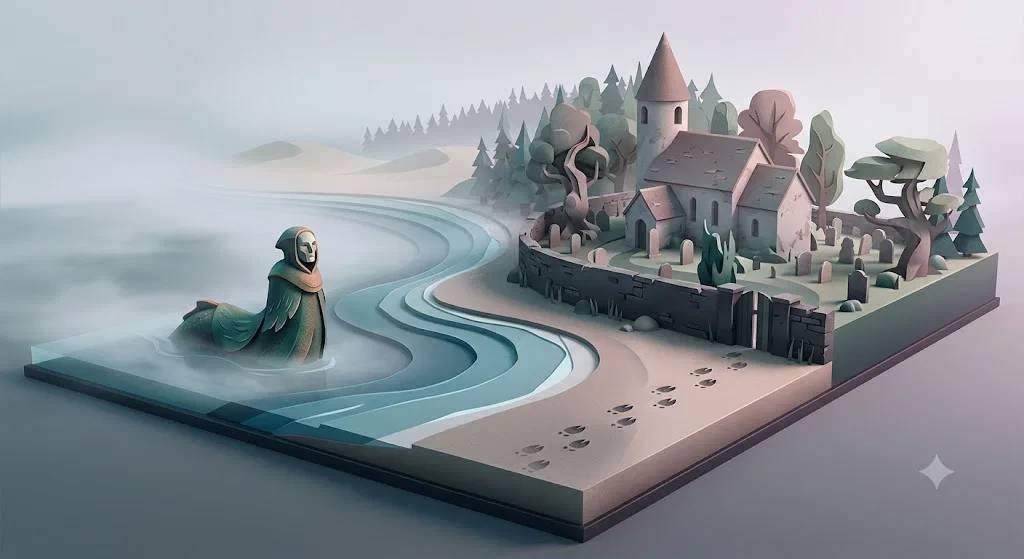
The first thing to know is geographical. Denmark is low-lying, coastal, island-rich, and heavily settled. That matters because it gives Danish monster tradition a different shape from countries with deep inland lakes, remote mountain valleys, or vast forests. Danish “cryptid” material tends to gather around shorelines, straits, harbours, churches, burial places, and travelling folk stories rather than around large wilderness sighting zones.
That does not make the material dull. It makes it more revealing. Denmark’s best-known anomalous creature, the Sea Monk, comes from the Øresund, a busy waterway rather than an untouched monster-haunt. The helhest belongs to churchyards and cathedral tradition, including Roskilde and Aarhus. The lindorm appears as a serpent-dragon in Danish and wider Nordic storytelling. The valravn comes through Danish ballad tradition, where it is less a bird to be photographed than a cursed, blood-hungry figure of transformation.[biodiversitylibrary.org]blog.biodiversitylibrary.orgOpen source on biodiversitylibrary.org.
This creates an important distinction for readers: Denmark has plenty of legendary creatures, but relatively few well-documented modern “flaps” of mystery animals. Claims about lake monsters, phantom cats, ape-like beings, or winged humanoids are not central to the Danish record in the way they are in some other countries. Where Danish material is strongest, it usually sits at the boundary between folklore, early natural history, religious symbolism, and plausible animal misidentification.
The Sea Monk: Denmark’s strangest near-cryptid
The Sea Monk is the closest Denmark comes to a famous country-level cryptid. In the 1540s, probably in 1546, a strange marine creature was reportedly caught or found in the Øresund, the strait between Zealand and Sweden. Renaissance writers described it as a fish with a human-like head and a body that seemed to resemble a monk’s habit. It was discussed by major 16th-century naturalists including Pierre Belon, Guillaume Rondelet, and Conrad Gesner, and later became one of the classic examples of how early modern Europe interpreted odd sea animals as “monsters”.[Biodiversity Heritage Library]blog.biodiversitylibrary.orgOpen source on biodiversitylibrary.org.
The story matters because it is not merely a campfire tale. It moved through learned natural history, manuscript illustration, printed books, courtly networks, and later zoological argument. Rondelet reportedly suspected that at least some depictions had been artistically improved to make the animal look more marvellous — an unusually sensible warning from inside the Renaissance monster tradition itself.[Wikipedia]WikipediaSea monkSea monk
The proposed explanations are almost as interesting as the creature. Danish zoologist Japetus Steenstrup argued in the 1850s that the Sea Monk was a squid, and later writers have connected it with the giant squid. Other suggestions have included an angelshark, a seal, a walrus, or even a hoaxed “Jenny Haniver” type specimen made from a dried ray. A modern scholarly reassessment by Charles Paxton and R. Holland framed the creature as a problem of historical zoology: what real animal, distorted by drawings and description, could have produced the monk-like image?[iziko.org.za]iziko.org.zathe giant squid architeuthisthe giant squid architeuthis
For a modern reader, the Sea Monk is valuable because it shows the whole cryptid process in miniature. A strange carcass or catch appears. Witnesses and artists describe it through familiar symbols. Naturalists repeat, compare, doubt, and embellish. Later scholars try to reverse-engineer the animal from a damaged tradition. Denmark’s “monster” is therefore not best understood as a surviving monk-fish species, but as a case study in how a real marine animal may have become a monster through culture, illustration, and the limits of 16th-century zoology.
Lindorms: serpent-dragons rather than lake monsters
If the Sea Monk belongs to Denmark’s coast, the lindorm belongs to its older serpent imagination. In Danish and wider Nordic tradition, the lindorm is a dragon-like or giant-serpent figure, often wingless and poisonous rather than a fire-breathing dragon in the later fantasy sense. The Danish fairy tale usually known in English as “King Lindworm” or “Prince Lindworm” was published from Danish folk tradition in the 19th century by Svend Grundtvig, with roots in oral storytelling rather than modern sighting reports.[Wikipedia]WikipediaKing LindwormKing Lindworm
This is where the boundary between “cryptid” and “folklore creature” matters. The Danish lindorm is not supported by a chain of modern eyewitness testimony in the way a lake monster claim might be. It is a story-being: a dangerous serpent-husband, a curse, a devourer, a figure of transformation. In “King Lindworm”, the monster is embedded in fairy-tale structure, not field observation. The point is not “a large unknown reptile lives in Denmark”, but “Danish folk tradition used the serpent-body to talk about danger, marriage, appetite, fear, and release from enchantment”.[ResearchGate]researchgate.netResearch Gate(PDF) King Serpent (Kong Lindorm): A Wondertale fromResearch Gate(PDF) King Serpent (Kong Lindorm): A Wondertale from
There is also a wider Scandinavian comparison. Sweden has a stronger 19th-century strand of “lindorm as possible real giant snake” belief, including collected reports and even a reward offered for a specimen. Denmark’s lindorm material, by contrast, is most useful as a folklore root for serpent-monster imagery rather than as a Danish mystery-animal case. That makes it relevant to cryptid history, but it should not be oversold as a hidden reptile tradition.[Wikipedia]WikipediaOpen source on wikipedia.org.
The helhest: Denmark’s graveyard beast
The helhest, or “Hel horse”, is one of Denmark’s most memorable legendary animals: a three-legged horse associated with death, illness, churchyards, and the world of the dead. It appears in Danish folklore as a creature whose sight or sound could foretell death. Older accounts connect it with the belief that a horse was buried at a churchyard or church foundation and later returned as a spectral guardian or deathly presence.[Wikipedia]WikipediaOpen source on wikipedia.org.
Its strongest public anchor today is Roskilde Cathedral. The cathedral is famous as a UNESCO World Heritage Site and royal burial church, but its guide material also points visitors to the “grave of the Helhest”, explaining the folklore of a ghostly horse buried alive when a church was founded. That is exactly the sort of place where Danish monster tradition survives: not as a remote beast trail, but as a localised legend attached to a major historic building.[Roskilde Domkirke]roskildedomkirke.dkRoskilde Guide 5marts2024 ENGELSK TH webRoskilde Guide 5marts2024 ENGELSK TH web
Aarhus also appears in helhest tradition. Folklore cited in older sources tells of the Hel-horse near Aarhus Cathedral, where seeing the creature could be followed by sickness and death. Again, the story is not a zoological claim. It is a churchyard legend: a way of making death audible, hoofed, and close.[Wikipedia]WikipediaOpen source on wikipedia.org.
For cryptid readers, the helhest is useful because it shows how “beast reports” do not always begin with unusual animals. Sometimes they begin with a social fear — plague, burial, consecrated ground, the dangerous first grave — and then give that fear an animal body.
Valravn: the battlefield bird that became a monster
The valravn is a supernatural raven from Danish folklore and ballad tradition. Its name is commonly glossed as a “raven of the slain”, and its best-known appearances are not field reports but traditional songs and stories. In the folk ballad “Valravnen”, the creature is connected with transformation, violence, and the breaking of a curse. Some later folklore presents valravne as ravens associated with battlefields and human knowledge after feeding on the dead.[Wikipedia]WikipediaOpen source on wikipedia.org.
This is not a Danish thunderbird or giant bird case in the modern cryptid sense. It is darker and older: a carrion bird turned into a moral and supernatural figure. Ravens already have an obvious real-world basis — they are intelligent, black-plumed scavengers with a long symbolic history across northern cultures — so the leap from bird to omen is easy to understand. The valravn is what happens when battlefield ecology becomes folklore.[Wikipedia]WikipediaOpen source on wikipedia.org.
The creature has also had a modern afterlife. The valravn name has been reused in music, games, and fantasy settings, sometimes detached from its Danish ballad roots. That pop-cultural survival can make the creature seem more like a bestiary monster than it originally was. Its core, however, remains Danish folk tradition: a raven-shaped figure of death, curse, and transformation.[Wikipedia]WikipediaOpen source on wikipedia.org.

Why Denmark has fewer modern monster flaps
A country can have rich folklore without having many modern cryptid waves. Denmark is a good example. Several factors make large hidden-animal claims less likely to develop there than in larger or less densely observed landscapes.
First, Denmark has limited wilderness by European standards. A large unknown land animal would have to survive in a landscape with roads, farms, towns, managed forests, hunters, wildlife agencies, and widespread mobile-phone cameras. Secondly, Denmark’s large native or returning animals are comparatively well monitored. Wolves, for example, returned after almost 200 years of absence; their presence was confirmed through a dead animal found in National Park Thy in November 2012, and observations are now channelled through official reporting systems.[sgavmst.dk]sgavmst.dkOpen source on sgavmst.dk.
Thirdly, several “monster” impressions already have ordinary candidates. Denmark’s coasts host large seals. The Wadden Sea National Park notes that grey seal males can weigh up to 300 kg and grow to more than two metres, making the grey seal Denmark’s largest mammal and largest predator. A brief, unfamiliar view of a large seal in poor light, surf, or harbour water is exactly the kind of encounter that can feel more monstrous than it is.[National Park Vadehavet]eng.nationalparkvadehavet.dkNational Park Vadehavet Seals in the Wadden SeaNational Park Vadehavet Seals in the Wadden Sea
Finally, Danish folklore collecting was historically strong. The Royal Danish Library notes that the Danish folklore archives were established in 1904, building on 19th-century cultural currents and preserving tales, customs, songs, proverbs, manuscripts, recordings, images, and everyday memories. That means many Danish “monster” traditions survive as documented folklore rather than as modern rumour chains.[The Royal Library]kb.dkhistory danish folklore archiveshistory danish folklore archives

Plausible animals behind Danish monster impressions
The most sensible sceptical explanations for Danish creature stories are not “nothing happened”. They are usually “something was seen, but interpreted through the wrong frame”.
For the Sea Monk, the candidates include squid, angelshark, seal, walrus, or constructed hoax specimen. None can be proven with certainty from the surviving 16th-century descriptions and pictures, but all are more plausible than a monk-shaped unknown species. The strongest lesson is that carcasses, damaged animals, drawings from drawings, and symbolic naming can create a monster record even when the starting point is biological.[wordpress.com]cryptozoologicalreferencelibrary.files.wordpress.compaxton holland 2005paxton holland 2005
For sea-serpent-style impressions around northern waters, long-bodied fish and marine mammals are relevant. Oarfish are famously capable of inspiring “sea serpent” language elsewhere, and Danish-language reporting on Scandinavian oarfish finds has explicitly noted their association with the sea-serpent idea. Whales, seals, floating carcasses, wave trains, and partially seen animals can also produce large, dark, moving shapes at sea.[Avisen]avisen.dkGigantisk søslange fundet på svensk strandGigantisk søslange fundet på svensk strand
For phantom cats or big-cat rumours, Denmark is not a major European hotspot. Official European large-carnivore information states that Eurasian lynx are not present in Denmark, while wolves have recolonised and are monitored. That does not make every unusual cat report impossible — escaped exotics and misidentified domestic animals can happen anywhere — but it does mean Denmark lacks the strong evidential base that would be needed to argue for a breeding hidden big-cat population.[Environment]environment.ec.europa.euEnvironment Large carnivore populations across EuropeEnvironment Large carnivore populations across Europe
For graveyard horses, ravens of the slain, and serpent princes, the explanation is cultural rather than zoological. These creatures are made from real animal forms — horse, raven, snake — but their force comes from death customs, battlefield symbolism, fairy-tale structure, and Christianised or post-Christian local belief.
Denmark’s cryptid value is in the evidence trail, not the body count
Denmark’s creature tradition rewards a different kind of curiosity. A reader looking only for a Danish Nessie may come away disappointed. A reader interested in how monsters are made will find one of Europe’s neatest examples in the Sea Monk: a possibly real animal transformed by witnesses, artists, naturalists, printers, and later zoologists into an enduring mystery.
The same is true of the folk creatures. The lindorm shows how serpent imagery moved through Danish oral tradition. The helhest shows how churchyards and burial fears could become an animal legend tied to real places such as Roskilde Cathedral. The valravn shows how the battlefield raven became a supernatural figure with a long afterlife in Danish culture. None of these needs to be treated as a confirmed animal to be worth reading about.
The honest verdict is simple: Denmark has thin evidence for living cryptids in the modern zoological sense, but strong evidence for a distinctive monster tradition shaped by coastlines, carcasses, churches, ravens, serpents, and the long memory of folklore. That makes Denmark less a land of hidden beasts than a country where ordinary animals and old fears have repeatedly been given extraordinary forms.
Amazon book picks
Further Reading
Books and field guides related to What Monsters Haunt Denmark's Shores and Churchyards?. Use these as the next step if you want deeper reading beyond the article.
Norse Mythology
Provides broad cultural context for many legendary Scandinavian creatures and beliefs.
The Viking Spirit
Explains mythic and folkloric traditions connected to Denmark's supernatural lore.
The Book of Imaginary Beings
Places Danish legendary creatures within a wider tradition of fantastic beings.
Scandinavian Folk Belief and Legend
Directly addresses Scandinavian folk creatures, supernatural traditions and legends.
eBay marketplace picks
Marketplace Samples
Live-tested eBay searches with available results related to this page.

Endnotes
1.
Source: blog.biodiversitylibrary.org
Link:https://blog.biodiversitylibrary.org/2016/10/sea-monks-and-other-page-frights-celebrate-halloween-library-and-archives-style
2.
Source: kb.dk
Title: history danish folklore archives
Link:https://www.kb.dk/en/find-materials/collections/folklore-archive/history-danish-folklore-archives
3.
Source: kb.dk
Link:https://www.kb.dk/en/find-materials/collections/folklore-archive
4.
Source: Wikipedia
Link:https://en.wikipedia.org/wiki/Helhest
5.
Source: Wikipedia
Link:https://en.wikipedia.org/wiki/Valravn
6.
Source: Wikipedia
Title: Sea monk
Link:https://en.wikipedia.org/wiki/Sea_monk
7.
Source: iziko.org.za
Title: the giant squid architeuthis
Link:https://www.iziko.org.za/exhibitions/the-giant-squid-architeuthis/
8.
Source: smithsonianmag.com
Link:https://www.smithsonianmag.com/smithsonian-institution/reports-sea-monster-looked-like-monk-wearing-fish-scales-horrified-renaissance-europe-180960885/
9.
Source: cryptozoologicalreferencelibrary.files.wordpress.com
Title: paxton holland 2005
Link:https://cryptozoologicalreferencelibrary.files.wordpress.com/2019/10/paxton-holland-2005.pdf
10.
Source: Wikipedia
Title: King Lindworm
Link:https://en.wikipedia.org/wiki/King_Lindworm
11.
Source: researchgate.net
Title: Research Gate(PDF) King Serpent (Kong Lindorm): A Wondertale from
Link:https://www.researchgate.net/publication/376809684_King_Serpent_Kong_Lindorm_A_Wondertale_from_Danish_Folk_Tradition_Working_Paper
12.
Source: Wikipedia
Link:https://en.wikipedia.org/wiki/Lindworm
13.
Source: roskildedomkirke.dk
Title: Roskilde Guide 5marts2024 ENGELSK TH web
Link:https://roskildedomkirke.dk/fileadmin/user_upload/filarkiv/Guideboeger/Roskilde-Guide_5marts2024_ENGELSK-TH-web.pdf
14.
Source: whc.unesco.org
Link:https://whc.unesco.org/en/list/695/
15.
Source: Wikipedia
Title: Common raven
Link:https://en.wikipedia.org/wiki/Common_raven
16.
Source: sgavmst.dk
Link:https://sgavmst.dk/arter/artsforvaltning/beskyttede-arter/ulv
17.
Source: eng.nationalparkvadehavet.dk
Title: National Park Vadehavet Seals in the Wadden Sea
Link:https://eng.nationalparkvadehavet.dk/experience-the-wadden-sea/animal-and-bird-life/seals-in-the-wadden-sea
18.
Source: avisen.dk
Title: Gigantisk søslange fundet på svensk strand
Link:https://www.avisen.dk/gigantisk-soeslange-fundet-paa-svensk-strand_127334.aspx
19.
Source: blog.biodiversitylibrary.org
Title: the quest for sea serpent oarfish or
Link:https://blog.biodiversitylibrary.org/2014/10/the-quest-for-sea-serpent-oarfish-or
20.
Source: environment.ec.europa.eu
Title: Environment Large carnivore populations across Europe
Link:https://environment.ec.europa.eu/topics/nature-and-biodiversity/habitats-directive/large-carnivores/large-carnivore-populations-across-europe_en
21.
Source: cryptidz.fandom.com
Title: Sea Monk
Link:https://cryptidz.fandom.com/wiki/Sea_Monk
22.
Source: cryptidz.fandom.com
Title: Lake Monsters
Link:https://cryptidz.fandom.com/wiki/Lake_Monsters
23.
Source: cryptidz.fandom.com
Link:https://cryptidz.fandom.com/wiki/Lindworm
24.
Source: dragonwisdom.fandom.com
Link:https://dragonwisdom.fandom.com/wiki/Lindworm
25.
Source: cryptidz.fandom.com
Title: Sea Monk
Link:https://cryptidz.fandom.com/f/t/Sea%20Monk
26.
Source: pdsh.fandom.com
Title: Sea Monk
Link:https://pdsh.fandom.com/wiki/Sea_Monk
27.
Source: warriorsofmyth.fandom.com
Link:https://warriorsofmyth.fandom.com/wiki/Valravn
28.
Source: animated-character-database.fandom.com
Link:https://animated-character-database.fandom.com/wiki/Valravn
29.
Source: Wikipedia
Title: Danish language
Link:https://en.wikipedia.org/wiki/Danish_language
30.
Source: Wikipedia
Title: Selma (lake monster)
Link:https://en.wikipedia.org/wiki/Selma_%28lake_monster%29
31.
Source: Wikipedia
Title: Phantom cat
Link:https://en.wikipedia.org/wiki/Phantom_cat
32.
Source: Wikipedia
Title: Nordic folklore
Link:https://en.wikipedia.org/wiki/Nordic_folklore
33.
Source: Wikipedia
Link:https://en.wikipedia.org/wiki/Storsj%C3%B6odjuret
34.
Source: Wikipedia
Title: List of mammals of Denmark
Link:https://en.wikipedia.org/wiki/List_of_mammals_of_Denmark
35.
Source: Wikipedia
Link:https://da.wikipedia.org/wiki/S%C3%B8slange
36.
Source: Wikipedia
Title: Roskilde Cathedral
Link:https://en.wikipedia.org/wiki/Roskilde_Cathedral
37.
Source: Wikipedia
Title: Hel (mythological being)
Link:https://en.wikipedia.org/wiki/Hel_%28mythological_being%29
38.
Source: researchgate.net
Link:https://www.researchgate.net/figure/arious-drawings-of-the-sea-monk-with-some-possible-source-animals-a-Rondelets-sea_fig1_237570554
39.
Source: mythfolks.com
Title: danish folklore
Link:https://www.mythfolks.com/danish-folklore
40.
Source: trinkelbonker.wordpress.com
Title: the great lake monster
Link:https://trinkelbonker.wordpress.com/2012/08/24/the-great-lake-monster/
41.
Source: stevethings.wordpress.com
Title: aarhus cathedral 2
Link:https://stevethings.wordpress.com/2022/10/07/aarhus-cathedral-2/
42.
Source: kanaskie.wordpress.com
Title: n f s grundtvig the man the myth the legend
Link:https://kanaskie.wordpress.com/2016/02/18/n-f-s-grundtvig-the-man-the-myth-the-legend/
43.
Source: worldheritagesites.net
Title: Roskilde Cathedral
Link:https://worldheritagesites.net/roskilde-cathedral/
44.
Source: norse.life
Link:https://norse.life/2019/04/17/valravn/
45.
Source: traditionarchives.org
Link:https://www.traditionarchives.org/archives/denmark
46.
Source: avisen.dk
Link:https://www.avisen.dk/havmonster-fisker-mit-livs-fund_127391.aspx
47.
Source: abookofcreatures.com
Link:https://abookofcreatures.com/tag/river-and-lake-monsters/page/2/
48.
Source: nature.com
Link:https://www.nature.com/articles/029348a0
49.
Source: archive.org
Link:https://archive.org/stream/greatseaserpenth00oude/greatseaserpenth00oude_djvu.txt
50.
Source: dn790007.ca.archive.org
Link:https://dn790007.ca.archive.org/0/items/heroiclegendsofd00olriuoft/heroiclegendsofd00olriuoft.pdf
51.
Source: waddensea-worldheritage.org
Link:https://www.waddensea-worldheritage.org/seals
Additional References
52.
Source: youtube.com
Title: Fables and Folktales: Prince Lindworm
Link:https://www.youtube.com/watch?v=F24DV_Og5ug
Source snippet
Danish folklore creatures mythical beasts Creatures and Monsters from Norse Mythology and Scandinavian Folklore | Part 2 WILD Mythology...
53.
Source: facebook.com
Link:https://www.facebook.com/exmoorzoo/posts/funfactfriday-eurasian-lynx-are-europes-third-largest-predator-after-brown-bears/3318032788267294/
54.
Source: instagram.com
Link:https://www.instagram.com/p/Bk007OdHS3K/
55.
Source: reddit.com
Link:https://www.reddit.com/r/Cryptozoology/comments/15aa1kh/are_there_any_danish_cryptids/
56.
Source: facebook.com
Link:https://www.facebook.com/100063703086121/posts/big-cat-sightings-revealed-in-the-welsh-countryside-after-official-documents-lea/1610880871045334/
57.
Source: gwern.net
Link:https://gwern.net/doc/biology/2005-paxton.pdf
58.
Source: nationalpark-wattenmeer.de
Link:https://www.nationalpark-wattenmeer.de/wp-content/uploads/2025/03/bro_seals_en_2025_web.pdf
59.
Source: facebook.com
Link:https://www.facebook.com/groups/onhmfd/posts/1078197806845728/
60.
Source: facebook.com
Link:https://www.facebook.com/groups/onhmfd/posts/1072404854091690/
61.
Source: instagram.com
Link:https://www.instagram.com/p/DX_YfsnDrHd/
Topic Tree
Follow this branch
Related pages 192
- Antigua Cryptids
- Maldives Monsters
- Malta Monsters
- Qatar Monsters
- Argentina Monsters
- +187 more in sidebar