Does Kiribati Have Its Own Sea Monster?
Kiribati does not have a Nessie-style national monster: there is no well-attested modern “Kiribati cryptid” with a trail of newspaper sightings, photographs, tourist boards and rival explanations.
Page outline Jump by section
Why Kiribati’s “cryptids” are mostly sea folklore, not sighting reports
In many countries, cryptid history starts with a named sighting: a lake monster seen from a road, a hairy figure crossing a track, a strange carcass on a beach. Kiribati is different. The strongest material is not a modern claim of an unknown animal but a body of oral tradition from the former Gilbert Islands, where animals and spirit-beings occupy creation stories, clan identity and ritual practice. The Kiribati National Tourism Office summarises early legend as a world of Turtle and Spider gods, Eel and Stingray gods, and ancestral spirits moving from Samoa to the Gilbert Islands, becoming half-human and half-spirit before becoming human.[Kiribati Tourism]kiribatitourism.gov.kiOpen source on kiribatitourism.gov.ki.
That makes Kiribati a useful corrective to the way “cryptid by country” lists can flatten very different traditions into one monster-shaped slot. A shark, eel or octopus in Kiribati tradition is not automatically a hidden animal waiting to be discovered. It may be a creator, ancestor, clan totem, taboo animal, protective being, dangerous food source, ritual figure or teaching story. The mystery is not whether a huge beast is literally roaming the atolls; it is how real marine animals became powerful enough in story to stand for creation, kinship and the uncertain boundary between human society and the sea.
This also explains why Kiribati’s creature lore feels less like a “monster flap” and more like an ecological imagination. The country’s islands are scattered across a vast central Pacific setting, and modern tourism descriptions still foreground fishing, diving, cultural experiences and outer-island journeys. In such a setting, the animals most likely to become legendary are not forest apes or mountain dragons, but reef, lagoon and ocean beings.[Pacific Tourism Organisation]southpacificislands.travelOpen source on southpacificislands.travel.
Na Kika: the octopus at the centre of the modern cryptid afterlife
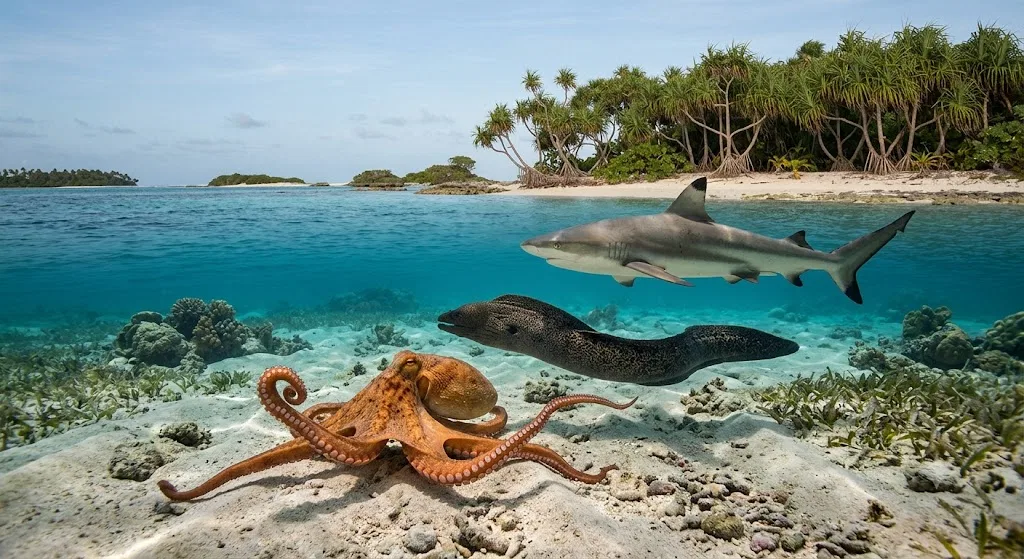
The creature most often pulled into cryptid and monster-pop-culture discussions is Na Kika, usually described online as an octopus figure from Gilbertese or Kiribati mythology. A careful reading should keep two versions apart. In older cultural material, Na Kika belongs to creation tradition. In modern pop culture, “Na Kika” has become a giant cephalopod-style monster name, especially in Godzilla fandom and MonsterVerse reference pages.
The most useful primary-style retelling available online comes from Museums Victoria’s Kiribati resource on the separation of earth and sky. In that story, Na Kika is not presented as a modern monster but as an octopus with ten legs. Nareau the Wise takes two of Na Kika’s legs and feeds them to Riiki, giving Riiki the strength to lift the sky. Riiki then raises the upper part of the world until it reaches its present height, while Nareau creates light, winds, food, water, trees, ocean, sun, moon and stars.[Museums Victoria]museumsvictoria.com.auMuseums Victoria The separation of earth and sky | Resources | Melbourne MuseumMuseums Victoria The separation of earth and sky | Resources | Melbourne Museum
That is powerful creature imagery, but it is not cryptozoological evidence. Na Kika is not a reported animal seen off Tarawa in a particular year. The octopus matters because its many limbs make mythic sense in a story about lifting, separating and shaping the world. Later web summaries sometimes simplify this into a more cryptid-friendly claim that Na Kika “used his arms” to raise land from the sea, but the more grounded point is broader: Kiribati creation tradition gives marine bodies cosmic work to do.[Godchecker - Your Guide to the Gods]godchecker.comYour Guide to the Gods NA KIKAYour Guide to the Gods NA KIKA
Na Kika’s modern afterlife shows how folklore can be re-skinned as monster entertainment. Wikizilla, a specialist fan reference for Godzilla media, notes that the MonsterVerse creature Na Kika is named after an octopus god from the Gilbert Islands, now part of Kiribati, and is treated in that fictional setting as a Titan-class cephalopod. That is pop culture borrowing, not a local sighting tradition. It tells us more about how global monster franchises harvest mythic names than it does about Kiribati belief.[Wikizilla]wikizilla.orgNa KikaNa Kika
Riiki the eel and the thin line between sacred animal and sea serpent
If Na Kika is the easiest creature to mistake for a “Kiribati kraken”, Riiki the eel is the more revealing figure. Katharine Luomala’s study of eels in Gilbert Islands culture describes eels as valued food and as prominent in ritual and myth, especially through Riiki, an eel god invoked with other great gods from the period of world creation. Luomala also records that some people avoided eating eels because the eel was a personal or clan totem and Riiki was understood as ancestor and god.[Persée]persee.frOpen source on persee.fr.
This is where Kiribati becomes especially interesting for a mystery-animal reader. In another country, a large eel in a lagoon might become a “sea serpent” story. In Kiribati, the eel is already thick with meaning before anyone needs to exaggerate its size. Luomala notes that people connected with eel totems could be understood as protected by Riiki in eel-inhabited waters, and that marine-creature totems could be conceived in human-like terms while also being linked to the animal form.[Persée]persee.frOpen source on persee.fr.
The likely sceptical explanation is therefore not “people invented a monster because they saw nothing”. It is subtler: people lived with real eels, reefs, lagoons, food restrictions and dangerous water, and those experiences became myth, taboo and social identity. A large eel seen in poor light can certainly look serpentine, but Kiribati’s eel material is better treated as sacred-animal tradition than as a lost-zoology case.
Sharks: feared animals, protected animals and cultural animals
Sharks occupy a different place from Na Kika and Riiki because they are not merely legendary. They are real, ecologically important animals in Kiribati waters, and they have become part of modern conservation policy as well as cultural memory. In 2015, Kiribati declared its waters a shark sanctuary, banning commercial shark fishing and wire traces for fishing vessels operating in its waters. The United Nations sustainable development partnership page says the sanctuary was intended to conserve sharks, protect marine ecosystem balance and support shark- and marine-related ecotourism, while still recognising traditional culture by allowing people of I-Kiribati descent to harvest sharks for food rather than commercial trade.[Sustainable Development Goals]sdgs.un.orgOpen source on un.org.
That modern policy gives shark folklore a practical edge. A shark near shore may be frightening, impressive or meaningful, but it is also part of a living marine system that the country has chosen to protect. Pew reported in 2016 that Kiribati’s sanctuary covered its 3.4 million-square-kilometre exclusive economic zone, larger than India, and was described as the world’s second-largest shark sanctuary at the time.[Pew Charitable Trusts]pew.orgOpen source on pew.org.
For cryptid readers, sharks are a reminder that not every “monster” needs to be unknown. Some of the most dramatic animals in Kiribati waters are completely real. The legendary charge comes from relationship: danger, respect, food, taboo, navigation, fishing skill and the sense that the ocean is inhabited by beings with agency. That is much more culturally grounded than trying to force Kiribati into a borrowed pattern of “giant shark monster” lore.

Where reports would cluster if Kiribati had a monster flap
Because the evidence for modern Kiribati cryptids is thin, it is useful to ask where such stories would plausibly cluster. The answer is around lagoons, reef passages, outer-island waters, fishing grounds and culturally important coastal places, not remote forests or mountain caves. Kiribati’s geography makes that almost unavoidable: it is a scattered atoll nation with small land area, wide ocean space and many low-lying coral islands.[Commonwealth]thecommonwealth.orgCommonwealth Kiribati | CommonwealthCommonwealth Kiribati | Commonwealth
The recurring creature types fit that map. Octopus stories belong to reef and lagoon imagination. Eel traditions belong to pools, traps, food rules and ritual practice. Shark stories belong to fishing, open water, danger and conservation. Turtle, stingray and spider figures belong to creation and origin stories as preserved in summary accounts of Kiribati legend.[Kiribati Tourism]kiribatitourism.gov.kiOpen source on kiribatitourism.gov.ki.
This matters because it prevents a common mistake: importing land-based cryptid expectations into a sea-based culture. A reader looking for Kiribati’s answer to Bigfoot will probably be disappointed. A reader looking for the way an atoll society turns marine life into cosmic architecture, ancestry and warning will find much richer material.
Misidentifications and natural explanations
The most likely natural explanations for any “monster-like” Kiribati animal account are ordinary but impressive marine animals seen under difficult conditions. Large eels can appear snake-like. Octopuses can look uncanny because of their arms, colour changes and flexible bodies. Sharks can be both dangerous and symbolically charged. Stingrays, turtles and large fish can also become strange shapes in shallow water, moonlight, surf or oral retelling.
That does not make the stories foolish. It makes them local. In Kiribati tradition, animals are not just biological specimens. They are food, relatives, warnings, clan signs, gods, ancestors and measures of proper behaviour. Luomala’s discussion of eel taboo shows that the creature’s meaning could shape who ate it, who avoided it and how people understood their own descent and protection.[Persée]persee.frOpen source on persee.fr.
A sceptical reading should therefore avoid two extremes. It should not present Na Kika, Riiki or shark traditions as proof of undiscovered giant beasts. But it should also not reduce them to “mistakes”. In Kiribati, the sea is both environment and archive. Creature stories preserve how people thought with animals, not just what they thought they saw.
Tourism, pop culture and the risk of turning tradition into a mascot
Kiribati is marketed to travellers through its remoteness, fishing, diving, cultural experiences and outer-island adventures, not through a monster-tourism brand. The Pacific Tourism Organisation describes Kiribati as a culturally rich island nation with 33 islands, world-class fishing, diving and outer-island adventure, while the national tourism office frames early history through creation myth, ancestral spirits and the development of Tungaru culture.[Pacific Tourism Organisation]southpacificislands.travelOpen source on southpacificislands.travel.
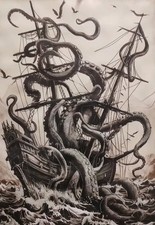
That makes the country’s creature lore attractive but easy to mishandle. A giant octopus mascot may be fun on a cryptid page, yet it can flatten a living cultural tradition into a novelty beast. Na Kika’s appearance in monster fandom is a good example: the name travels well because a giant octopus suits global kaiju storytelling, but the local tradition is not simply “Kiribati has a kraken”. It is a creation framework in which an octopus, an eel and creator figures participate in making a habitable world.[Wikizilla]wikizilla.orgNa KikaNa Kika
The better public-facing approach is to treat Kiribati as a country where marine folklore and mystery-animal interest overlap without becoming the same thing. The sea creatures are memorable enough for cryptid readers, but the most honest version of the story keeps folklore, real ecology and pop-culture reinvention in separate boxes.
What is known, what is not, and how to read the Kiribati creature tradition
The best-supported conclusion is that Kiribati’s country-level “cryptid” profile is folklore-heavy and sighting-light. There is no strong public record of a single modern monster case comparable to Loch Ness, Mokele-mbembe or the thylacine-afterlife tradition. The most important figures are mythic or culturally embedded marine beings: Na Kika the octopus in creation tradition, Riiki the eel in myth and taboo, and sharks as real animals with cultural and conservation significance.[com.au]museumsvictoria.com.auMuseums Victoria The separation of earth and sky | Resources | Melbourne MuseumMuseums Victoria The separation of earth and sky | Resources | Melbourne Museum
The evidence is strongest where it comes from cultural institutions, academic work and official conservation sources. Museums Victoria preserves a Kiribati creation narrative in which Na Kika and Riiki appear in the separation of earth and sky. Luomala’s article documents eel belief, taboo and ritual in Gilbert Islands culture. Kiribati’s own tourism and conservation materials show how creation stories, ancestral spirits and marine protection remain part of the country’s public identity.[com.au]museumsvictoria.com.auMuseums Victoria The separation of earth and sky | Resources | Melbourne MuseumMuseums Victoria The separation of earth and sky | Resources | Melbourne Museum
So the most accurate answer to “what is Kiribati’s cryptid?” is not a single hidden monster. It is a small cluster of sea-creature traditions that later readers may recognise as cryptid-adjacent: the octopus that belongs to creation, the eel that belongs to ancestry and taboo, and the shark that belongs to both danger and protection. Kiribati’s strange-creature history is not about proving a beast exists. It is about understanding why, in an atoll nation surrounded by immense ocean, animals of the reef and deep sea became large enough in story to help hold up the world.
Amazon book picks
Further Reading
Books and field guides related to Does Kiribati Have Its Own Sea Monster?. Use these as the next step if you want deeper reading beyond the article.
Myths and Legends of the Pacific
Introduces the wider Pacific tradition of sea beings and creation stories.
eBay marketplace picks
Marketplace Samples
Live-tested eBay searches with available results related to this page.
Endnotes
1.
Source: godchecker.com
Title: Your Guide to the Gods NA KIKA
Link:https://www.godchecker.com/micronesian-mythology/NA-KIKA/
2.
Source: wikizilla.org
Title: Na Kika
Link:https://wikizilla.org/wiki/Na_Kika
3.
Source: pew.org
Link:https://www.pew.org/en/research-and-analysis/articles/2016/11/29/kiribati-announces-worlds-second-largest-shark-sanctuary
4.
Source: cryptidz.fandom.com
Title: List of Cryptids
Link:https://cryptidz.fandom.com/wiki/List_of_Cryptids
5.
Source: cryptidz.fandom.com
Title: Sea Serpents
Link:https://cryptidz.fandom.com/wiki/Sea_Serpents
6.
Source: cryptidz.fandom.com
Link:https://cryptidz.fandom.com/wiki/Lusca
7.
Source: godzilla.fandom.com
Title: Na Kika
Link:https://godzilla.fandom.com/wiki/Na_Kika
8.
Source: lordverse.fandom.com
Title: Na Kika
Link:https://lordverse.fandom.com/wiki/Na_Kika
9.
Source: gods-and-mortals.fandom.com
Title: The Monsterverse: A New Dawn Awakens
Link:https://gods-and-mortals.fandom.com/wiki/The_Monsterverse%3A_A_New_Dawn_Awakens
10.
Source: multiversology.fandom.com
Title: Na Kika (Monster Verse)
Link:https://multiversology.fandom.com/wiki/Na_Kika_%28MonsterVerse%29
11.
Source: godzilla.fandom.com
Title: Na Kika
Link:https://godzilla.fandom.com/f/t/Na%20Kika
12.
Source: godchecker.com
Title: NE I TITUAABINE
Link:https://www.godchecker.com/micronesian-mythology/NEI-TITUAABINE/
13.
Source: godchecker.com
Link:https://www.godchecker.com/micronesian-mythology/explore/
14.
Source: thecommonwealth.org
Title: Commonwealth Kiribati | Commonwealth
Link:https://thecommonwealth.org/our-member-countries/kiribati
15.
Source: kiribatitourism.gov.ki
Link:https://www.kiribatitourism.gov.ki/kiribati-pacific-ocean-location/history/
16.
Source: southpacificislands.travel
Link:https://southpacificislands.travel/discover/countries/kiribati/
17.
Source: museumsvictoria.com.au
Title: Museums Victoria The separation of earth and sky | Resources | Melbourne Museum
Link:https://museumsvictoria.com.au/melbournemuseum/resources/tok-stori-vikitolia-pasifiki/kiribati/the-separation-of-earth-and-sky/
18.
Source: persee.fr
Link:https://www.persee.fr/doc/jso_0300-953x_1981_num
19.
Source: sdgs.un.org
Link:https://sdgs.un.org/partnerships/kiribatis-voluntary-commitment-shark-sanctuary
20.
Source: kiribatitourism.gov.ki
Link:https://www.kiribatitourism.gov.ki/
21.
Source: Wikipedia
Link:https://en.wikipedia.org/wiki/Kiribati
22.
Source: Wikipedia
Title: Sea serpent
Link:https://en.wikipedia.org/wiki/Sea_serpent
23.
Source: Wikipedia
Link:https://en.wikipedia.org/wiki/Nareau
24.
Source: mfed.gov.ki
Link:https://mfed.gov.ki/sites/default/files/2025-06/KIRIBATI%20BIODIVERSITY%20AREA%20Report%20-%20KBA%20REPORT%20FINAL.pdf
25.
Source: johanegerkrans.com
Title: sea serpent
Link:https://www.johanegerkrans.com/products/sea-serpent?srsltid=AfmBOop7APG66urDsMYn3dQjg9TY17FJRwMABCEA4xTaKv1zelPP9reH
26.
Source: good-travel.org
Link:https://www.good-travel.org/blog/how-to-be-a-good-traveller-in-kiribati
27.
Source: science.howstuffworks.com
Link:https://science.howstuffworks.com/science-vs-myth/strange-creatures/cryptids.htm
28.
Source: dfat.gov.au
Title: kiribati country brief
Link:https://www.dfat.gov.au/geo/kiribati/kiribati-country-brief
29.
Source: globaledge.msu.edu
Link:https://globaledge.msu.edu/countries/kiribati
30.
Source: ebsco.com
Link:https://www.ebsco.com/research-starters/geography-and-cartography/kiribati
Additional References
31.
Source: folkknowledgeplace.org
Link:https://folkknowledgeplace.org/article/141210-traditional-ecological-knowledge-in-kiribati-elders-insights-on-indigenous-fishing-practices.xml
32.
Source: researchgate.net
Link:https://www.researchgate.net/publication/279092781_The_cosmic_deep_blue_The_significance_of_the_celestial_water_world_sphere_across_cultures
33.
Source: instagram.com
Link:https://www.instagram.com/reel/DK_oKggNBla/
34.
Source: instagram.com
Link:https://www.instagram.com/p/DPuTe7tEu9w/
35.
Source: thegef.org
Link:https://www.thegef.org/sites/default/files/publications/Anote%20Tong%20on%20Kiribati.pdf
36.
Source: facebook.com
Link:https://www.facebook.com/kiribatikaraokeandmusic/videos/noong-nakita-kita/198771448405833/
37.
Source: pdfcoffee.com
Link:https://pdfcoffee.com/ap-8-9-pdf-free.html
38.
Source: repfocus.dk
Link:https://repfocus.dk/Elapidae_2_bibliography.html
39.
Source: alamy.com
Link:https://www.alamy.com/stock-photo/bottom-jaw.html
40.
Source: instagram.com
Link:https://www.instagram.com/p/B8-GncOpwXx/
Topic Tree
Follow this branch
Related pages 192
- Antigua Cryptids
- Maldives Monsters
- Malta Monsters
- Qatar Monsters
- Argentina Monsters
- +187 more in sidebar