Within Hungary Cryptids
Why Hungarian Monsters Start in Folklore
Hungary's older monster tradition is less like a hidden zoo and more like a world of dragons, nightmares, storms and dangerous waters.
On this page
- Dragons, storms and heroic tales
- Nightmare spirits and household fear
- Water, weather and supernatural danger
Page outline Jump by section
Introduction
Hungary’s deepest monster traditions do not begin with reports of unknown animals hiding in remote forests. They begin with dragons in thunderclouds, spirits that sit on sleepers in the night, and supernatural forces believed to live in rivers, marshes and storms. These older beliefs matter because they provide the cultural roots from which many later Hungarian monster stories grew. When modern readers encounter tales of strange beings in the hills or unexplained presences near water, they are often seeing echoes of a much older folklore landscape rather than evidence for a hidden species.
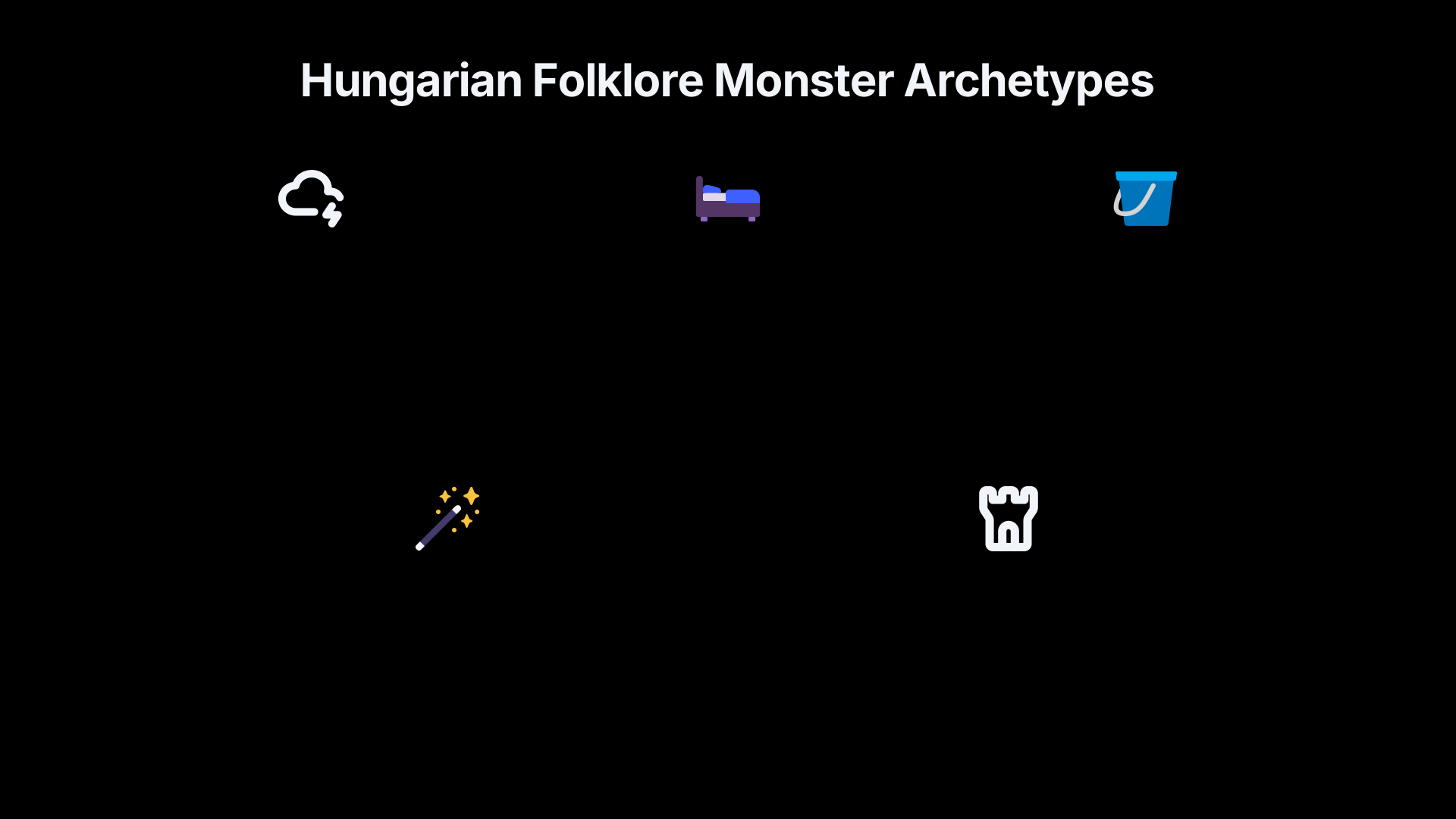
In Hungarian tradition, monsters were frequently explanations for dangerous weather, sudden illness, nightmares and the unpredictable power of nature. Dragons, night spirits and supernatural water beings formed a connected system of beliefs that helped communities make sense of storms, disease and fear long before modern science became widely available.[blogspot.com]multicoloreddiary.blogspot.comfolklore thursday two words stormMulticolored DiaryFolklore Thursday: Two words: Storm dragons21 Jan 2016 — Dragons in garabonciás lore are aquatic, serpentine creatures…
Why Hungarian Monsters Start in Folklore
Unlike countries whose best-known creature legends centre on a single lake monster or wildman, Hungary’s traditional monster world was woven into everyday life. Folklore linked strange events to invisible beings that could influence crops, weather, health and luck. A violent hailstorm was not simply bad weather; it might be the work of supernatural forces. A terrifying experience of waking unable to move might be explained as an attack by a night spirit.[Multicolored Diary]multicoloreddiary.blogspot.comfolklore thursday two words stormMulticolored DiaryFolklore Thursday: Two words: Storm dragons21 Jan 2016 — Dragons in garabonciás lore are aquatic, serpentine creatures…
This helps explain a recurring pattern in Hungarian monster traditions. The creatures are often tied to natural processes rather than isolated sightings. The monster is not merely seen; it causes something. Storms arrive, rivers become dangerous, livestock suffer, people fall ill, or travellers lose their way. The folklore focuses on consequences rather than physical evidence.[Multicolored Diary]multicoloreddiary.blogspot.comfolklore thursday two words stormMulticolored DiaryFolklore Thursday: Two words: Storm dragons21 Jan 2016 — Dragons in garabonciás lore are aquatic, serpentine creatures…
The result is a monster tradition that feels less like a catalogue of hidden beasts and more like a map of human anxieties projected onto the landscape.
Dragons, Storms and Heroic Tales
The dragon occupies a central place in Hungarian folklore, but it is not always the dragon familiar from Western fantasy. Hungarian dragon traditions contain several overlapping versions that evolved over centuries.[Wikipedia]WikipediaSárkány (mythologySárkány (mythology
One version appears in fairy tales as the classic many-headed monster. These dragons guard treasure, abduct maidens, challenge heroes and inhabit distant castles. They often possess human characteristics, wield weapons and behave more like powerful supernatural rulers than giant reptiles. Seven-headed dragons are especially common, although dragons with three, nine, twelve or even more heads appear in folktales.[Wikipedia]WikipediaHungarian mythologyHungarian mythology
Another tradition links dragons directly to weather. In folk belief, dragons were associated with thunderstorms, hail and destructive winds. The roaring of thunder could be interpreted as dragons battling above the clouds. Some stories described dragons striking clouds with their tails, releasing torrents of rain onto the countryside.[Wikipedia]WikipediaSárkány (mythologySárkány (mythology
A particularly distinctive figure in Hungarian folklore is the garabonciás, a wandering magical scholar or wizard. According to folk tradition, the garabonciás could summon or control dragons and ride them through storm clouds. Villagers sometimes believed severe storms were caused by these supernatural riders crossing the sky. In some regions, offering hospitality to a travelling stranger was considered important because a mistreated garabonciás might respond by bringing hail or destructive weather.[Multicolored Diary]multicoloreddiary.blogspot.comfolklore thursday two words stormMulticolored DiaryFolklore Thursday: Two words: Storm dragons21 Jan 2016 — Dragons in garabonciás lore are aquatic, serpentine creatures…
These stories reveal an important feature of Hungarian monster lore. Dragons were not simply enemies. They acted as forces of nature, linking the human world with storms, rain and agricultural fortune.[Multicolored Diary]multicoloreddiary.blogspot.comfolklore thursday two words stormMulticolored DiaryFolklore Thursday: Two words: Storm dragons21 Jan 2016 — Dragons in garabonciás lore are aquatic, serpentine creatures…
Dragons as Symbols Rather Than Animals
From a cryptid perspective, Hungarian dragons are best understood as folklore creatures rather than hidden-animal claims. They belong to the symbolic world of myth, where dragons often represent chaos, danger or the untamed forces of nature.
Many heroic folktales revolve around defeating dragons to restore balance. The hero’s struggle is frequently interpreted by folklorists as a symbolic confrontation with disorder, fear or destructive power. Later Hungarian literature even transformed dragons from villains into sympathetic figures, showing how the creature evolved alongside changing cultural attitudes.[Wikipedia]WikipediaSárkány (mythologySárkány (mythology

Nightmare Spirits and Household Fear
If dragons represented the dangers of storms and wilderness, the most intimate monster in Hungarian folklore was the lidérc, a night spirit associated with fear, exhaustion and mysterious illness.[Wikipedia]WikipediaOpen source on wikipedia.org.
The lidérc appears in several forms across Hungarian tradition. Sometimes it is described as a fiery apparition moving through the night sky. In other stories it takes human form or appears as a supernatural companion attached to a particular person. The details vary from region to region, but one feature appears repeatedly: the lidérc presses upon sleeping people.[Wikipedia]WikipediaOpen source on wikipedia.org.
This belief survives linguistically in the Hungarian term for nightmare, which literally translates as “lidérc pressure”. The description closely resembles what modern medicine identifies as sleep paralysis, a frightening state in which a person wakes but cannot move and may feel a heavy weight on the chest. Before scientific explanations existed, the experience was often interpreted as a supernatural attack.[Wikipedia]WikipediaOpen source on wikipedia.org.
The lidérc therefore occupies an interesting place between folklore and human psychology. Unlike dragons, which belong to heroic tales and cosmic struggles, the lidérc operates inside homes and bedrooms. It transforms a private fear into a creature with motives and personality.
Stories about night spirits also reveal how communities attempted to manage uncertainty. Traditional protections included prayers, incense, blessed objects and household rituals intended to keep harmful supernatural visitors away.[Wikipedia]WikipediaOpen source on wikipedia.org.
From Folk Demon to Modern Monster
The lidérc demonstrates how old folklore can survive long after belief declines. Modern Hungarians may not literally fear a supernatural being sitting on their chest at night, yet the creature remains a powerful cultural image. It appears in fiction, folklore collections and discussions of traditional beliefs, preserving an older explanation for experiences that people still encounter today.[Wikipedia]WikipediaOpen source on wikipedia.org.
For students of monster traditions, the lidérc is a reminder that not every monster originates from sightings of mysterious animals. Some emerge from recurring human experiences that demand explanation.
Water, Weather and Supernatural Danger
Hungary’s rivers, marshes and lakes also contributed to its folklore monster landscape. Although the country lacks a globally famous lake monster, water remained a major source of supernatural danger in traditional belief.[World of Souza]worldofsouza.comWorld of Souza3 folklore creatures the Souzaverse hopes to meet in…June 26, 2025 — 26 Jun 2025 — These tales were shaped by a mix of C…
Before modern flood control and weather forecasting, rivers such as the Danube and Tisza could be unpredictable and deadly. Floods, sudden storms and drowning accidents required explanation. Folklore often filled that role by populating dangerous places with supernatural beings, spirits or dragon-like forces associated with water and weather.[Wikipedia]WikipediaSárkány (mythologySárkány (mythology
Dragon legends frequently blur the boundary between water and sky. Some traditions describe dragons emerging from marshes, rivers or lakes before rising into storm clouds. Others claim dragons originated from transformed animals and later became airborne forces connected with thunder and rain. These stories create a chain linking wetlands, weather and supernatural power.[Wikipedia]WikipediaSárkány (mythologySárkány (mythology
The pattern is not unique to Hungary. Across Central and Eastern Europe, dragons often functioned as explanations for destructive weather. What makes the Hungarian tradition distinctive is the strong connection between dragons, wandering magical figures and agricultural concerns. Storms were not distant mythological events; they threatened harvests and livelihoods.[Multicolored Diary]multicoloreddiary.blogspot.comfolklore thursday two words stormMulticolored DiaryFolklore Thursday: Two words: Storm dragons21 Jan 2016 — Dragons in garabonciás lore are aquatic, serpentine creatures…

How Folklore Shaped Later Monster Stories
Modern Hungarian mystery-creature reports emerged in a country already rich with stories about dangerous forests, magical travellers, storm dragons and night spirits. Even when contemporary accounts involve seemingly physical creatures, older folklore provides the imaginative framework through which unusual experiences are interpreted.
A strange figure glimpsed at dusk, an unexplained scream in woodland, or a frightening experience near water can acquire meaning because the culture already possesses a vocabulary of supernatural beings. The folklore does not prove modern creature claims, but it helps explain why certain stories feel believable and why some legends persist.[World of Souza]worldofsouza.comWorld of Souza3 folklore creatures the Souzaverse hopes to meet in…June 26, 2025 — 26 Jun 2025 — These tales were shaped by a mix of C…
That is why Hungary’s monster heritage is best understood not as a hidden zoology but as a long conversation between people and landscape. Dragons explained storms. Night spirits explained nightmares. Water-linked beings explained danger in rivers and marshes. Together they created the foundation upon which later mystery-beast traditions would be built.[blogspot.com]multicoloreddiary.blogspot.comfolklore thursday two words stormMulticolored DiaryFolklore Thursday: Two words: Storm dragons21 Jan 2016 — Dragons in garabonciás lore are aquatic, serpentine creatures…
Amazon book picks
Further Reading
Books and field guides related to Why Hungarian Monsters Start in Folklore. Use these as the next step if you want deeper reading beyond the article.
The Element Encyclopedia of Magical Creatures
Strong fit for dragons, spirits and folklore monsters.
The Book of Imaginary Beings
Relevant to the symbolic creatures of Hungarian tradition.
eBay marketplace picks
Marketplace Samples
Live-tested eBay searches with available results related to this page.
Endnotes
1.
Source: Wikipedia
Title: Hungarian mythology
Link:https://en.wikipedia.org/wiki/Hungarian_mythology
2.
Source: Wikipedia
Title: Sárkány (mythology)
Link:https://en.wikipedia.org/wiki/S%C3%A1rk%C3%A1ny_%28mythology%29
3.
Source: Wikipedia
Link:https://en.wikipedia.org/wiki/Lid%C3%A9rc
4.
Source: multicoloreddiary.blogspot.com
Title: folklore thursday two words storm
Link:https://multicoloreddiary.blogspot.com/2016/01/folklore-thursday-two-words-storm.html
Source snippet
Multicolored DiaryFolklore Thursday: Two words: Storm dragons21 Jan 2016 — Dragons in garabonciás lore are aquatic, serpentine creatures...
5.
Source: worldofsouza.com
Link:https://www.worldofsouza.com/post/3-folklore-creatures-the-souzaverse-hopes-to-meet-in-hungary
Source snippet
World of Souza3 folklore creatures the Souzaverse hopes to meet in...June 26, 2025 — 26 Jun 2025 — These tales were shaped by a mix of C...
Published: June 26, 2025
Additional References
6.
Source: mrmusette.ro
Link:https://mrmusette.ro/hungarian-folk-tails/
Source snippet
HUNGARIAN FOLK TAILSIllustrations inspired by the Hungarian Folk Tails. The Garabonciás and the Sárkány (Dragon). Garabonciás is a supern...
7.
Source: facebook.com
Link:https://www.facebook.com/groups/dragon.lovers.community/posts/655165081525167/
Source snippet
Hungarian mythology and folklore about dragonsThe dragons of the Hungarian folktales usually live in dark forests or underground caves in...
8.
Source: instagram.com
Link:https://www.instagram.com/reel/DQC5ZDZEYHP/
Source snippet
THE PORTAL OPENS — Hungarian Horror Folklore Awakes...From the flaming breath of Lidérc, to the storm-born rage of Mura-kobold, Hungaria...
9.
Source: facebook.com
Link:https://www.facebook.com/groups/124268025140018/posts/617357089164440/
10.
Source: youtube.com
Link:https://www.youtube.com/watch?v=YALjN8bL3wQ&vl=en
Source snippet
Mythical Creatures and Monsters of Hungarian FolkloreThe enchanting world of Hungarian folklore, full with mythical creatures, dark magic...
11.
Source: budgetpixel.com
Title: ultimate list of mythical creatures from hungarian folklore
Link:https://budgetpixel.com/blog/ultimate-list-of-mythical-creatures-from-hungarian-folklore
Source snippet
5 May 2026 — There is an infinite number of these Folklores these are most known and rare. Plus from other countries the list is huge.Rea...
Published: May 2026
12.
Source: fromhungarywithlove.wordpress.com
Title: dragons in the hungarian tales and mythology
Link:https://fromhungarywithlove.wordpress.com/2017/02/24/dragons-in-the-hungarian-tales-and-mythology/
Source snippet
Dragons in the Hungarian Tales and Mythology24 Feb 2017 — The dragons of the Hungarian mythology were the symbols of t...
13.
Source: instagram.com
Link:https://www.instagram.com/reel/DM7e_IVeT/?hl=en
Source snippet
irits born under mysterious omens—often with extra bones or teeth...
14.
Source: youtube.com
Title: Folklore and Mythology Part 3
Link:https://www.youtube.com/watch?v=QdNslqs1UJk
Source snippet
Stories from Hungary and...The third and final part of the Hungarian-Malaysian folklore stories! Come join Petra and Nelvin as they shar...
15.
Source: youtube.com
Title: Every Mythical Creature That Comes for Your Children Explained
Link:https://www.youtube.com/watch?v=Pxf9R_HL_Dk
Source snippet
Monsters and Mythical Creatures of Love and Lust...
Topic Tree