Within Honduran Monsters
Is the Sisimite Honduras' Bigfoot?
The Sisimite is Honduras' strongest Bigfoot-like tradition, rooted in mountain caves, backward tracks, and old forest warnings.
On this page
- The cave dwelling mountain figure
- Backward feet, abduction tales, and forest warnings
- Why folklore is stronger than physical evidence
Page outline Jump by section
Introduction
The Sisimite is the closest thing Honduras has to a native Bigfoot tradition, but the comparison only goes so far. In Honduran folklore, the creature is not simply an unknown ape wandering the wilderness. It is a cave-dwelling mountain being associated with remote forests, backward-facing feet, great strength, and stories that warn people about the dangers of isolated landscapes. For generations, tales of the Sisimite have circulated in rural communities, particularly in mountainous regions where caves, cloud forests, and difficult terrain encourage both mystery and storytelling.[Wikipedia]WikipediaOpen source on wikipedia.org.

The key question is whether the Sisimite is best understood as an undiscovered animal, a remembered folk figure, or something in between. When the available evidence is examined, the folklore proves rich and deeply rooted, while the physical evidence remains remarkably thin. That contrast explains why the Sisimite remains one of Honduras’s most enduring mystery creatures.
The cave-dwelling mountain figure
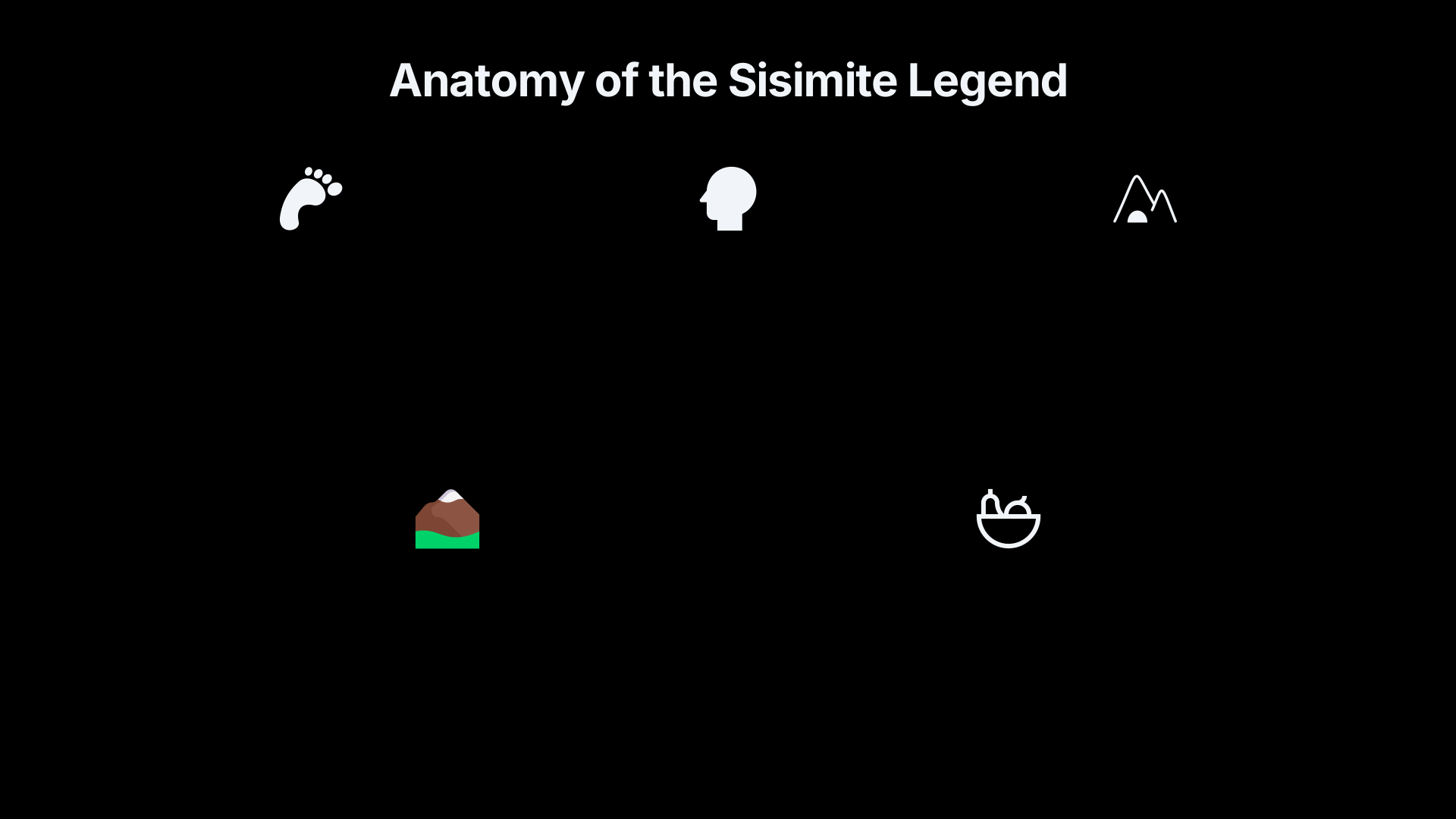
Descriptions of the Sisimite are surprisingly consistent across many versions of the legend. The creature is usually portrayed as a large, hairy humanoid with ape-like features, standing upright and living in inaccessible mountain caves. Stories often place it high in the Honduran mountains, emerging from forests or rocky caverns far from settlements.[Wikipedia]WikipediaOpen source on wikipedia.org.
One of the most influential descriptions comes from Honduran folklorist and cartographer Jesús Aguilar Paz, who collected oral traditions during his extensive travels across the country in the early twentieth century. In his account, the Sisimite inhabited remote caves in the mountains and survived on wild berries and other forest foods. Rather than presenting the creature as a biological discovery, Aguilar Paz treated it as part of Honduras’s living folklore tradition.[Wikipedia]WikipediaTradiciones y leyendas de Honduras (libroTradiciones y leyendas de Honduras (libro
The creature’s names vary between regions and communities. Sisimite, Sisimito, Sisimita and Itacayo all appear in different accounts. Similar legends also occur in neighbouring countries, including Belize, Guatemala and Nicaragua, suggesting a broader Central American wild-man tradition rather than an isolated Honduran invention.[Wikipedia]WikipediaOpen source on wikipedia.org.
This regional spread is important. It shows that the Sisimite belongs to a long-running folklore complex that predates modern Bigfoot culture. While contemporary writers sometimes label it the “Bigfoot of Honduras”, the legend developed within local traditions rather than emerging from North American cryptozoology.[Wikipedia]WikipediaOpen source on wikipedia.org.
Backward feet, abduction tales, and forest warnings
The most famous feature of the Sisimite is its backward-facing feet. According to the legend, its tracks point in the opposite direction from its actual movement, making it almost impossible to follow. In some versions the creature’s legs are unusual or seemingly knee-less, adding to the sense that it is not quite human.[Wikipedia]WikipediaOpen source on wikipedia.org.
From a folkloric perspective, backward feet are especially significant. Similar motifs appear in legends across Latin America and South Asia, where supernatural beings use reversed footprints to confuse travellers. Rather than functioning as a biological detail, the trait works as a narrative explanation for why the creature can never be tracked successfully. A hunter who follows footprints deeper into the mountains may unknowingly be travelling in exactly the wrong direction.[Wikipedia]WikipediaOpen source on wikipedia.org.
Many stories also portray the Sisimite as a threat to women. Traditional accounts describe it descending from the mountains to abduct women and carry them back to hidden caves. These tales are among the darkest elements of the legend and appear repeatedly in Honduran and neighbouring Central American versions. Some stories even claim that offspring resulted from these encounters, creating a lineage of ape-like mountain people.[Wikipedia]WikipediaOpen source on wikipedia.org.
Modern readers often interpret these narratives less as reports of actual encounters and more as cautionary folklore. In isolated rural communities, stories about a dangerous being lurking beyond settled areas could discourage children from wandering into forests, caves, ravines and other hazardous places. The Sisimite becomes both monster and warning sign, embodying the risks of entering the wilderness alone.[Wikipedia]WikipediaOpen source on wikipedia.org.
What evidence do believers point to?
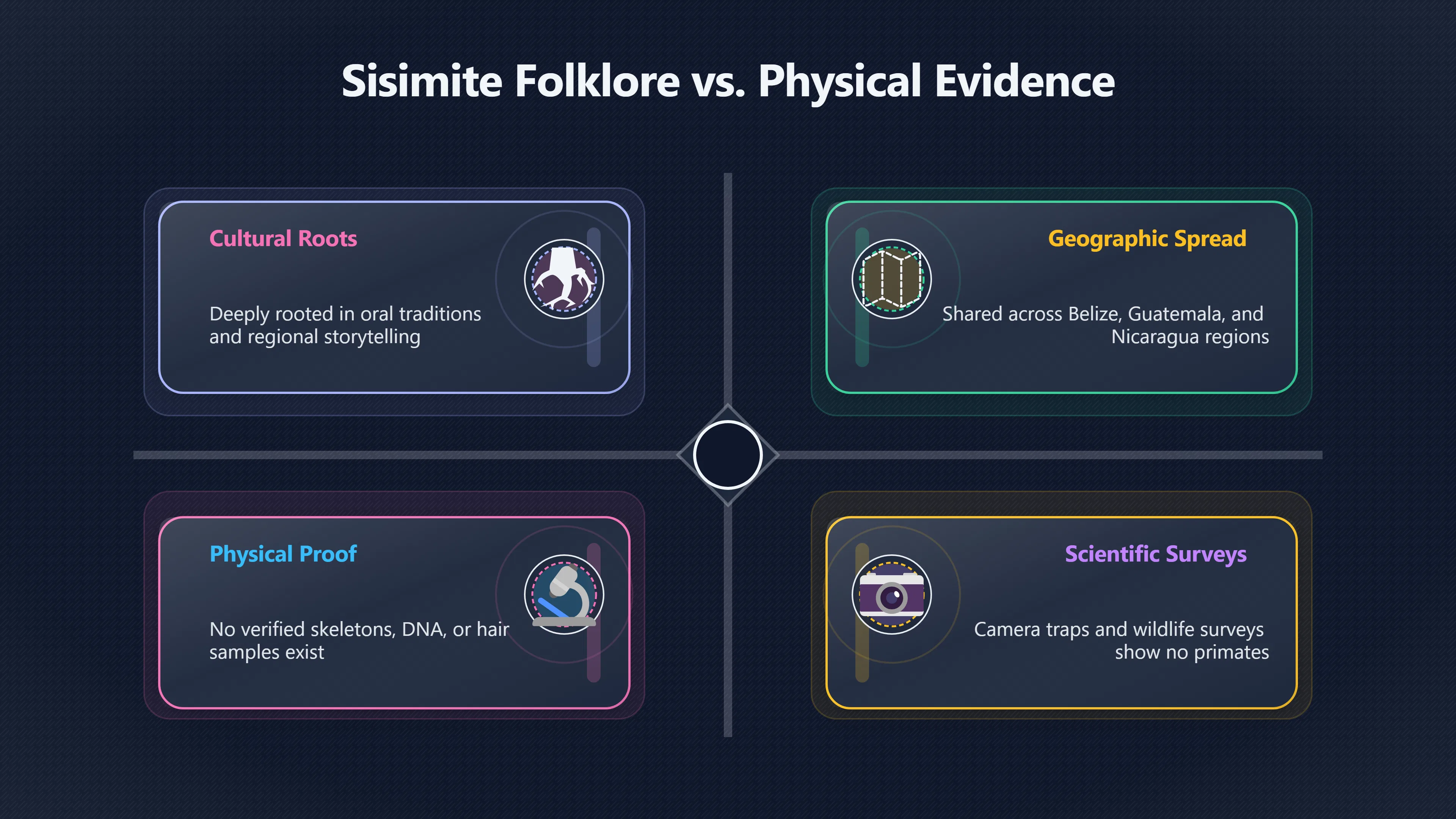
Unlike some famous cryptids, the Sisimite has never been supported by a widely accepted photograph, body, skeleton, hair sample or verified footprint cast. The evidence cited by believers generally falls into three categories: eyewitness stories, reported tracks, and the persistence of local testimony.[Wikipedia]WikipediaOpen source on wikipedia.org.
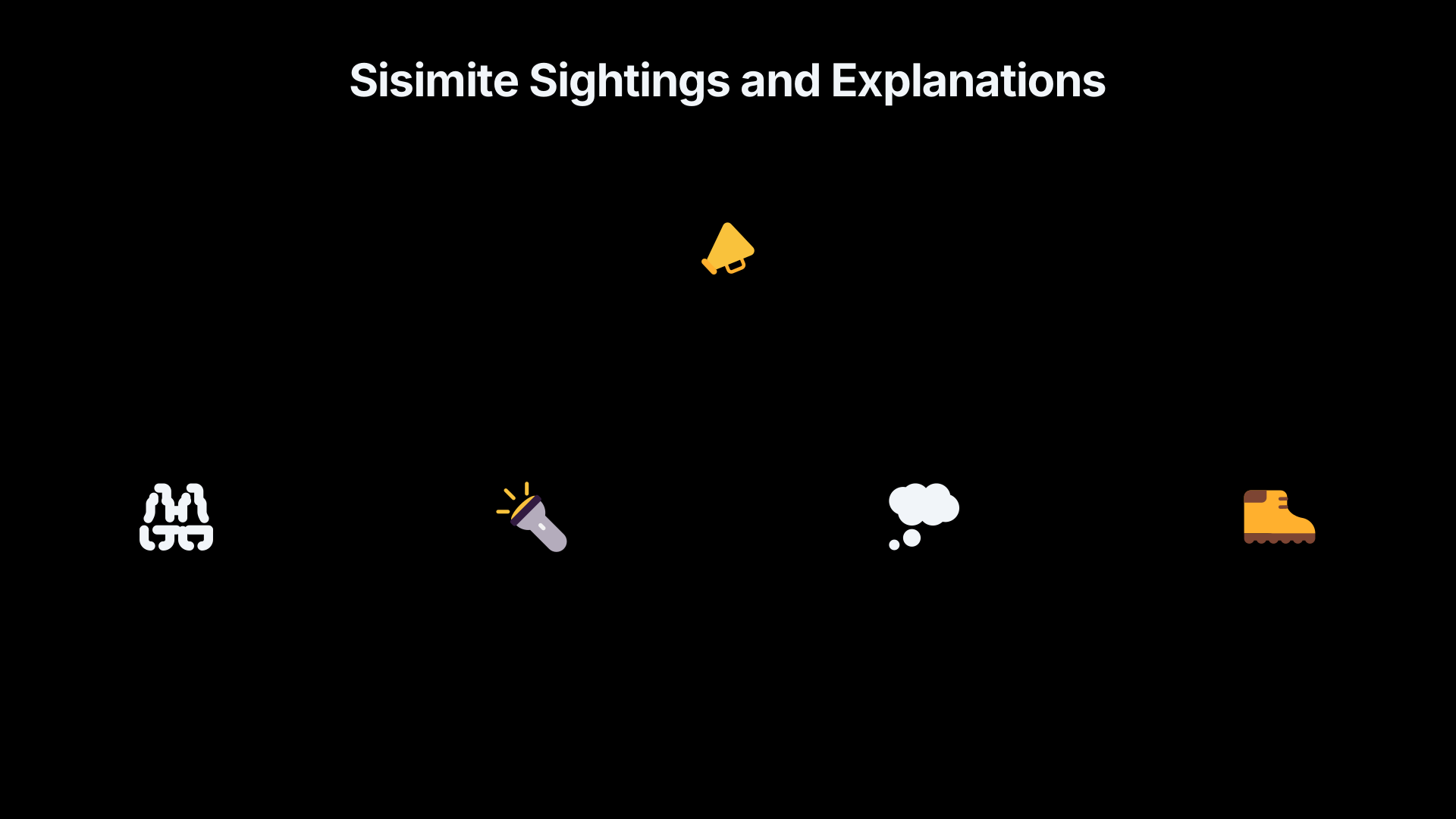
Eyewitness accounts typically describe:
- A large hairy figure seen briefly near forest edges.
- Strange footprints in muddy mountain terrain.
- Unusual sounds or screams heard near caves.
- Encounters in remote areas where visibility is poor and access is difficult.[Wikipedia]WikipediaOpen source on wikipedia.org.
Such reports are difficult to evaluate because they are usually second-hand, lack physical documentation, and often emerge from oral tradition rather than formal investigation. Many accounts were transmitted through families and communities long before anyone attempted to collect them systematically.[Wikipedia]WikipediaTradiciones y leyendas de Honduras (libroTradiciones y leyendas de Honduras (libro
Supporters sometimes argue that Honduras’s rugged terrain leaves room for unknown animals. The country’s mountainous forests, caves and historically isolated regions certainly helped sustain the legend. Yet no biological evidence has emerged despite decades of increased access, wildlife surveys, conservation work and camera-trap projects in Honduran forests.[Wikipedia]WikipediaOpen source on wikipedia.org.
Why folklore is stronger than physical evidence
The strongest case for the Sisimite is cultural rather than zoological. The legend has deep roots, broad geographic distribution and a stable set of recurring traits. Folklorists can trace its presence through oral traditions, published collections and regional storytelling stretching back many decades.[Wikipedia]WikipediaTradiciones y leyendas de Honduras (libroTradiciones y leyendas de Honduras (libro
The case for the Sisimite as an undiscovered ape-man is much weaker. No verified specimen exists. No DNA evidence has been presented. No scientific survey has produced convincing proof of a large unknown primate living in Honduras. The reports remain anecdotal and often blend naturally into traditional storytelling.[Wikipedia]WikipediaOpen source on wikipedia.org.
Several non-mysterious explanations have been suggested for alleged sightings:
- Misidentification of known animals in poor light.
- Exaggerated retellings of unusual encounters.
- Folklore influencing witness expectations.
- Stories adapted and embellished over generations.
- Confusion caused by difficult mountain terrain and incomplete observations.[Wikipedia]WikipediaOpen source on wikipedia.org.
Interestingly, these explanations do not diminish the legend’s importance. In many ways, the Sisimite survives precisely because it functions as folklore rather than wildlife. It expresses fears about isolation, caves, forests and the unknown edges of human settlement. The creature’s backward tracks, hidden caves and elusive behaviour make it almost perfectly designed to resist verification.
Why the Sisimite remains Honduras’s enduring wild man
Among Honduras’s many supernatural and mystery-creature traditions, the Sisimite occupies a unique position. It combines the appeal of an ape-man cryptid with much older themes of wilderness spirits, mountain giants and cautionary folk tales. Unlike imported monster stories, it is deeply tied to Honduran landscapes and oral tradition.[Wikipedia]WikipediaOpen source on wikipedia.org.
For readers searching for a Honduran equivalent of Bigfoot, the Sisimite is the obvious candidate. Yet its lasting significance lies less in the possibility of an undiscovered primate and more in what the legend reveals about life around mountains, forests and caves. The evidence for a real creature remains sparse, but the evidence for a powerful and enduring piece of Honduran folklore is overwhelming.[Wikipedia]WikipediaOpen source on wikipedia.org.
Amazon book picks
Further Reading
Books and field guides related to Is the Sisimite Honduras' Bigfoot?. Use these as the next step if you want deeper reading beyond the article.
Field Guide To Bigfoot, Yeti, & Other Mystery Primates Worldwide
Closest commercial shelf category to the Sisimite.

eBay marketplace picks
Marketplace Samples
Live-tested eBay searches with available results related to this page.


Endnotes
1.
Source: Wikipedia
Link:https://es.wikipedia.org/wiki/Sisimite
2.
Source: Wikipedia
Link:https://en.wikipedia.org/wiki/Sisimito
3.
Source: Wikipedia
Title: Tradiciones y leyendas de Honduras (libro)
Link:https://es.wikipedia.org/wiki/Tradiciones_y_leyendas_de_Honduras_%28libro%29
4.
Source: Wikipedia
Title: Jesús Aguilar Paz
Link:https://en.wikipedia.org/wiki/Jes%C3%BAs_Aguilar_Paz
5.
Source: facebook.com
Link:https://www.facebook.com/unrulynationn/posts/sisimito-the-backward-footed-beast-of-belize/122118916436417000/
Source snippet
The Backward-Footed Beast of BelizeLegends of Abduction: A common (and darker) theme in the folklore is the Sisimito's tendency to descen...
6.
Source: instagram.com
Link:https://www.instagram.com/reel/DFRWJJdRLru/?hl=en
Source snippet
The Backward-Footed Beast of BelizeSisimitos are said to rip off thumbs and follow human footprints. But they fear water, dogs and can be...
7.
Source: cryptidz.fandom.com
Link:https://cryptidz.fandom.com/f/t/Sisimito
Source snippet
Discuss Everything About Cryptid Wiki | Fandom25 Dec 2024 — In Belizean and Honduran folklore, the Sisimito (alternatively called Sisimit...
Additional References
8.
Source: xplorhonduras.com
Link:https://www.xplorhonduras.com/el-sisimite/
Source snippet
El Sisimite | Cuentos y Leyendas de HondurasSegún narra la leyenda, El Sisimite, también conocido como Itacayo es un monstruo muy parecid...
9.
Source: reddit.com
Link:https://www.reddit.com/r/bigfoot/comments/mpke8g/i_am_from_belize_here_in_our_country_theres_folk/
Source snippet
sisemite female and sisimito male..i have heard somthing along the line of they are dirty spirits that...Read more...
10.
Source: youtube.com
Link:https://www.youtube.com/watch?v=H5CrJSd-eeU
11.
Source: academia.edu
Link:https://www.academia.edu/44477543/CRIPTOZOOLOG%C3%8DA_E_HISTORIA_NATURAL_UNA_APROXIMACI%C3%93N_AL_MITO_DEL_SISIMITE
Source snippet
Dentro de la tradición oral hondureña se rescata el mito del Sisimite, criatura homínida...
12.
Source: facebook.com
Link:https://www.facebook.com/100063740726941/posts/syn-honduras-esta-persona-es-un-ser-humano-que-le-dicen-sisimite-el-asegura-ser-/190450426243554/
Source snippet
🔷#SyN 🔷#HONDURAS // Esta Persona es un ser Humano...El Sisimite es una de las leyendas más conocidas del territorio hondureño...
13.
Source: instagram.com
Title: “Have you ever heard about the sisimite?
Link:https://www.instagram.com/p/DBp2O_Ts7yH/?hl=en
Source snippet
In Mexico and...There's stories about this ape-like creature that haunts mountains and forests and hides in caves. It varies in size, wi...
14.
Source: reddit.com
Link:https://www.reddit.com/r/Cryptozoology/comments/11rhbzy/the_sisimit%C3%A9_is_a_cryptid_primate_reported_from/
Source snippet
s describe the Sisimité as being very aggressive.Read more...
15.
Source: ambergriscaye.com
Link:https://ambergriscaye.com/25years/elsisimito.html
Source snippet
s hairy and looked like a gorilla.Read more...
16.
Source: youtube.com
Title: The White City (La Ciudad Blanca): The Jungle’s Buried Secret
Link:https://www.youtube.com/watch?v=vALHQkANTkg
Source snippet
Sisimite cryptid Honduras Sisimite en Honduras: ¿Mito o Monstruo? - “captado en cámara” MYTHS CAUGHT ON CCTV...
17.
Source: youtube.com
Link:https://www.youtube.com/watch?v=giOxGwFjKUw
Source snippet
The White City (La Ciudad Blanca): The Jungle’s Buried Secret...
Topic Tree