Within Uganda Monsters
How Did the Lukwata Become a Monster?
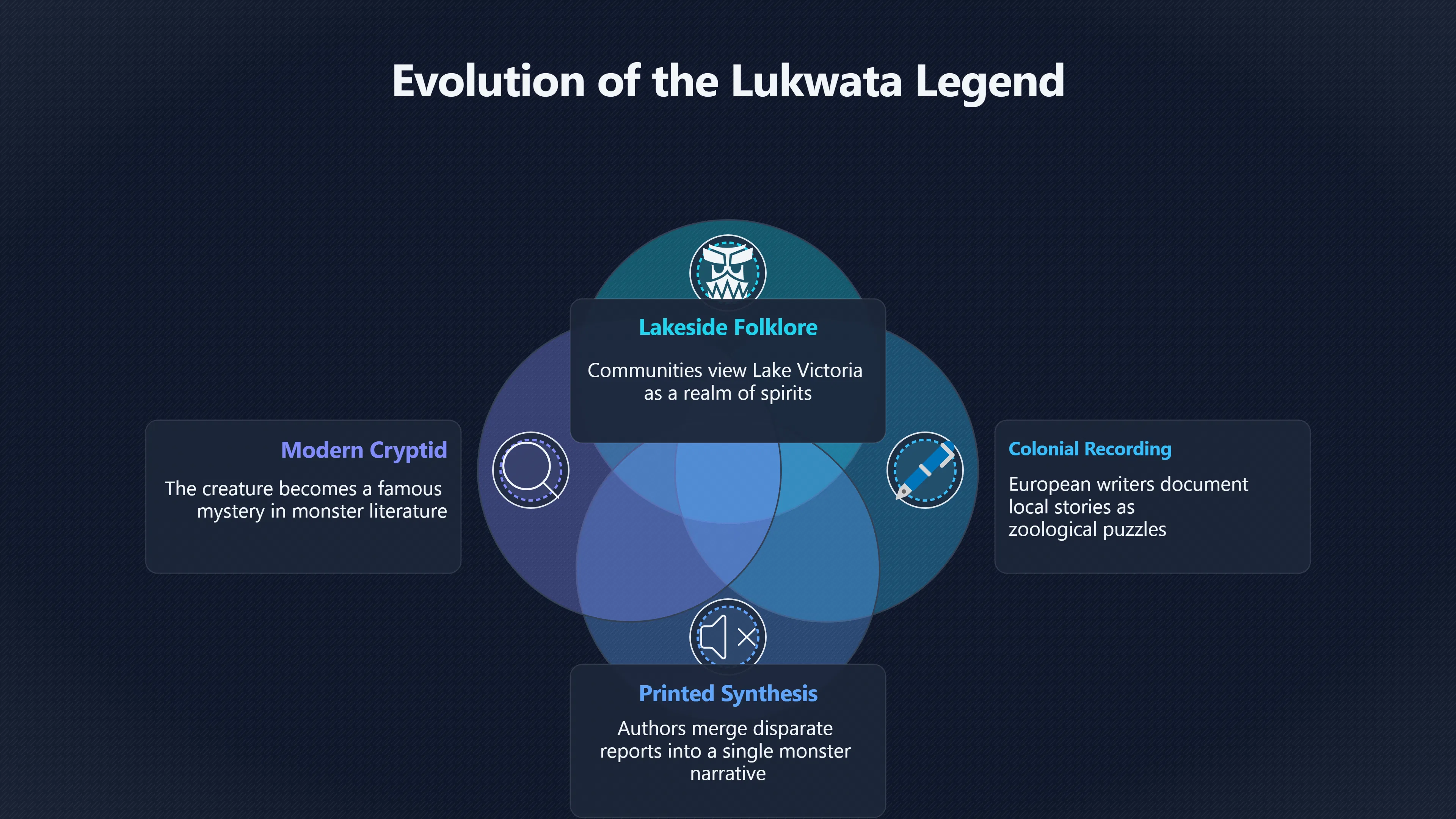
The Lukwata changed from a lakeside water being into a composite monster shaped by colonial writing and later cryptozoology.
On this page
- Lakeside folklore and spiritual meaning
- Colonial collectors and early printed accounts
- How later writers reshaped the creature
Page outline Jump by section
Introduction
The Lukwata did not begin as a neatly defined “lake monster”. What later became Uganda’s most famous mystery creature emerged from a much older world of lakeside beliefs, spiritual forces and stories about the dangers of Lake Victoria. By the early twentieth century, colonial administrators, travellers and naturalists were collecting local traditions and trying to interpret them as evidence of an unknown animal. Over time, those written accounts were repeated, expanded and combined until the Lukwata acquired the familiar shape of a cryptozoological lake monster.[Cryptid Archives]cryptidarchives.fandom.comCryptid Archives Lukwata | Encyclopaedia of Cryptozoologylukwata. In 1913, Hobley reported that the lukwata was known on the (now) Ugandan and Kenyan shores of the lake, and was said to sometime…

Understanding how that transformation happened is more revealing than asking whether the creature was real. The Lukwata’s history shows how folklore, colonial observation and later monster-hunting literature can reshape the same tradition into very different things. What began as a powerful lakeside being associated with danger and supernatural power gradually became Uganda’s equivalent of Loch Ness’s famous resident.[JSTOR]jstor.orgKenny Anthropos … powers of Lake Victoria made themselves evident through beings usually, spirit Mukasa (…
Lakeside Folklore Before the Monster
Long before the Lukwata appeared in cryptozoological books, communities around Lake Victoria already viewed the lake as a place of extraordinary power. Anthropological studies of the region describe a rich network of beliefs linking the lake to spirits, sacred forces, fertility, protection and danger. Water was not simply part of the landscape; it was a realm inhabited by powers that demanded respect.[jstor.org]jstor.orgKenny Anthropos … powers of Lake Victoria made themselves evident through beings usually, spirit Mukasa (…
Within that setting, stories about dangerous water beings served several purposes. They explained sudden deaths, storms, whirlpools and accidents that could strike fishermen without warning. Some traditions associated mysterious creatures with places where the lake seemed especially unpredictable. Early descriptions connected the Lukwata not only with a physical creature but also with unusual lake phenomena and feared stretches of water.[Cryptid Archives]cryptidarchives.fandom.comCryptid Archives Lukwata | Encyclopaedia of Cryptozoologylukwata. In 1913, Hobley reported that the lukwata was known on the (now) Ugandan and Kenyan shores of the lake, and was said to sometime…
This helps explain why descriptions of the Lukwata varied so widely. In some accounts it resembled a giant serpent. In others it appeared more fish-like or even cetacean-like. Such inconsistency is common when a being functions primarily as a cultural symbol rather than as a consistently observed animal. The important idea was often the creature’s power and danger, not its exact anatomy.[Cryptid Archives]cryptidarchives.fandom.comCryptid Archives Lukwata | Encyclopaedia of Cryptozoologylukwata. In 1913, Hobley reported that the lukwata was known on the (now) Ugandan and Kenyan shores of the lake, and was said to sometime…
Colonial Collectors and Early Printed Accounts
The shift from folklore to “monster” began when European writers started recording stories from around Lake Victoria.
One of the earliest influential descriptions appeared in Sir Harry Johnston’s The Uganda Protectorate in 1904. Johnston reported persistent rumours of a creature called the Lukwata and speculated that witnesses might have seen a giant fish, a manatee-like animal or something else unknown. By presenting the tradition as a zoological puzzle, he encouraged readers to think of the Lukwata as a possible undiscovered species rather than a figure embedded in local belief.[Cryptid Archives]cryptidarchives.fandom.comCryptid Archives Lukwata | Encyclopaedia of Cryptozoologylukwata. In 1913, Hobley reported that the lukwata was known on the (now) Ugandan and Kenyan shores of the lake, and was said to sometime…
Other travellers followed a similar pattern. John Cathcart Wason repeated dramatic reports of a creature raising its head and neck high above the lake surface. Such stories were often second-hand, collected from local informants rather than observed directly by the writers themselves. Nevertheless, once printed, they acquired an authority that oral stories rarely possessed in colonial scientific circles.[Cryptid Archives]cryptidarchives.fandom.comCryptid Archives Lukwata | Encyclopaedia of Cryptozoologylukwata. In 1913, Hobley reported that the lukwata was known on the (now) Ugandan and Kenyan shores of the lake, and was said to sometime…
The most important figure in this transition was British administrator Charles William Hobley. In 1913 he documented reports from both the Ugandan and Kenyan shores of Lake Victoria, noting stories that the Lukwata attacked canoes and frightened fishermen. Hobley did not claim to have discovered a new animal. In fact, he openly wondered whether large pythons might explain some reports. Yet by preserving the stories in a geographical journal, he transformed local traditions into material that later monster researchers could cite as evidence.[Cryptid Archives]cryptidarchives.fandom.comCryptid Archives Lukwata | Encyclopaedia of Cryptozoologylukwata. In 1913, Hobley reported that the lukwata was known on the (now) Ugandan and Kenyan shores of the lake, and was said to sometime…
Why Printed Accounts Changed the Story
The crucial change was not the information itself but the way it was framed.
For lakeside communities, the Lukwata existed within a broader understanding of sacred waters and unseen powers. For colonial readers, the same stories became clues in a mystery about unexplored Africa. The question shifted from “What does this being mean?” to “What animal could this be?”[JSTOR]jstor.orgKenny Anthropos … powers of Lake Victoria made themselves evident through beings usually, spirit Mukasa (…
This reframing encouraged selective reading. Details that sounded biological—length, colour, attacks on boats—were highlighted. Details connected to ritual, spiritual power or local cosmology received less attention. Over time, the surviving printed record became increasingly focused on the possibility of an unknown creature.[Cryptid Archives]cryptidarchives.fandom.comCryptid Archives Lukwata | Encyclopaedia of Cryptozoologylukwata. In 1913, Hobley reported that the lukwata was known on the (now) Ugandan and Kenyan shores of the lake, and was said to sometime…
The process was not unique to Uganda. Across the colonial world, stories about sacred animals, water spirits and supernatural beings were often reinterpreted through the lens of natural history. The Lukwata became one of East Africa’s clearest examples of this transformation.[Cryptid Archives]cryptidarchives.fandom.comCryptid Archives Lukwata | Encyclopaedia of Cryptozoologylukwata. In 1913, Hobley reported that the lukwata was known on the (now) Ugandan and Kenyan shores of the lake, and was said to sometime…
How Later Writers Reshaped the Creature
Once the Lukwata entered print, later authors began combining separate reports into a single narrative.
By the 1930s and beyond, writers interested in “African mystery beasts” treated the Lukwata as a candidate unknown animal. Accounts collected decades apart were merged together. Descriptions that originally disagreed with one another were presented as though they referred to the same creature. Reports of roaring sounds, long necks, attacks on boats and enormous size were woven into a composite image.[Cryptid Archives]cryptidarchives.fandom.comCryptid Archives Lukwata | Encyclopaedia of Cryptozoologylukwata. In 1913, Hobley reported that the lukwata was known on the (now) Ugandan and Kenyan shores of the lake, and was said to sometime…
Another influence came from neighbouring mystery-creature traditions. The Lukwata was sometimes linked to the Dingonek and to stories of the Lau, another East African water monster. Although the descriptions often differed substantially, later cryptozoological writers treated them as related mysteries, encouraging readers to imagine a continent-wide population of unknown lake creatures.[Cryptid Archives]cryptidarchives.fandom.comCryptid Archives Lukwata | Encyclopaedia of Cryptozoologylukwata. In 1913, Hobley reported that the lukwata was known on the (now) Ugandan and Kenyan shores of the lake, and was said to sometime…
As the story travelled through popular monster literature, the creature gradually acquired more stable features. Some writers described a long-necked reptilian animal reminiscent of a plesiosaur. Others portrayed it as a giant aquatic snake or a whale-like beast. The original ambiguity of the folklore was increasingly replaced by attempts to give the creature a definite biological form.[Cryptid Archives]cryptidarchives.fandom.comCryptid Archives Lukwata | Encyclopaedia of Cryptozoologylukwata. In 1913, Hobley reported that the lukwata was known on the (now) Ugandan and Kenyan shores of the lake, and was said to sometime…
From Water Being to Uganda’s Lake Monster
The modern image of the Lukwata owes as much to twentieth-century storytelling as to older traditions.
Several ingredients combined to create Uganda’s best-known lake monster:
- A powerful lakeside folklore tradition that already associated Lake Victoria with dangerous supernatural forces.[JSTOR]jstor.orgKenny Anthropos … powers of Lake Victoria made themselves evident through beings usually, spirit Mukasa (…
- Colonial-era documentation that preserved local stories while reframing them as possible zoological mysteries.[Cryptid Archives]cryptidarchives.fandom.comCryptid Archives Lukwata | Encyclopaedia of Cryptozoologylukwata. In 1913, Hobley reported that the lukwata was known on the (now) Ugandan and Kenyan shores of the lake, and was said to sometime…
- Cryptozoological reinterpretation that merged inconsistent reports into a single monster narrative.[Cryptid Archives]cryptidarchives.fandom.comCryptid Archives Lukwata | Encyclopaedia of Cryptozoologylukwata. In 1913, Hobley reported that the lukwata was known on the (now) Ugandan and Kenyan shores of the lake, and was said to sometime…
- Comparison with other famous lake monsters, which encouraged readers to view the Lukwata as East Africa’s equivalent of more famous mystery creatures.[Cryptid Archives]cryptidarchives.fandom.comCryptid Archives Lukwata | Encyclopaedia of Cryptozoologylukwata. In 1913, Hobley reported that the lukwata was known on the (now) Ugandan and Kenyan shores of the lake, and was said to sometime…
The result is a creature that occupies two worlds at once. In one sense, the Lukwata remains part of a much older tradition about the powers and dangers of Lake Victoria. In another, it has become a modern cryptid whose reputation depends largely on printed reports, retellings and speculation about unknown animals.[JSTOR]jstor.orgKenny Anthropos … powers of Lake Victoria made themselves evident through beings usually, spirit Mukasa (…

What the Legend Reveals Today
The most interesting question is no longer whether a giant creature swims beneath Lake Victoria’s surface. The evidence for a hidden species remains weak, with no verified specimen, photograph or scientific documentation.[Wikipedia]WikipediaOpen source on wikipedia.org.
What endures is the story’s ability to show how legends evolve. The Lukwata demonstrates how oral tradition can be transformed by colonial recording practices and then reshaped again by popular monster culture. Rather than a fixed creature with a stable description, it is a moving idea—part water spirit, part cautionary tale, part mystery animal and part cultural symbol of Lake Victoria itself.[JSTOR]jstor.orgKenny Anthropos … powers of Lake Victoria made themselves evident through beings usually, spirit Mukasa (…
Amazon book picks
Further Reading
Books and field guides related to How Did the Lukwata Become a Monster?. Use these as the next step if you want deeper reading beyond the article.
American Monsters
Illustrates how regional legends are transformed into monster narratives.
The Oxford Companion to World Mythology
Provides wider context for folklore, spirits and legendary creatures.
eBay marketplace picks
Marketplace Samples
Live-tested eBay searches with available results related to this page.


![Listing image for The Cute Monsters Doll Character Action Figure Collectible Toys [Random Colour]](/assets/images/marketplace-covers/29f5d3d446a0ddba82a6.jpg)
Endnotes
1.
Source: jstor.org
Link:https://www.jstor.org/stable/40459181
Source snippet
Kenny Anthropos … powers of Lake Victoria made themselves evident through beings usually, spirit Mukasa (...
2.
Source: Wikipedia
Link:https://en.wikipedia.org/wiki/Lukwata
3.
Source: cryptidarchives.fandom.com
Title: Cryptid Archives Lukwata | Encyclopaedia of Cryptozoology
Link:https://cryptidarchives.fandom.com/wiki/Lukwata
Source snippet
lukwata. In 1913, Hobley reported that the lukwata was known on the (now) Ugandan and Kenyan shores of the lake, and was said to sometime...
4.
Source: semanticscholar.org
Link:https://www.semanticscholar.org/paper/The-Powers-of-Lake-Victoria-Kenny/1f03c9a79023d9405c9db541a21756944f64c0af
Source snippet
Semantic ScholarThe Powers of Lake VictoriaThis essay will examine the nature of a complex of religious ideas and symbols existing along...
5.
Source: abookofcreatures.com
Link:https://abookofcreatures.com/2019/07/29/lukwata/
Source snippet
A Book of CreaturesLukwata29 Jul 2019 — It is a huge and terrifying lake demon, a serpent, a cetacean, or perhaps a giant fish. It is ass...
6.
Source: reddit.com
Title: The Lukwata
Link:https://www.reddit.com/r/Cryptozoology/comments/13tooe7/the_lukwata_debating_if_it_could_be_real_or_not/
Source snippet
The Lukwata - Debating if it could be real or not.: r...The Lukwata is 20 feet to 30 feet long, has a long neck, a dolphin like b...
Additional References
7.
Source: s3.amazonaws.com
Title: Kodesh History from the Healers Shrine
Link:https://s3.amazonaws.com/files.commons.gc.cuny.edu/wp-content/blogs.dir/1989/files/2014/09/Kodesh-History-from-the-Healers-Shrine.pdf
Source snippet
Amazon Web Services, Inc.History from the Healer's Shrine: Genre, Historical...3 Sept 2014 — Michael Kenny noted that the people living...
8.
Source: altezzatravel.com
Link:https://altezzatravel.com/articles/lake-victoria
Source snippet
Altezza TravelLake Victoria: History, Wildlife & Interesting Facts29 Nov 2023 — According to local legends, it's home to elusive creature...
9.
Source: deviantart.com
Link:https://www.deviantart.com/sheldonoswaldlee/art/Chapter-Twelve-Lukwata-983234979
10.
Source: researchgate.net
Link:https://www.researchgate.net/publication/11522145_History_and_timing_of_human_impact_on_Lake_Victoria_East_Africa
11.
Source: facebook.com
Link:https://www.facebook.com/groups/275114380263865/posts/1350417686066857/
12.
Source: deezer.com
Link:https://www.deezer.com/sl/episode/490670257
13.
Source: facebook.com
Link:https://www.facebook.com/groups/918595109023238/posts/1843487769867296/
14.
Source: youtube.com
Title: The Monsters of Lake Tanganyika
Link:https://www.youtube.com/watch?v=iW7Wa0VRwVA
Source snippet
The Battle to Relocate Uganda's Man-Eating Crocodile | Our World...
15.
Source: youtube.com
Title: I Risked My Life Swimming in Lake Victoria, Uganda | Crocodile Territory
Link:https://www.youtube.com/watch?v=RoS2TDVryfQ
Source snippet
Snakes of Africa, Tales and Legends...
16.
Source: youtube.com
Link:https://www.youtube.com/watch?v=y0qKRsyxgpY
Topic Tree