Cryptids of Bolivia's Wild Places
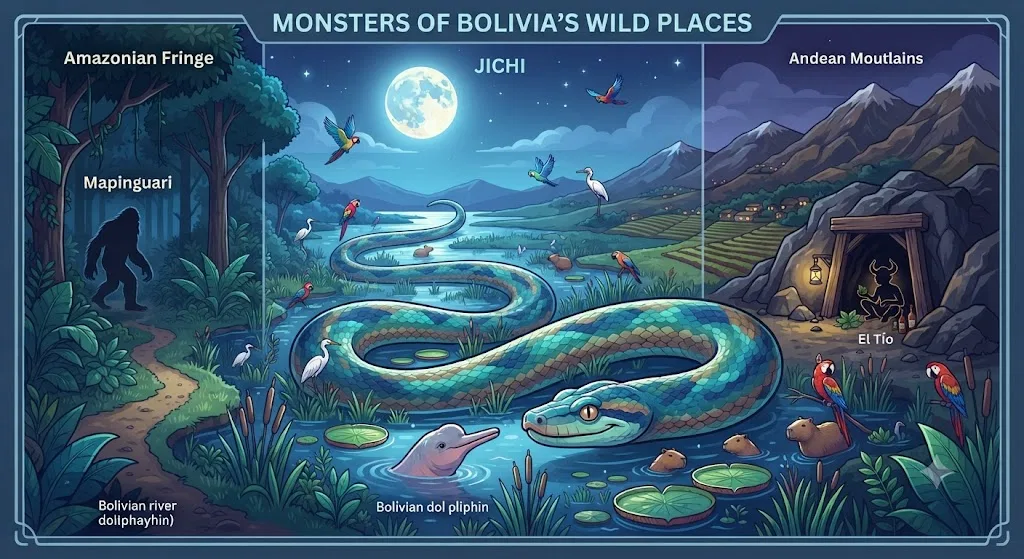
Bolivia’s mystery-creature traditions are less about one famous “national monster” and more about a set of powerful local beings tied to water, mines, forests and high Andean landscapes. The strongest folklore cluster is the Jichi, a water guardian often imagined as a giant serpent in the eastern lowlands.
Page outline Jump by section
Why Bolivia’s creature lore follows the landscape
Bolivia is unusually rich terrain for monster traditions because it combines very different worlds within one country: the Altiplano and Lake Titicaca, the Andean mining belt, the Chiquitano dry forest, the Beni and Mamoré river systems, Amazonian forest edges and the Gran Chaco. Each environment produces a different kind of fear. Deep water gives rise to serpents and lake beings. Mines produce underworld guardians. Forests and wetlands invite stories of hairy giants, big cats, river spirits and shape-changing animals.
That ecological variety matters. The Llanos de Moxos wetlands, for example, are crossed by the Beni, Iténez or Guaporé, and Mamoré rivers, which converge into the Madeira system, while WWF describes the region as exceptionally biodiverse, with hundreds of recorded birds, fish and other species, including threatened animals such as giant otters and Bolivian river dolphins. A landscape like that does not need invented dragons to feel alive with hidden presences; real animals, floods, droughts, night sounds and river danger already provide the raw material.[wwfca.org]wwfca.orgBolivia designates world’s largest protected wetland | WWFBolivia designates world’s largest protected wetland | WWF
The same is true in the Andes. Lake Titicaca is not just a body of water on a map. UNESCO describes it as South America’s largest freshwater lake and among the world’s highest large lakes, sitting about 3,810 metres above sea level between Peru and Bolivia. Another UNESCO listing for the Bolivian side gives its depth, drainage through the Desaguadero River and the large portion lying in Bolivian territory. A vast, cold, ancient lake at high altitude is exactly the kind of place where stories of submerged powers, drowned cities, sacred origins and hidden animals can gather.[UNESCO World Heritage Centre]whc.unesco.orgWorld Heritage Centre Lake TiticacaWorld Heritage Centre Lake Titicaca
The Jichi: Bolivia’s clearest water-monster tradition
The most important Bolivian creature for a cryptid-minded reader is the Jichi. In contemporary tellings from the eastern lowlands, the Jichi is usually a water guardian, often appearing as a giant snake or serpent-like being. It is not simply a beast to be hunted or photographed. It guards reservoirs, rivers, ponds and water sources, and when people mistreat water, the Jichi may leave, taking the water with it.
A 2024 AWASQA account from San Ignacio de Velasco in Santa Cruz records the Jichi as a “water protector” of the Chiquitano region, linked to the Guapomó reservoir. Local tellings in that article describe the being as wary of harm done to water places and capable of punishing a community by departing with the water, because the water is its home. The same report notes variations: a giant snake, a beautiful woman associated with a water source, and a being honoured with offerings when water runs low.[AWASQA]awasqa.orgJichi, the Water KeeperJichi, the Water Keeper
That makes the Jichi especially interesting because it sits halfway between monster story and environmental warning. In a simple creature catalogue, it might be filed as “giant serpent”. In lived folklore, it does more than frighten people. It explains drought, protects springs, warns against careless water use and gives communities a language for talking about scarcity. The AWASQA report links the legend directly to falling water levels and rationing around Guapomó, where local residents discussed muddy tap water, wells and pressure on the reservoir from population and livestock demand.[AWASQA]awasqa.orgJichi, the Water KeeperJichi, the Water Keeper
For cryptid readers, the important distinction is this: the Jichi is not well understood as a single alleged biological animal. It behaves more like a class of water-being stories adapted to local places. One village may imagine a snake; another may speak of a woman who disappears into a water source; another may connect the being to offerings and rain. The repeated core is not zoological anatomy but guardianship of water.

Lake Titicaca: sacred lake first, lake monster second
Lake Titicaca often attracts internet claims about a Bolivian or Peru-Bolivia lake monster. These claims usually sound familiar to anyone who has read about famous lake cryptids: a large creature in deep water, sometimes compared with a seal, manatee, serpent or long-bodied animal. The problem is that the modern “Lake Titicaca monster” is much less strongly documented than the lake’s sacred, archaeological and cultural traditions.
The lake’s real cultural weight is not thin at all. UNESCO notes Titicaca’s antiquity, altitude and importance, while a UNESCO article on underwater cultural heritage describes efforts to protect submerged heritage in the lake after Bolivia joined the 2001 Convention on the Protection of the Underwater Cultural Heritage. That same UNESCO article discusses an Inca stone offering box recovered from the lake, containing a miniature shell llama figurine and a small gold sheet, a reminder that Titicaca’s depths have genuine ritual and archaeological importance without needing a confirmed monster.[unesco.org]whc.unesco.orgWorld Heritage Centre Lake TiticacaWorld Heritage Centre Lake Titicaca
So why does Titicaca keep attracting monster language? Partly because it has all the right ingredients: size, depth, altitude, storms, sacred origin stories, old ruins, islands, and a borderland identity shared by Bolivia and Peru. A large lake with submerged offerings and dramatic weather easily becomes a screen for hidden-creature speculation. But when the question is evidence, the balance changes. There is strong evidence for sacred use, archaeological deposits and living lake traditions; there is not comparable mainstream evidence for a large unknown animal.
A sceptical reading does not make the lake less interesting. It makes it more specific. Titicaca’s “monster” is best treated as a loose modern cryptid label laid over a much older sacred-lake tradition. The richer Bolivian material is not a Nessie-style photo hunt but the way Andean cosmology, archaeology, tourism and local storytelling turn the lake into a living place with hidden depths.
Mapinguari and the Amazonian forest giant
Bolivia also sits within the wider Amazonian range of Mapinguari stories: tales of a huge, hairy, foul-smelling forest being, often described in Brazil but sometimes extended across Amazonian borderlands into Bolivia and Peru. In popular cryptozoology, the Mapinguari is often compared with Bigfoot or with an extinct ground sloth. Its features vary wildly: claws, backwards feet, a terrible smell, tough skin, and in some versions a monstrous mouth in the belly.
The most famous naturalistic explanation is that Mapinguari stories may preserve memories of giant ground sloths. National Geographic, reporting on a frog species named after the Mapinguari, summarised the legend as a tall, furry rainforest beast with giant claws and a second mouth, and noted the suggestion that it may originate in memories or sightings connected to extinct ground sloths. That is an intriguing idea, but it remains speculative rather than evidence for a surviving animal.[National Geographic]nationalgeographic.com160502 amazon frogs new species animals science160502 amazon frogs new species animals science
Recent science makes the sloth connection culturally plausible without making survival likely. Associated Press reporting on research from Brazil describes giant ground sloths as enormous prehistoric animals, some with bony structures in their skin, and discusses evidence that humans in the Americas may have overlapped with megafauna for longer than once assumed. Such overlap could help explain why striking extinct animals leave long cultural shadows. It does not show that giant sloths still live in Bolivian forests.[AP News]apnews.comOpen source on apnews.com.
Bolivia also has real animals that can feed forest-beast reports. The Andean bear, the only bear species in South America, ranges from Venezuela to southern Bolivia and occupies habitats from forests to high grasslands; the IUCN lists it as Vulnerable and notes its distinctive pale facial markings. A brief, frightened or second-hand sighting of a bear, jaguar, tapir or giant anteater in poor light can become far stranger in retelling, especially when the story already has a waiting mould.[IUCN Red List]nc.iucnredlist.orgIUCN Red List
El Tío: the mine monster who is not really a cryptid
El Tío belongs on a Bolivia monster page, even though he is not a cryptid in the animal sense. He is a mine spirit: horned, powerful, dangerous, protective and feared. In the mines of Potosí and other Andean mining areas, he is represented by figures that receive offerings. For miners, he is less a campfire creature than a working presence in a deadly underground world.
The reason he matters here is that El Tío shows how a “monster” can be socially real without being zoologically real. In Cerro Rico, the threat is not an unknown species but collapse, dust, darkness, exhaustion, bad luck and the brutal history of mining. El Tío gives those dangers a face. Atlas Obscura’s report on Potosí describes miners leaving offerings such as cigarettes, alcohol and coca leaves to an underground devil figure, while UNESCO’s material on Oruro shows how devil imagery, masks and dance are central to public ritual expression in Bolivia.[Atlas Obscura]atlasobscura.comAtlas Obscura The Liquor-Soaked Devil Shrines of Bolivia's Deadliest MineAtlas Obscura The Liquor-Soaked Devil Shrines of Bolivia's Deadliest Mine
Oruro’s famous carnival also shows how underworld beings move from mine to street. UNESCO records the Carnaval de Oruro as inscribed on the Representative List of the Intangible Cultural Heritage of Humanity in 2008, with thousands of dancers and musicians taking part. In UNESCO archive material, older Andean ceremonies are described as continuing under Christian forms, with the diablada becoming the principal dance of Oruro.[UNESCO]unesco.orgCarnaval de Oruro | Unesco.orgCarnaval de Oruro | Unesco.org
For readers looking for “Bolivian cryptids”, El Tío is a useful boundary marker. He is not a hidden animal, and treating him as one would miss the point. But he is central to Bolivia’s monster imagination: a horned figure at the meeting point of labour, danger, colonial history, Indigenous and Catholic symbolism, and public performance.
Real animals behind strange reports
Many Bolivian monster stories become more understandable when placed beside real wildlife. The point is not to “debunk” every tale with a single animal, but to recognise how ordinary animals can become extraordinary under the right conditions.
In the rivers and wetlands, the Bolivian river dolphin is a real, endangered animal whose surfacing, blows, pale body and sudden disappearances can seem uncanny to people unfamiliar with river dolphins. Scientific work on the Mamoré River notes that South American river dolphins are endangered and still poorly understood in basic ecology, which is exactly the kind of knowledge gap that allows folklore and wildlife perception to overlap.[THERYA]therya.mastozoologiamexicana.comBolivian river dolphin site preference in the middle-section of Mamoré River, upper Madeira river basin, Bolivia | THERYA…
In forests and Andean foothills, jaguars, Andean bears, tapirs, giant armadillos and anteaters can all complicate eyewitness claims. A jaguar glimpsed at night may become a phantom cat. A bear standing upright can become an ape-man. A giant anteater’s claws and odd profile can look monstrous to someone who sees it briefly. Bolivia’s real biodiversity is not a boring alternative to cryptids; it is one of the reasons the stories have texture.
There is also a social factor. Remote sightings often pass through several tellers before reaching print or the internet. Details sharpen, sizes increase, and uncertain animals become named monsters. By the time a story is collected as a “cryptid report”, it may contain three layers at once: a real encounter, a local legend and a modern monster category.
How to read Bolivian cryptid claims fairly
A fair approach to Bolivia’s creature lore needs more than a yes-or-no verdict. The strongest stories are not all trying to do the same thing.
The Jichi is best read as a living water-guardian tradition, especially strong in lowland communities where drought, reservoirs and water management are practical concerns. Lake Titicaca monster claims are weaker as animal reports but sit on top of an immensely important sacred-lake tradition. Mapinguari belongs to a broader Amazonian forest-monster complex, with a tempting but unproven link to memories of extinct megafauna. El Tío is a ritual and mining figure whose power comes from the dangerous underground world rather than from eyewitness zoology.
A useful reader’s test is to ask four questions:
- Is the story presented as folklore, a witnessed animal, a ritual being or modern entertainment?
- Does it cluster around a specific landscape, such as a mine, lake, reservoir or forest?
- Are there plausible real animals or environmental events that could explain part of the account?
- Has the story changed as it moved into tourism, television, social media or cryptid catalogues?
Bolivia’s monster traditions become clearest when those categories are kept separate. The country does not offer a single confirmed mystery beast waiting to be added to a field guide. It offers something more culturally interesting: water serpents that warn against scarcity, a sacred lake that attracts modern monster labels, Amazonian forest giants shaped by memory and misidentification, and a horned mine spirit who turns danger underground into a figure miners can address.
Amazon book picks
Further Reading
Books and field guides related to What Monsters Haunt Bolivia's Wild Places?. Use these as the next step if you want deeper reading beyond the article.
Encyclopedia of Cryptozoology
Includes numerous South American mystery creatures and folklore traditions.
Monsters of the Gévaudan
Helps explain the relationship between folklore and reported creatures.
eBay marketplace picks
Marketplace Samples
Live-tested eBay searches with available results related to this page.



Endnotes
1.
Source: wwfca.org
Title: Bolivia designates world’s largest protected wetland | WWF
Link:https://www.wwfca.org/en/?207471%2FBolivia-designates-worlds-largest-protected-wetland=
2.
Source: whc.unesco.org
Title: World Heritage Centre Lake Titicaca
Link:https://whc.unesco.org/en/tentativelists/5080/
3.
Source: whc.unesco.org
Title: World Heritage Centre Sacred Titicaca Lake
Link:https://whc.unesco.org/en/tentativelists/1817/
4.
Source: awasqa.org
Title: Jichi, the Water Keeper
Link:https://awasqa.org/jichi-the-water-keeper/?lang=en
5.
Source: unesco.org
Title: protecting underwater cultural heritage lake titicaca
Link:https://www.unesco.org/en/articles/protecting-underwater-cultural-heritage-lake-titicaca
6.
Source: courier.unesco.org
Title: titicaca sacred lake reveals its secrets
Link:https://courier.unesco.org/en/articles/titicaca-sacred-lake-reveals-its-secrets
7.
Source: nc.iucnredlist.org
Title: IUCN Red List
Link:https://nc.iucnredlist.org/redlist/species-of-the-day/tremarctos-ornatus/pdfs/original/tremarctos-ornatus.pdf
8.
Source: unesco.org
Title: Carnaval de Oruro | Unesco.org
Link:https://www.unesco.org/tich4sd/es/bolivia/diablada
9.
Source: unesco.org
Title: the Oruro Carnival | Intangible Heritage
Link:https://www.unesco.org/archives/multimedia/document-616
10.
Source: therya.mastozoologiamexicana.com
Link:https://therya.mastozoologiamexicana.com/index.php/THERYA/article/view/977
Source snippet
Bolivian river dolphin site preference in the middle-section of Mamoré River, upper Madeira river basin, Bolivia | THERYA...
11.
Source: iucn.nl
Link:https://www.iucn.nl/en/project/indigenous-led-conservation-in-nembi-guasu/
12.
Source: iucn.org
Title: launch stories lake titikaka a collection stories myths and legends
Link:https://iucn.org/news/south-america/202102/launch-stories-lake-titikaka-a-collection-stories-myths-and-legends
13.
Source: digitalcollections.sit.edu
Link:https://digitalcollections.sit.edu/cgi/viewcontent.cgi?article=2220&context=isp_collection
14.
Source: nationalgeographic.com
Title: 160502 amazon frogs new species animals science
Link:https://www.nationalgeographic.com/animals/article/160502-amazon-frogs-new-species-animals-science
15.
Source: apnews.com
Link:https://apnews.com/article/3c21c77cd108c5bfcdd8d8c87195c4c8
16.
Source: atlasobscura.com
Title: Atlas Obscura The Liquor-Soaked Devil Shrines of Bolivia’s Deadliest Mine
Link:https://www.atlasobscura.com/articles/what-are-potosi-silver-mines-like
17.
Source: villains.fandom.com
Title: Lake Titicaca Monster
Link:https://villains.fandom.com/wiki/Lake_Titicaca_Monster
18.
Source: cryptidarchives.fandom.com
Link:https://cryptidarchives.fandom.com/wiki/Mapinguari
19.
Source: cryptidz.fandom.com
Link:https://cryptidz.fandom.com/wiki/Mapinguari
20.
Source: mythus.fandom.com
Link:https://mythus.fandom.com/wiki/El_T%C3%ADo
21.
Source: villains.fandom.com
Link:https://villains.fandom.com/wiki/El_T%C3%ADo
22.
Source: cryptidarchives.fandom.com
Title: Lake Titicaca monster
Link:https://cryptidarchives.fandom.com/wiki/Lake_Titicaca_monster
23.
Source: Wikipedia
Title: Lake Titicaca
Link:https://en.wikipedia.org/wiki/Lake_Titicaca
24.
Source: Wikipedia
Link:https://en.wikipedia.org/wiki/El_T%C3%ADo
25.
Source: Wikipedia
Link:https://en.wikipedia.org/wiki/Mapinguari
26.
Source: Wikipedia
Title: Carnaval de Oruro
Link:https://es.wikipedia.org/wiki/Carnaval_de_Oruro
27.
Source: amazon.de
Link:https://www.amazon.de/-/en/Bolivian-Mythology-Unveiling-Mysteries-Andes/dp/B0CHL96V7G?tag=searcht-20
28.
Source: amazon.de
Link:https://www.amazon.de/-/en/Chronicle-Press-ebook/dp/B0CH3J3R9J?tag=searcht-20
29.
Source: citizendium.org
Link:https://citizendium.org/wiki/El_T%C3%ADo
30.
Source: arcanebeastsandcritters.wordpress.com
Link:https://arcanebeastsandcritters.wordpress.com/2018/05/16/mapinguari/
31.
Source: atlasobscura.com
Title: carnaval de oruro bolivia
Link:https://www.atlasobscura.com/articles/carnaval-de-oruro-bolivia
32.
Source: amazon.com
Link:https://www.amazon.com/Myths-legends-Bolivian-Andes-literature-ebook/dp/B07825ZZFP?tag=searcht-20
33.
Source: allthatsinteresting.com
Link:https://allthatsinteresting.com/mapinguari
34.
Source: urosexpeditions.com
Link:https://www.urosexpeditions.com/blog/titicaca
35.
Source: flickr.com
Link:https://www.flickr.com/photos/87199759%40N00/6067159929
36.
Source: worldhistory.org
Title: Lake Titicaca
Link:https://www.worldhistory.org/Lake_Titicaca/
Additional References
37.
Source: youtube.com
Title: Mapinguari Origins
Link:https://www.youtube.com/watch?v=0Ll_e5oa37g
Source snippet
WILD BOLIVIA | Secret Forests, Rare Animals and Forgotten Lands - Documentary...
38.
Source: youtube.com
Title: Hunting the King of the Amazon! | Chasing Monsters Season 4 Episode 2
Link:https://www.youtube.com/watch?v=kPydY6sSOT0
Source snippet
Mapinguari Origins - This Amazonian Monster With Giant Human Eating Mouth In Stomach May Not Be Myth...
39.
Source: youtube.com
Title: WILD BOLIVIA | Secret Forests, Rare Animals and Forgotten Lands
Link:https://www.youtube.com/watch?v=pgdsJZfQBL4
Source snippet
Lake Titicaca: The Lost World of the Incas...
40.
Source: facebook.com
Link:https://www.facebook.com/BarbaraRachko/posts/carnaval-de-oruro-diablos-refers-to-the-iconic-diablada-dance-of-the-devils-at-b/1417178796442153/
41.
Source: facebook.com
Link:https://www.facebook.com/groups/252779587552494/posts/421590017338116/
42.
Source: researchgate.net
Link:https://www.researchgate.net/publication/346335017_A_Fossil_Bone_of_a_Giant_Ground_Sloth_from_the_Last_Millennium_of_the_Pleistocene_New_Data_from_Salto_Department_Uruguay
43.
Source: facebook.com
Link:https://www.facebook.com/wildlenschronicleswlc/posts/a-slow-moving-mountain-of-fur-and-strengththe-giant-ground-sloth-that-once-turne/122125914609137078/
44.
Source: facebook.com
Link:https://www.facebook.com/groups/1076576893425144/posts/1110724656677034/
45.
Source: iiecco.org
Link:https://www.iiecco.org/andeanbear/
46.
Source: iucn-ctsg.org
Link:https://iucn-ctsg.org/wp-content/uploads/2017/12/Andean-Bear-Rehabilitation-Guidelines-1.pdf
Topic Tree
Follow this branch
Related pages 192
- Antigua Cryptids
- Maldives Monsters
- Malta Monsters
- Qatar Monsters
- Argentina Monsters
- +187 more in sidebar