Within Mongolian Monsters
What Is Mongolia's Elusive Almas?
The Almas sits between mountain folklore, wild-person traditions and modern claims about bears, feral humans or surviving hominins.
On this page
- The Almas in Mongolian and Central Asian folklore
- The disputed early expedition story
- Bears, feral people and relict human theories
Page outline Jump by section
Introduction
The Almas is Mongolia’s most enduring wild-person legend: a hairy, human-like being said to inhabit remote mountain regions, particularly the Altai ranges of western Mongolia. Unlike the more famous Himalayan Yeti, the Almas is usually described not as an ape-like monster but as something unsettlingly human — a shy, primitive figure that walks upright, leaves footprints, and occasionally appears at the edge of herding country before vanishing into the mountains. Stories of the creature are woven into local folklore, but they also became the subject of twentieth-century expeditions, Soviet-era speculation, and modern cryptozoological debate. What makes the Almas unusual is that arguments about its identity have often centred not on giant apes, but on the possibility of feral humans, misunderstood bears, or even surviving archaic humans. The result is a legend that sits midway between folklore, anthropology, and mystery-animal hunting.[sit.edu]digitalcollections.sit.eduThe stories are primarily found in the western aimags of Mongolia.Read moreSIT Digital CollectionsThe Legend of the Almas: A Comparative and Critical…by N Wenzel · 2009 — The legend of the almas, the wildman o…
What Is Mongolia’s Elusive Almas?
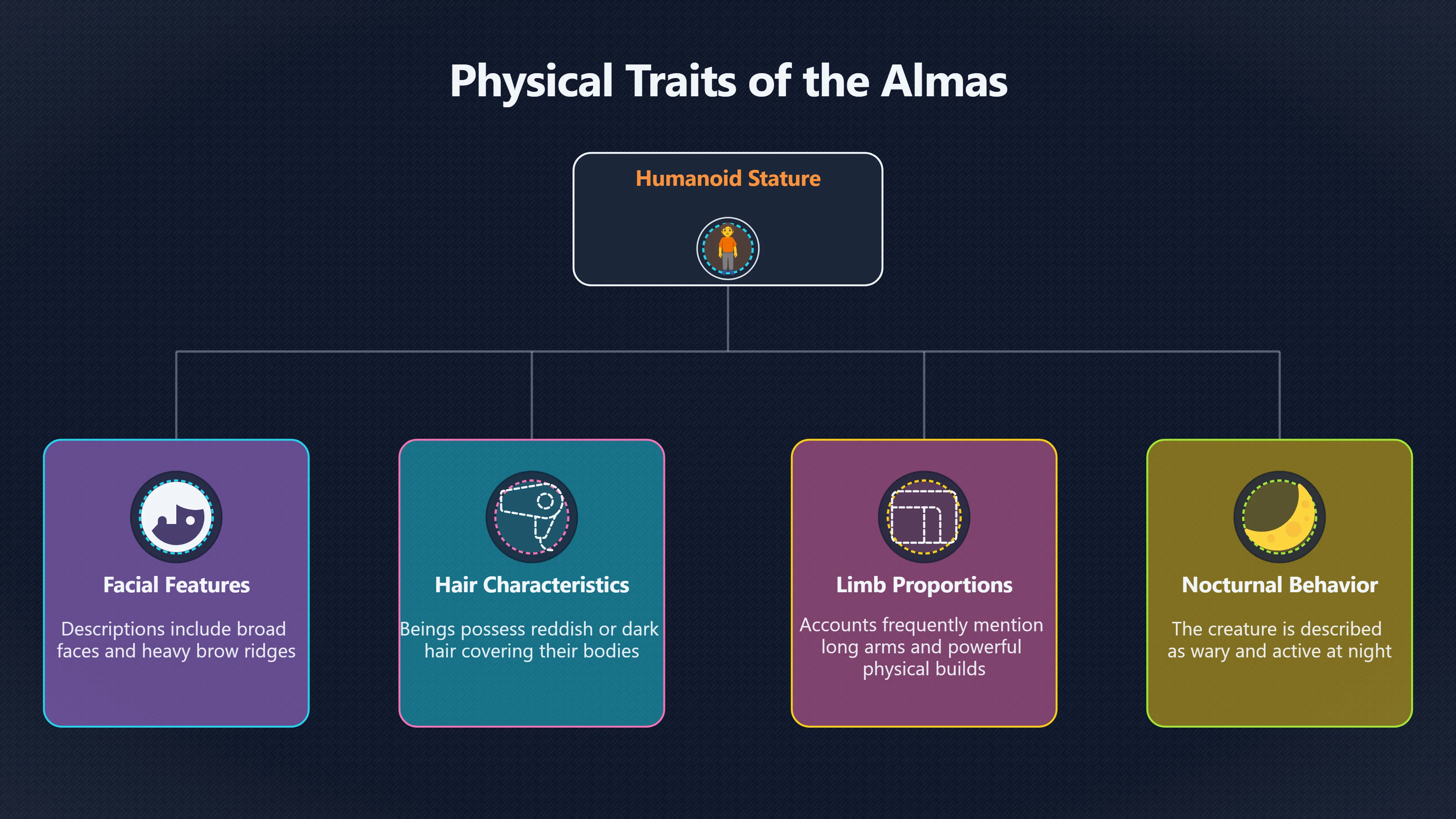
Across Mongolia and neighbouring parts of Central Asia, the Almas is traditionally described as a wild, hairy humaniform creature living in mountains and sparsely populated uplands. Folklore places it especially in the Altai region, including areas of present-day Bayan-Ölgii Province, although related traditions extend across the wider Central Asian mountain belt. Accounts typically portray a being of roughly human height with a broad face, heavy brow ridges, reddish or dark hair, long arms, and a wary, nocturnal nature. Unlike many monster traditions, the Almas is rarely portrayed as aggressive or supernatural; it is more often remembered as a hidden neighbour of humanity living beyond settled territory.[sit.edu]digitalcollections.sit.eduThe stories are primarily found in the western aimags of Mongolia.Read moreSIT Digital CollectionsThe Legend of the Almas: A Comparative and Critical…by N Wenzel · 2009 — The legend of the almas, the wildman o…
Researchers who have examined Mongolian folklore note that Almas traditions are not isolated stories but part of a wider Central Asian wildman complex. Similar figures appear in Kazakhstan, Kyrgyzstan, Siberia, the Pamirs, and the Caucasus, suggesting a long-running regional tradition rather than a modern invention. In Mongolia, place names associated with the Almas and references in local oral traditions indicate that the legend was established long before the rise of modern cryptozoology.[wikipedia.org]WikipediaAlmas (folkloreAlmas (folklore
This distinction matters because the Almas occupies a different place in folklore from creatures such as Bigfoot. Many traditional accounts describe a being that is fundamentally human-like but uncivilised, reflecting ancient ideas about wilderness, isolation, and the boundary between society and nature.[SIT Digital Collections]digitalcollections.sit.eduThe stories are primarily found in the western aimags of Mongolia.Read moreSIT Digital CollectionsThe Legend of the Almas: A Comparative and Critical…by N Wenzel · 2009 — The legend of the almas, the wildman o…
The Almas in Mongolian and Central Asian Folklore
The oldest layers of the tradition are difficult to date precisely, but references to wild human-like beings in Central Asian travel literature and folklore extend back centuries. Nineteenth-century explorer Nikolai Przhevalsky recorded reports of a man-beast in the region, while later Mongolian scholars collected local traditions describing hairy, elusive people living in mountain valleys and forests.[Wikipedia]WikipediaAlmas (folkloreAlmas (folklore
In folk narratives, the Almas is often characterised by several recurring themes:
- It avoids villages and human settlements.
- It is physically powerful but generally shy.
- It may be glimpsed while herding livestock or travelling through remote mountain country.
- It is described as more human than ape-like.
- Encounters are brief and usually occur at a distance.[sit.edu]digitalcollections.sit.eduThe stories are primarily found in the western aimags of Mongolia.Read moreSIT Digital CollectionsThe Legend of the Almas: A Comparative and Critical…by N Wenzel · 2009 — The legend of the almas, the wildman o…
Anthropologists have suggested that such stories may reflect long-standing cultural ideas about wilderness peoples living beyond the edge of settled society. Nomadic communities often distinguished between the civilised world of camps and the unknown spaces of the mountains, creating fertile ground for tales of hidden human-like beings.[ResearchGate]researchgate.net318563173 Wildmen in Central AsiaResearchGate(PDF) Wildmen in Central Asia8 Aug 2017 — We focus here on the wildmen in Mongolia, Kazakstand, and Kyrgyzstan, describing an…
The Almas also differs from many Western monster traditions because it is frequently treated in local stories as a real but rare creature rather than a purely supernatural being. That ambiguity helped later investigators reinterpret folklore as possible zoological evidence.[SIT Digital Collections]digitalcollections.sit.eduThe stories are primarily found in the western aimags of Mongolia.Read moreSIT Digital CollectionsThe Legend of the Almas: A Comparative and Critical…by N Wenzel · 2009 — The legend of the almas, the wildman o…
The Disputed Early Expedition Story
One of the most frequently repeated claims in Almas literature concerns reports collected during the early twentieth century. Cryptozoological writers often point to accounts gathered by Mongolian and Soviet researchers who interviewed herders and hunters in western Mongolia. These reports described sightings of hairy, human-like figures crossing valleys, watching camps from ridges, or disappearing into rugged terrain.[Oxford University Research Archive]ora.ox.ac.ukford University Research ArchiveTHE MONGOLIAN ALMASby M Heaney · 1983 · Cited by 4 — ABSTRACT: Research into the Almas, a supposed man…
The difficulty is that almost all of these stories are second-hand, retrospective, or anecdotal. Michael Heaney’s influential study of the Almas noted that many reports were collected years after the alleged encounters and lacked physical evidence such as bones, skins, photographs, or verifiable tracks.[Oxford University Research Archive]ora.ox.ac.ukford University Research ArchiveTHE MONGOLIAN ALMASby M Heaney · 1983 · Cited by 4 — ABSTRACT: Research into the Almas, a supposed man…
Particularly controversial are stories linked to researcher Byambyn Rinchen, who became one of the best-known advocates of Almas investigations in Mongolia during the twentieth century. Rinchen gathered witness testimony and argued that reports deserved scientific attention. However, even supporters acknowledged that the evidence consisted mainly of interviews and local recollections rather than specimens or repeatable observations.[Wikipedia]WikipediaAlmas (folkloreAlmas (folklore
Later expedition reports from western Mongolia recorded witnesses describing reddish hair, human-like faces, and fleeting encounters in isolated mountain areas. Yet these investigations never produced material evidence capable of convincing mainstream zoologists. The result is a historical record rich in testimony but poor in verification.[Idaho State University]isu.eduBayan-Olgii aimaq, gave a detailed story. She noted the red color, unpleasant eyes, and clearly saw red eyebrows. The almas squinted at h…
Why Western Mongolia Became the Centre of the Legend
Most modern Almas reports cluster around the Altai Mountains and adjacent western regions. This geography helps explain the persistence of the tradition.
The Altai landscape contains vast stretches of rugged terrain, deep valleys, seasonal migration routes, and relatively low population density. For centuries, herders could travel through remote country where unusual animal sightings were difficult to investigate or verify. In such settings, a brief glimpse of an unfamiliar figure could easily become part of local oral tradition.[SIT Digital Collections]digitalcollections.sit.eduThe stories are primarily found in the western aimags of Mongolia.Read moreSIT Digital CollectionsThe Legend of the Almas: A Comparative and Critical…by N Wenzel · 2009 — The legend of the almas, the wildman o…
The region also sits at a cultural crossroads linking Mongolian, Turkic, Siberian, and Central Asian traditions. Wildman stories appear across many of these neighbouring cultures, allowing motifs and legends to spread across borders and generations. Researchers studying Central Asian wildman traditions argue that the Mongolian Almas belongs to a broader cultural pattern rather than a uniquely local phenomenon.[ResearchGate]researchgate.net318563173 Wildmen in Central AsiaResearchGate(PDF) Wildmen in Central Asia8 Aug 2017 — We focus here on the wildmen in Mongolia, Kazakstand, and Kyrgyzstan, describing an…
This wider distribution is one reason many folklorists view the Almas primarily as a traditional cultural figure rather than evidence for a hidden species restricted to one isolated mountain range.[ResearchGate]researchgate.net318563173 Wildmen in Central AsiaResearchGate(PDF) Wildmen in Central Asia8 Aug 2017 — We focus here on the wildmen in Mongolia, Kazakstand, and Kyrgyzstan, describing an…
Bears, Feral People and Relict-Human Theories
The debate surrounding the Almas has produced several competing explanations.
Misidentified Bears
The most conventional explanation is simple misidentification. Brown bears occur across parts of Central Asia and can occasionally stand upright, appear human-shaped at a distance, and leave unusual tracks under certain conditions. Modern genetic testing of hair samples attributed to related Central Asian wildman traditions has repeatedly identified known animals, particularly brown bears.[Wikipedia]WikipediaAlmas (folkloreAlmas (folklore
A bear explanation does not fit every description, especially reports emphasising clearly human facial features, but it offers a plausible interpretation for many distant sightings in difficult terrain.[Wikipedia]WikipediaAlmas (folkloreAlmas (folklore
Feral or Marginalised Humans
Another theory proposes that at least some Almas stories originated from encounters with isolated people. Throughout history, remote mountain regions occasionally sheltered hermits, fugitives, abandoned children, or individuals living on the margins of society. A brief encounter with a dirty, heavily bearded, or mentally ill person could generate stories of a wild human living outside civilisation.[SIT Digital Collections]digitalcollections.sit.eduThe stories are primarily found in the western aimags of Mongolia.Read moreSIT Digital CollectionsThe Legend of the Almas: A Comparative and Critical…by N Wenzel · 2009 — The legend of the almas, the wildman o…
Because many Almas descriptions emphasise human rather than ape-like characteristics, some researchers consider this explanation more persuasive than the idea of an undiscovered primate.[SIT Digital Collections]digitalcollections.sit.eduThe stories are primarily found in the western aimags of Mongolia.Read moreSIT Digital CollectionsThe Legend of the Almas: A Comparative and Critical…by N Wenzel · 2009 — The legend of the almas, the wildman o…
Surviving Archaic Humans
The most famous but least supported hypothesis suggests that the Almas represents a surviving population of archaic humans, such as Neanderthals or another extinct hominin. During the Soviet era, a handful of researchers speculated that isolated relic populations might still survive in remote mountain regions.[Wikipedia]WikipediaAlmas (folkloreAlmas (folklore
This idea gained attention because Almas descriptions often emphasised heavy brow ridges, flattened foreheads, and other supposedly primitive features. However, no skeletal remains, DNA samples, or confirmed specimens have ever supported the existence of a surviving archaic human population in Mongolia or elsewhere in Central Asia. Modern palaeoanthropology regards the theory as highly unlikely.[Wikipedia]WikipediaAlmas (folkloreAlmas (folklore
The collapse of similar claims elsewhere has reinforced scepticism. The famous Caucasian case of Zana, once cited by some cryptozoologists as evidence of an Almas-like being, was ultimately shown through genetic analysis to involve a fully human woman of relatively recent African ancestry rather than a relic hominin.[Wikipedia]WikipediaAlmas (folkloreAlmas (folklore
Why the Almas Endures
The Almas survives because it occupies a fascinating middle ground. It is neither a straightforward monster nor a simple ghost story. Instead, it reflects a long tradition of imagining human-like beings inhabiting the spaces beyond ordinary society. The legend gained new life when twentieth-century investigators attempted to treat folklore as zoological evidence, creating decades of debate about what witnesses might actually have seen.[sit.edu]digitalcollections.sit.eduThe stories are primarily found in the western aimags of Mongolia.Read moreSIT Digital CollectionsThe Legend of the Almas: A Comparative and Critical…by N Wenzel · 2009 — The legend of the almas, the wildman o…
For modern readers, the most intriguing aspect of the Almas is not the prospect of discovering a hidden species. It is the way folklore, eyewitness testimony, scientific curiosity, and cultural memory became intertwined. Western Mongolia’s remote mountains provided the setting, but the enduring mystery comes from a question that remains unresolved: when people reported seeing the Almas, were they recalling an ancient folk figure, misidentifying a real animal, encountering an unusual person, or blending all three into a legend that still lingers in the imagination today?[sit.edu]digitalcollections.sit.eduThe stories are primarily found in the western aimags of Mongolia.Read moreSIT Digital CollectionsThe Legend of the Almas: A Comparative and Critical…by N Wenzel · 2009 — The legend of the almas, the wildman o…
Amazon book picks
Further Reading
Books and field guides related to What Is Mongolia's Elusive Almas?. Use these as the next step if you want deeper reading beyond the article.
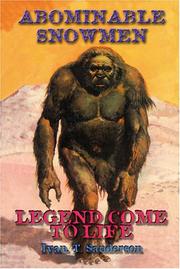
Abominable Snowmen, Legend Come to Life
Closely related to Central Asian wildman traditions.
eBay marketplace picks
Marketplace Samples
Live-tested eBay searches with available results related to this page.


Endnotes
1.
Source: digitalcollections.sit.edu
Title: The stories are primarily found in the western aimags of Mongolia.Read more
Link:https://digitalcollections.sit.edu/cgi/viewcontent.cgi?article=1780&context=isp_collection
Source snippet
SIT Digital CollectionsThe Legend of the Almas: A Comparative and Critical...by N Wenzel · 2009 — The legend of the almas, the wildman o...
2.
Source: researchgate.net
Title: 318563173 Wildmen in Central Asia
Link:https://www.researchgate.net/publication/318563173_Wildmen_in_Central_Asia
Source snippet
ResearchGate(PDF) Wildmen in Central Asia8 Aug 2017 — We focus here on the wildmen in Mongolia, Kazakstand, and Kyrgyzstan, describing an...
3.
Source: Wikipedia
Title: Almas (folklore)
Link:https://en.wikipedia.org/wiki/Almas_%28folklore%29
4.
Source: Wikipedia
Title: Bayan-Ölgii Province
Link:https://en.wikipedia.org/wiki/Bayan-%C3%96lgii_Province
5.
Source: ora.ox.ac.uk
Link:https://ora.ox.ac.uk/objects/uuid%3A85d4d3f6-d0be-4c8d-839a-3a6736ceeec6/files/mfc46cc4661f4477cdd7469b1cc5839df
Source snippet
ford University Research ArchiveTHE MONGOLIAN ALMASby M Heaney · 1983 · Cited by 4 — ABSTRACT: Research into the Almas, a supposed man...
6.
Source: isu.edu
Link:https://www.isu.edu/media/libraries/rhi/research-papers/DAMDIN.pdf
Source snippet
Bayan-Olgii aimaq, gave a detailed story. She noted the red color, unpleasant eyes, and clearly saw red eyebrows. The almas squinted at h...
7.
Source: itsmth.fandom.com
Link:https://itsmth.fandom.com/wiki/Almas
Additional References
8.
Source: reddit.com
Link:https://www.reddit.com/r/mongolia/comments/1igmg8p/about_the_almas_the_mongolian_wildman/
Source snippet
About the Almas, the Mongolian wildman: r/mongoliaAccording to Mongolian folklore, the Gobi desert and the Altai areas of South West Mon...
9.
Source: reddit.com
Link:https://www.reddit.com/r/Cryptozoology/comments/1d9qk37/since_most_people_here_do_not_believe_homo/
Source snippet
Since most people here do not believe Homo erectus...The dead "Almas" body would have been a local, Central Asian feral human with...
10.
Source: godsandmonsters.info
Title: Gods and Monsters
Link:https://godsandmonsters.info/almas/
Source snippet
Mythology and WonderAlmas: Mongolia's Hair-Covered Wild Man of the MountainsAlmas is a hair-covered wild-man cryptid of Mongolian and Cen...
11.
Source: youtube.com
Link:https://www.youtube.com/watch?v=Cc4QP7Y0lSI
Source snippet
Top 10 Bigfoots from Around the World | Stories of Legend...
12.
Source: youtube.com
Title: The Mongolian Bigfoot: a firsthand encounter with the Almas
Link:https://www.youtube.com/watch?v=-JG4IAJdu7I
Source snippet
The Almas: Wild Men of Central Asia Unveiled...
13.
Source: youtube.com
Title: Top 10 Bigfoots from Around the World | Stories of Legend
Link:https://www.youtube.com/watch?v=ZW8zounKx3w
Source snippet
Stories of Bigfoot from Around the World...
14.
Source: reddit.com
Link:https://www.reddit.com/r/Cryptozoology/comments/1p828kt/about_the_western_mongolian_almas_tradition_and/
15.
Source: facebook.com
Link:https://www.facebook.com/groups/281886105961506/posts/1781428779340557/
16.
Source: youtube.com
Title: The Almas: Wild Men of Central Asia Unveiled
Link:https://www.youtube.com/watch?v=pgOPmIunARY
Source snippet
In 1241 Mongol Warriors Fled Almas in the Altai Mountains...
17.
Source: youtube.com
Title: Stories of Bigfoot from Around the World
Link:https://www.youtube.com/watch?v=65REbiDzzC4
Topic Tree