Where Morocco's Monsters Meet Real Wildlife
Morocco does not have one internationally famous lake monster or a single “national cryptid” in the Loch Ness style. Its mystery-creature tradition is more interesting than that: a mix of water spirits, cemetery beasts, last-lion stories, possible leopard survivals, vanished crocodiles, and real animals that can look uncanny in the right light.
Page outline Jump by section
Introduction
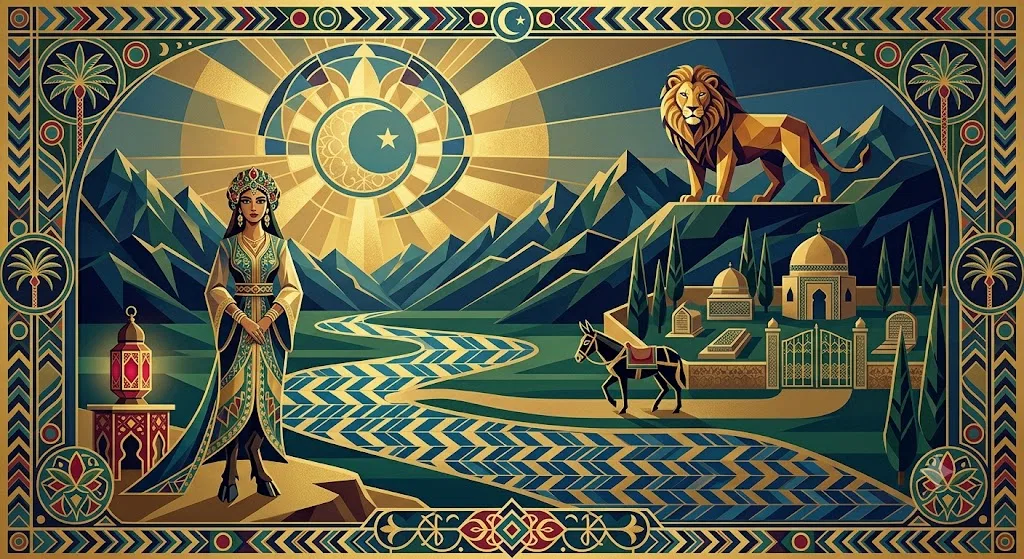
The best-known figure is Aisha Qandisha, usually remembered as a dangerous female spirit linked to water, seduction and hoofed animal features. Alongside her are the cemetery mule, Atlas lion afterlives, disputed leopard claims, Barbary macaque encounters, and Saharan crocodile memories. Read as cryptid history, Morocco is less a catalogue of monsters than a case study in how folklore, extinction, misidentification and local landscape memory feed one another.
Morocco’s creature lore is strongest where water, mountains and ruins meet
Moroccan monster traditions tend to cluster around liminal places: rivers, marshes, cemeteries, high mountain forests, desert waterholes and roads at night. That matters because these are exactly the places where ordinary life already feels uncertain. A river at dusk, a cemetery path, a remote Atlas pass or a guelta in the desert can turn a half-seen animal, a moral warning or a story of danger into something that feels physically present.
Aisha Qandisha is the clearest example. In many accounts she is not a hidden animal at all, but a supernatural female figure, often described as beautiful from a distance and animal-footed when seen closely. The recurring hoofed detail — goat, camel or mule legs depending on the version — is what gives her a cryptid-like shape even though her main home is folklore rather than zoology. Older ethnographic and reference traditions place her near water: rivers, marshes, lakes, the sea, drainage channels or local streams, with regional variants attached to places such as Tangier, Tetouan, Fez and the Sebou area.[Wikipedia]WikipediaAisha QandichaAisha Qandicha
That watery setting makes her different from a generic demon. She belongs to a recognisable Moroccan geography. The story warns young men about desire, night travel and dangerous places, but it also maps fear onto real environments. When she appears beside water, she acts almost like a Moroccan answer to the siren, the river hag or the marsh spirit: a creature whose body is partly human, partly animal, and whose power depends on being encountered away from social protection.
A second pattern appears in the Atlas and rural cemetery traditions. The grave or cemetery mule is usually treated as a cursed, hybrid or spirit-beast associated with burial grounds, moral taboo and nighttime danger. Recent Moroccan retellings describe her as a half-woman, half-mule figure haunting Atlas villages and cemeteries; a recent comparative study of Moroccan folk belief pairs her with Aisha Qandisha as one of the country’s most prominent supernatural beings linked to illness, taboo and social boundary-making.[Yabiladi]en.yabiladi.comMoroccan horror stories #1: The cursed mule of…October 3, 2024 — 3 Oct 2024 — In remote Atlas villages, locals fear a cursed…
Aisha Qandisha: Morocco’s most famous monster-like figure
Aisha Qandisha is the Moroccan creature most likely to be recognised outside Morocco, partly because she sits at the crossroads of folklore, horror cinema, feminist reinterpretation and possession traditions. She is usually not presented as a species or flesh-and-blood beast. She is a named being with personality, powers and local variations: sometimes a jinn-like seductress, sometimes an avenger, sometimes a frightening bedtime warning, and sometimes an ambivalent figure within ritual healing traditions.
The most common story-shape is simple and memorable. A man sees a beautiful woman near water or alone at night. He approaches or follows her. The glamour breaks when he notices her animal feet. Depending on the version, she drives him mad, kills him, possesses him or leaves him psychologically marked. The hoof is the reveal: it tells the listener that the encounter was never with an ordinary woman. It is also why the legend belongs on a cryptid page, even though the proper category is folklore rather than unknown animal.
Scholars have treated Aisha Qandisha in several ways. Edward Westermarck’s early work on Moroccan belief recorded her as a figure used to frighten children away from dangerous water, and later anthropological sources connect her with possession and healing practices. Vincent Crapanzano’s study of the Hamadsha, a Moroccan religious brotherhood, places Aisha Qandisha within a ritual world where illness, possession, music and social meaning are intertwined rather than treated as simple superstition.[JSTOR]jstor.orgShe has a husbanid.Read moreThe Nature of the Arab Ǧinn, Illustrated by the Present…by E Westermarck · 1899 · Cited by 40 — A Moorish frienid of mine tells m…
The Hamadsha link is important because it stops the creature becoming a flat “monster of the week”. In some contexts, Aisha Qandisha is not merely avoided; she is ritually negotiated. Accounts of the Hamadsha describe Moroccan possession practice as therapeutic as well as frightening, and Aisha appears as a being whose relationship with humans can be dangerous, socially meaningful and spiritually managed.[Wikipedia]WikipediaOpen source on wikipedia.org.
Modern media has changed her afterlife. The 2021 French horror film Kandisha brought a Moroccan legend into international horror circulation, turning a locally rooted figure into a screen monster for global audiences. That does not make the film a folklore source, but it shows how the legend has travelled: from oral warning and ritual figure to urban horror and pop-cultural icon.[Wikipedia]WikipediaAisha QandichaAisha Qandicha
The cemetery mule: a night beast with a moral bite
The cemetery mule is less globally famous than Aisha Qandisha, but it may be more obviously “creature-like” to readers looking for Moroccan monster folklore. In recent Moroccan accounts, it appears in remote Atlas settings as a cursed half-woman, half-mule being that haunts cemeteries after dark. The details vary, but the basic function is consistent: it punishes transgression, makes graveyards dangerous at night, and gives a visible body to fear of contamination, taboo and punishment.[Yabiladi]en.yabiladi.comMoroccan horror stories #1: The cursed mule of…October 3, 2024 — 3 Oct 2024 — In remote Atlas villages, locals fear a cursed…
This legend belongs to a broad family of hoofed nightmare beings. Mules, horses and donkeys are ordinary working animals, but in folklore they often become carriers of curses because they stand close to human labour, roads, burdens and rural hardship. A cemetery mule dragging chains or revealing a human upper body is frightening because it twists the familiar. It is not an exotic dragon from elsewhere; it is a local animal made wrong.
The most useful sceptical reading is not that villagers mistook a mule for a monster in a simple one-to-one way. The story works because everyone already knows what a mule looks and sounds like. Night, burial grounds and moral storytelling transform the animal into a warning. A real braying mule, a chain sound, a widowhood taboo, a dangerous path and a frightening story can reinforce one another until the “creature” becomes part of local mental geography.
Unlike Aisha Qandisha, the cemetery mule has not yet been heavily globalised through cinema and tourism. That makes it harder to source in older English-language material, but it also keeps the tradition closer to regional oral storytelling. The evidence is therefore thinner and more folkloric, not zoological. It is best described as a Moroccan night-beast tradition rather than as a report of an unknown animal.
Atlas lions: when an extinct animal becomes almost cryptid-like
The Atlas or Barbary lion is not a cryptid in the strict sense. It was a real North African lion population, now extinct in the wild. Yet it has a cryptid afterlife because its disappearance was slow, patchily documented and emotionally powerful. Historical reviews of hunting and sighting records suggest lions survived in Morocco into the twentieth century, with the last recorded shooting often placed in 1942 near Tizi n’Tichka in the Atlas, while small relict groups may have persisted into the mid-1960s.[Wikipedia]WikipediaBarbary lionBarbary lion
That “may have survived” space is where cryptid thinking enters. Mountain lions becoming rarer, retreating into difficult terrain, appearing in family groups or solitary sightings, and then slipping from record into memory is exactly the kind of extinction story that produces rumours. People do not instantly stop seeing a feared animal when science declares it gone. For decades, old sightings, livestock losses, tracks, roars, family stories and place names can keep the animal culturally alive.
The Atlas lion also survives institutionally. Rabat Zoo says it preserves a population of Atlas or Barbary lions, while international zoo news in 2025 reported fresh cub births and renewed discussion of possible reintroduction ideas, though any real reintroduction would face serious ecological, bureaucratic and community challenges.[rabatzoo.ma]rabatzoo.maOpen source on rabatzoo.ma.
For a Morocco cryptid page, the Atlas lion is a reminder that not every “mystery beast” starts as fantasy. Some begin as real animals pushed to the edge. Once they vanish, the boundary between last confirmed record, plausible late survivor and impossible modern rumour becomes blurred. A reported lion in the wrong decade is not proof of survival, but it is not culturally meaningless either: it shows how extinction leaves a ghost in the landscape.
Barbary leopards and phantom cats in the mountains
If Morocco has a modern mystery-animal candidate, the Barbary leopard is stronger than any lake monster. Leopards historically lived in North Africa, including Morocco, and were hunted well into the twentieth century. Today, however, the IUCN’s global leopard assessment treats North Africa as effectively extirpated from its former leopard range, while noting uncertainty over whether any tiny remnant populations survive.[IUCN Red List]iucnredlist.orgOpen source on iucnredlist.org.
That uncertainty matters. A leopard is not a supernatural claim. It is a known, adaptable, secretive predator with a real former range. In countries where leopards have become extremely rare, late survival claims can persist for years because the animal is hard to detect even when present. Local testimony, livestock predation, possible tracks and occasional sightings may be meaningful, but without camera-trap photographs, DNA, a carcass or other hard evidence, they remain claims.
Moroccan media has continued to revisit the idea that the Atlas leopard “still haunts” the mountains, pointing to scattered sightings, tracks and testimonies rather than confirmed population evidence.[Yabiladi]en.yabiladi.comAtlas leopard still haunts Morocco's mountainsAtlas leopard still haunts Morocco's mountains That phrasing is revealing: the leopard is both a conservation question and a ghost story. It is close enough to real zoology to be plausible in principle, but sparse enough in evidence to sit in the same readerly space as phantom cats.
The sceptical explanation is not that witnesses are foolish. Morocco still has wild carnivores, rugged cover, poor visibility in some terrain and a deep memory of large predators. Misidentified dogs, jackals, foxes, hyenas, domestic cats seen at odd scale, shadowed rock forms, and second-hand retellings can all feed leopard reports. But because leopards genuinely belonged to the region, this is one of the few Moroccan mystery-beast themes where further fieldwork could, at least in theory, change the answer.
Barbary macaques: real monkeys that can become monster-shaped
The Barbary macaque is a real endangered primate, not a cryptid. It is still important to Moroccan mystery-creature history because it offers one of the clearest examples of how real wildlife can seed strange reports. It is the only macaque species found outside Asia, and in Morocco it survives in fragmented mountain habitats, especially in the Middle Atlas, High Atlas and Rif. Conservation studies link its decline to habitat loss, overgrazing, firewood cutting, drought, conflict with farmers and illegal capture for the pet trade.[Cambridge University Press & Assessment]cambridge.orgOpen source on cambridge.org.
For a visitor unfamiliar with North African monkeys, a macaque seen suddenly in cedar forest or near a tourist road can feel startlingly out of place. It is tailless, expressive, social and human-like in posture. In poor light, a macaque moving through trees or rocks can become the seed of ape-like or goblin-like local storytelling. That does not mean Morocco has an unknown ape. It means the country already has a primate whose behaviour and appearance can carry a lot of imaginative weight.
Tourism complicates the picture. Barbary macaques are encountered by visitors, photographed, fed and sometimes exploited as props, despite conservation concerns. Research on Moroccan macaques has found that tourism and human feeding alter behaviour and diet, while conservation groups warn that illegal trade remains a threat.[Wikipedia]WikipediaBarbary macaqueBarbary macaque
This is where “cryptid” reading should be careful. A strange monkey report in Morocco may be a real macaque, an escaped captive animal, a distorted anecdote, or a folklore motif. The most responsible interpretation starts with known ecology before reaching for unknown species.

Crocodiles, desert waterholes and memories of a wetter Sahara
Morocco does not have a famous living crocodile monster, but crocodile memory is relevant to the country’s mystery-animal landscape. North Africa once had wider crocodile distributions in wetter periods, and relict Saharan crocodiles survived in isolated water bodies elsewhere in the Sahara into modern times. A major study of Saharan crocodiles in Mauritania found crocodiles in scattered river basins, mostly in permanent gueltas and seasonal wetland habitats, and noted that Saharan crocodiles had been widespread until increased aridity and human persecution caused local extinctions across much of the region.[PLOS]journals.plos.orgOpen source on plos.org.
Southern Morocco’s desert margins, oases and river systems therefore sit beside a real palaeoecological story: the Sahara was not always as dry as it is now, and crocodile traditions are not automatically fantasy. Recent popular science reporting has even discussed the idea that crocodiles once lived around southern Moroccan water systems such as the Draa, though present-day reintroduction or return claims should be treated cautiously unless tied to formal conservation evidence.[ANA KIDS]ana-kids.netANA KIDSMorocco: Crocodiles Could Return to the DesertANA KIDSMorocco: Crocodiles Could Return to the Desert
This matters because “lake monster” traditions often grow around old ecological memory. A community does not need living crocodiles today to preserve stories of dangerous water animals, especially in regions where fossils, bones, oral memory and neighbouring Saharan survivals all suggest a different environmental past. A large reptile in a desert pool sounds like a monster only until the deeper climate history is remembered.
For Morocco, the crocodile theme is best framed as a vanished-animal tradition rather than an active cryptid flap. It gives the country’s creature lore a prehistoric and environmental depth: some monsters are not imaginary animals, but old animals remembered after the habitat that sustained them disappeared.
Why Morocco has fewer “classic cryptids” than some countries
Readers searching for Moroccan lake monsters, sea serpents or Bigfoot-style beasts may be surprised by how thin the evidence is. There are scattered modern retellings, horror articles and online folklore lists, but Morocco does not appear to have a well-documented, long-running, newspaper-rich monster flap equivalent to Nessie, Mokele-mbembe or the British big cat wave. That absence is itself useful.
One reason is cultural category. Many Moroccan creature stories belong to jinn, saints, possession, taboo and oral warning, not to the modern cryptozoological category of “unknown animal”. Aisha Qandisha is not usually investigated like a zoological species; she is interpreted through fear, ritual, sexuality, water, illness and social boundaries. The cemetery mule is not tracked like a rare ungulate; it is told as a night warning and moral creature.
Another reason is ecological. Morocco’s plausible mystery beasts are usually not unknown monsters but rare, extinct or nearly vanished known animals: lion, leopard, macaque, crocodile, hyena. This makes the country’s cryptid material quieter but more grounded. The key question is often not “what new animal is hiding here?” but “which old animal, half-remembered animal or mis-seen animal is shaping the story?”
A third reason is documentation. Oral traditions do not always leave neat English-language archives. A local creature may be widely known in families, villages or regional storytelling and still be poorly represented in searchable historical newspapers. That makes responsible writing difficult: the evidence can be culturally strong but textually patchy.
How to read Moroccan monster reports without flattening them
The most useful way to approach Moroccan cryptids is to sort each story into four overlapping boxes.
Folklore beings include Aisha Qandisha and the cemetery mule. Their power comes from repeated storytelling, social meaning and place-based fear. Asking whether they are “real animals” misses the point, but their animal features still matter.
Extinct or vanished animals include the Atlas lion and, probably in much of North Africa, the leopard. These stories carry genuine zoological weight because the animals were real and their disappearances were recent enough to leave living cultural memory.
Misidentified wildlife may include macaques, dogs, jackals, hyenas, snakes, domestic animals, birds, shadows and livestock sounds. A known animal glimpsed badly can become strange without anyone intending a hoax.
Media and pop-culture afterlives include horror films, online creature lists and tourist retellings. These keep legends alive but can also smooth out local variation, turning complex beings into generic monsters.
That framework keeps the Moroccan material interesting without overclaiming. Aisha Qandisha does not need to be a hidden species to be one of North Africa’s great monster-like figures. A leopard report does not need to be proven true to reveal how extinction, landscape and memory interact. A macaque encounter does not need to become an ape-man myth to show how real animals generate wonder.
The honest bottom line on Morocco’s cryptids
Morocco’s cryptid tradition is strongest as folklore-rich mystery-animal history, not as a portfolio of confirmed unknown beasts. The best-known “creature” is Aisha Qandisha, a water-linked, hoof-footed female figure whose story belongs to Moroccan folklore, possession traditions and modern horror culture. The cemetery mule adds a darker rural night-beast tradition. The Atlas lion and Barbary leopard show how real predators can become ghost animals after extinction or near-extinction. Barbary macaques and Saharan crocodile history show how real ecology can make strange stories feel plausible.
There is no strong public evidence for a surviving Moroccan lake monster, sea serpent population, unknown ape or confirmed phantom panther. There is, however, a rich set of creature traditions shaped by water, mountains, cemeteries, vanished predators and the uneasy boundary between animal and spirit. That is what makes Morocco distinctive: its monsters are rarely just monsters. They are warnings, memories, landscapes, old predators and half-seen animals, all moving through the same stories.
Amazon book picks
Further Reading
Books and field guides related to Where Morocco's Monsters Meet Real Wildlife. Use these as the next step if you want deeper reading beyond the article.
The Element Encyclopedia of Magical Creatures
Supports the folklore side of Morocco's monster traditions.
Encyclopedia of Things that Never Were
Provides broader context for legendary creatures and spirits.
Moroccan Folktales
Directly connects to Moroccan monsters, spirits and oral traditions.
eBay marketplace picks
Marketplace Samples
Live-tested eBay searches with available results related to this page.



Endnotes
1.
Source: Wikipedia
Title: Aisha Qandicha
Link:https://en.wikipedia.org/wiki/Aisha_Qandicha
2.
Source: jstor.org
Title: She has a husbanid.Read more
Link:https://www.jstor.org/stable/2843009
Source snippet
The Nature of the Arab Ǧinn, Illustrated by the Present...by E Westermarck · 1899 · Cited by 40 — A Moorish frienid of mine tells m...
3.
Source: en.yabiladi.com
Link:https://en.yabiladi.com/articles/details/154777/moroccan-horror-stories-cursed-mule
Source snippet
Moroccan horror stories #1: The cursed mule of...October 3, 2024 — 3 Oct 2024 — In remote Atlas villages, locals fear a cursed...
Published: October 3, 2024
4.
Source: Wikipedia
Link:https://en.wikipedia.org/wiki/Hamadsha
5.
Source: Wikipedia
Title: Barbary lion
Link:https://en.wikipedia.org/wiki/Barbary_lion
6.
Source: rabatzoo.ma
Link:https://www.rabatzoo.ma/en/conservation-2/
7.
Source: en.yabiladi.com
Title: Atlas leopard still haunts Morocco’s mountains
Link:https://en.yabiladi.com/articles/details/194734/atlas-leopard-still-haunts-morocco-s
8.
Source: cambridge.org
Link:https://www.cambridge.org/core/journals/oryx/article/decline-of-the-endangered-barbary-macaque-macaca-sylvanus-in-the-cedar-forest-of-the-middle-atlas-mountains-morocco/40D6327C1957632D66AAA8492160C5A6
9.
Source: Wikipedia
Title: Barbary macaque
Link:https://en.wikipedia.org/wiki/Barbary_macaque
10.
Source: journals.plos.org
Link:https://journals.plos.org/plosone/article?id=10.1371%2Fjournal.pone.0014734
11.
Source: ana-kids.net
Title: ANA KIDSMorocco: Crocodiles Could Return to the Desert
Link:https://ana-kids.net/morocco-crocodiles-could-return-to-the-desert/
12.
Source: Wikipedia
Title: Atlas bear
Link:https://en.wikipedia.org/wiki/Atlas_bear
13.
Source: Wikipedia
Title: Phantom cat
Link:https://en.wikipedia.org/wiki/Phantom_cat
14.
Source: iucn.org
Title: deforestation spells doom barbary macaque
Link:https://iucn.org/content/deforestation-spells-doom-barbary-macaque
15.
Source: portals.iucn.org
Title: mono 005
Link:https://portals.iucn.org/library/efiles/documents/mono-005.pdf
16.
Source: iucn.org
Link:https://iucn.org/sites/default/files/2023-05/site_e.high-atlas_final.pdf
17.
Source: journals.plos.org
Link:https://journals.plos.org/plosone/article/figures?id=10.1371%2Fjournal.pone.0014734
18.
Source: iucnredlist.org
Link:https://www.iucnredlist.org/species/pdf/254576956
19.
Source: facebook.com
Link:https://www.facebook.com/groups/964935275062398/posts/1458454735710447/
20.
Source: reddit.com
Title: Barbary Leopard
Link:https://www.reddit.com/r/Morocco/comments/1ffyj2b/barbary_leopard_part_1/
21.
Source: genies.fandom.com
Title: Aisha Qandisha
Link:https://genies.fandom.com/wiki/Aisha_Qandisha
22.
Source: jinn.fandom.com
Title: Aisha Qandisha
Link:https://jinn.fandom.com/wiki/Aisha_Qandisha
23.
Source: cryptidarchives.fandom.com
Title: Sea serpent
Link:https://cryptidarchives.fandom.com/wiki/Sea_serpent
24.
Source: iucnredlist.org
Link:https://www.iucnredlist.org/species/pdf/102421779
25.
Source: iucnredlist.org
Title: IUC N Red List of Threatened Species EN
Link:https://www.iucnredlist.org/es/search/map?searchType=species&taxonomies=130129
26.
Source: mammalsmaroc.substack.com
Title: barbary leopard
Link:https://mammalsmaroc.substack.com/p/barbary-leopard
Additional References
27.
Source: apnews.com
Link:https://apnews.com/article/3376f7e3740469568fb1555260c6bd5d
Source snippet
The Barbary lion, once native to North Africa and the Atlas Mountains, vanished from the wild due to overhunting, habitat loss, and explo...
28.
Source: researchgate.net
Link:https://www.researchgate.net/publication/395844879_Spirit-Induced_Illness_In_Moroccan_Folk_Belief_A_Comparative_Study_Of_Aisha_Qandisha_And_The_Grave_Mule
Source snippet
ResearchGate(PDF) Spirit-Induced Illness In Moroccan Folk Belief A...This article examines the cultural and symbolic functions of spirit...
29.
Source: alcfes.org
Link:https://alcfes.org/upload/student-voice/Myth%20Horror%20Legend.pdf
30.
Source: ucpress.edu
Title: University of California Press The Hamadsha by Vincent Crapanzano
Link:https://www.ucpress.edu/flyer/books/the-hamadsha/paper
Source snippet
University of California PressThe Hamadsha by Vincent Crapanzano - PaperThe book situates the Hamadsha within the broader Moroccan socio...
31.
Source: books.google.com
Link:https://books.google.com/books/about/The_Hamadsha.html?id=A9paCG9Qc3kC
Source snippet
Google BooksThe Hamadsha: A Study in Moroccan EthnopsychiatryThe Hamadsha are members of a loosely and diversely organized religious brot...
32.
Source: youtube.com
Title: The Legend of Aisha Kandisha | Morocco’s Most Feared
Link:https://www.youtube.com/watch?v=0IJ1KprM84k
Source snippet
Aisha Kandisha – Moroccan Succubus Urban Legend | Top Stories...
33.
Source: facebook.com
Link:https://www.facebook.com/trenthammonkeyforest/posts/barbary-macaques-are-still-in-trouble-stronger-protection-from-the-threat-of-poa/1164083795765358/
34.
Source: researchgate.net
Link:https://www.researchgate.net/publication/371072166_Biodiversity_Loss_in_the_Moroccan_central_High_Atlas_its_Impact_on_Local_Ecosystems_and_National_Economy_and_Wildlife_Conservation_Strategy_Findings_from_20_years_of_Research
35.
Source: researchgate.net
Link:https://www.researchgate.net/publication/231977417_Decline_of_the_Endangered_Barbary_macaque_Macaca_sylvanus_in_the_cedar_forest_of_the_Middle_Atlas_Mountains_Morocco
36.
Source: researchgate.net
Link:https://www.researchgate.net/publication/369014400_Deborahh_Kapchan_Traveling_Spirit_Masters_Moroccan_Gnawa_Trance_and_Music_in_the_Global_Marketplace
Topic Tree
Follow this branch
Related pages 192
- Antigua Cryptids
- Maldives Monsters
- Malta Monsters
- Qatar Monsters
- Argentina Monsters
- +187 more in sidebar