Which Monsters Really Belong to Panama?
Panama’s best-known “cryptid” is not an undiscovered jungle animal but a solved case: the pale, hairless carcass photographed near Cerro Azul in September 2009. Dubbed the Panama Creature, Panama E.T. and the Cerro Azul Monster, it briefly looked extraordinary online, yet examination identified it as a decomposing sloth.
Page outline Jump by section
Introduction
That distinction matters. Panama has immense biodiversity, dense forest and genuinely elusive wildlife, all of which make strange encounters plausible. However, the surviving record does not support a hidden population of ape-men, lake monsters or unknown giant predators. Its most revealing monster stories instead show how unfamiliar carcasses, dangerous animals, oral tradition and fast-moving media can turn uncertainty into legend.
The Cerro Azul creature
The defining Panamanian mystery-animal story began near Cerro Azul, a wooded highland area east of Panama City. In September 2009, several teenagers reported encountering an unusual creature near water. Accounts varied in detail, but the young people said that they struck it with stones or sticks because they were frightened, then photographed the body. The images showed a pale, swollen, almost hairless animal with a blunt-looking face, long limbs and conspicuous curved claws.
Panamanian broadcaster Telemetro reported on 16 September that the national environmental authority was investigating the find. Wildlife specialist Melquiades Ramos noted that the animal looked peculiar and required closer examination; another headless carcass found in the area was identified as a sloth.[Telemetro]telemetro.comInvestigan caso de criatura extraña de Cerro Azul2009 - 20:21. Investigan caso de criatura extraña de Cerro Azul… perezoso", una especie de mamífero. Hay quienes insisten en pensar qu…
Once the photographs escaped their local setting, the animal acquired increasingly dramatic names. International coverage compared it with the “Montauk Monster”, a similarly degraded carcass photographed in New York the previous year. Online commentary proposed an alien, a genetic mutation, a new species or an aquatic humanoid. The photographs were striking enough to sustain speculation because decomposition had removed many of the features ordinarily used to recognise a familiar mammal.
The anatomical clues nevertheless pointed towards a sloth from the beginning. The limbs, body proportions and especially the long hooked claws resembled those of a three-toed sloth, an animal widely found in Panama. Contemporary wildlife reporting judged this explanation much more likely than an unknown species.[Mongabay News]news.mongabay.comMongabay NewsPhoto: Mystery 'alien-beast' in Panama is likely a slothThe 'mystery alien-beast' discovered by four teens in Panama and wid…
What the examination found
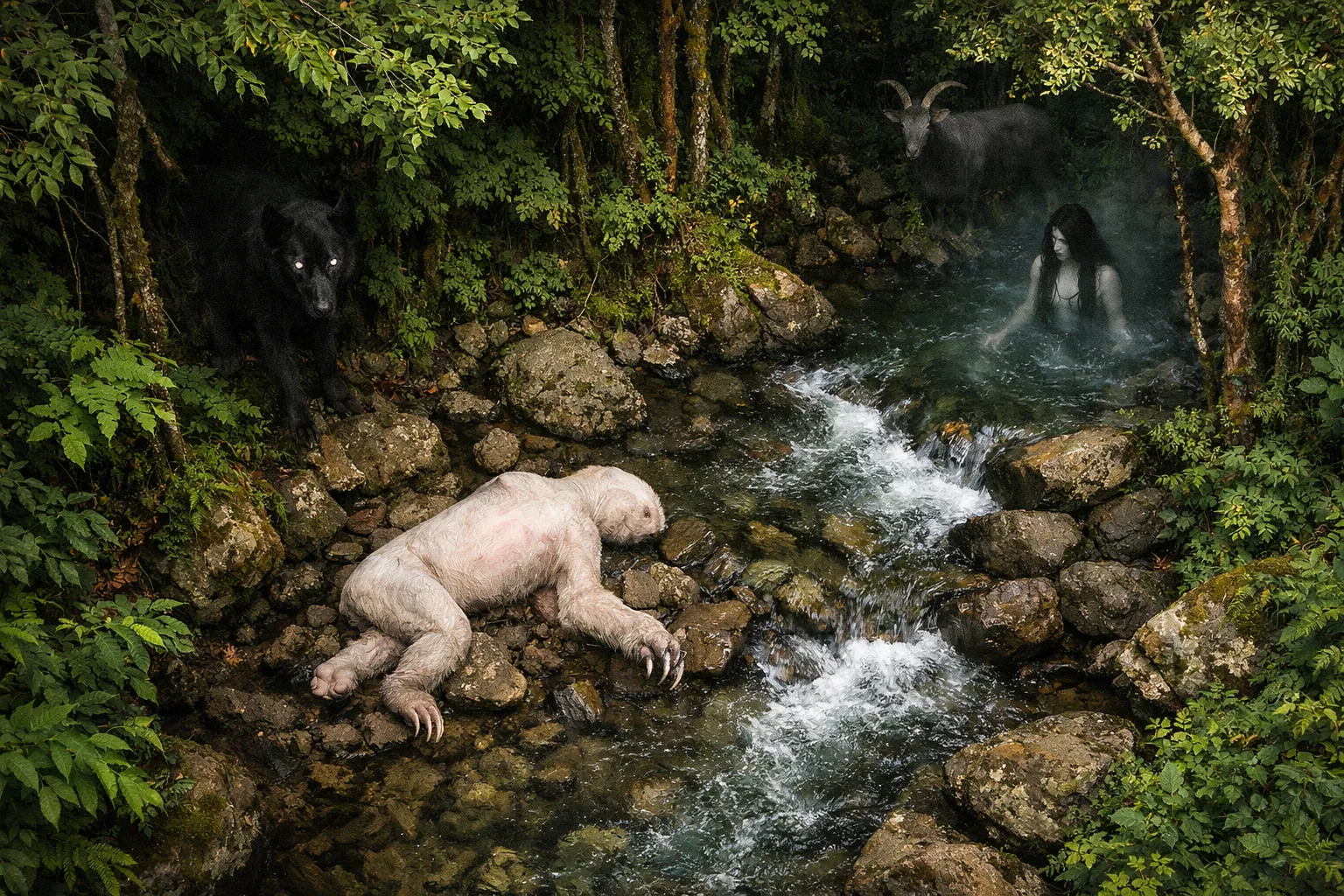
Officials recovered and examined the remains. The eventual identification was a male brown-throated sloth. Its strange appearance was attributed to decomposition in water: the fur had been lost, the skin had become pale and smooth, and post-mortem swelling had distorted the body. Trauma was also visible on the remains, consistent with the reported attack on the animal or carcass.[Wikipedia]WikipediaPanama CreatureApril 5, 2011 — The Panama Creature was shown to be a decomposing brown-throated sloth. The creature's corpse was recovered four days aft…
This explanation fits the local wildlife. Three-toed sloths are native to Panama and have been extensively studied there, including by researchers working through the Smithsonian Tropical Research Institute.[Smithsonian Magazine]smithsonianmag.comSmithsonian MagazineHow Sleepy Are Sloths and Other Lessons LearnedFebruary 3, 2010 — 3 Feb 2010 — Three toed sloth in Panama Three-toed… A living sloth is instantly recognisable when hanging in a tree with its fur intact. A waterlogged, hairless and bloated one is much harder to place, particularly when photographed from low angles without any reliable scale.
The case is therefore unusual among monster stories because investigators had a physical specimen rather than a distant silhouette, footprint or witness memory. That evidence did not reveal a new animal; it allowed an ordinary one to be identified under extraordinary-looking conditions.

Why the photographs became a monster story
The Panama Creature arrived at an ideal moment for an internet-age legend. Its images contained enough recognisable anatomy to look organic, but enough damage and distortion to prevent immediate recognition. The reports also supplied the memorable details that help modern legends spread: named witnesses, a specific location, alleged danger, a recovered body and photographs that appeared to prove something remarkable.
Research into viral urban legends has found that successful stories often combine the factual texture of news — a place, date and apparent eyewitnesses — with the emotional force of a frightening or astonishing tale.[arXiv]arxiv.orgarXiv Why Do Urban Legends Go Viral?Why Do Urban Legends Go Viral?January 22, 2016… The Cerro Azul story followed that pattern almost perfectly. “Teenagers find unfamiliar corpse” was accurate but limited; “alien-like monster attacks teenagers in Panama” travelled much further.
The changing labels also altered how people interpreted the pictures. Calling the body a “creature” left the question open. Calling it Panama E.T. encouraged viewers to see an alien. Comparing it with another internet monster placed it inside an emerging category of grotesque beach and waterside carcasses. By the time the sloth identification circulated, the sensational version had already become the more memorable one.
The episode demonstrates a recurring problem in mystery-animal reports: photographs do not interpret themselves. A real image can be paired with an incorrect story, and a genuine carcass can be presented as evidence of the wrong species. Physical evidence is valuable only when its location, condition, anatomy and chain of custody can also be examined.
Panama’s older creature folklore
The Cerro Azul carcass belongs to modern cryptozoological culture, but Panama’s deeper monster tradition comes from oral folklore. These beings are not usually claimed as undiscovered animal species. They are supernatural figures associated with particular landscapes, moral warnings and the dangers of travelling alone.
The river-haunting woman
One of the most distinctive figures is the Tulivieja, remembered in Panamanian tradition as a condemned woman or monstrous female being who wanders near rivers, streams and isolated country paths. Details vary widely. Some accounts describe a woman transformed after killing or abandoning her child; others give her claws, animal limbs, wings, reversed feet or a face so distorted that it barely appears human.
A Panamanian version recorded in a University of Southern California folklore collection describes the Tulivieja as a ghost that assumes monstrous form and roams deserted places, especially rural areas.[USC Digital Folklore Archives]folklore.usc.edula tulivieja panamaUSC Digital Folklore ArchivesLa Tulivieja, Panama6 May 2018 — It is the story about La Tulivieja, a ghost who turns itself into a monster… Printed compilations have preserved still more elaborate forms, including a composite body with feline or equine features and a piercing, bird-like cry.
The legend overlaps with the wider Central American tradition of the wandering, grieving mother, yet it is not simply a report of a strange animal. Rivers provide both setting and meaning: they are dangerous physical places, boundaries between settlements and wilderness, and locations where drowning stories naturally gather. The creature’s shifting anatomy is typical of oral tradition, in which memorable features are added, removed or adapted to local audiences.
Some versions also connect the story with Indigenous traditions from the borderlands of Panama and Costa Rica, followed by later Christian moral themes. That layered history makes it difficult to identify one “original” Tulivieja. It is better understood as a family of related stories than as a single creature with a fixed description.
Black dogs, goats and night spirits
Panamanian folklore also includes the Cadejo, commonly imagined across Central America as a supernatural dog encountered on lonely roads. Depending on the version, one dog protects travellers while another threatens, misleads or punishes them. The Chivato is another animal-shaped menace, generally represented as a demonic goat or goat-like being. The Silampa is less zoological: it may appear as a pale shape, sheet or mist-like presence that grows larger as it approaches.
These traditions can resemble cryptid reports because witnesses describe animal forms, glowing eyes, hoofbeats or nocturnal pursuit. Their narrative function is different, however. They explain fear on dark roads, reinforce rules about drinking or travelling late, and turn familiar animals into moral agents. A Cadejo tale is principally about protection, danger or conduct, not about establishing an unclassified canine population.
Treating every folkloric being as a cryptid can flatten that cultural meaning. It also risks forcing supernatural stories into a scientific question that their tellers were not necessarily trying to answer.
The chupacabra reaches Panama
The chupacabra is associated with Panama, but it did not originate there. The modern legend emerged in Puerto Rico in 1995 and rapidly spread through Latin American and Spanish-language media. Reports of mysteriously killed livestock were soon attributed to it in numerous countries, including Panama.[Wikipedia]WikipediaOpen source on wikipedia.org.
Descriptions changed as the story travelled. Early Puerto Rican accounts often imagined a bipedal creature with large eyes, spines or an almost extraterrestrial appearance. Later reports in Mexico and the southern United States increasingly involved hairless, dog-like animals. The shared name concealed the fact that witnesses were not consistently describing the same body shape.
Panamanian livestock deaths can easily acquire the chupacabra label because the country has farms bordering forest, free-roaming dogs, native carnivores and scavengers that alter carcasses after death. Puncture wounds do not show that blood was deliberately consumed, while the absence of blood around a body can result from internal bleeding, clotting or post-mortem settling. Predators may also kill more animals than they eat, particularly in enclosed pens.
Investigations elsewhere have repeatedly identified suspected dog-like chupacabras as canids with severe mange, a skin disease that causes hair loss, thickened skin and an unfamiliar outline. Ordinary predation by dogs has also accounted for alleged attacks.[Mongabay News]news.mongabay.comOpen source on mongabay.com. No Panamanian specimen has established the existence of a distinct blood-feeding predator.
The chupacabra’s importance in Panama is therefore cultural rather than zoological. It shows how a media-born creature can cross borders and supply a ready-made explanation whenever domestic animals die in disturbing circumstances.
Real wildlife behind strange encounters
Panama is a convincing setting for monster stories because its actual fauna can be startling. Forest cover, steep terrain, wetlands and low night-time visibility make brief encounters difficult to interpret. Animals may be heard without being seen, glimpsed through vegetation or encountered only after scavenging and decomposition have changed their bodies.
Several real animals are particularly relevant:
- Sloths can become almost unrecognisable after immersion and hair loss, as the Cerro Azul case demonstrated.
- Howler monkeys produce deep, carrying calls that can sound far larger and more threatening than the animal responsible.
- Tayras and other mustelids have long bodies, quick movements and dark coats, making their size difficult to judge during fleeting sightings.
- Harpy eagles are exceptionally large forest raptors whose silhouette, wings and powerful legs can encourage stories of outsized flying creatures.
- Jaguars are native to Panama and include melanistic individuals that appear black at a distance. Unlike “phantom panthers” reported in countries without native big cats, a black big-cat sighting in Panamanian forest can have a straightforward zoological explanation.
Melanistic jaguars have been documented by camera traps in eastern Panama. Their spots remain present but are partly concealed by dark pigmentation.[Wikipedia]WikipediaBlack pantherBlack panther This makes the phrase “black panther” misleading rather than wholly fabulous: in Panama it may refer to a rare colour form of a known local species.
Jaguar attacks on livestock also create conditions in which folklore and wildlife conflict can overlap. Recent conservation work in Darién has focused on preventing cattle losses and retaliatory killing of jaguars, illustrating that the feared predator around a farm may be real even when the supernatural explanation is not.[Mongabay News]news.mongabay.comfences tech and trust help save jaguars in panamas darienfences tech and trust help save jaguars in panamas darien
This ecological context does not prove that every report has been solved. It does show why unknown-species claims should be tested against local fauna first. Distance, darkness and surprise routinely make familiar animals appear larger, paler, more upright or less recognisable than they are.
Where Panama’s monster reports cluster
Panama does not have a well-documented equivalent of Loch Ness: a single lake or tourist site with decades of named sightings and organised monster hunting. The country’s creature stories instead gather around three broad landscape types.
Forested settlements near Panama City. Cerro Azul became internationally associated with a monster because of one carcass and a burst of media coverage, not because it had a long-standing population of reported creatures.
Rivers and rural paths in western and central Panama. These are the classic settings of Tulivieja, Cadejo and related oral traditions. The location is part of the warning: water, darkness and distance from neighbours turn an ordinary journey into a vulnerable one.
Forest-and-farm edges, particularly towards Darién. Here, unexplained livestock deaths or large-animal sightings may involve dogs, jaguars or scavengers. The region’s remoteness encourages mystery, but it also contains precisely the wildlife capable of producing frightening encounters.
No strong archival pattern currently supports a separate Panamanian lake monster, sea serpent or giant ape tradition comparable to the country’s Cerro Azul story and supernatural folklore. Individual claims may circulate online, but repetition on cryptid lists is not the same as independent testimony or historical documentation.
Claim, folklore or misidentification?
Panama’s cases become clearer when separated by the kind of evidence involved.
Tradition or reportWhat is being claimedBest-supported interpretationCerro Azul or Panama CreatureA pale, hairless, possibly unknown animalExamined carcass identified as a decomposing slothTuliviejaA monstrous woman or animal-human being near rivers and rural pathsOral folklore with regional and moral meaningsCadejo or ChivatoSupernatural dog- or goat-shaped night beingsWarning tales and religious folk traditionChupacabra attacksA blood-feeding creature killing domestic animalsImported modern legend; likely ordinary predation, disease or carcass misreading in investigated casesBlack panther sightingsA large, dark felinePotentially a melanistic jaguar, which is documented in PanamaUnusual jungle cries or silhouettesAn unknown large animalOften consistent with monkeys, birds, known mammals or poor viewing conditions
This does not require dismissing witnesses as dishonest. Someone may accurately report that they saw a large black shape, heard a terrifying cry or found animals dead in a pen while still being mistaken about the cause. Memory, expectation and local storytelling influence interpretation after the encounter.
Hoaxes are only one possible explanation and should not be used automatically. The Cerro Azul photographs, for example, showed a real carcass rather than a fabricated model. The error lay in identification and presentation. Folklore, meanwhile, is not failed zoology: a supernatural story can be culturally meaningful without describing a biological species.

How later accounts reshaped Panama’s cryptid traditions
Panama’s mystery-creature history reflects a shift from local oral storytelling to global image-sharing. Older legends changed slowly as families and communities retold them. Their beings could vary from province to province because there was no single authoritative picture.
The 2009 creature travelled differently. A small set of photographs was copied internationally within days, while headlines supplied a succession of identities. The same carcass became a monster, alien, mutant and new species before the examination received comparable attention. The visual record fixed the creature’s appearance, but online retelling detached that appearance from its eventual identification.
The result is a curious afterlife. The Panama Creature still appears in monster compilations even though it is one of the rare cases with a recovered body and an official biological explanation. Its continued popularity does not indicate unresolved evidence. It shows that a memorable mystery often survives its solution.
Panama’s older beings have also entered tourism pages, social media, podcasts and illustrated monster catalogues. This exposure keeps the stories alive but can standardise traditions that were once deliberately variable. The Tulivieja may be presented as though she has one canonical anatomy, while the Cadejo may be reduced to a simple “cryptid dog”. Both changes make the creatures easier to market but less faithful to the complexity of oral folklore.
The evidential limits around Panama’s cryptid traditions
Panama offers excellent conditions for mystery-animal stories but weak evidence for an undiscovered large creature. Its most famous physical case was solved as a sloth; its black big cats belong to a documented jaguar population; and its best-established monsters are folkloric beings rather than proposed zoological species.
That does not make the country’s creature traditions uninteresting. The Cerro Azul incident is a particularly useful example of how decomposition creates convincing monsters and how photographs acquire meaning through captions and headlines. The Tulivieja and animal-shaped night spirits preserve older ideas about rivers, forests, danger, guilt and social behaviour. The chupacabra demonstrates how a young legend can migrate rapidly and absorb unrelated animal deaths.
The most evidence-aware reading therefore leaves room for wonder without confusing categories. Panama has real elusive predators, strange-looking carcasses, sincere witnesses, supernatural folklore and internet-era monster making. What it does not yet have is persuasive biological evidence that any celebrated Panamanian cryptid represents an unknown living species.
Amazon book picks
Further Reading
Books and field guides related to Which Monsters Really Belong to Panama?. Use these as the next step if you want deeper reading beyond the article.
Tracking the Chupacabra
Highly relevant to Panama's most famous imported monster legend.
eBay marketplace picks
Marketplace Samples
Live-tested eBay searches with available results related to this page.


Endnotes
1.
Source: telemetro.com
Title: Investigan caso de criatura extraña de Cerro Azul
Link:https://www.telemetro.com/insolito/2009/09/16/investigan-criatura-extrana-cerro-azul/2076790.html
Source snippet
2009 - 20:21. Investigan caso de criatura extraña de Cerro Azul... perezoso", una especie de mamífero. Hay quienes insisten en pensar qu...
2.
Source: news.mongabay.com
Link:https://news.mongabay.com/2009/09/photo-mystery-alien-beast-in-panama-is-likely-a-sloth/
Source snippet
Mongabay NewsPhoto: Mystery 'alien-beast' in Panama is likely a slothThe 'mystery alien-beast' discovered by four teens in Panama and wid...
3.
Source: Wikipedia
Title: Panama Creature
Link:https://en.wikipedia.org/wiki/Panama_Creature
Source snippet
April 5, 2011 — The Panama Creature was shown to be a decomposing brown-throated sloth. The creature's corpse was recovered four days aft...
Published: April 5, 2011
4.
Source: arxiv.org
Title: arXiv Why Do Urban Legends Go Viral?
Link:https://arxiv.org/abs/1601.06081
Source snippet
Why Do Urban Legends Go Viral?January 22, 2016...
Published: January 22, 2016
5.
Source: folklore.usc.edu
Title: la tulivieja panama
Link:https://folklore.usc.edu/la-tulivieja-panama/
Source snippet
USC Digital Folklore ArchivesLa Tulivieja, Panama6 May 2018 — It is the story about La Tulivieja, a ghost who turns itself into a monster...
Published: May 2018
6.
Source: Wikipedia
Link:https://en.wikipedia.org/wiki/Chupacabra
7.
Source: news.mongabay.com
Link:https://news.mongabay.com/2010/10/mystery-of-the-chupacabra-monster-likely-solved/
8.
Source: Wikipedia
Title: Black panther
Link:https://en.wikipedia.org/wiki/Black_panther
9.
Source: news.mongabay.com
Title: fences tech and trust help save jaguars in panamas darien
Link:https://news.mongabay.com/2025/08/fences-tech-and-trust-help-save-jaguars-in-panamas-darien/
10.
Source: Wikipedia
Title: List of cryptids
Link:https://en.wikipedia.org/wiki/List_of_cryptids
11.
Source: Wikipedia
Title: List of lake monsters
Link:https://en.wikipedia.org/wiki/List_of_lake_monsters
12.
Source: Wikipedia
Link:https://en.wikipedia.org/wiki/Tulevieja
13.
Source: youtube.com
Title: So What Exactly Is The Cerro Azul Monster?
Link:https://www.youtube.com/watch?v=AEhQVC5U-Dg
Source snippet
The Cerro Azul Monster...
14.
Source: youtube.com
Title: The Cerro Azul Monster
Link:https://www.youtube.com/watch?v=Apv6XpqyPuM
Source snippet
Mystery Creature Found Dead in Panama...
15.
Source: smithsonianmag.com
Link:https://www.smithsonianmag.com/science-nature/how-sleepy-are-sloths-and-other-lessons-learned-6678458/
Source snippet
Smithsonian MagazineHow Sleepy Are Sloths and Other Lessons LearnedFebruary 3, 2010 — 3 Feb 2010 — Three toed sloth in Panama Three-toed...
Published: February 3, 2010
16.
Source: smithsonianmag.com
Link:https://www.smithsonianmag.com/tag/national-zoo/?page=14
17.
Source: smithsonianmag.com
Title: frank gehrys biomuseo panama finally open business 180952677
Link:https://www.smithsonianmag.com/travel/frank-gehrys-biomuseo-panama-finally-open-business-180952677/
18.
Source: ohiomemory.ohiohistory.org
Link:https://ohiomemory.ohiohistory.org/archives/5419
19.
Source: cryptidarchives.fandom.com
Title: Sea serpent
Link:https://cryptidarchives.fandom.com/wiki/Sea_serpent
20.
Source: obscurban-legend.fandom.com
Title: Panama Creature
Link:https://obscurban-legend.fandom.com/wiki/Panama_Creature
21.
Source: new-cryptozoology.fandom.com
Title: Panama Creature
Link:https://new-cryptozoology.fandom.com/wiki/Panama_Creature
Additional References
22.
Source: oneindia.com
Title: sloth that had died and started to decay before the boys’ discovery.Read more
Link:https://www.oneindia.com/2009/11/10/panamaalien-revealed-to-be-a-dead-bloatedsloth.html
Source snippet
[https://www.oneindia.com/Panama](https://www.oneindia.com/Panama) 'alien' revealed to be a dead, bloated sloth10 Nov 2009 — But, according to a report in National Geograph...
23.
Source: youtube.com
Title: STRANGE MYSTERIES Episode #6 with Steve Stockton
Link:https://www.youtube.com/watch?v=VvCH_XzJ2gE
Source snippet
Panama Creature 2009 Mystery Creature Found Dead in Panama Richy UFO...
24.
Source: reddit.com
Link:https://www.reddit.com/r/Cryptozoology/comments/10gyamt/are_there_black_big_cats_in_the_usa/
25.
Source: facebook.com
Link:https://www.facebook.com/ticoswildstudio/posts/-black-jaguaaaarrrr-alerrrt-this-is-jagi-moving-in-broad-daylight-with-full-conf/1456957753098244/
26.
Source: mythfolks.com
Link:https://www.mythfolks.com/cryptids/cadborosaurus
27.
Source: facebook.com
Link:https://www.facebook.com/groups/669979166452016/posts/9582457901870720/
28.
Source: princeton.edu
Link:https://www.princeton.edu/~accion/chupa21.html
29.
Source: geotoys.com
Link:https://geotoys.com/blogs/geotoys-blog/cryptids-across-continents-global-legends-of-mystery-and-myth?srsltid=AfmBOooRnkBYqQMcCfdm4Jy6ONWg5bcqolJiF6-Ti9sEKaCuSAZHOnMy
30.
Source: reddit.com
Link:https://www.reddit.com/r/WTF/comments/22avnt/i_never_knew_a_hairless_sloth_could_be_so/
31.
Source: facebook.com
Link:https://www.facebook.com/wfaa/posts/if-mythical-creatures-arent-your-thing-a-chupacabra-is-a-folklore-creature-belie/10158919418226545/
Topic Tree
Follow this branch
Related pages 192
- Antigua Cryptids
- Maldives Monsters
- Malta Monsters
- Qatar Monsters
- Argentina Monsters
- +187 more in sidebar