Within Sri Lankan Cryptids
Were the Nittaewo Creatures or Forgotten People?
The Nittaewo legend may preserve memories of conflict, misidentified wildlife or a marginalised human community.
On this page
- The earliest recorded extinction story
- Caves, expeditions and missing physical evidence
- Apes, people and modern hairy creature reports
Page outline Jump by section
Introduction
The Nittaewo occupy a unique place in Sri Lanka’s mystery-creature tradition because they are not remembered primarily as a beast that was occasionally seen in the forest. Instead, they are remembered as a people—or something very like a people—who supposedly lived in the island’s south-eastern wilderness until they were wiped out. The core story describes small, hairy, aggressive forest dwellers who clashed with local Vedda communities and were eventually trapped inside a cave and burned to death. What makes the legend unusual is that it is framed as an extinction story rather than a sighting story. The central question is therefore not simply whether a strange creature existed, but whether the legend preserves a memory of a forgotten human group, a misunderstood animal, or a piece of folklore that became increasingly literal over time.[Wikipedia]WikipediaOpen source on wikipedia.org.
Unlike many famous ape-man traditions, the Nittaewo have never produced a body, skeleton, skin, photograph or verified footprint. Yet the story has survived for more than a century in recorded accounts and remains one of Sri Lanka’s most debated cryptid traditions.[Wikipedia]WikipediaOpen source on wikipedia.org.
Were the Nittaewo Creatures or Forgotten People?
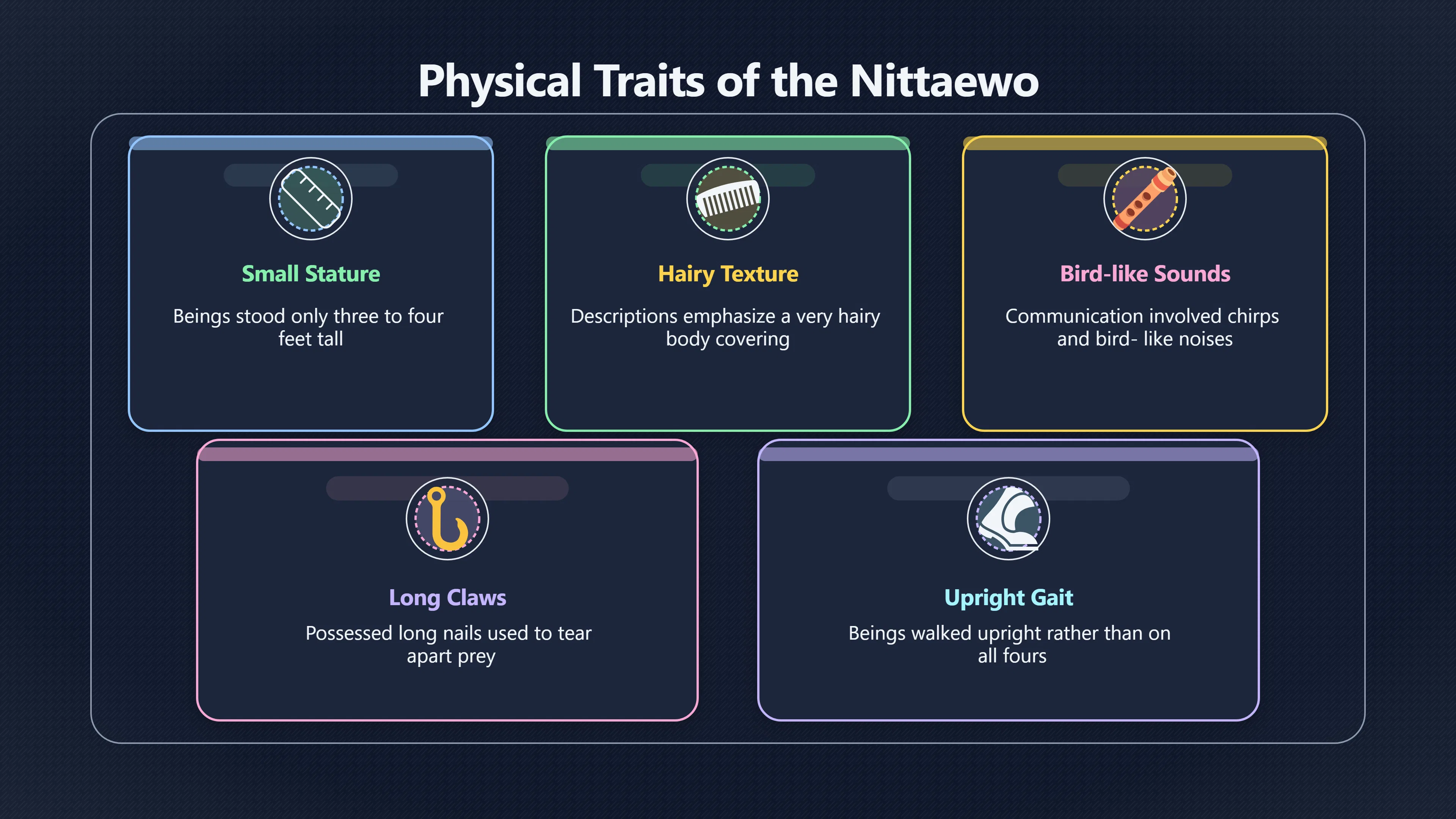
Descriptions collected from Vedda informants portray the Nittaewo as very small, hairy beings, often said to stand only around three to four feet tall. They supposedly lived in caves or temporary shelters, moved in groups, communicated in sounds that listeners compared to chirps or bird-like noises, and possessed long claws or nails used to tear apart prey. They were said to walk upright rather than on all fours.[Wikipedia]WikipediaOpen source on wikipedia.org.
These details have encouraged two very different interpretations. One sees the Nittaewo as an unknown animal, perhaps an ape-like creature. The other treats them as distorted memories of a real human population that occupied parts of Sri Lanka before being absorbed, displaced or exterminated. The second interpretation has attracted considerable interest because oral traditions around the world sometimes preserve memories of vanished communities long after written records disappear.[Academia]academia.eduOpen source on academia.edu.
The story is closely tied to the forests and rocky country of south-eastern Sri Lanka, especially areas around Lenama, Panama and Kudumbigala. The remoteness of these landscapes helped sustain the idea that an isolated population might once have survived there beyond the reach of settled society.[Wikipedia]WikipediaOpen source on wikipedia.org.
The Earliest Recorded Extinction Story
The most influential written account came from British civil servant and antiquarian Hugh Nevill in the 1880s. Nevill did not claim personal knowledge of the Nittaewo. Instead, he recorded a chain of testimony that passed through several storytellers before reaching him. According to the account, the Nittaewo were longstanding enemies of local Veddas and frequently attacked them. Eventually the Veddas trapped the remaining Nittaewo in a cave, sealed the entrance with brushwood and fire, and waited several days while those inside died.[Wikipedia]WikipediaOpen source on wikipedia.org.
From a cryptozoological perspective, this narrative is important because it explains why no living Nittaewo were expected to be found. The tradition itself claimed that they had already become extinct. The story therefore differs from modern Bigfoot or Yeti reports, where believers argue that a hidden population still survives.[Wikipedia]WikipediaOpen source on wikipedia.org.
A second significant detail is that later investigators reportedly collected versions of the same story from multiple informants. In the early twentieth century, Frederick Lewis recorded similar traditions in eastern Sri Lanka and noted claims that the extermination had occurred only a few generations earlier. While this repetition does not prove the story true, it suggests that it was not merely a single isolated tale invented for a colonial visitor.[Wikipedia]WikipediaOpen source on wikipedia.org.
The weakness, however, is obvious. Every known account is second-hand, third-hand or even fourth-hand. No contemporary witness statement survives from the supposed conflict itself, and no physical evidence accompanied the stories.[Wikipedia]WikipediaOpen source on wikipedia.org.

Caves, Expeditions and Missing Physical Evidence
If the Nittaewo were a real population, a cave sealed during a mass killing would be an extraordinary archaeological site. Yet no such cave has ever been conclusively identified. The tradition claims that knowledge of its location was eventually lost after the disappearance of the local group that remembered it.[Wikipedia]WikipediaOpen source on wikipedia.org.
Interest in the mystery encouraged several investigations during the twentieth century. Primatologist William C. Osman Hill treated the Nittaewo as an unresolved anthropological puzzle and explored possible biological explanations. Later, Captain A. T. Rambukwella organised searches in the Kudumbigala region, looking for evidence connected to the legend. Excavations reportedly uncovered animal remains such as shells, turtle fragments and reptile bones, but nothing demonstrated the existence of an unknown species or lost human population.[kiptra.com]kiptra.comNittaewoNovember 14, 2019 — 14 Nov 2019 — Osman Hill led an expedition into the region in 1945 and found widespread belief in the N…
This absence of evidence matters because Sri Lanka possesses a rich archaeological record. Human remains and traces of prehistoric occupation have been recovered from caves across the island. Sites such as Fa Hien Cave have produced ancient human fossils and artefacts dating back tens of thousands of years. If a separate hominid population had survived into recent centuries, archaeologists would expect at least some distinctive skeletal or material evidence. None has yet been found.[Wikipedia]WikipediaFa Hien CaveFa Hien Cave
Modern archaeological discussions of the Nittaewo therefore tend to be cautious. Researchers acknowledge the persistence of the tradition while noting that excavations have not produced evidence for a separate surviving hominid group.[Academia]academia.eduOpen source on academia.edu.
Apes, People and Modern Hairy-Creature Reports
The most famous zoological explanation proposes that the Nittaewo were based on an ape. Osman Hill and later cryptozoologists considered whether traditions of a small ape-like animal might have been transformed into stories about hostile forest beings. Gibbons were often mentioned because they are relatively small, can move upright, and are highly vocal. The problem is geographical: no native gibbon population is known from Sri Lanka, and several physical details do not match the traditional descriptions.[Wikipedia]WikipediaOpen source on wikipedia.org.
Other suggestions have included sloth bears, orangutans reported in error, or unknown ape species. Each theory explains some details but struggles with others. Bears can stand upright and possess impressive claws, but they are not small, permanently bipedal creatures. Orangutans fit even less well and are not native to Sri Lanka.[Wikipedia]WikipediaOpen source on wikipedia.org.
The human-origin theories are often more intriguing. Some researchers and writers have suggested that the legend may preserve memories of a marginalised population of short-statured hunter-gatherers. Comparisons have been made with small-bodied populations elsewhere in South and Southeast Asia. Others have speculated about extinct human relatives, particularly after the discovery of the diminutive Homo floresiensis in Indonesia demonstrated that unusual human species survived on islands far later than once imagined. None of these ideas has direct evidence linking them to Sri Lanka, but they illustrate why the Nittaewo story continues to attract attention.[Wikipedia]WikipediaOpen source on wikipedia.org.
Modern reports of hairy creatures occasionally appear in Sri Lankan media and cryptid discussions, including scattered claims from the late twentieth and early twenty-first centuries. These accounts generally differ from the traditional Vedda descriptions and often resemble generic ape-man stories found elsewhere in the world. As a result, most researchers treat them as separate phenomena rather than continuations of the original tradition.[Wikipedia]WikipediaOpen source on wikipedia.org.
How Nittaewo endured in local tradition
The lasting fascination of the Nittaewo comes from the way the story sits between folklore, history and anthropology. Unlike many monster legends, it contains recognisably human elements: territorial conflict, cultural difference, displacement and extinction. It reads less like a tale about a supernatural creature and more like a memory of a vanished neighbour whose identity became increasingly mysterious with time.[Academia]academia.eduOpen source on academia.edu.
That does not mean the Nittaewo were real. The evidence remains extremely thin, and no verified archaeological discovery supports the existence of a separate ape-like or human species in historic Sri Lanka. Yet the legend persists because it asks a compelling question: when oral tradition remembers a lost people, how much of the story is myth and how much might be a distant echo of real events? For now, the Nittaewo remain one of Sri Lanka’s most intriguing unresolved legends—balanced somewhere between cryptid lore, cultural memory and the possibility of a forgotten chapter of human history.[Academia]academia.eduOpen source on academia.edu.
Amazon book picks
Further Reading
Books and field guides related to Were the Nittaewo Creatures or Forgotten People?. Use these as the next step if you want deeper reading beyond the article.
eBay marketplace picks
Marketplace Samples
Live-tested eBay searches with available results related to this page.




Endnotes
1.
Source: Wikipedia
Link:https://en.wikipedia.org/wiki/Nittaewo
2.
Source: academia.edu
Link:https://www.academia.edu/8158183/Nittaewo_The_Cursed_Child_of_the_Veddah
3.
Source: kiptra.com
Link:https://kiptra.com/nittaewo/
Source snippet
NittaewoNovember 14, 2019 — 14 Nov 2019 — Osman Hill led an expedition into the region in 1945 and found widespread belief in the N...
Published: November 14, 2019
4.
Source: arugam.info
Link:https://www.arugam.info/2013/02/02/nitteawo/
Source snippet
Arugam Bay InformationNitteawo « Arugam Bay Information2 Feb 2013 — During an excavation of a cave at Kudumbingala they discovered, at a...
5.
Source: Wikipedia
Title: Fa Hien Cave
Link:https://en.wikipedia.org/wiki/Fa_Hien_Cave
6.
Source: cryptidz.fandom.com
Link:https://cryptidz.fandom.com/wiki/Nittaewo
Additional References
7.
Source: reddit.com
Link:https://www.reddit.com/r/Cryptozoology/comments/1kqrc8k/as_someone_who_is_an_enthusiast_of_south_asian/
Source snippet
As someone who is an enthusiast of south asian history...The Nittaewo are a group of small bipedal primate cryptids from Sri Lanka...
8.
Source: facebook.com
Title: in the panama region of southeast sri lanka theres a legend about a race of half
Link:https://www.facebook.com/aeglecreations/posts/in-the-panama-region-of-southeast-sri-lanka-theres-a-legend-about-a-race-of-half/1443606627781528/
Source snippet
In the Panama region of Southeast Sri Lanka, there's a...NITTAEWO (නිට්ටෑවෝ) Hugh Nevil stated in 1886 that a strange race of '...
9.
Source: cryptidarchives.fandom.com
Title: Cryptid Archives Nittaewo | Encyclopaedia of Cryptozoology
Link:https://cryptidarchives.fandom.com/wiki/Nittaewo
Source snippet
Cryptid ArchivesNittaewo | Encyclopaedia of Cryptozoology - Fandom4 Jun 2019 — The story of the extermination was first reported by explo...
10.
Source: srilanka.travel
Title: Sri Lanka Travel Nittaewo
Link:https://srilanka.travel/nittaewo-in-srilanka
Source snippet
Sri Lanka TravelNittaewo - The Dagger Clawed Pygmies of Sri LankaNevill also learned that the Nittaewo used to descend from the rocks in...
11.
Source: facebook.com
Link:https://www.facebook.com/aeglecreations/posts/according-to-legend-the-nittaewo-%E0%B6%B1%E0%B7%92%E0%B6%A7%E0%B7%8A%E0%B6%A7%E0%B7%91%E0%B7%80%E0%B7%9D-were-driven-into-a-cave-and-destroyed-/1466237558851768/
12.
Source: instagram.com
Link:https://www.instagram.com/reel/DYYmrD-p32T/
13.
Source: facebook.com
Link:https://www.facebook.com/groups/277933739075780/posts/1400931583442651/
14.
Source: facebook.com
Link:https://www.facebook.com/aeglecreations/posts/in-the-panama-region-of-southeast-sri-lanka-theres-a-legend-about-a-savage-clan-/1449414253867432/
15.
Source: facebook.com
Link:https://www.facebook.com/aeglecreations/posts/deraniyagalas-kudumbigala-expedition-and-the-diet-of-the-nittaewoin-the-1950s-an/1469298641878993/
16.
Source: shh.mpg.de
Title: forest reliance sri lanka
Link:https://www.shh.mpg.de/906627/forest-reliance-sri-lanka
Topic Tree