Strange Creatures of the Dominican Republic's Wild Places
The Dominican Republic’s mystery-creature tradition is less a catalogue of proven “unknown animals” than a lively mixture of rural folklore, mountain warnings, shapeshifter stories, frightening livestock rumours and real wildlife seen under strange conditions.
Page outline Jump by section
Introduction
For readers looking for hard cryptozoological evidence, the short answer is sober: the Dominican Republic has no well-documented modern lake monster, ape-man or big-cat case comparable to famous cryptid traditions elsewhere. Its strongest “monster” material is folklore with deep cultural life, plus occasional Caribbean-style rumours such as chupacabra-like animal attacks. The interesting question is not “which monster has been proved real?”, but why so many Dominican legends lead into the same landscapes: mountains, caves, rivers, dry borderlands, night roads and places where ordinary animals can become briefly uncanny.
The ciguapa is the country’s signature mystery creature
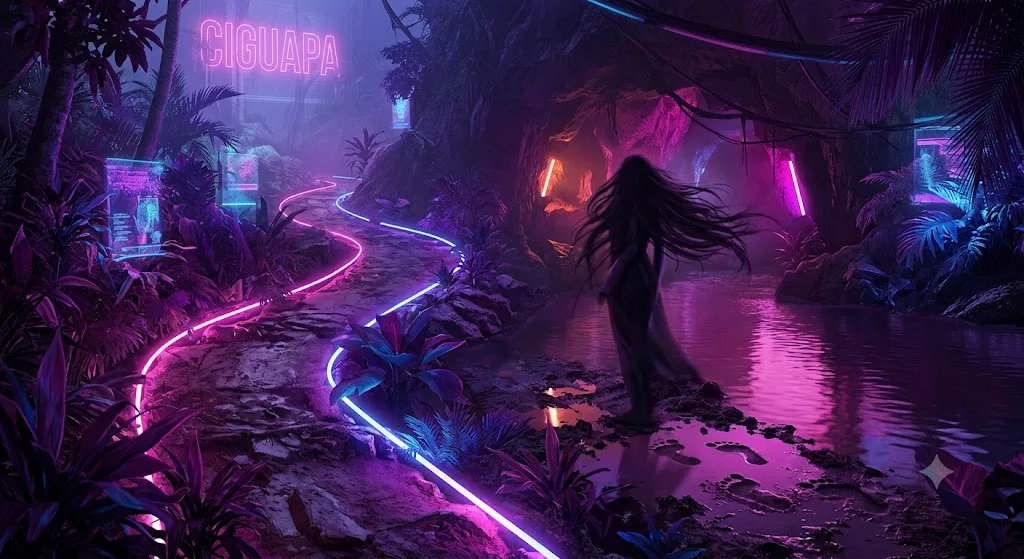
The ciguapa is the Dominican Republic’s most recognisable legendary being. Dominicana Online, a cultural resource connected with the Global Foundation for Democracy and Development, describes her as a magical creature with inverted feet and long hair who appears around caverns and rivers. In countryside versions, she is a small, beautiful woman who draws men into her nocturnal world.[Dominicana Online]dominicanaonline.orgDominicana Online Myths and Beliefs – Dominicana OnlineDominicana Online Myths and Beliefs – Dominicana Online
The backwards feet are the detail that makes the ciguapa feel almost like a tracking puzzle. A creature that leaves footprints pointing the wrong way is not just frightening; she defeats the basic rural skill of following a trail. Smithsonian Folklife similarly presents the ciguapa as a rural mountain figure whose long hair covers her body, whose skin is described in varying traditions as blue or pale brown, and whose backwards feet make it impossible to know where she is coming from or going.[Smithsonian Folklife]folklife.si.eduOpen source on si.edu.
That tracking detail also gives the legend its cryptid-like flavour. Unlike a ghost that simply vanishes, the ciguapa belongs to the world of prints, paths, caves and dogs. Some versions even say she can be hunted only under special conditions, by moonlight and with the aid of a particular dog. That does not make the story zoological evidence, but it does show why the ciguapa sits naturally beside mystery-beast traditions: she is imagined as a being with habitat, behaviour, tracks and field signs.[Smithsonian Folklife]folklife.si.eduOpen source on si.edu.
Her origin is disputed, which is part of the point. Dominicana Online reports one version linking the legend to Onaney, a ciguaya princess of Samaná who retreats into a cave after the death of Caonabo, with the backwards walking explained as a way of avoiding pursuit. Smithsonian Folklife notes other readings: some people connect the figure with Taíno flight into the mountains, others with escaped enslavement, and others with a pre-Columbian presence.[Dominicana Online]dominicanaonline.orgDominicana Online Myths and Beliefs – Dominicana OnlineDominicana Online Myths and Beliefs – Dominicana Online
The ciguapa has also moved well beyond campfire warning. Smithsonian’s discussion of Afro-Dominican writer Elizabeth Acevedo shows how contemporary artists use the figure to think about memory, gender, Blackness, Indigenous erasure and survival. In other words, the ciguapa is not just “a Dominican monster”; she is a flexible cultural symbol whose meaning changes depending on who is telling the story.[Smithsonian Folklife]folklife.si.eduOpen source on si.edu.
Why so many Dominican monsters live in mountains, caves and rivers
Dominican monster folklore repeatedly sends the listener away from the safe centre: into the mountains, towards riverbanks, into caves, or onto night paths. That geography matters. The Dominican Republic is marketed today through beaches, national parks, adventure travel and mountain destinations such as Jarabacoa, Barahona, Pedernales and Samaná, but the same varied landscape also gives folklore plenty of shadowy edges.[Visit Dominican Republic]godominicanrepublic.comOpen source on godominicanrepublic.com.
The ciguapa belongs to caves, rivers and mountain spaces. Jupías, described in Dominican cultural summaries as ghostly women who circle mountains at night, also pull men into disappearance. The Biembienes are linked specifically to the Bahoruco mountains, where stories describe hidden, wild clans moving at night, stealing crops and leaving backwards tracks to confuse pursuers.[Dominicana Online]dominicanaonline.orgDominicana Online Myths and Beliefs – Dominicana OnlineDominicana Online Myths and Beliefs – Dominicana Online
This is where folklore and history blur. The Bahoruco region is not just atmospheric scenery. It is associated in Dominican cultural memory with refuge, resistance and difficult terrain. Dominicana Online’s account, drawing on Lo Dominicano/All Things Dominican, frames the Biembienes story as growing out of mountain refuges used by Indigenous people and runaway slaves.[Dominicana Online]dominicanaonline.orgDominicana Online Myths and Beliefs – Dominicana OnlineDominicana Online Myths and Beliefs – Dominicana Online
That does not mean the Biembienes were a literal hidden species. A more evidence-aware reading is that the legend preserves anxieties around people living beyond colonial control, rural isolation, hunger, pursuit and the fear of being watched from the margins. The “creature” is therefore partly a monster and partly a social memory of those who survived outside official society.
Shapeshifters: galipotes, bacás and animals that are not quite animals
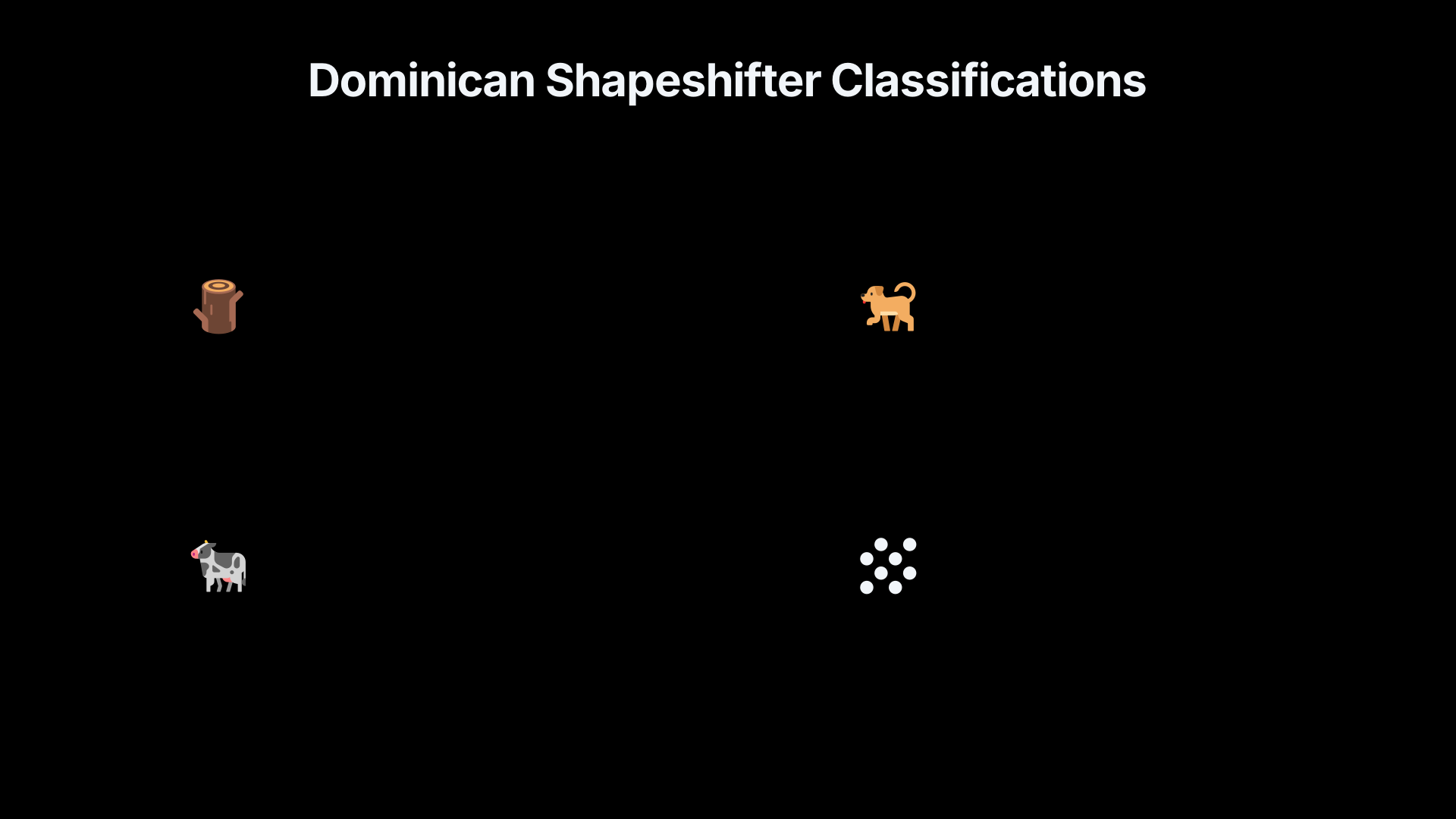
The galipote is the Dominican Republic’s strongest shapeshifter tradition. Dominicana Online summarises galipotes as men who transform into animals or even inanimate objects such as tree trunks or rocks. They are described as cruel, violent and immune to weapons. The dog-form galipote is called a lugarú, a term connected with the French loup-garou, the werewolf tradition.[Dominicana Online]dominicanaonline.orgDominicana Online Myths and Beliefs – Dominicana OnlineDominicana Online Myths and Beliefs – Dominicana Online
That borrowing matters because it shows the mixed ancestry of Dominican monster lore. The galipote is not a simple imported werewolf, nor a purely local animal claim. It sits at a crossroads of European shapeshifter ideas, Christian demonology, African-Caribbean spiritual fears and Dominican rural storytelling. When people speak of a dog, bird, tree or stone that is secretly a dangerous person, they are not making a straightforward wildlife report. They are describing a world where moral suspicion, night travel and animal behaviour overlap.
The bacá belongs to a related but distinct pattern: the animal familiar or wealth-giving spirit. In Dominican folklore summaries, it is commonly treated as a dangerous being linked with pacts, protection, prosperity and sacrifice. In cryptid terms, the bacá is important because it often takes animal form: a frightening dog, bull or other domestic-looking creature may be imagined as something more than an animal.[Wikipedia]WikipediaBacá (mythological creatureBacá (mythological creature
The sceptical reading is not that every bacá report is “really” a dog or bull. It is that the legend makes ordinary animals symbolically unstable. A black dog on a path, a bull seen at night, a bird circling a roof, or a shape beside a field can become charged with a story that already exists in the community. The creature is recognised not through biological features alone, but through timing, setting, reputation and fear.
The Biembienes are the closest thing to a Dominican “wild people” legend
If the ciguapa is the country’s signature mystery woman and the galipote its shapeshifter, the Biembienes are its closest equivalent to a “wild people of the mountains” tradition. They are described as savage beings living in hidden Bahoruco clans, moving in groups at night, stealing crops, using grunts rather than ordinary speech, and leaving backward tracks like the ciguapa.[Dominicana Online]dominicanaonline.orgDominicana Online Myths and Beliefs – Dominicana OnlineDominicana Online Myths and Beliefs – Dominicana Online
For cryptid readers, the resemblance to ape-man or relict-tribe folklore is obvious: remote mountains, hidden communities, night raids, strange tracks and limited speech. But the Dominican version is not mainly about an unknown primate. It is more historically loaded. The story is tied to Indigenous survival, maroon communities, slavery and the fear or fascination surrounding people who escaped the plantation and colonial order.
That makes the Biembienes more valuable as folklore than as zoology. The Dominican Republic has no native apes, and there is no credible scientific evidence for a hidden hominid population in Bahoruco. What the legend does preserve is the sense that mountains could hide other ways of living, and that those who vanished from official records might return in popular imagination as something half-human, half-monstrous.
Lake Enriquillo shows how real animals can feel legendary
The Dominican Republic does have one place that feels ready-made for monster stories: Lake Enriquillo. It is a hypersaline inland lake in the arid south-west, part of the Jaragua-Bahoruco-Enriquillo Biosphere Reserve. UNESCO describes the Dominican side of the reserve as spanning the Hoya del Lago Enriquillo, Sierra de Bahoruco and Barahona region, with ecosystems ranging from tropical highlands to karst terraces, coastal areas, islands and cays.[UNESCO]unesco.orgOpen source on unesco.org.
The real “monsters” of Lake Enriquillo are American crocodiles. A herpetological study on the conservation of Crocodylus acutus in the Dominican Republic reported that the species was once widespread on Hispaniola but, by the late twentieth century, survived in the Dominican Republic chiefly in Lake Enriquillo, a hyper-saline inland lake. The same study described a severe decline in the late 1980s and early 1990s, followed by conservation measures and an adult/subadult population estimate of about 200 individuals after 1992.[crocodileandy]crocodileandy.org4 3 conservation of american crocodile lago enriquillo4 3 conservation of american crocodile lago enriquillo
This is a useful corrective to lake-monster thinking. A visitor seeing a large crocodile in a hot, saline, below-sea-level lake does not need an unknown species to have a strange encounter. The setting itself is unusual. The lake is bordered by arid and semi-arid terrain, its water levels and salinity shift, and it contains islands and wetland margins that create dramatic wildlife viewing conditions.[crocodileandy]crocodileandy.org4 3 conservation of american crocodile lago enriquillo4 3 conservation of american crocodile lago enriquillo
Unlike a claimed lake monster, the crocodile is fully real, scientifically documented and conservation-relevant. Yet it also explains how Dominican landscapes can produce monster feeling without monster evidence. Large reptiles, night water, harsh heat, remote shorelines and oral warning stories are enough to make the natural world feel uncanny.
Chupacabra rumours reached the region, but the Dominican trail is thin
The chupacabra is not originally a Dominican creature. The modern version emerged from Puerto Rican reports in the 1990s and then spread through Latin America, the Caribbean and the United States as a media-driven livestock-attack legend. General accounts of the phenomenon list the Dominican Republic among places where the story circulated, but the strongest early identity of the creature remains Puerto Rican rather than Dominican.[Wikipedia]WikipediaOpen source on wikipedia.org.
This distinction matters. It is easy to pad a Dominican cryptid page with chupacabra material, but that would distort the country’s own folklore. In the Dominican Republic, chupacabra-style rumours fit best as imported or regional monster media: a ready-made label that can be applied to dead goats, strange dogs, unexplained livestock wounds or frightening night noises.
The usual sceptical explanations also travel with the legend. Across the wider chupacabra tradition, investigators and wildlife experts have often pointed to dogs, coyotes or other canids, sometimes sick or hairless from mange, as explanations for many alleged “blood-sucking” animals. Livestock found with puncture wounds can look more mysterious than the actual predation event was, especially when the carcass is discovered later and retold through an already famous monster story.[Wikipedia]WikipediaOpen source on wikipedia.org.
For the Dominican Republic specifically, the evidence base is thin: not a strong sequence of well-documented local cases, but a regional legend that can attach itself to rural animal losses. The more deeply rooted Dominican material remains the ciguapa, galipote, bacá and Biembienes.
Real Dominican wildlife complicates the monster map
A good cryptid reading of the Dominican Republic has to take ordinary wildlife seriously. Hispaniola’s real fauna is already unusual. Durrell Wildlife Conservation Trust notes that the Caribbean once had a far richer mammal fauna, but today only a small number of non-flying native land mammals survive, mainly hutias and solenodons. On Hispaniola, the hutia and solenodon are endemic survivors that conservation projects have studied in the Dominican Republic.[Durrell Wildlife Conservation Trust]durrell.orgWildlife Conservation Trust The Caribbean’s Last Survivors | DurrellWildlife Conservation Trust The Caribbean’s Last Survivors | Durrell
The Hispaniolan solenodon in particular has the kind of features that would sound invented if it were not real: it is nocturnal, ancient-looking, shrew-like and venomous. The hutia, meanwhile, is a nocturnal rodent-like mammal that can move through trees and burrows. These animals do not explain the ciguapa or galipote, but they show why “strange animal” experiences in Dominican forests need not involve unknown species.[Grupo Jaragua]grupojaragua.org.doOpen source on grupojaragua.org.do.
The country’s mammal list also works against some popular cryptid claims. There is no good ecological basis for native big cats, bears or apes in the Dominican Republic. Introduced and feral animals, however, matter: dogs, cats, mongooses, rats, goats, pigs, cattle and other animals can produce night sightings, livestock damage or odd tracks.[Wikipedia]WikipediaList of mammals of the Dominican RepublicList of mammals of the Dominican Republic
That makes the Dominican Republic a useful case study in separating three things that often get blurred:
- Folklore creatures, such as the ciguapa or galipote, whose meaning is cultural and symbolic.
- Misidentified or story-charged animals, such as dogs, bulls, birds or crocodiles seen in frightening circumstances.
- Genuinely unusual native wildlife, such as solenodons, hutias and crocodiles, which are real, rare or locally threatened, but not cryptids.
How the legends changed in modern culture
Dominican creature lore has not stayed fixed in rural oral tradition. The ciguapa in particular has become a figure in literature, visual art, children’s books, film and diaspora writing. Smithsonian Folklife’s profile of Elizabeth Acevedo shows the creature being reworked as a symbol of gender, ancestry, Afro-Dominican identity and the unresolved histories of colonisation and enslavement.[Smithsonian Folklife]folklife.si.eduOpen source on si.edu.
Dominicana Online also notes that the ciguapa story has been exaggerated and reshaped over centuries, influencing visual art, music, literature and Dominican film. That evolution is typical of successful monster folklore. A creature begins as a warning or rural tale, then becomes a national emblem, then a flexible image for artists and writers who may be less interested in “is it real?” than in “what does it reveal?”[Dominicana Online]dominicanaonline.orgDominicana Online Myths and Beliefs – Dominicana OnlineDominicana Online Myths and Beliefs – Dominicana Online
The same process affects shapeshifters and witches. A galipote may once have been a night-road terror; now it can also be discussed as folklore, identity, Halloween material, children’s storytelling or internet content. The monster becomes safer in one sense, because it is packaged as culture, but it also travels further.
What is the best evidence-aware reading?
The Dominican Republic’s cryptid tradition is strongest when read as creature folklore rooted in place, rather than as a set of pending zoological discoveries. The ciguapa has habitat, tracks and behaviour, but she is best understood as a legendary being whose power lies in misdirection, disappearance and cultural memory. The galipote and bacá turn animals into moral signs: not “unknown species”, but familiar forms made dangerous by stories of pacts, shapeshifting and night travel. The Biembienes preserve a mountain wild-people motif tied to Bahoruco, refuge and colonial history.[Dominicana Online]dominicanaonline.orgDominicana Online Myths and Beliefs – Dominicana OnlineDominicana Online Myths and Beliefs – Dominicana Online
The country’s real landscapes do much of the work. Caves, rivers, highlands, karst, dry forests, borderlands and a crocodile lake give Dominican folklore an unusually physical setting. UNESCO’s description of the south-western biosphere reserve as a diverse zone of highlands, karst terraces, coastal ecosystems, islands, cays, reptiles, birds and manatees helps explain why this is not just abstract superstition: the stories grew in places where the natural world is varied, difficult and memorable.[UNESCO]unesco.orgOpen source on unesco.org.
So the honest conclusion is also the most interesting one. The Dominican Republic has few verified “mystery animal” cases in the strict cryptozoological sense, but it has one of the Caribbean’s richest creature-folklore landscapes. Its monsters are not waiting neatly in a field guide. They are hiding in backwards footprints, night roads, mountain refuges, animal disguises and the uneasy border between real wildlife and the stories people tell when the dark starts moving.
Amazon book picks
Further Reading
Books and field guides related to What Haunts the Dominican Republic's Wild Places?. Use these as the next step if you want deeper reading beyond the article.
The Mythology Book
Explains how monster and folklore traditions develop across cultures.
American Myths, Legends, and Tall Tales
Places Caribbean and New World legends in wider context.
Encyclopedia of Things that Never Were
Covers legendary beings and the cultural imagination behind them.
eBay marketplace picks
Marketplace Samples
Live-tested eBay searches with available results related to this page.



Endnotes
1.
Source: Wikipedia
Title: Bacá (mythological creature)
Link:https://en.wikipedia.org/wiki/Bac%C3%A1_%28mythological_creature%29
2.
Source: unesco.org
Link:https://www.unesco.org/en/mab/jaragua-bahoruco-enriquillo
3.
Source: crocodileandy.org
Title: 4 3 conservation of american crocodile lago enriquillo
Link:https://crocodileandy.org/wp-content/uploads/2015/05/4-3-conservation-of-american-crocodile-lago-enriquillo.pdf
4.
Source: Wikipedia
Link:https://en.wikipedia.org/wiki/Chupacabra
5.
Source: durrell.org
Title: Wildlife Conservation Trust The Caribbean’s Last Survivors | Durrell
Link:https://www.durrell.org/news/the-caribbean-s-last-survivors/
6.
Source: Wikipedia
Title: List of mammals of the Dominican Republic
Link:https://en.wikipedia.org/wiki/List_of_mammals_of_the_Dominican_Republic
7.
Source: Wikipedia
Title: Dominican Republic
Link:https://en.wikipedia.org/wiki/Dominican_Republic
8.
Source: Wikipedia
Title: Folklore of the Dominican Republic
Link:https://en.wikipedia.org/wiki/Folklore_of_the_Dominican_Republic
9.
Source: Wikipedia
Title: List of lake monsters
Link:https://en.wikipedia.org/wiki/List_of_lake_monsters
10.
Source: Wikipedia
Link:https://en.wikipedia.org/wiki/Ciguapa
11.
Source: Wikipedia
Title: People of the Dominican Republic
Link:https://en.wikipedia.org/wiki/People_of_the_Dominican_Republic
12.
Source: Wikipedia
Title: Galipote (mythological creature)
Link:https://en.wikipedia.org/wiki/Galipote_%28mythological_creature%29
13.
Source: Wikipedia
Title: Hispaniolan hutia
Link:https://en.wikipedia.org/wiki/Hispaniolan_hutia
14.
Source: Wikipedia
Title: Lake Enriquillo
Link:https://en.wikipedia.org/wiki/Lake_Enriquillo
15.
Source: crocodileandy.org
Title: Sympathische Monster
Link:https://crocodileandy.org/wp-content/uploads/2015/05/4-8-sympathetic-monsters-german-english-version.pdf
16.
Source: dominicanaonline.org
Title: Dominicana Online Myths and Beliefs – Dominicana Online
Link:https://www.dominicanaonline.org/en/cultura/mitos-creencias/
17.
Source: folklife.si.edu
Link:https://folklife.si.edu/magazine/beautiful-monsters-elizabeth-acevedo-poetry
18.
Source: godominicanrepublic.com
Link:https://www.godominicanrepublic.com/
19.
Source: globalfoundationdd.org
Title: Lo Dominicano | All Things Dominican Now Available for Sale Online
Link:https://www.globalfoundationdd.org/lo-dominicano-all-things-dominican-now-available-for-sale-online/
20.
Source: grupojaragua.org.do
Link:https://www.grupojaragua.org.do/jutia_solenodon_english.html
21.
Source: avsi.org
Title: lago enriquillo
Link:https://www.avsi.org/en/news-and-press/news/lago-enriquillo
22.
Source: spkofmarvels.wordpress.com
Title: elizabeth acevedo
Link:https://spkofmarvels.wordpress.com/2017/04/04/elizabeth-acevedo/
23.
Source: everythingpuntacana.com
Link:https://everythingpuntacana.com/tag/wildlife/
24.
Source: state.gov
Title: Dominican Republic
Link:https://www.state.gov/countries-areas/dominican-republic
25.
Source: monaconatureencyclopedia.com
Title: crocodylus acutus
Link:https://www.monaconatureencyclopedia.com/crocodylus-acutus/?lang=en
26.
Source: critter.science
Title: the hispaniolan solenodon
Link:https://critter.science/the-hispaniolan-solenodon/
27.
Source: merriam-webster.com
Link:https://www.merriam-webster.com/dictionary/Dominican
28.
Source: visitdominicanrepublic.com
Link:https://visitdominicanrepublic.com/wildlife-nature/wildlife-dominican-republic/
29.
Source: myguidedominicanrepublic.com
Link:https://www.myguidedominicanrepublic.com/travel-articles/lago-enriquillo
Additional References
30.
Source: youtube.com
Title: The Galipote, Witchcraft and Black Magic in the Dominican Republic and Haiti
Link:https://www.youtube.com/watch?v=BgMjMy0ZFCA
Source snippet
Bêtes Noires: Sorcery as History in the Haitian-Dominican Borderlands...
31.
Source: youtube.com
Title: The Ciguapa: Don’t Follow the Footprints
Link:https://www.youtube.com/watch?v=Y_-gT8nc264
Source snippet
The Galipote, Witchcraft and Black Magic in the Dominican Republic and Haiti...
32.
Source: pisqueya.com
Link:https://pisqueya.com/blogs/news/4-dominican-urban-legends-of-dark-creatures-that-go-bump-in-the-night?srsltid=AfmBOooQMANLUCm-6VSdBNafYg-ETxAbusHqlefnAaGX8AjCY0Z5QWwl
33.
Source: pisqueya.com
Link:https://pisqueya.com/blogs/news/4-dominican-urban-legends-of-dark-creatures-that-go-bump-in-the-night?srsltid=AfmBOorGafI9Cl0WFRsyACQFGKeTWE2JkLztjpCq0RzooxtXwIIhZ0AS
34.
Source: pisqueya.com
Link:https://pisqueya.com/blogs/news/4-dominican-urban-legends-of-dark-creatures-that-go-bump-in-the-night?srsltid=AfmBOorv7G_iGaUYxpKXT4Go_9r9AUahad90OZ4wq4CjrIYSQWJ_8sEn
35.
Source: panorama.solutions
Link:https://panorama.solutions/sites/default/files/2025-01/4-10-hispaniola-island-for-crocodile-conservation-units-ccu.pdf
36.
Source: history.co.uk
Link:https://www.history.co.uk/articles/strange-sea-serpent-sightings-from-history
37.
Source: facebook.com
Link:https://www.facebook.com/groups/281886105961506/posts/1526491644834273/
38.
Source: facebook.com
Link:https://www.facebook.com/timesofmalta/videos/a-large-feline-believed-by-activists-to-be-a-black-panther-was-caught-on-cctv-fa/802798362862388/
39.
Source: facebook.com
Link:https://www.facebook.com/VancouverArtGallery/videos/ask-the-artist-questions-for-firelei-b%C3%A1ez-episode-3-the-ciguapa/4142999702653776/
Topic Tree
Follow this branch
Related pages 192
- Antigua Cryptids
- Maldives Monsters
- Malta Monsters
- Qatar Monsters
- Argentina Monsters
- +187 more in sidebar