Cryptids of Lebanon's Stories
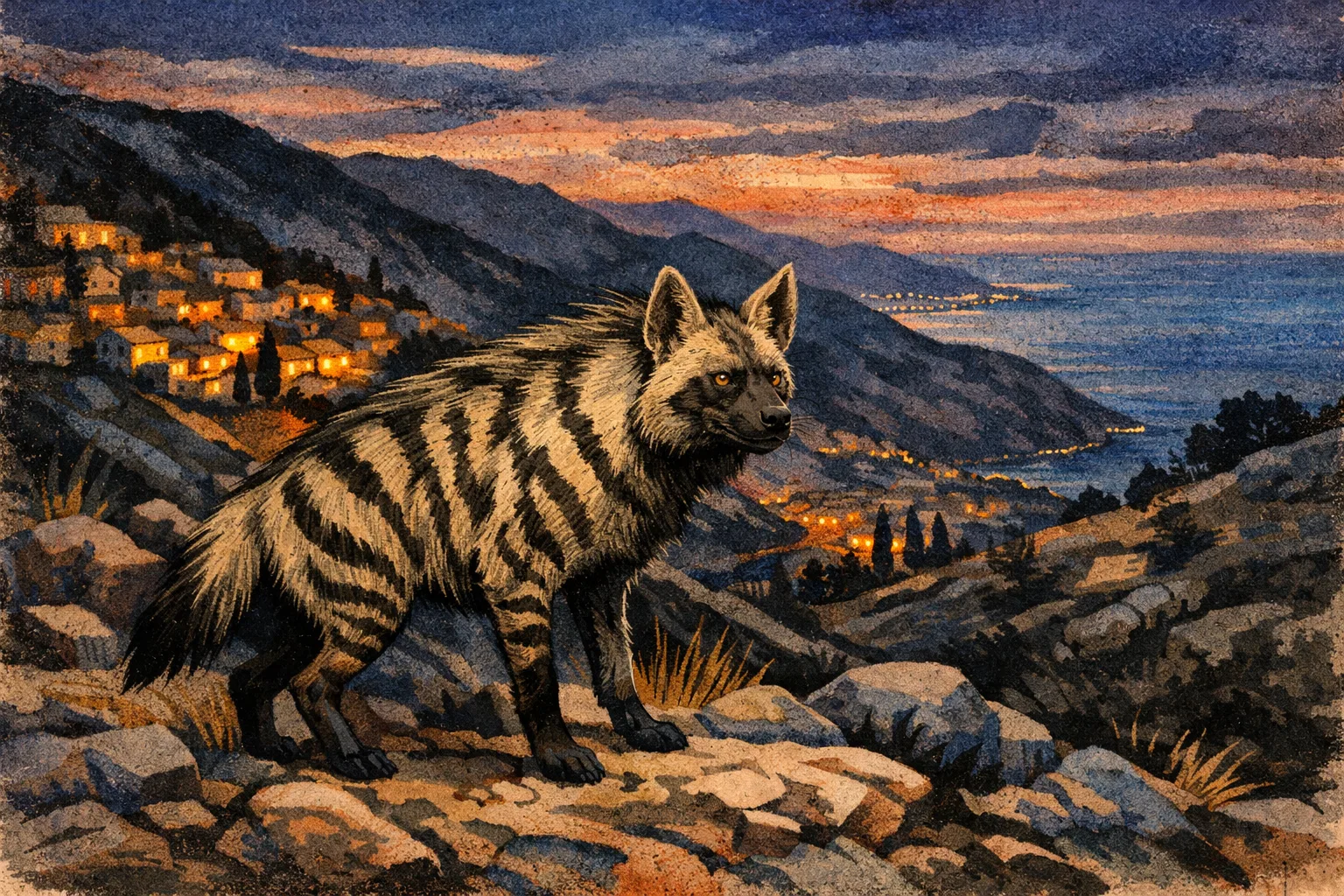
Lebanon does not have a famous Nessie-style lake monster or a well-documented modern “mystery beast” flap. Its strongest cryptid-adjacent tradition is stranger and more local: the striped hyena, a real nocturnal animal that has been wrapped in stories of grave-robbing, hypnotic powers, bad omens and man-eating danger.
Page outline Jump by section
The striped hyena is Lebanon’s real mystery beast
The striped hyena is the centrepiece of Lebanon’s mystery-animal tradition because it is both genuinely present and culturally overcharged. A 2007 study by Mounir R. Abi-Said and Diana Marrouche Abi-Said found that striped hyenas remained widely distributed across Lebanon, based on sources including newspapers, oral reports and official ministerial reports, with observations in urban and rural settings and in all governorates except densely populated Beirut.[ResearchGate]researchgate.netResearch Gate Hyaenidae) in urban and rural areas of LebanonResearch Gate Hyaenidae) in urban and rural areas of Lebanon
That matters because the hyena is not a fantasy creature being imported into Lebanese folklore from elsewhere. It is a living animal whose habits invite exaggeration: it is nocturnal, shy, scavenging, often glimpsed briefly, and associated with caves, rocky country, rubbish, carrion and village edges. Animal Diversity Web describes the striped hyena as predominantly a scavenger that eats carrion and human refuse, while also taking fruit, insects and small animals such as rodents, reptiles and birds.[Animal Diversity Web]animaldiversity.orgOpen source on animaldiversity.org.
Lebanese conservation law also treats the animal as wildlife, not as vermin. Lebanon’s Sixth National Report to the Convention on Biological Diversity notes Ministry of Environment Decision #798/1 of 10 September 2018, which banned hunting foxes, hyenas and wolves all year round. The same report also mentions a caracal management plan at the Shouf Biosphere Reserve, a useful reminder that Lebanon’s “large shadow animals” include real but elusive carnivores beyond the hyena.[Convention on Biological Diversity]cbd.intConvention on Biological Diversity CBD Sixth National ReportConvention on Biological Diversity CBD Sixth National Report
The hyena’s cryptid-like reputation comes from the gap between what people imagine and what the animal usually does. Across parts of the Middle East, striped hyenas have been described in folklore as grave robbers or animals able to cast a spell on people before dragging them away. Conservation writing on the species repeatedly points out that such stories are more powerful than the animal’s actual danger to humans.[NRDC]nrdc.orgstriped hyenas dont have magical powers their disappearing act realstriped hyenas dont have magical powers their disappearing act real
Why hyena stories became so dark
Hyena legends make emotional sense even when the claims are not zoologically sound. The animal moves at night, has an unusual sloping body shape, makes unsettling sounds, scavenges, and may be seen near dumps, carcasses or graveyards. In a village setting, those traits can easily become a story about an uncanny creature that crosses the boundary between the living and the dead.
The most important Lebanese source title says a great deal by itself: Abi-Said’s doctoral thesis is called Reviled as a grave-robber: the ecology and conservation of striped hyaenas in the human-dominated landscapes of Lebanon. The phrasing captures the basic tension: a real scavenger trying to survive in a human-dominated country becomes morally labelled as a monster.[Kent Academic Repository]kar.kent.ac.ukOpen source on kent.ac.uk.
There is a small kernel of reality behind one part of the fear. A humanities essay on hyena myths notes that research by Abi-Said in Lebanon found striped hyenas can dig up bodies from shallow or unprotected graves, but that this forms only a small part of their diet; they are chiefly scavengers and foragers, eating carrion, refuse, fruit, vegetable matter and small prey more often than hunting large animals.[Talking Humanities]talkinghumanities.blogs.sas.ac.ukhyenas and humans millennia of myths misrepresentations and persecutionhyenas and humans millennia of myths misrepresentations and persecution
This is exactly how many monster traditions grow: a rare behaviour becomes the whole identity of the animal. Once “it scavenges from exposed remains” becomes “it is a grave-robber”, the next steps are easy: it becomes cursed, clever, supernatural, and possibly able to lure or paralyse people. Comparable research in Iran found that superstition and emotion can negatively affect attitudes towards striped hyenas, showing how folklore can become a conservation problem rather than just a story.[PLOS]journals.plos.orgOpen source on plos.org.
Where reports and encounters are most plausible
The best-supported pattern is not a single “haunted” valley or monster lake, but a countrywide overlap between people and nocturnal carnivores. The 2007 distribution study’s key point is that striped hyenas were recorded across Lebanon in both protected and non-protected areas, urban and rural sites, and nearly every governorate outside Beirut.[ResearchGate]researchgate.netResearch Gate Hyaenidae) in urban and rural areas of LebanonResearch Gate Hyaenidae) in urban and rural areas of Lebanon
That wide spread helps explain why the animal is remembered in village talk rather than confined to one tourist legend. Lebanon is small, mountainous, heavily settled in places, and ecologically varied. A shy nocturnal scavenger can move through rocky slopes, agricultural edges, woodland patches and village outskirts without being seen clearly. When it is seen, a brief torchlit or phone-camera encounter may feel much stranger than a daytime sighting would.
Modern environmental reporting continues to frame the hyena as misunderstood. Recent Lebanese coverage has stressed that myths and viral sightings fuel fear, while conservationists argue that the animal’s ecological role as a scavenger is useful in landscapes where carcasses, rubbish and roadkill can otherwise accumulate.[annahar.com]annahar.comBeyond the myths: The real life of hyenas in LebanonBeyond the myths: The real life of hyenas in Lebanon
Other real animals can complicate the picture. Lebanon’s mammal fauna includes jackals, foxes, wolves, wildcats, jungle cats and caracals; the Convention on Biological Diversity report specifically groups foxes, hyenas and wolves together under year-round hunting protection, and separately notes caracal conservation work. A fleeting night sighting of a canid, hyena or medium-sized cat can become a “beast” story when the observer has only a silhouette, eye shine or tracks to go on.[Convention on Biological Diversity]cbd.intConvention on Biological Diversity CBD Sixth National ReportConvention on Biological Diversity CBD Sixth National Report
The older sea monster behind Lebanon’s mythic landscape
Lebanon’s monster traditions also connect to ancient Levantine sea-serpent myths. This does not mean a sea serpent is reported off modern Beirut in any strong cryptozoological sense. It means the coastal Levant has deep mythic material in which the sea is imagined as a place of chaos, conflict and monstrous power.
The World History Encyclopedia summarises the Canaanite and Phoenician figure Yamm as a god of sea and river whose story appears in the Ugaritic Baal Cycle, and notes his association with Lotan, a Leviathan-like monster who churns the seas.[World History Encyclopedia]worldhistory.orgOpen source on worldhistory.org.
The related figure Tannin appears in Canaanite, Phoenician and Hebrew mythology as a sea monster or dragon-like symbol of chaos. In later biblical and Near Eastern tradition, this serpent-dragon complex becomes part of the wider Leviathan family of monsters: less a “creature report” than a mythic image of untamed water, storm, kingship and divine combat.[Wikipedia]WikipediaTannin (mythologyTannin (mythology
For a Lebanon cryptid page, the sea monster is useful as background rather than evidence. It shows that the region’s monster imagination is not only rural and animal-based. It also has an ancient coastal layer: the Mediterranean as a dangerous edge, the sea as a living force, and the serpent or dragon as a way to picture overwhelming natural power.
Household monsters and child-frighteners
Lebanon also has bogeyman-style figures that belong more to folklore than cryptozoology. The best-known example in accessible English sources is Abu Kees, the “man with the bag” or sack-man figure used to frighten children. The broader Sack Man tradition appears in many countries; in Lebanon, Abu Kees is described as a figure who carries away naughty children in a sack.[Wikipedia]WikipediaSack ManSack Man
A Lebanese folktale podcast source gives a more everyday version of the story: Abu Kees was imagined as someone who passed through villages at night with a huge bag, stealing chickens, pigeons, fruit and anything else he found, before mothers began using him as a warning for children who misbehaved.[Language Wave]languagewave.comLanguage Wave Episode 18Language Wave Episode 18
This is not a “hidden animal” claim, but it belongs on the same map of fear. Abu Kees works like many local monsters: he turns ordinary night-time risks into a memorable figure. The sack makes him visual, portable and easy to adapt. In a modern pop-culture setting, he can be treated humorously; in an older household setting, he is a behavioural warning dressed as a monster.
Folklore, cryptid claim or misidentified wildlife?
Lebanon’s creature traditions are easiest to understand if sorted into three types.
Real animal, legendary reputation: the striped hyena is the clearest case. It exists, is widely recorded in Lebanon, and has ecological explanations for many behaviours that became frightening stories. The monster element is not the animal’s existence, but the supernatural or exaggerated claims attached to it.[ResearchGate]researchgate.netResearch Gate Hyaenidae) in urban and rural areas of LebanonResearch Gate Hyaenidae) in urban and rural areas of Lebanon
Mythic monster, not a modern animal report: the ancient sea-serpent tradition belongs here. Tannin, Lotan and Leviathan-type figures are important to the wider Levantine imagination, but they are not evidence of a modern Lebanese sea monster. They are mythic language for chaos, water and divine struggle.[Wikipedia]WikipediaTannin (mythologyTannin (mythology
Social warning figure: Abu Kees is a bogeyman, not a zoological mystery. Its value is cultural: it shows how Lebanese monster stories can be domestic, comic, frightening and disciplinary all at once.[ICON]icon.inkMythical Legends of the Arab WorldMythical Legends of the Arab World
The misidentification angle is especially important for modern sightings. Lebanon’s nocturnal wildlife includes animals that can look uncanny in poor light: hyenas with sloping backs, jackals and foxes with eye shine, wildcats and caracals moving silently, and wolves in remote or wooded landscapes. A short, frightened encounter rarely gives enough information to separate a rare animal, an escaped captive animal, a domestic hybrid or a folklore-shaped memory.[Convention on Biological Diversity]cbd.intConvention on Biological Diversity CBD Sixth National ReportConvention on Biological Diversity CBD Sixth National Report
What the Lebanese monster tradition really says
Lebanon’s cryptid landscape is not thin because it lacks imagination. It is subtle because the strongest stories sit right on the border between natural history and folklore. The striped hyena is a real national animal treated by some people as if it were a cursed intruder. Ancient sea-serpents connect Lebanon’s coast to older Levantine myths of chaos and divine combat. Abu Kees shows how a household warning can become a durable monster figure.
The most evidence-aware reading is also the most interesting one: Lebanon’s monsters are often real-world encounters made strange by darkness, fear, memory and cultural inheritance. The hyena is not a confirmed cryptid; it is something more revealing — a living animal that became legendary because people saw it at the wrong time, in the wrong place, doing a job humans found disturbing.
Amazon book picks
Further Reading
Books and field guides related to What Monsters Haunt Lebanon's Stories?. Use these as the next step if you want deeper reading beyond the article.

The Penguin Book of Dragons
Covers dragon and monster traditions comparable to Lebanese tales.
Myths from Mesopotamia
Provides background for Levantine monster, dragon and chaos-serpent traditions.
eBay marketplace picks
Marketplace Samples
Live-tested eBay searches with available results related to this page.
Endnotes
1.
Source: researchgate.net
Title: Research Gate Hyaenidae) in urban and rural areas of Lebanon
Link:https://www.researchgate.net/publication/257132274_Distribution_of_Striped_Hyaena_Hyaena_hyaena_syriaca_Matius_1882_Carnivora_Hyaenidae_in_urban_and_rural_areas_of_Lebanon
2.
Source: nrdc.org
Title: striped hyenas dont have magical powers their disappearing act real
Link:https://www.nrdc.org/stories/striped-hyenas-dont-have-magical-powers-their-disappearing-act-real
3.
Source: journals.plos.org
Link:https://journals.plos.org/plosone/article?id=10.1371%2Fjournal.pone.0285546
4.
Source: annahar.com
Title: Beyond the myths: The real life of hyenas in Lebanon
Link:https://www.annahar.com/News/Details?lang=1&pageid=277816
5.
Source: Wikipedia
Title: List of mammals of Lebanon
Link:https://en.wikipedia.org/wiki/List_of_mammals_of_Lebanon
6.
Source: Wikipedia
Title: Tannin (mythology)
Link:https://en.wikipedia.org/wiki/Tannin_%28mythology%29
7.
Source: Wikipedia
Link:https://en.wikipedia.org/wiki/Leviathan
8.
Source: Wikipedia
Title: Sack Man
Link:https://en.wikipedia.org/wiki/Sack_Man
9.
Source: icon.ink
Title: Mythical Legends of the Arab World
Link:https://icon.ink/articles/mythical-creatures/
10.
Source: researchgate.net
Title: (PDF) Zoo’s Print Mammal Tales
Link:https://www.researchgate.net/publication/329466206_Zoo%27s_Print_Mammal_Tales
11.
Source: researchgate.net
Link:https://www.researchgate.net/publication/379643728_Reproductive_ecology_of_free-ranging_striped_hyena_Hyaena_hyaena_in_central_Israel
12.
Source: researchgate.net
Link:https://www.researchgate.net/publication/276546429_Food_habits_of_striped_hyena_Hyaena_hyaena_in_a_semi-arid_conservation_area_of_India
13.
Source: researchgate.net
Link:https://www.researchgate.net/publication/391367753_Striped_Hyena_Hyaena_hyaena_Linnaeus_1758_Carnivora_Mammalia_Distribution_Threats_and_Conservation_Recommendations_in_Batman_Province
14.
Source: researchgate.net
Link:https://www.researchgate.net/publication/235967597_Vulnerability_of_Striped_Hyaenas_Hyaena_hyaena_in_a_human-dominated_landscape_of_Central_Iran
15.
Source: researchgate.net
Link:https://www.researchgate.net/profile/Diana-Marroush-Abi-Said
16.
Source: researchgate.net
Link:https://www.researchgate.net/publication/317018973_Hair_Morphology_of_Striped_Hyena_Hyaena_hyaena_Linnaeus_1758
17.
Source: researchgate.net
Title: (PDF) Phylogenetic Analysis of Striped Hyaena
Link:https://www.researchgate.net/publication/352988412_Phylogenetic_Analysis_of_Striped_Hyaena_Hyaena_hyaena_Hyaenidae_Carnivora_in_Hatay_Province_in_Turkey
18.
Source: researchgate.net
Link:https://www.researchgate.net/publication/261691716_Observations_on_the_behaviour_and_ecology_of_the_striped_hyaena_Hyaena_hyaena_in_Israel
19.
Source: researchgate.net
Link:https://www.researchgate.net/publication/341725041_The_Arabian_Striped_Hyaena_Hyaena_hyaena_sultana_Pocock_1934_Carnivora_Hyaenidae_in_the_Kingdom_of_Saudi_Arabia_aldb_almukhtt_alrby_fy_almmlkt_alrbyt_alswdyt
20.
Source: researchgate.net
Link:https://www.researchgate.net/publication/399762310_Protected_areas_habitat_integrity_and_terrestrial_mammal_biodiversity_in_Lebanon
21.
Source: researchgate.net
Link:https://www.researchgate.net/publication/254289317_The_Arabic_Ghoul_and_its_Western_Transformation
22.
Source: researchgate.net
Title: 277816715 The Mythical Ghoul in Arabic Culture
Link:https://www.researchgate.net/publication/277816715_The_Mythical_Ghoul_in_Arabic_Culture
23.
Source: researchgate.net
Link:https://www.researchgate.net/publication/372990394_The_influence_of_superstitions_and_emotions_on_villagers%27_attitudes_towards_striped_hyena_in_southwestern_Iran
24.
Source: Wikipedia
Title: Category:Arabian legendary creatures
Link:https://en.wikipedia.org/wiki/Category%3AArabian_legendary_creatures
25.
Source: Wikipedia
Link:https://en.wikipedia.org/wiki/Ghoul
26.
Source: Wikipedia
Title: Striped hyena
Link:https://en.wikipedia.org/wiki/Striped_hyena
27.
Source: Wikipedia
Link:https://en.wikipedia.org/wiki/Werehyena
28.
Source: Wikipedia
Link:https://en.wikipedia.org/wiki/Lotan
29.
Source: Wikipedia
Title: Wildlife of Lebanon
Link:https://en.wikipedia.org/wiki/Wildlife_of_Lebanon
30.
Source: Wikipedia
Link:https://en.wikipedia.org/wiki/Caracal
31.
Source: journals.plos.org
Link:https://journals.plos.org/plosone/article?id=10.1371%2Fjournal.pone.0260807
32.
Source: journals.plos.org
Link:https://journals.plos.org/plosone/article/file?id=10.1371%2Fjournal.pone.0285546&type=printable
33.
Source: journals.plos.org
Link:https://journals.plos.org/plosone/article/figures?id=10.1371%2Fjournal.pone.0285546
34.
Source: worldhistory.org
Link:https://www.worldhistory.org/Yamm/
35.
Source: animaldiversity.org
Link:https://animaldiversity.org/accounts/Hyaena_hyaena/
36.
Source: cbd.int
Title: Convention on Biological Diversity CBD Sixth National Report
Link:https://www.cbd.int/doc/nr/nr-06/lb-nr-06-en.pdf
37.
Source: talkinghumanities.blogs.sas.ac.uk
Title: hyenas and humans millennia of myths misrepresentations and persecution
Link:https://talkinghumanities.blogs.sas.ac.uk/2021/03/16/hyenas-and-humans-millennia-of-myths-misrepresentations-and-persecution/
38.
Source: kar.kent.ac.uk
Link:https://kar.kent.ac.uk/86346/
39.
Source: languagewave.com
Title: Language Wave Episode 18
Link:https://languagewave.com/2020/03/26/episode-18-folktales-from-once-upon-a-time/
40.
Source: kar.kent.ac.uk
Title: kent.ac.uk Reviled as a grave-robber
Link:https://kar.kent.ac.uk/86346/1/443775.pdf
41.
Source: religion.fandom.com
Link:https://religion.fandom.com/wiki/Lotan
42.
Source: the-demonic-paradise.fandom.com
Link:https://the-demonic-paradise.fandom.com/wiki/Lotan
43.
Source: pdsh.fandom.com
Title: Sea Serpent
Link:https://pdsh.fandom.com/wiki/Sea_Serpent
44.
Source: facebook.com
Link:https://www.facebook.com/groups/2396916380538057/posts/4769877349908603/
45.
Source: brickthology.com
Link:https://brickthology.com/2020/01/08/tannin/
46.
Source: observation.org
Title: Striped Hyena
Link:https://observation.org/species/83984/
47.
Source: bereanunderground.org
Link:https://www.bereanunderground.org/p/leviathan
48.
Source: kids.kiddle.co
Title: Sack Man
Link:https://kids.kiddle.co/Sack_Man
49.
Source: mythbeasts.com
Link:https://mythbeasts.com/beast/tannin/
50.
Source: freebiblecommentary.org
Link:https://www.freebiblecommentary.org/special_topics/leviathan.html
51.
Source: allbirdswiki.miraheze.org
Link:https://allbirdswiki.miraheze.org/wiki/Hyena
52.
Source: betemunah.org
Link:https://www.betemunah.org/tannin.html
53.
Source: gbif.org
Link:https://www.gbif.org/zh/species/113401561
54.
Source: theveganary.com
Link:https://www.theveganary.com/lebanon/animals/
Additional References
55.
Source: youtube.com
Title: Everything you NEED to know About Striped HYENAS
Link:https://www.youtube.com/watch?v=-5r0i8RHZsc
Source snippet
The Striped Hyena the national animal of Lebanon seen at Animal Encounter Aley, Ras Al Jabal...
56.
Source: youtube.com
Title: Voices of QLF Episode 4 with Mounir Abi-Said & Diana Marroush
Link:https://www.youtube.com/watch?v=YM4pp8RIt14
Source snippet
Everything you NEED to know About Striped HYENAS...
57.
Source: youtube.com
Link:https://www.youtube.com/watch?v=wesFIL-1NR0
Source snippet
Two hyenas rescued during protests...
58.
Source: academia.edu
Link:https://www.academia.edu/5802424/The_Mythical_Ghoul_in_Arabic_Culture
59.
Source: instagram.com
Link:https://www.instagram.com/p/Cx-ACjjMGs9/?hl=en
60.
Source: instagram.com
Link:https://www.instagram.com/popular/abu-kees-lebanon/
61.
Source: facebook.com
Link:https://www.facebook.com/BahraniHistory/posts/al-ghoul-devilish-arabian-monsterhow-a-supernatural-creature-preoccupied-the-liv/1177430391238131/
62.
Source: facebook.com
Link:https://www.facebook.com/AnimalsLebanon/posts/%F0%9D%90%92%F0%9D%90%93%F0%9D%90%8E%F0%9D%90%8F-%F0%9D%90%87%F0%9D%90%94%F0%9D%90%8D%F0%9D%90%93%F0%9D%90%88%F0%9D%90%8D%F0%9D%90%86-hyenasimportant-statement-issued-by-ministry-of-agriculture-remindi/10161670997279922/
63.
Source: instagram.com
Link:https://www.instagram.com/p/DN2sXoo3k-k/
64.
Source: catexpeditions.com
Link:https://catexpeditions.com/all-cat-photography-tours/caracals-of-the-cape-photo-tour/
Topic Tree
Follow this branch
Related pages 192
- Antigua Cryptids
- Maldives Monsters
- Malta Monsters
- Qatar Monsters
- Argentina Monsters
- +187 more in sidebar