What Are Micronesia's Most Mysterious Creatures?
The Federated States of Micronesia is not a country with a famous modern “cryptid” in the Loch Ness or Bigfoot sense.
Page outline Jump by section
Introduction
The clearest centre of gravity is Pohnpei, especially Nan Madol and the sacred eel traditions associated with Saudeleur rule. Kosrae adds a giant channel-making snake or lizard story linked to Lelu. Yap, Chuuk and wider Micronesian traditions contribute animal totems, trickster stories and spirit-animal beliefs. The evidence is mostly oral tradition, ethnography, cultural interpretation and modern visitor writing, not photographs, carcasses or continuing sighting files.
The main “monster” is the eel, not an undiscovered beast
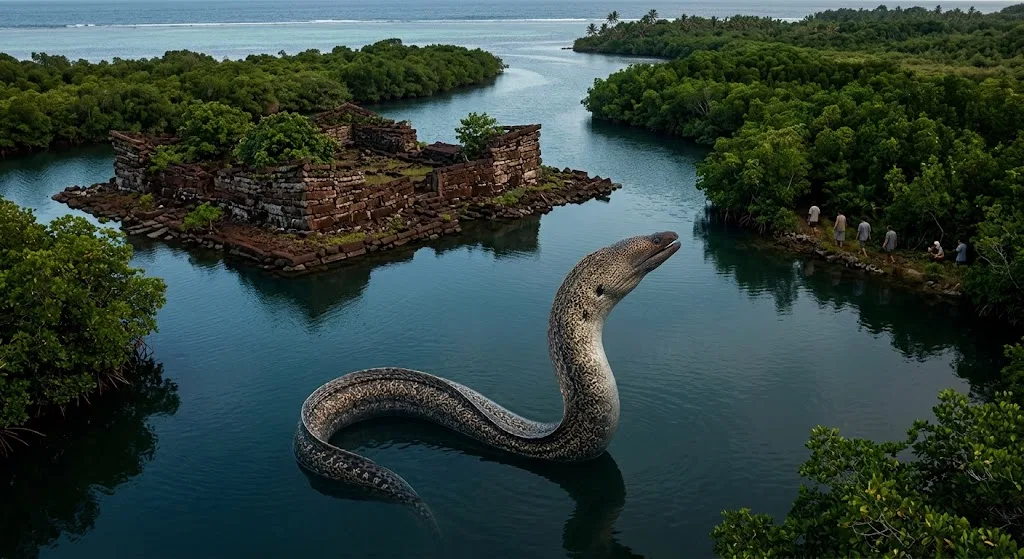
For a reader looking for Micronesia’s nearest equivalent to a national cryptid, the best answer is the giant sacred eel of Pohnpei. It is not a zoological mystery in the usual cryptozoology sense, because real large eels live in Pohnpei’s rivers and pools. The mystery lies in how the eel becomes more than an animal: an ancestor, a clan relation, a sacred presence, a political symbol and, in some stories, a landscape-making monster.
Pohnpei’s modern visitor lore still gives the eel a very visible place. At Pilen Seleur in Pwudoi, river pools are known for large marbled or giant mottled eels, identified as Anguilla marmorata. The Pohnpei Eco-Adventure Guide describes these eels as sacred on Pohnpei, prominent in local mythology, and linked to the Lasialap, or Great Eel Clan, whose members treat them as extended family. It also notes a local taboo on eating freshwater eels on Pohnpei, contrasting this with nearby Kosrae, where they may be eaten. Some eels at the pools are described as more than a metre long, and visitors may see them being fed or handled.[Pohnpei Adventure]pohnpei-adventure.comPohnpei Adventureclan totem – Pohnpei Eco-Adventure GuidePohnpei Adventureclan totem – Pohnpei Eco-Adventure Guide
The biological animal behind many of these impressions is impressive enough to feed legend. FishBase describes the giant mottled eel as living in freshwater as an adult and in estuaries and seas when young, with adults using lowland rivers and upland tributaries before migrating to the sea to breed. It is nocturnal, feeds on prey such as crabs, frogs and fish, and is classed globally as Least Concern.[FishBase]fishbase.seOpen source on fishbase.se. The Pohnpei guide adds that mature females can reach about two metres and that Pohnpei’s eels may migrate more than 1,600 kilometres to breed in the open ocean west of the Mariana Islands.[Pohnpei Adventure]pohnpei-adventure.comPohnpei Adventureclan totem – Pohnpei Eco-Adventure GuidePohnpei Adventureclan totem – Pohnpei Eco-Adventure Guide
That life cycle matters for folklore. A creature that appears in inland pools, grows large, emerges at night, has a snake-like body and eventually vanishes towards the sea is almost designed to become a boundary-crosser in story. It is river and ocean, familiar and uncanny, edible in one island context yet taboo in another. In Micronesia, the eel’s “cryptid” quality is not that it cannot be identified; it is that ordinary identification does not exhaust its cultural meaning.
Nan Madol: where sacred animals meet political power
Nan Madol gives Pohnpei’s eel traditions their most dramatic setting. UNESCO describes Nan Madol as more than 100 artificial islets off Pohnpei’s south-east coast, built with basalt and coral boulders and containing palaces, temples, tombs and residential areas dating mainly from 1200 to 1500 CE. It identifies the site as the ceremonial centre of the Saudeleur dynasty and notes that its scale and technical sophistication testify to complex social and religious practices.[UNESCO World Heritage Centre]whc.unesco.orgWorld Heritage Centre Nan Madol: Ceremonial Centre of Eastern MicronesiaUNESCO World Heritage CentreNan Madol: Ceremonial Centre of Eastern Micronesia - UNESCO World Heritage Centre…
Within this setting, the sacred eel Nan Samol becomes a creature of rule as much as of water. The Cultural Site Research and Management Foundation, discussing work for Nan Madol’s sustainable conservation planning, says oral traditions make Nan Samol a major figure in ancient Pohnpeian society. In those accounts, the Saudeleur dynasty ruled Pohnpei from Nan Madol from roughly 1200 to 1500 CE, and ritual action helped present Saudeleur authority as divinely endorsed.[csrmfoundation.org]csrmfoundation.orgOpen source on csrmfoundation.org.
The most striking episode is the offering of cooked turtle to Nan Samol during the closing ceremony of a yearly rite. According to this interpretation, when the sacred saltwater eel accepted the offering, it signalled the god’s approval of Saudeleur rule. The same source stresses that Nan Samol was distinct from the freshwater eels honoured elsewhere on Pohnpei: he was imagined as a large, frightening moray eel of the open ocean, a fitting symbol of Nan Madol’s foreignness, ferocity and dominance.[csrmfoundation.org]csrmfoundation.orgOpen source on csrmfoundation.org.
This is where Micronesian monster lore becomes unusually sophisticated. The eel is not merely “a big animal people feared”. It is a ritual mediator. The turtle is not merely prey. It represents land, districts, sacrifice and political submission. The story turns an animal encounter into a map of power: ocean over land, ruler over subject, sacred centre over village districts. For cryptid readers, Nan Samol is best understood as a legendary creature embedded in statecraft, not as a surviving unknown species.
The monster eel that becomes a mountain
Pohnpei’s eel lore is not confined to temple ritual. It also appears in landscape stories, where a creature’s body becomes a place. Dolen Nett, a steep-sided mountain along the Nett Point peninsula east of Kolonia, is described in local visitor material as having been formed from the corpse of a monster eel. The same eel is said to have founded the Lasialap clan, created Lipwentiak, and lived for many years in the Lehdau River before dying; its carcass became the hill.[Pohnpei Adventure]pohnpei-adventure.comPohnpei Adventure Dolen Nett / Pohnlehr – Pohnpei Eco-Adventure GuidePohnpei Adventure Dolen Nett / Pohnlehr – Pohnpei Eco-Adventure Guide
This is a classic place-making pattern: an animal is not just seen in the landscape, but explains why the landscape has its shape. The mountain’s long form, jutting into the lagoon, becomes legible as a body. That does not make the story a “sighting report”, but it does make it highly relevant to any country-level account of Micronesian mystery creatures. The creature is remembered through geography.
In modern cryptid language, a reader might be tempted to ask whether this was once a report of a huge eel exaggerated over time. That is possible in the loose sense that real large eels provide the imaginative raw material. But the story’s function is broader than animal description. It ties clan ancestry, river habitat, named sites and visible topography into one narrative. The “monster” is doing cultural work that a simple misidentification theory cannot fully explain.
Kosrae’s channel-making snake or lizard
Kosrae contributes a parallel water-creature tradition centred on a giant reptilian or serpentine being associated with a channel near Lelu. A short educational version from the College of Micronesia-FSM says a large snake made the channel while searching for her daughter, who had disappeared. The story then moves into royal encounter, taboo and tragedy: the king is involved, the creature’s daughter is human or human-like, and the mother’s monstrous form becomes dangerous when seen or mishandled.[comfsm.fm]comfsm.fmHOW A CHANNEL WAS FORMED ON KOSRAEA large snake while searching for her daughter who had disappeared originally made the channel. One day…
A wider Micronesian mythic summary gives a Pohnpei variant in which “Good Lizard” makes channels as she crawls to visit her daughter, who has married the king holding the title Sau Deleur. The husband is told not to look at his mother-in-law, disobeys, panics, and burns the enormous guesthouse prepared for her; the wife and husband also die in the flames.[Encyclopedia]encyclopedia.comMicronesian Religions: Mythic Themes | Encyclopedia.comMicronesian Religions: Mythic Themes | Encyclopedia.com… A travel account from Kosrae similarly records a local legend in which a giant snake carved a meandering channel while searching for a daughter abducted by the King of Lelu.[San Diego Reader]sandiegoreader.comSan Diego Reader Up a Mangrove Channel in MicronesiaSan Diego ReaderUp a Mangrove Channel in MicronesiaFebruary 12, 2013 — 12 Feb 2013 — Kosrae legend holds that a giant snake carved the me…
The variations matter. In one telling the being is a snake; in another, a lizard; in another, the emphasis falls on Lelu and royal abduction. This is exactly how living oral traditions often behave: the creature’s role stays recognisable while species labels, motives and local details shift. For a cryptid page, the cautious reading is that Kosrae preserves a giant-serpent or giant-lizard place legend, not a modern record of an unknown reptile.
The setting also matters. Lelu is not just a random backdrop. Kosrae’s ruins are part of the same broad eastern Micronesian world of monumental stone centres that makes Nan Madol so powerful in Pohnpei’s imagination. The Australian Museum notes that coral was used extensively in Lelu’s construction, especially in sacred burial tombs.[The Australian Museum]australian.museumThe Australian Museum Corals of KosraeThe Australian Museum Corals of Kosrae In this context, a channel-making reptile is less a zoological claim than a way of making engineered or altered landscapes speak through story.
Animal ancestors, spirit animals and the Yap problem
A common mistake in reading Micronesian creature lore is to flatten all sacred animals into “monsters”. Many traditions are better understood as clan ancestry, totemism or spirit presence. Encyclopedia.com’s account of Micronesian mythic themes notes that female animal ancestors may become clan totems. One Yap example tells of a man who hides the fins of a dolphin girl who comes ashore to dance, marries her, and later loses her when she finds the fins and returns to the sea; her daughters establish a Dolphin totemic clan.[Encyclopedia]encyclopedia.comMicronesian Religions: Mythic Themes | Encyclopedia.comMicronesian Religions: Mythic Themes | Encyclopedia.com…
The same source gives a Pohnpei story in which stingrays punish a disrespectful minor chief, showing that sea animals in these traditions may act as moral agents rather than mere beasts.[Encyclopedia]encyclopedia.comMicronesian Religions: Mythic Themes | Encyclopedia.comMicronesian Religions: Mythic Themes | Encyclopedia.com… Another summary of Micronesian spirit belief notes that in Yap, animals of unusually large size or unusual appearance, including monitor lizards and certain eels, were thought to house spirits.[Micsem]micsem.orgOpen source on micsem.org.
That last detail is especially relevant to cryptid interpretation. In many modern mystery-animal traditions, an unusually large animal may be taken as evidence of an unknown species. In Yapese spirit logic, the same unusual animal could be significant because it houses or signals a spirit. The creature is anomalous, but the anomaly is religious and social before it is biological.
This also helps explain why the Federated States of Micronesia does not produce a neat list of modern cryptids. Local creature traditions often do not separate “animal”, “ancestor”, “spirit”, “place” and “moral lesson” in the way a cryptozoology catalogue might prefer. A dolphin girl, a sacred eel, a giant lizard mother and a shark or turtle totem belong to a different storytelling system from a newspaper report of an unidentified beast.
Chuuk, tricksters and sea-creature transformation
Chuukese and wider central Micronesian mythology adds another strand: trickster and creator figures whose stories involve animals, bodily transformation and the sea. Anulap appears in Truk or Chuuk mythology as a sky god associated with knowledge and creation, while the trickster figure Olifat is linked in secondary myth summaries to a family line involving deities and animal or sea-associated beings.[Wikipedia]WikipediaOpen source on wikipedia.org.
These figures are not cryptids, and they should not be forced into that category. Their value for this page is contextual. They show that Micronesian story worlds are full of beings that cross categories: gods with human entanglements, animal ancestors, trickster episodes, and creatures that explain why the world is as it is. A children’s collection, From the Mouth of the Monster Eel: Stories from Micronesia, was reviewed as a set of six legends about beginnings, magic, trickery, courage and sacrifice, explaining subjects such as birds, breadfruit, coconuts and navigational stars.[Storytellers of Canada]storytellers-conteurs.caStorytellers of Canada From the Mouth of the Monster EelStorytellers of Canada From the Mouth of the Monster Eel
For a mainstream reader, this distinction is important. Micronesia’s “monster” traditions are not mostly built from modern claims of people glimpsing unknown animals in remote forests. They are older narrative systems in which animals explain origins, behaviour, rank, taboo, survival and place. That makes them creature lore, but not always cryptid lore in the strict sense.

Why sea and river creatures dominate
The Federated States of Micronesia is made up of four states — Chuuk, Kosrae, Pohnpei and Yap — spread across 607 islands in the north-western Pacific.[FSM DoFA]dofa.gov.fmFSM Do FAAsian Development BankFSM Do FAAsian Development Bank The United Nations describes the country as more than 600 islands across the western Pacific, with most Micronesians living on or near the coast.[The United Nations in Micronesia]micronesia.un.orgOpen source on un.org. This geography matters. In a country of reefs, lagoons, mangroves, rivers and ocean passages, the most memorable creature traditions naturally cluster around water.
Pohnpei makes this especially clear. The island is described by its official tourism site as the largest and tallest island in the FSM, with heavy rainfall, mountains, rainforests, winding rivers, more than 40 waterfalls, mangrove-lined coasts and a reef-sheltered lagoon.[Visit Pohnpei]visitpohnpei.travelOpen source on visitpohnpei.travel. That is ideal eel country, but also ideal story country: dark pools, sudden channels, tidal edges and inland streams all become places where ordinary animals can feel uncanny.
This environmental grounding helps keep the legends evidence-aware. There is no need to invent surviving dinosaurs, hidden lake monsters or paranormal beasts to explain why eels, turtles, sharks, dolphins, rays and snakes or lizards loom large in Micronesian traditions. The surrounding ecology already supplies powerful animals with strange behaviours: eels that migrate between river and sea, reef predators that appear and vanish, turtles with ritual value, and marine mammals or fish that connect human communities to ocean space.
Modern cryptid claims are thin
Compared with countries that have produced repeated newspaper flaps, blurry photographs or organised monster hunts, the Federated States of Micronesia has a thin modern cryptid record. Searchable public material is dominated by folklore, tourism, archaeology, ethnography and pop-paranormal uses of sites such as Nan Madol. Even television treatments have tended to frame Micronesian locations through ghosts, ancient ruins or general mystery rather than a named unknown animal.
That absence should not be treated as a failure of the tradition. It simply means the country’s strongest creature material sits in a different category. The best-supported claims are:
- Folklore and oral tradition: sacred eels, giant snakes or lizards, animal mothers, dolphin ancestors and totemic sea creatures.
- Cultural practice: taboos, feeding, clan identity and ritual associations, especially around eels on Pohnpei.
- Archaeological setting: Nan Madol and Lelu, where monumental sites give creature stories a powerful physical anchor.
- Plausible animal basis: giant mottled eels, moray eels, turtles, rays, dolphins, sharks and lizards are real animals whose size, behaviour or rarity can support extraordinary stories.
- Modern tourism afterlife: eel pools, Nan Madol visits and ruin legends keep creature lore visible to outsiders, sometimes simplifying it into “monster” language.
The sceptical explanation is therefore not “everyone imagined it”. A better explanation is layered. Real animals shaped local experience; oral tradition made those animals ancestors, messengers or symbols; sacred sites gave the stories political weight; modern tourism and cryptid curiosity then translated some of them into monster terms.
How the legend changes when outsiders retell it
Outsider retellings tend to pull Micronesian creature lore in two directions. One direction is archaeological mystery: Nan Madol becomes a “lost city”, and its oral histories are detached from Pohnpeian history in favour of generic ancient-world speculation. UNESCO’s description is a useful corrective because it treats Nan Madol as a documented ceremonial centre of the Saudeleur dynasty, not as an unexplained fantasy ruin.[UNESCO World Heritage Centre]whc.unesco.orgWorld Heritage Centre Nan Madol: Ceremonial Centre of Eastern MicronesiaUNESCO World Heritage CentreNan Madol: Ceremonial Centre of Eastern Micronesia - UNESCO World Heritage Centre…
The other direction is cryptid simplification. A sacred eel becomes a “monster eel”; a channel-making mother becomes a “giant snake”; a spirit-bearing unusual animal becomes a mystery beast. Those labels can attract readers, but they also risk stripping away the social meaning of the stories. In Pohnpei, the eel is connected to clan, taboo, sacrifice, rulership and place. In Kosrae and related variants, the giant reptile story is bound to marriage, kinship, royal power, taboo and landscape formation.
A good Micronesian cryptid page should therefore keep two truths together. First, these are genuinely strange and memorable creature traditions, full of giant eels, sacred reptiles, animal ancestors and dangerous sea beings. Second, they are not best understood as reports waiting for zoological confirmation. They are local ways of explaining why a channel exists, why a mountain has its shape, why a clan honours an animal, why rulers claimed divine sanction, and why the boundary between human society and the surrounding sea is never quite closed.
What to remember
The Federated States of Micronesia’s creature lore is strongest when read through water, place and authority. Pohnpei’s sacred eels are the key case: real animals large enough to impress any visitor, but also beings of clan identity, taboo and Nan Madol ritual. Kosrae’s giant snake or lizard tradition adds a channel-making monster mother tied to Lelu and royal tragedy. Yap and wider Micronesian traditions show how animal ancestors, totems and spirit-bearing creatures complicate any simple “cryptid or not?” question.
The result is not a catalogue of hidden beasts. It is a country-level tradition in which animals become ancestors, ruins become ritual theatres, waterways remember giant bodies, and the ordinary wildlife of island environments gains a second life as legend.

Amazon book picks
Further Reading
Books and field guides related to What Are Micronesia's Most Mysterious Creatures?. Use these as the next step if you want deeper reading beyond the article.

The Book of Luelen
Contains folklore, sacred beings and traditional narratives from Micronesia.
The Island of Stone Money
Offers insight into traditional Micronesian societies and beliefs.
eBay marketplace picks
Marketplace Samples
Live-tested eBay searches with available results related to this page.
Endnotes
1.
Source: pohnpei-adventure.com
Title: Pohnpei Adventureclan totem – Pohnpei Eco-Adventure Guide
Link:https://www.pohnpei-adventure.com/tag/clan-totem/
2.
Source: fishbase.se
Link:https://fishbase.se/summary/Anguilla-marmorata
3.
Source: whc.unesco.org
Title: World Heritage Centre Nan Madol: Ceremonial Centre of Eastern Micronesia
Link:https://whc.unesco.org/en/list/1503/
Source snippet
UNESCO World Heritage CentreNan Madol: Ceremonial Centre of Eastern Micronesia - UNESCO World Heritage Centre...
4.
Source: csrmfoundation.org
Link:https://www.csrmfoundation.org/new-blog/2018/12/14/the-sacred-eels-and-turtles-of-nan-madol
5.
Source: pohnpei-adventure.com
Title: Pohnpei Adventure Dolen Nett / Pohnlehr – Pohnpei Eco-Adventure Guide
Link:https://www.pohnpei-adventure.com/dolen-nett/
6.
Source: comfsm.fm
Link:https://www.comfsm.fm/~dleeling/ub/stories/noda_channel.doc
Source snippet
HOW A CHANNEL WAS FORMED ON KOSRAEA large snake while searching for her daughter who had disappeared originally made the channel. One day...
7.
Source: encyclopedia.com
Title: Micronesian Religions: Mythic Themes | Encyclopedia.com
Link:https://www.encyclopedia.com/environment/encyclopedias-almanacs-transcripts-and-maps/micronesian-religions-mythic-themes
Source snippet
Micronesian Religions: Mythic Themes | Encyclopedia.com...
8.
Source: australian.museum
Title: The Australian Museum Corals of Kosrae
Link:https://australian.museum/blog-archive/science/corals-of-kosrae-the-lelu-ruins/
9.
Source: micsem.org
Link:https://micsem.org/article/congeries-of-spirits/
10.
Source: Wikipedia
Link:https://en.wikipedia.org/wiki/Anulap
11.
Source: Wikipedia
Title: Micronesian mythology
Link:https://en.wikipedia.org/wiki/Micronesian_mythology
12.
Source: Wikipedia
Title: Nan Madol
Link:https://en.wikipedia.org/wiki/Nan_Madol
13.
Source: Wikipedia
Title: Federated States of Micronesia
Link:https://en.wikipedia.org/wiki/Federated_States_of_Micronesia
14.
Source: Wikipedia
Title: Giant mottled eel
Link:https://en.wikipedia.org/wiki/Giant_mottled_eel
15.
Source: Wikipedia
Title: Leluh archaeological site
Link:https://en.wikipedia.org/wiki/Leluh_archaeological_site
16.
Source: Wikipedia
Title: Unusual articles
Link:https://en.wikipedia.org/wiki/Wikipedia%3AUnusual_articles
17.
Source: Wikipedia
Title: List of Destination Truth episodes
Link:https://en.wikipedia.org/wiki/List_of_Destination_Truth_episodes
18.
Source: whc.unesco.org
Link:https://whc.unesco.org/uploads/nominations/1503.pdf
19.
Source: unesdoc.unesco.org
Link:https://unesdoc.unesco.org/ark%3A/48223/pf0000211232
20.
Source: pohnpei-adventure.com
Link:https://www.pohnpei-adventure.com/tag/pohnpei/page/8/
21.
Source: pohnpei-adventure.com
Title: nan madol
Link:https://www.pohnpei-adventure.com/nan-madol/
22.
Source: pohnpei-adventure.com
Link:https://www.pohnpei-adventure.com/category/adventures/cultural-sites/
23.
Source: pohnpei-adventure.com
Link:https://www.pohnpei-adventure.com/tag/eels/
24.
Source: pohnpei-adventure.com
Title: giant mottled eel
Link:https://www.pohnpei-adventure.com/tag/giant-mottled-eel/
25.
Source: pohnpei-adventure.com
Link:https://www.pohnpei-adventure.com/tag/cultural-sites/
26.
Source: pohnpei-adventure.com
Link:https://www.pohnpei-adventure.com/category/adventures/world-war/page/2/
27.
Source: pohnpei-adventure.com
Link:https://www.pohnpei-adventure.com/tag/mountains/
28.
Source: micsem.org
Link:https://www.micsem.org/pubs/books/Summoning-the-Powers-Beyond.pdf
29.
Source: micsem.org
Title: from the mouth of the monster eel stories from micronesia
Link:https://micsem.org/librarysearch/from-the-mouth-of-the-monster-eel-stories-from-micronesia/
30.
Source: encyclopedia.com
Link:https://www.encyclopedia.com/humanities/news-wires-white-papers-and-books/micronesian-mythology
31.
Source: nan-madol.com
Link:https://nan-madol.com/
32.
Source: unesco.nl
Link:https://unesco.nl/werelderfgoed/nan-madol-ceremonieel-centrum-van-oost-micronesie
33.
Source: sacred-sites.org
Link:https://sacred-sites.org/nan-madol-sacred-city-of-micronesia-by-carol-nervig/
34.
Source: sandiegoreader.com
Title: San Diego Reader Up a Mangrove Channel in Micronesia
Link:https://www.sandiegoreader.com/news/2013/feb/12/travel-micronesia-up-a-mangrove-channel/
Source snippet
San Diego ReaderUp a Mangrove Channel in MicronesiaFebruary 12, 2013 — 12 Feb 2013 — Kosrae legend holds that a giant snake carved the me...
Published: February 12, 2013
35.
Source: storytellers-conteurs.ca
Title: Storytellers of Canada From the Mouth of the Monster Eel
Link:https://www.storytellers-conteurs.ca/en/reviews/From-the-Mouth-of-the-Monster-Eel.html
36.
Source: dofa.gov.fm
Title: FSM Do FAAsian Development Bank
Link:https://dofa.gov.fm/donors/asian-development-bank/
37.
Source: micronesia.un.org
Link:https://micronesia.un.org/en/about/federated-states-micronesia
38.
Source: visitpohnpei.travel
Link:https://visitpohnpei.travel/
39.
Source: tci.gov.fm
Title: digitalfsm esmp 12 nov rm PF no track
Link:https://tci.gov.fm/documents/communications/digitalfsm/digitalfsm-esmp-12-nov-rmPF-no-track.pdf
40.
Source: tci.gov.fm
Title: FSM IDP FY2016 FY2025 Outline (version 151202)
Link:https://tci.gov.fm/documents/infrastructure/IDP/FSM%20IDP%20FY2016-FY2025%20-%20Outline%20%28version%20151202%29.pdf
41.
Source: hsa.gov.fm
Link:https://hsa.gov.fm/wp-content/uploads/2024/01/Comprehensive-Assessment-of-Primary-Care-Systems.pdf
42.
Source: personnel.gov.fm
Title: LC TOR Compilation of Traditional Information final draft 1
Link:https://personnel.gov.fm/wp-content/uploads/2025/03/LC-TOR_Compilation-of-Traditional-Information_final-draft-1.pdf
43.
Source: gov.fm
Link:https://gov.fm/state/
44.
Source: dofa.gov.fm
Link:https://dofa.gov.fm/wp-content/uploads/2025/11/P1770730PRIME0SCORE0ESMF00final0draft-1.pdf
45.
Source: personnel.gov.fm
Title: Local Consultant KSA
Link:https://personnel.gov.fm/wp-content/uploads/2025/07/Local-Consultant-KSA.pdf
46.
Source: tci.gov.fm
Link:https://tci.gov.fm/documents/communications/policy/ict-policy2012.pdf
47.
Source: tci.gov.fm
Title: pmu rfp tor project architect
Link:https://tci.gov.fm/documents/pmu/rfp%2Ctor/pmu-rfp-tor-project-architect.PDF
48.
Source: tci.gov.fm
Link:https://tci.gov.fm/documents/pmu/safeguardinstruments/prime-score-esmf-app-a-baseline-report.pdf
49.
Source: books.google.com
Title: From the Mouth of the Monster Eel
Link:https://books.google.com/books/about/From_the_Mouth_of_the_Monster_Eel.html?id=eTcCAAAACAAJ
50.
Source: 2021-2025.state.gov
Title: federated states of micronesia
Link:https://2021-2025.state.gov/reports/2018-country-reports-on-human-rights-practices/federated-states-of-micronesia/
51.
Source: 2017-2021.state.gov
Link:https://2017-2021.state.gov/countries-areas/micronesia/
52.
Source: dfat.gov.au
Link:https://www.dfat.gov.au/geo/federated-states-of-micronesia/federated-states-of-micronesia-country-brief
53.
Source: ebsco.com
Link:https://www.ebsco.com/research-starters/social-sciences-and-humanities/federated-states-micronesia
54.
Source: smarthistory.org
Title: nan madol
Link:https://smarthistory.org/nan-madol/
55.
Source: southpacificislands.travel
Title: federated states of micronesia
Link:https://southpacificislands.travel/discover/countries/federated-states-of-micronesia/
56.
Source: geraldrknight.com
Title: nan madol
Link:https://geraldrknight.com/2020/06/08/nan-madol/
57.
Source: worldbooktour.wordpress.com
Title: federated states of micronesia
Link:https://worldbooktour.wordpress.com/2017/02/05/federated-states-of-micronesia/
58.
Source: pacific-studies.net
Title: Federated States of Micronesia | The World Factbook
Link:https://www.pacific-studies.net/datadetails.php?place=9&source=3&type=Data
59.
Source: globaledge.msu.edu
Title: federated states of micronesia
Link:https://globaledge.msu.edu/countries/federated-states-of-micronesia
60.
Source: metmuseum.org
Title: nan madol
Link:https://www.metmuseum.org/essays/nan-madol
61.
Source: observation.org
Title: Giant mottled eel
Link:https://observation.org/species/534177/
62.
Source: imdb.com
Link:https://www.imdb.com/title/tt0941372/episodes/?year=2010
Additional References
63.
Source: researchgate.net
Link:https://www.researchgate.net/publication/301729978_Federated_states_of_Micronesia
64.
Source: researchgate.net
Link:https://www.researchgate.net/publication/351762510_Micronesian_Archaeoastronomy_Expedition_Kosrae_and_Pohnpei_the_Federated_States_of_Micronesia
65.
Source: facebook.com
Link:https://www.facebook.com/61574974992206/posts/adaro-the-storm-spirit-of-the-solomon-islandsacross-the-islands-of-the-solomon-i/122166025670832499/
66.
Source: researchgate.net
Link:https://www.researchgate.net/publication/232687807_Anguilla_marmorata_Giant_Mottled_Eel_Discovered_in_a_New_Location_Natural_Range_Expansion_or_Recent_Human_Introduction1
67.
Source: instagram.com
Link:https://www.instagram.com/reel/DSm8kzACZwM/
68.
Source: facebook.com
Link:https://www.facebook.com/upsoclthekiwi/posts/divers-were-startled-in-the-depths-of-the-ocean-they-didnt-know-they-were-seeing/928598902642095/
69.
Source: mapy.com
Link:https://mapy.com/zakladni?id=583&source=osm&x=150.1859540&y=6.0829299&z=5
70.
Source: geography-site.co.uk
Link:https://www.geography-site.co.uk/pages/countries/atlas/micronesia.html
71.
Source: facebook.com
Link:https://www.facebook.com/iamperezphotography/posts/federated-states-of-micronesia-lelu-ruinskosrae-state-/1338929477674461/
72.
Source: facebook.com
Link:https://www.facebook.com/iamperezphotography/posts/federated-states-of-micronesianan-madol-ruinspohnpei-state/953354076232005/
Topic Tree
Follow this branch
Related pages 192
- Antigua Cryptids
- Maldives Monsters
- Malta Monsters
- Qatar Monsters
- Argentina Monsters
- +187 more in sidebar