Within Oman Cryptids
Which Omani Animals Look Like Monsters?
Leopards, hyenas, wolves, caracals and whale sharks can appear startling enough to inspire reports of unknown creatures.
On this page
- Elusive predators in mountains and deserts
- Whale sharks and large shapes at sea
- How distance, darkness and brief sightings mislead
Page outline Jump by section
Introduction
Many Omani monster stories become less mysterious when viewed through the lens of the country’s real wildlife. Oman is home to some of the Arabian Peninsula’s rarest predators and largest marine animals, including Arabian leopards, striped hyenas, wolves, caracals and whale sharks. Most people never see these animals clearly in the wild. When a fleeting encounter happens at dusk, in rough terrain or at sea, an ordinary animal can appear extraordinary. In a country where mountains, deserts and deep offshore waters create dramatic settings, misidentifications are often a more plausible explanation than an undiscovered creature.[PMC]pmc.ncbi.nlm.nih.govIn recent decades, authorities have actively protected wildlife and the natural environment.Read more…
This does not mean every strange-animal report is easily explained. Rather, Oman provides a good example of how rare wildlife, unusual viewing conditions and local storytelling traditions can combine to create reports of beasts that seem larger, stranger or more mysterious than they really are.
Elusive Predators in Mountains and Deserts
The most convincing source of many land-based monster sightings is Oman’s population of rarely seen carnivores. These animals are real, but because they are uncommon, secretive and often active at night, many people have little experience judging their appearance in the wild.
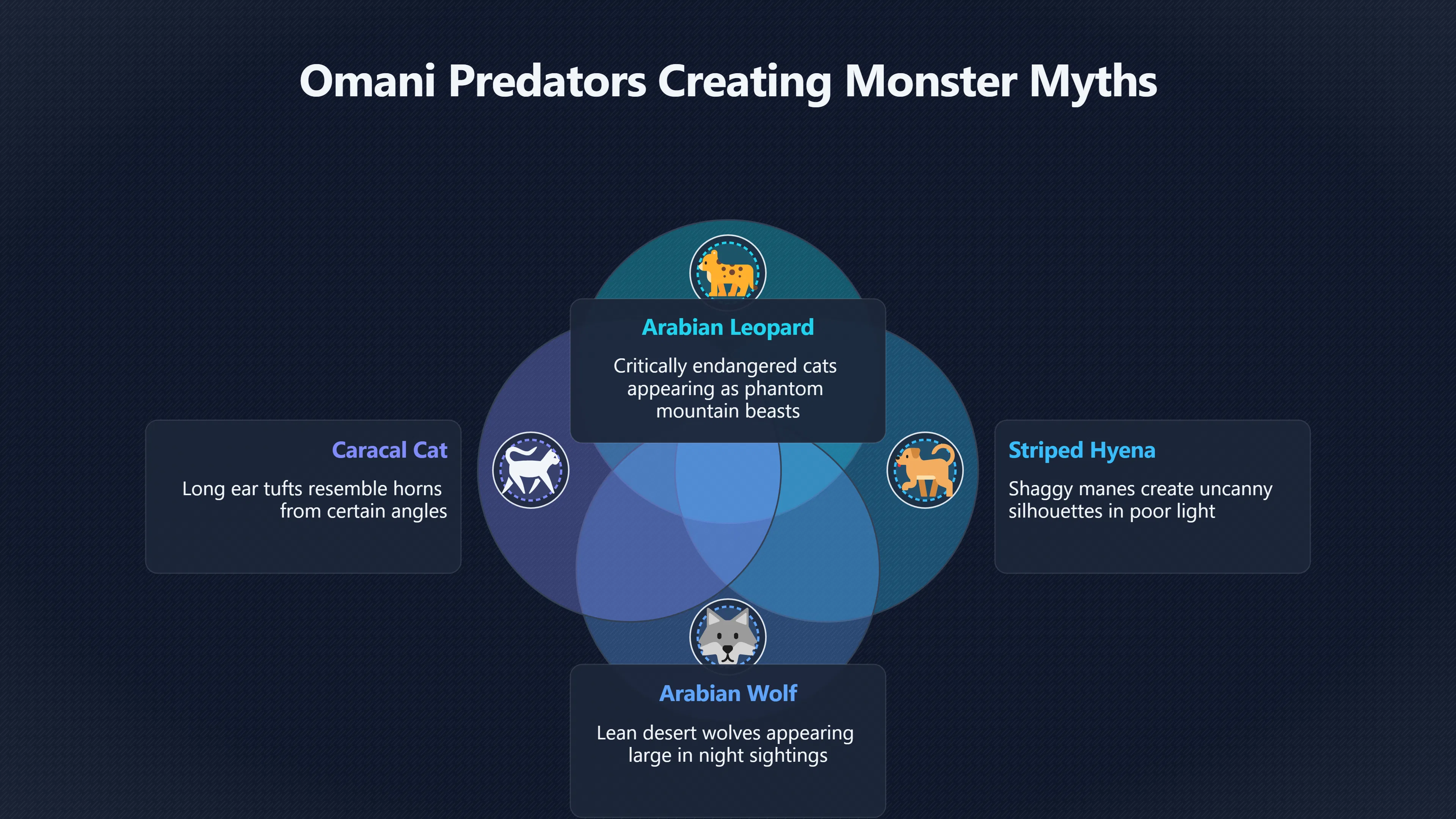
The Arabian leopard is the most dramatic example. Southern Oman, particularly the Dhofar region and Jabal Samhan Nature Reserve, contains one of the last strongholds of this critically endangered big cat. Fewer than 100 Arabian leopards are believed to survive in Oman, and sightings are exceptionally rare. A person unexpectedly encountering a leopard on a mountain track at dawn or dusk could easily describe an enormous phantom cat, especially if the animal vanished before it was seen clearly.[ea.gov.om]ea.gov.omEnvironmental AuthorityBiological DiversityIn case of leopards, there are fewer than 100 Arabian Leopards still roaming around the mounta…
Striped hyenas can be even more misleading. Unlike the spotted hyenas familiar from African wildlife documentaries, striped hyenas have a shaggy mane that can stand erect when the animal is alarmed. In poor light this makes them appear much larger than they really are. Their sloping backs, unusual gait and pale colouring can create an uncanny silhouette that looks unlike any familiar dog or cat. Striped hyenas are known from Oman and continue to survive in remote areas despite being seldom observed.[cbd.int]cbd.intConvention on Biological Diversity OmanConvention on Biological DiversityOman - Country ProfileThe country's fauna includes the Arabian Gazelle, Wolf, Striped Hyena, Arabian Le…
Arabian wolves also contribute to reports of mysterious beasts. They are smaller and leaner than many European wolves, yet a lone wolf seen crossing a desert plain at night can appear surprisingly large. Because wolves are rarely encountered by most residents and visitors, witnesses may struggle to identify them confidently.[Convention on Biological Diversity]cbd.intConvention on Biological Diversity OmanConvention on Biological DiversityOman - Country ProfileThe country's fauna includes the Arabian Gazelle, Wolf, Striped Hyena, Arabian Le…
Caracals add another layer of confusion. These medium-sized wild cats possess long black ear tufts that can look almost horn-like from certain angles. Brief sightings often emphasise the animal’s unusual outline rather than its actual size, making it seem like an unknown predator rather than a recognised species. Caracals remain part of Oman’s wildlife and occasionally attract attention when reported near settlements.[wikipedia.org]WikipediaWildlife of OmanWildlife of Oman
Several features make these predators particularly effective “monster makers”:
- They are genuinely rare and unfamiliar.
- Many are most active at night or in twilight.
- Encounters are often sudden and brief.
- Witnesses may overestimate size when frightened.
- Rugged terrain makes judging distance difficult.
Whale Sharks and Large Shapes at Sea
On land, Oman offers elusive predators. Offshore, it offers giants.
The Arabian Sea and waters around Oman support whale sharks, the largest fish on Earth. Despite their immense size, whale sharks are harmless filter feeders. However, a person seeing only part of a whale shark at the surface may perceive something very different: a huge dark back, a moving hump or an apparently enormous creature disappearing beneath the waves.[PMC]pmc.ncbi.nlm.nih.govIn recent decades, authorities have actively protected wildlife and the natural environment.Read more…
This is a classic source of sea-monster reports worldwide. Human observers rarely see an entire large marine animal at once. Instead they glimpse fragments—a fin, a tail, a shadow or a section of the back. The brain naturally attempts to connect these pieces into a complete image, often exaggerating the animal’s size and strangeness.
Oman’s seas contain other large animals that can contribute to the same effect:
- Sperm whales and other large whales.
- Dolphins travelling in groups.
- Large rays.
- Sea turtles surfacing briefly.
- Schools of fish creating unusual surface disturbances.[Wikipedia]WikipediaOman Natural History MuseumOman Natural History Museum
A whale surfacing in stages can appear to have multiple humps. Several dolphins travelling in a line may look like a single serpentine creature. A large ray breaking the surface can resemble an unknown marine beast. Such misinterpretations are especially common when visibility is poor or observers are unfamiliar with local marine life.
How Distance, Darkness and Brief Sightings Mislead
The most important explanation behind many monster reports is not a specific animal but the way humans perceive unexpected events.
Psychologists and wildlife researchers have long noted that eyewitness descriptions become less reliable when three factors combine: distance, low light and surprise. Oman provides all three conditions regularly.
In mountain regions, steep slopes distort perceptions of size and distance. A leopard on a ridge may seem far larger than it really is. In deserts, heat haze can alter outlines and create shimmering visual effects. At sea, waves constantly obscure and reveal portions of animals, making shapes appear to change from moment to moment.[PMC]pmc.ncbi.nlm.nih.govIn recent decades, authorities have actively protected wildlife and the natural environment.Read more…
Brief encounters are particularly vulnerable to error. Most witnesses do not calmly observe an unusual animal for several minutes. Instead they see something unexpected for a few seconds before it disappears. During those seconds, the brain fills in missing information using assumptions, expectations and emotion.
Fear can amplify the effect. A person startled by an unfamiliar predator is more likely to remember it as larger, darker or stranger than it actually was. Over time, retelling can further exaggerate details, especially when stories are shared within communities already familiar with local folklore about dangerous creatures.
Why Ordinary Animals Become Extraordinary Stories
The most successful monster legends often begin with something real. Oman’s wildlife offers many candidates: a leopard glimpsed on a cliff, a hyena crossing a road at night, a caracal disappearing into rocks, or a whale shark surfacing offshore.
What makes these encounters memorable is not merely the animal itself but its rarity. Most people expect to recognise familiar domestic animals. They do not expect to meet one of Arabia’s last wild leopards or see a fish longer than a bus emerging from the sea. When they do, the experience can feel uncanny enough to become a local mystery.
For that reason, real wildlife remains one of the strongest explanations for many Omani monster reports. The country does not need undiscovered creatures to produce remarkable sightings. Its existing animals are unusual, elusive and impressive enough on their own.[ea.gov.om]ea.gov.omEnvironmental AuthorityBiological DiversityIn case of leopards, there are fewer than 100 Arabian Leopards still roaming around the mounta…
Amazon book picks
Further Reading
Books and field guides related to Which Omani Animals Look Like Monsters?. Use these as the next step if you want deeper reading beyond the article.
Abominable Science!
Examines misidentification and evidence problems in cryptid reports.
SHARKS OF THE WORLD
Useful for understanding large marine animals mistaken for monsters.
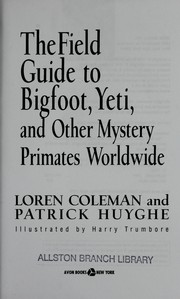
The field guide to Bigfoot, Yeti, and other mystery primates...
Provides comparative examples of mistaken-identity cases.
eBay marketplace picks
Marketplace Samples
Live-tested eBay searches with available results related to this page.



Endnotes
1.
Source: pmc.ncbi.nlm.nih.gov
Link:https://pmc.ncbi.nlm.nih.gov/articles/PMC11910281/
Source snippet
In recent decades, authorities have actively protected wildlife and the natural environment.Read more...
2.
Source: Wikipedia
Title: Jabal Samhan Nature Reserve
Link:https://en.wikipedia.org/wiki/Jabal_Samhan_Nature_Reserve
3.
Source: facebook.com
Link:https://www.facebook.com/muscatdailyonline/posts/the-three-realms-of-omani-conservationfrom-the-high-rugged-peaks-of-the-hajar-mo/1623802153079486/
Source snippet
The Three Realms of Omani Conservation!...striped hyenas, wild rabbits, estimate there are around 44 to 58 wild Arabian leopards...
4.
Source: Wikipedia
Title: Wildlife of Oman
Link:https://en.wikipedia.org/wiki/Wildlife_of_Oman
5.
Source: facebook.com
Link:https://www.facebook.com/muscatdailyonline/posts/following-reports-of-an-arabian-caracal-in-al-maysar-village-the-environment-aut/1548955470564155/
Source snippet
Following reports of an Arabian Caracal in Al Maysar...Most of the Arabian leopard is now found along the border between Oman an...
6.
Source: Wikipedia
Title: Al Wusta Wildlife Reserve
Link:https://en.wikipedia.org/wiki/Al_Wusta_Wildlife_Reserve
7.
Source: Wikipedia
Title: Oman Natural History Museum
Link:https://en.wikipedia.org/wiki/Oman_Natural_History_Museum
8.
Source: cbd.int
Title: Convention on Biological Diversity Oman
Link:https://www.cbd.int/countries/profile/?country=om
Source snippet
Convention on Biological DiversityOman - Country ProfileThe country's fauna includes the Arabian Gazelle, Wolf, Striped Hyena, Arabian Le...
9.
Source: ea.gov.om
Link:https://www.ea.gov.om/en/the-authority/authority-mandates/nature-conservation/biological-diversity/
Source snippet
Environmental AuthorityBiological DiversityIn case of leopards, there are fewer than 100 Arabian Leopards still roaming around the mounta...
10.
Source: theanimalmap.com
Link:https://theanimalmap.com/en/countries/oman
Additional References
11.
Source: wisebirding.co.uk
Title: oman mostly mammals
Link:https://www.wisebirding.co.uk/oman-mostly-mammals/
Source snippet
OMAN: Mostly Mammals 2026 -Oman has recently been put on the mammal watching map due to its surprisingly high abundance of some impressiv...
12.
Source: youtube.com
Link:https://www.youtube.com/watch?v=ngA7lY0P76c
Source snippet
Arabian Leopard's Mating Call - Wild Arabia - Episode 2 Preview...
13.
Source: researchgate.net
Link:https://www.researchgate.net/publication/389919755_Wild_fauna_in_Oman_Current_situation_and_perspectives_with_particular_interest_to_turtles_and_ungulates
14.
Source: sqcc.org
Link:https://www.sqcc.org/wp-content/uploads/2020/04/FINAL-Sea-Turtle-Module-January-2020.pdf
15.
Source: youtube.com
Link:https://www.youtube.com/watch?v=G9hOru-S4cM
Source snippet
Arabian Wolf!!! Pretty Common in Pockets of Oman...
16.
Source: biosphere-expeditions.org
Title: report oman0607
Link:https://www.biosphere-expeditions.org/images/stories/pdfs/reports/report-oman0607.pdf
Source snippet
Arabian peninsula. Its last stronghold is Oman's Dhofar...Read more...
17.
Source: youtube.com
Title: Arabian Leopard’s Mating Call
Link:https://www.youtube.com/watch?v=Po8-8sZp62s
Source snippet
Wild Oman...
18.
Source: nationalgeographic.com
Title: paid content where spot oman wildlife
Link:https://www.nationalgeographic.com/travel/article/paid-content-where-spot-oman-wildlife
19.
Source: youtube.com
Title: Arabian Wolf!!! Pretty Common in Pockets of Oman
Link:https://www.youtube.com/watch?v=AIi-uIPu-iw
20.
Source: a-z-animals.com
Title: Wildlife in Oman
Link:https://a-z-animals.com/animals/location/asia/oman/
Topic Tree