Within Santomean Mysteries
Why Santomean Animals Speak in Stories
Santomean stories turn birds, tortoises and dogs into voices of memory, wit and warning rather than claims about hidden species.
On this page
- The ossobo as bird, voice and island symbol
- Sun Tataluga and the clever tortoise tradition
- How oral tales differ from eyewitness claims
Page outline Jump by section
Introduction
When people search for mystery creatures in São Tomé and Príncipe, they often expect tales of hidden beasts lurking in the rainforest. Instead, some of the islands’ most important animal stories are about creatures that speak, reason and outwit one another. The ossobó bird and the clever tortoise belong to a rich tradition of oral storytelling in which animals carry memory, moral lessons and cultural identity rather than evidence for unknown species.
These stories sit closer to folklore than to cryptozoology. They help explain how Santomeans have interpreted the natural world, passed on social values and expressed island identity across generations. In this tradition, animals are not mysterious because they are undiscovered. They are meaningful because they speak for human experience.
Why Santomean Animals Speak in Stories
Like many societies along the Atlantic coast of Africa, São Tomé and Príncipe developed a strong oral tradition in which animals act as teachers, tricksters and commentators on human behaviour. Folktales, songs, proverbs and performances have long circulated in local communities and creole-speaking environments, preserving cultural memory even during periods of colonial rule and social change.[Wikipedia]WikipediaLittérature santoméenneLittérature santoméenne
In these stories, animals are rarely presented as supernatural monsters. Instead, they become recognisable personalities:
- Birds may represent wisdom, warning or ancestral memory.
- Tortoises often embody cleverness, patience and cunning.
- Dogs, forest animals and other creatures can stand in for human strengths and weaknesses.
- Talking animals allow storytellers to discuss greed, justice, cooperation and pride without directly criticising particular people.[arXiv]arxiv.orgOpen source on arxiv.org.
For readers interested in cryptids, this distinction matters. A cryptid story asks whether an unknown animal exists. A folktale asks what a familiar animal can teach.
The Ossobó as Bird, Voice and Island Symbol
The ossobó is a real bird of São Tomé, but it occupies a much larger place in the islands’ imagination than its biological description alone would suggest. Over time, the bird became a recurring cultural symbol and an important figure in Santomean literature and oral tradition. Scholars have noted that the ossobó moved from folk storytelling into poetry, essays and national cultural symbolism, becoming one of the best-known animal figures associated with the islands.[Gale]go.gale.comOssobo: myth, history, and intertextuality in Santomean literatureby J Staller · 2016 · Cited by 5 — This paper traces how the ossobo…
What makes the ossobó remarkable is not a claim that it is mysterious or undiscovered. Rather, it functions as a voice linking landscape, memory and identity. Writers and storytellers have used the bird to evoke the forests of São Tomé, the persistence of local culture and the relationship between people and their island environment.[Gale]go.gale.comOssobo: myth, history, and intertextuality in Santomean literatureby J Staller · 2016 · Cited by 5 — This paper traces how the ossobo…
Because of this symbolic role, the ossobó sometimes appears in discussions of Santomean heritage in a way that resembles how ravens, eagles or nightingales appear in other cultures. The bird becomes larger than life without becoming a monster.
For visitors hearing stories about the ossobó for the first time, the important question is not “What unknown creature is this?” but “Why has this bird become such a powerful cultural messenger?”
Sun Tataluga and the Clever Tortoise Tradition
If the ossobó represents voice and memory, the tortoise represents intelligence.
The Santomean tortoise tradition belongs to a much wider West and Central African storytelling world in which the tortoise is a famous trickster. Across the region, tortoise tales portray a slow-looking animal that repeatedly defeats stronger, faster or more powerful opponents through wit.[Wikipedia]WikipediaThe Tortoise and the BirdsThe Tortoise and the Birds
In São Tomé and Príncipe, stories associated with the tortoise—often remembered through figures such as Sun Tataluga—follow this broader pattern. The tortoise is rarely heroic in a conventional sense. Instead, it is clever, opportunistic and sometimes selfish. Audiences are invited to admire its ingenuity while also recognising the consequences of greed and deception.
Several recurring themes appear in tortoise folklore across Atlantic African traditions:
- Outsmarting stronger rivals. Physical weakness is overcome through planning and clever speech.
- Greed leading to trouble. The tortoise often succeeds at first but eventually suffers because it pushes its luck too far.
- Social lessons. Tales warn against selfishness, arrogance or dishonesty.
- Humour. Much of the tortoise’s appeal comes from comic reversals and unexpected solutions.[wikipedia.org]WikipediaThe Tortoise and the BirdsThe Tortoise and the Birds
These stories survived because they worked on several levels at once. Children enjoyed the adventures, while adults recognised the social commentary hidden beneath them.
Why These Tales Are Not Cryptid Reports
Modern readers sometimes blur the line between folklore and reports of strange animals. In São Tomé and Príncipe, however, the distinction is usually clear.
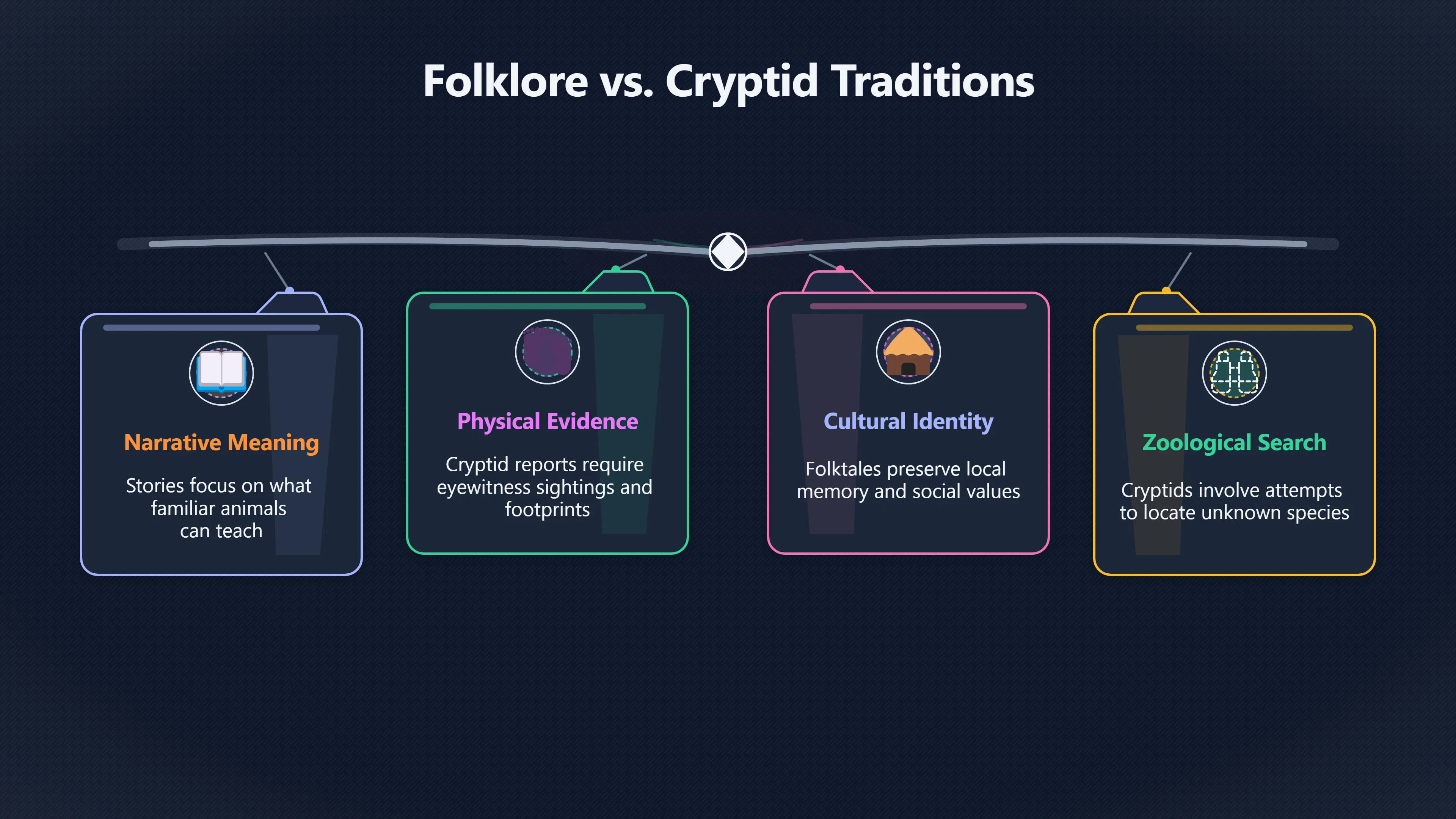
A cryptid tradition typically includes claims such as:
- eyewitness sightings,
- descriptions of unusual animals,
- attempts to locate or identify a creature,
- recurring reports from particular places.
The ossobó and tortoise stories do not fit that pattern. Their importance comes from narrative meaning rather than physical evidence. No one is collecting footprints of a talking tortoise or searching the rainforest for a giant ossobó. These animals operate within the logic of storytelling rather than zoology.[Gale]go.gale.comOssobo: myth, history, and intertextuality in Santomean literatureby J Staller · 2016 · Cited by 5 — This paper traces how the ossobo…
This difference helps explain why São Tomé and Príncipe lacks a famous national cryptid despite possessing a rich creature folklore. The islands’ animal traditions focus less on hidden species and more on moral imagination.
What Creature Folklore Reveals About the Islands
The most revealing aspect of Santomean creature folklore is how closely it connects animals with cultural survival. The islands developed through encounters between African, European and creole traditions, and oral storytelling became one of the ways communities preserved identity across generations.[Wikipedia]WikipediaLittérature santoméenneLittérature santoméenne
In that setting, the ossobó and the tortoise serve different but complementary roles:
- The ossobó links people to place, landscape and memory.
- The tortoise links people to lessons about behaviour, intelligence and community.
- Both transform familiar animals into cultural symbols without turning them into cryptozoological mysteries.
For anyone exploring the creature traditions of São Tomé and Príncipe, these stories offer something more enduring than a monster hunt. They show how a small island nation turned ordinary animals into carriers of history, humour and collective memory.
Amazon book picks
Further Reading
Books and field guides related to Why Santomean Animals Speak in Stories. Use these as the next step if you want deeper reading beyond the article.
The Palm-Wine Drinkard
Reflects storytelling traditions where animals and spirits carry meaning.
The Annotated African American Folktales
Provides broader Atlantic-world animal storytelling context.
eBay marketplace picks
Marketplace Samples
Example marketplace items related to this page. Use the search link to explore similar finds on eBay.
Endnotes
1.
Source: Wikipedia
Title: Littérature santoméenne
Link:https://fr.wikipedia.org/wiki/Litt%C3%A9rature_santom%C3%A9enne
2.
Source: arxiv.org
Link:https://arxiv.org/abs/1907.03969
3.
Source: go.gale.com
Link:https://go.gale.com/ps/i.do?id=GALE%7CA480708416&issn=00345210&it=r&linkaccess=abs&p=LitRC&sid=googleScholar&sw=w&v=2.1
Source snippet
Ossobo: myth, history, and intertextuality in Santomean literatureby J Staller · 2016 · Cited by 5 — This paper traces how the ossobo...
4.
Source: Wikipedia
Title: Culture de Sao Tomé-et-Principe
Link:https://fr.wikipedia.org/wiki/Culture_de_Sao_Tom%C3%A9-et-Principe
5.
Source: Wikipedia
Title: The Tortoise and the Birds
Link:https://en.wikipedia.org/wiki/The_Tortoise_and_the_Birds
6.
Source: oiroegbu.com
Title: Folklore: Tortoise and The Spirits 1
Link:https://oiroegbu.com/2020/11/01/folklore-tortoise-and-the-spirits-1/
Source snippet
As he looked around, he found a spirit happily chewing on one of his palm kernels, the very last palm kernel.Read more...
7.
Source: oiroegbu.com
Title: The Tortoise and The Dove
Link:https://oiroegbu.com/african-folklore/the-tortoise-and-the-dove/
Source snippet
Okechukwu's MusingsThe Tortoise became friends with the Dove. The Dove was a stammerer so that they couldn't talk properly. They lived to...
Additional References
8.
Source: instagram.com
Link:https://www.instagram.com/hr.numis/
Source snippet
HR (@hr.numis) • Instagram photos and videos2.6K+ followers · 358 following · 313 posts · @hr.numis: “My worldwide private paper money co...
9.
Source: medium.com
Link:https://medium.com/%40francisgodswisdom/the-story-of-sigidi-and-the-tortoise-14dd1525f4b6
Source snippet
THE STORY OF SIGIDI AND THE TORTOISE.Once upon a time, the tortoise dwelled among a people known for their agricultural prowess; cultivat...
10.
Source: puracomm.eu
Link:https://www.puracomm.eu/downloads/guia%20de%20lazer%20-%20Reisef%C3%BChrer%20-%20port.%20%26%20english.pdf
Source snippet
são tomé e príncipePrincipe sea turtles, contact: Daniel Ramos (Director of the. Natural Park of the Principe). 990 62 69. Hualton Oak (B...
11.
Source: books.google.com
Link:https://books.google.com/books/about/African_Folktale_Stories.html?id=IRTYzwEACAAJ
Source snippet
Folktale Stories: The Cunning Tortoise and Other...A folktale is a story created by the "folk" or common people. Folktales are passed do...
12.
Source: youtube.com
Link:https://www.youtube.com/watch?v=xCfnmUg-n-0
Source snippet
ing from them, filming and documenting everything they...
13.
Source: youtube.com
Title: How the Tortoise Got Its Shell | African Folktale | Legends Before Bedtime
Link:https://www.youtube.com/watch?v=VHKu8iiLebk
Source snippet
The Greedy Tortoise And The Birds | African Folktales for Kids & Families...
14.
Source: youtube.com
Title: The Greedy Tortoise And The Birds | African Folktales for Kids & Families
Link:https://www.youtube.com/watch?v=2eCdmwI9OHE
Source snippet
Why the Tortoise Has a Cracked Shell | Story Time with Títí Speaks...
15.
Source: youtube.com
Title: The Trickster Tortoise: Ijapa Tiroko Oko Yanibo | African Folktale
Link:https://www.youtube.com/watch?v=JOYei1XpOmQ
Source snippet
How the Tortoise Got Its Shell | African Folktale | Legends Before Bedtime...
16.
Source: youtube.com
Title: Tortoise’s Iconic Shell | 1 Hour of African Animal Folk Tales
Link:https://www.youtube.com/watch?v=R2XfEiizM1k
Source snippet
The Trickster Tortoise: Ijapa Tiroko Oko Yanibo | African Folktale...
17.
Source: youtube.com
Title: Why the Tortoise Has a Cracked Shell | Story Time with Títí Speaks
Link:https://www.youtube.com/watch?v=NeI-yr-XCT8
Topic Tree