Cryptid Reports from New Zealand's Wild Places
New Zealand’s creature legends are not a simple parade of “monsters”. They sit at the meeting point of Māori tradition, colonial newspaper culture, rugged geography, introduced animals, conservation science and the pleasure of a good yarn.
Page outline Jump by section
Introduction
The evidence varies sharply. Taniwha are best understood as living traditions and place-based supernatural beings, not undiscovered zoological species. Waitoreke and Fiordland moose claims are closer to mystery-animal debates, because they involve reported animals, tracks, hair, or historical introductions. Phantom cats are usually explained by unusually large feral cats. New Zealand’s cryptid landscape is therefore less about one national monster and more about how strange animal stories adapt to a country where real ecology is already unusual: native land mammals are limited to bats, while many familiar large mammals arrived only through human introduction.[govt.nz]teara.govt.nzTe Ara Encyclopedia of New ZealandTaniwhaTaniwha have been described as fabulous monsters that live in deep water…. There are several…
Why New Zealand’s monster stories feel different
New Zealand’s mystery-animal folklore has a distinctive ecological problem at its centre: the country does not naturally have the kind of large native land mammals that anchor many cryptid traditions elsewhere. The Department of Conservation states that New Zealand’s only native land mammals are bats, while marine mammals are part of the native fauna around the coast. That makes claims of native otters, big cats, apes or unknown land beasts immediately more biologically awkward than, say, reports of a large cat in a country where wild cats already exist.[Doc.govt.nz]doc.govt.nzNew Zealand bats/pekapeka: Native animal conservationBats are New Zealand's only native land mammals. There are two species of bats in Ne…
That does not make the stories uninteresting. It makes them more revealing. A mystery animal in New Zealand usually has to fit one of several categories: a being from Māori tradition; a misidentified known animal; an introduced animal surviving where it is not expected; a hoax or local joke; or a genuine but poorly documented encounter with ordinary wildlife under difficult conditions. The country’s isolation, dense bush, fiords, mountain valleys and dangerous waterways give these stories room to breathe, but its well-studied conservation landscape also puts strong pressure on extraordinary claims.
There is one wrinkle in the “no native land mammals except bats” story. In 2006, researchers reported fossil evidence of a small, non-flying mammal from Miocene deposits near St Bathans in Central Otago, showing that ancient New Zealand was not always as mammal-poor as the recent natural history suggests. That fossil does not support modern cryptid claims, but it does add useful context: New Zealand’s deep past was stranger than the simplified “land of birds” phrase implies.[PNAS]pnas.orgMiocene mammal reveals a Mesozoic ghost lineage on…by TH Worthy · 2006 · Cited by 145 — Here we report discovery of a nonvolant ma…
Taniwha are the heart of the tradition, but not “just lake monsters”
For many readers outside New Zealand, taniwha are the obvious starting point because they look, at first glance, like the country’s answer to dragons, lake monsters or sea serpents. That comparison is useful only up to a point. Te Ara, the Encyclopaedia of New Zealand, describes taniwha as supernatural creatures in Māori tradition whose forms vary by tribal tradition: some live in deep water, caves, rivers or the sea; some are dangerous; others act as guardians; and their forms can include reptile-like beings, sharks, whales, octopuses or even logs.[Te Ara Encyclopedia of New Zealand]teara.govt.nzTe Ara Encyclopedia of New ZealandTaniwhaTaniwha have been described as fabulous monsters that live in deep water…. There are several…
The important point is that taniwha are place-based. They are often tied to a specific harbour, river bend, dangerous current, cave, lake or tribal history. That means a taniwha story may explain why a place is dangerous, why it is tapu or significant, why people avoid a pool, or how a landscape feature came to be. New Zealand’s dramatic landscape encouraged traditions in which giants, water creatures and powerful beings shaped lakes, rivers and landforms; Te Ara notes that such stories can work as explanation, metaphor and memory-map at once.[Te Ara Encyclopedia of New Zealand]teara.govt.nzTheir stories tell of giants digging out the South Island lakes, water creatures…Read more…
This matters for cryptid readers because treating taniwha as “unconfirmed animals” strips away the very thing that makes them New Zealand’s richest monster tradition. Some stories do involve creature-like bodies, attacks and heroic slayers. Others are guardianship traditions, environmental warnings or histories encoded in landscape. A sceptical reading can ask whether some taniwha imagery was influenced by sharks, whales, logs, waves, landslides or dangerous currents, but the tradition itself is not reducible to a misidentified animal.
Several famous examples show the range. Wellington Harbour is associated with a tradition in which the harbour was once a lake occupied by two taniwha, one of which broke out to the open sea and created the harbour entrance. At Kawautahi, a small lake in the Whanganui region, Māori were said to avoid the place because a fierce taniwha lived there, and an 1892 account described survey assistants allegedly being attacked there. At Piha, the man-eating taniwha Kaiwhare was said to live in an underwater cave until the hero Tāmure fought it and reduced its threat.[Te Ara Encyclopedia of New Zealand]teara.govt.nzOpen source on govt.nz.

Pelorus Jack: when a real animal becomes a legendary guardian
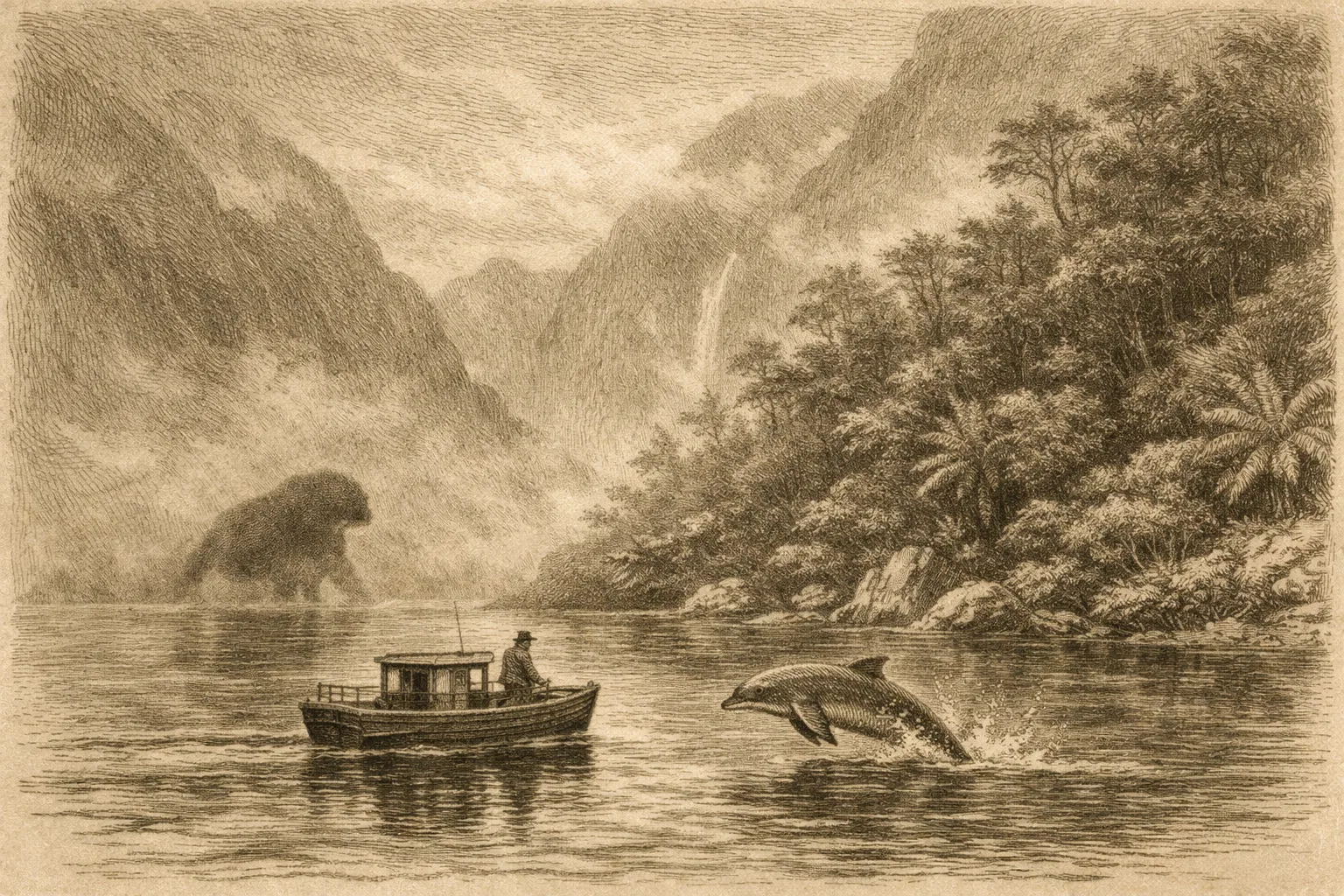
Pelorus Jack is one of the best bridges between New Zealand’s factual animal history and its monster folklore. He was a real Risso’s dolphin known for accompanying ships near French Pass, between D’Urville Island and the South Island, from the late nineteenth century into the early twentieth. Te Ara records that many Māori believed Pelorus Jack was Tuhirangi, a taniwha associated with the explorer Kupe, in dolphin form.[Te Ara Encyclopedia of New Zealand]teara.govt.nzTe Ara Encyclopedia of New ZealandStory: Taniwha22 Sept 2012 — Taniwha are supernatural creatures in Māori tradition, similar to serpents…
The story became nationally famous because the dolphin’s behaviour was repeatable, public and useful. He guided or accompanied vessels through a dangerous area, became a tourist attraction, and reportedly drew public outrage when someone shot at him from a steamer. Demands for protection led to a 1904 order under fisheries law, renewed before his disappearance; Te Ara notes that this legal protection became part of his story.[Te Ara Encyclopedia of New Zealand]teara.govt.nzthe story of pelorus jackthe story of pelorus jack
Pelorus Jack is not a cryptid in the usual sense, because the animal was observed, photographed and identified. Yet his afterlife belongs on a New Zealand cryptid page because he shows how the boundary between animal, guardian, celebrity and legend can blur. Unlike a hidden monster, he was famous precisely because he was seen so often. His case also warns against a crude split between “real animal” and “folklore”: a real dolphin could be understood through a taniwha tradition without ceasing to be a dolphin.
Waitoreke: the South Island’s otter-shaped puzzle
The waitoreke, also known as kaurehe or the “New Zealand otter”, is probably New Zealand’s most cryptozoological mystery animal in the strict sense: a reported creature that would be biologically surprising if real, but not supernatural in the way taniwha are. The 1966 Encyclopaedia of New Zealand described it as an aquatic, otter- or beaver-like animal supposedly associated with Fiordland and the Southern Lakes, and noted that crew members from Cook’s Resolution saw a greyish, cat-like quadruped with a bushy tail in Dusky Sound in May 1773, though the naturalists J. R. and G. Forster were sceptical.[Te Ara Encyclopedia of New Zealand]teara.govt.nzOpen source on govt.nz.
The appeal of the waitoreke is easy to understand. A small amphibious mammal in South Island waterways would be a dramatic exception to the modern rule that New Zealand’s native land mammals are bats. Many later summaries describe a cat-sized or otter-like creature near water, sometimes with brown fur and short legs. The problem is that the physical evidence has never reached the standard needed to establish an unknown living species.[Wikipedia]WikipediaOpen source on wikipedia.org.
The most useful sceptical frame is not “everyone lied”. It is that several different things may have been folded into one tradition. Early observers may have misidentified dogs, seals, large rats, introduced mammals, swimming birds, or fleeting shapes in poor light. European naturalists also interpreted Māori and settler accounts through familiar animal categories such as otter, beaver, muskrat or platypus. Once a label exists, later reports can begin to orbit it.
The waitoreke remains interesting because it is not merely an internet-era monster. It has roots in early exploration, nineteenth-century natural-history speculation and South Island geography. But the balance of evidence remains thin: a tradition of reports and interpretations, rather than a confirmed animal.
Moehau Man: Coromandel’s hairy bush figure
The Moehau, often called the Moehau Man or Moehau Monster, is New Zealand’s nearest equivalent to a Bigfoot-style hairy hominid story. It is associated especially with the Coromandel and Moehau ranges on the North Island, where stories describe a large, hairy, man-like creature in the bush. Some versions connect it with older Māori traditions of wild or mountain beings; modern pop-cryptid versions tend to frame it as an ape-man.[Wikipedia]WikipediaOpen source on wikipedia.org.
The case is a good example of how a local legend can gain layers. One explanation repeated in later accounts is that the story grew from an exaggerated report of an escaped baboon or gorilla. Another is that the “monster” began as a joke or as a nickname connected with logging machinery. A 2024 SunLive piece, revisiting earlier reporting, quoted Coromandel county councillor Jim Reedy’s view that there had “never been” such a monster in the area and that the tale started as a joke before superstition and added yarns made it feel real to some listeners.[Wikipedia]WikipediaOpen source on wikipedia.org.
Those explanations do not erase the story’s cultural life. They help explain why the Moehau functions less like a zoological lead and more like a bush legend that has been repeatedly re-costumed. In a country without native apes, and with no strong physical evidence for a surviving primate, the biological case is extremely weak. As folklore, however, the Moehau has legs: remote ranges, old warnings about the bush, a memorable name and a creature type that international audiences instantly recognise.
The strongest way to read the Moehau is as a New Zealand localisation of several motifs: wild men of the hills, dangerous forest outsiders, settler-era exaggeration, and later Bigfoot-style cryptid culture. Its geography matters more than its anatomy. Coromandel bush gives the story its atmosphere; the lack of evidence keeps it in the realm of legend.
Phantom cats: why the “panther” keeps coming back
New Zealand’s phantom cat stories are unusually persistent because they are not entirely built on impossible sightings. People do see large black cats in rural New Zealand. The disputed part is whether those cats are escaped panthers, pumas or other exotic big cats. Reports have clustered especially around Canterbury, Otago, Southland and parts of the South Island high country, with headlines about the Canterbury Panther or South Island black cats appearing periodically.[1news.co.nz]1news.co.nz1News Two independent sightings of mystery South Island panther1News Two independent sightings of mystery South Island panther
The mainstream explanation is that witnesses are usually seeing feral domestic cats, sometimes at the large end of the range, under conditions that exaggerate scale. The Department of Conservation says feral cats can grow much larger than companion cats, measuring up to a metre including the tail; male feral cats captured in South Island high country averaged 3.75 kg, with the heaviest recorded by DOC at 7 kg.[Doc.govt.nz]doc.govt.nzOpen source on govt.nz.
That may sound too small for a “panther”, but perception in open country is tricky. A black animal seen at speed, at night, across a road, or without a reliable size reference can look much larger than it is. Otago zoologist Yolanda van Heezik, quoted in RNZ coverage republished by the Otago Daily Times, made a useful distinction: people may genuinely be seeing large black cats, while it remains extremely unlikely that New Zealand has panthers or pumas living wild.[Otago Daily Times Online News]odt.co.nzpeople are really seeing these large south island black cats sightingspeople are really seeing these large south island black cats sightings
The phantom cat legend also feeds on a real conservation issue. Feral cats are not harmless background animals in New Zealand; they are predators in a country whose native wildlife evolved largely without mammalian land predators. That gives “big cat” stories a sharper edge than simple campfire entertainment, because even ordinary feral cats matter ecologically.[Doc.govt.nz]doc.govt.nzOpen source on govt.nz.

Fiordland moose: the rare case where the animal really was introduced
The Fiordland moose is different from most cryptids because there is no doubt about the starting point. Moose were introduced to Fiordland in the early twentieth century as part of acclimatisation and hunting ambitions. The mystery is whether any descendants survived long after official confidence in the population faded.[The Guardian]theguardian.comOpen source on theguardian.com.
This makes the Fiordland moose a “survival” mystery rather than an unknown-species claim. Reports mention sightings, browsing signs, footprints, cast antlers, hair samples and searches by dedicated investigators. Recent journalism has highlighted the work of biologist Ken Tustin and others who argue that the landscape is difficult enough, and the signs intriguing enough, to keep the question open. The Guardian reported that a confirmed moose hair sample from the early 2000s helped keep the story alive, while noting that the Department of Conservation remains sceptical without clear photographic proof.[The Guardian]theguardian.comOpen source on theguardian.com.
Scepticism is still reasonable. A tiny introduced population in rugged habitat faces obvious problems: finding mates, avoiding detection over generations, leaving enough sign to be found, and persisting in an environment often described as less than ideal for moose. But unlike the Moehau or panther stories, the Fiordland moose has a known historical mechanism. Ten moose released into remote country is not folklore; what is uncertain is whether their line survived.
The enduring appeal of the story comes from Fiordland itself. The same terrain that frustrates confirmation makes survival feel imaginable: deep bush, rain, steep valleys, difficult access and a national memory of animals such as the takahē, once thought lost and then rediscovered. That does not prove moose remain, but it explains why the possibility refuses to die.
Living moa: the most tempting lost-bird legend
No New Zealand mystery animal has more emotional pull than the idea of a living moa. Moa were real giant flightless birds, central to New Zealand’s pre-European ecology and extinction history. The cryptid question is whether small populations survived into the European period, especially in remote Fiordland or South Westland, and whether later sightings might have recorded living birds.[New Zealand Ecological Society]newzealandecology.orgOpen source on newzealandecology.org.
The evidence is not strong. Atholl Anderson’s study on claims for moa survival in European Fiordland examined possible sightings and archaeological arguments, including the well-known Alice McKenzie account, and concluded that the material was insufficient to sustain the survival claim. Later sceptical treatments have made the same broad point: stories exist, but reliable tracks, photographs, remains or ecological signs do not.[New Zealand Ecological Society]newzealandecology.orgOpen source on newzealandecology.org.
The takahē complicates the public imagination. This flightless bird was famously rediscovered in 1948 after being thought extinct, showing that New Zealand’s remote landscapes can hide rare birds from science for decades. But the comparison has limits. A moa would be far larger, would need a breeding population, would leave substantial physical traces, and would have had to escape confirmation for centuries in country used by hunters, trampers, conservation workers and researchers.[All About Birds]allaboutbirds.orgAll About Birds Dr. Orbell's Unlikely Quest: New Zealand's Bush MoaAll About Birds Dr. Orbell's Unlikely Quest: New Zealand's Bush Moa
The most evidence-aware conclusion is that living-moa stories are culturally powerful but zoologically very unlikely. They are best read as an extinction haunting: a country remembering an animal so extraordinary that people keep imagining it might still step out of the bush.
Sea serpents and newspaper monsters
Nineteenth-century New Zealand newspapers carried sea-serpent reports in the same lively style found across the English-speaking maritime world. Papers Past, the National Library of New Zealand’s digitised newspaper archive, preserves examples such as “A Sea Serpent in New Zealand Waters” in the New Zealand Herald in 1891 and other “sea serpent” items in the Auckland Star, Evening Post, Timaru Herald and New Zealand Graphic.[Papers Past]paperspast.natlib.govt.nzOpen source on govt.nz.
These reports belong to a global newspaper culture as much as to local zoology. Sailors, coastal witnesses and editors had a ready-made category for long, strange things seen at sea: the sea serpent. In New Zealand waters, possible inspirations include whales, dolphins, basking sharks, giant oarfish-like forms reported elsewhere, floating kelp, lines of birds or seals, wave effects, and ordinary exaggeration after a brief sighting.
Their value today is not that they prove a hidden marine reptile. It is that they show how colonial New Zealand plugged local coastlines into a worldwide monster-report network. A strange shape offshore did not remain just a strange shape. It became “the sea serpent”, a travelling headline that readers already knew how to enjoy.
How to sort folklore, hoax, misidentification and mystery animal
New Zealand’s creature stories are easiest to understand if they are not forced into one box. Different cases ask for different standards of evidence.
Taniwha belong primarily to Māori tradition, place memory and spiritual geography. They may draw on real dangers in rivers, harbours and seas, but they should not be flattened into “misidentified animals”.
Waitoreke is a true mystery-animal claim in the classic sense: repeated descriptions of an otter-like creature in a country where such an animal would be surprising. The problem is the lack of decisive physical evidence.
Moehau Man is best treated as bush folklore with modern cryptid dressing. The biological claim is weak, while the local legend is strong.
Phantom cats probably have the most ordinary explanation: large feral cats, distorted size judgement, and occasional media amplification. The sightings can be sincere without requiring panthers.
Fiordland moose are a survival question. The animals were introduced, and there have been intriguing signs, but clear modern proof remains lacking.
Living moa are the most emotionally compelling but among the least likely zoologically, because a breeding population of large birds should leave better evidence.
This sorting is not meant to drain the fun from the stories. It makes them more interesting. A hoax, a sacred tradition, a real introduced animal and a mistaken road-crossing sighting are not the same kind of thing, even if all can end up on a “cryptids of New Zealand” list.
The modern afterlife of New Zealand’s cryptids
New Zealand’s creature legends continue because they are useful stories. They give tourists a reason to look twice at a lake, a pass, a bush road or a dark line of trees. They give local media a recurring mystery. They give conservation-minded readers a way into real ecological questions about invasive mammals, lost birds and fragile native species. They also give New Zealand a monster map that is distinct from the usual northern-hemisphere line-up of wolves, bears, apes and lake reptiles.
The country’s best monster stories are not always the ones with the strongest chance of being “real”. Pelorus Jack was real, but became legendary. Taniwha are not cryptids in a narrow zoological sense, but they are central to the country’s monster imagination. Fiordland moose may be biologically possible but unconfirmed. Phantom cats are probably just cats, yet they reveal how scale, fear and landscape can turn an ordinary predator into a panther. The living moa is almost certainly gone, but its shadow remains because extinction is hard to accept when the vanished animal was so spectacular.
That is the particular flavour of New Zealand cryptid history: strange reports in a land where the ordinary natural history is already surprising, and where the most enduring monsters often tell us as much about place, memory and ecology as they do about animals.
Amazon book picks
Further Reading
Books and field guides related to What Lurks in New Zealand's Wild Places?. Use these as the next step if you want deeper reading beyond the article.
Maori Myths & Legendary Tales
Provides foundational stories behind taniwha and other legendary beings.
Reed Book of Maori Mythology
Explains the mythological context for many New Zealand supernatural traditions.
The World of Lore: Monstrous Creatures
Places New Zealand creature traditions within global monster folklore.
Endnotes
1.
Source: teara.govt.nz
Link:https://teara.govt.nz/en/taniwha/print
Source snippet
Te Ara Encyclopedia of New ZealandTaniwhaTaniwha have been described as fabulous monsters that live in deep water.... There are several...
2.
Source: doc.govt.nz
Link:https://www.doc.govt.nz/nature/native-animals/bats-pekapeka/
Source snippet
New Zealand bats/pekapeka: Native animal conservationBats are New Zealand's only native land mammals. There are two species of bats in Ne...
3.
Source: doc.govt.nz
Link:https://www.doc.govt.nz/nature/native-animals/
Source snippet
New Zealand native animalsNew Zealand has many unique native fish, insects, birds, lizards and frogs. Our only native mammals are bats an...
4.
Source: pnas.org
Link:https://www.pnas.org/doi/10.1073/pnas.0605684103
Source snippet
Miocene mammal reveals a Mesozoic ghost lineage on...by TH Worthy · 2006 · Cited by 145 — Here we report discovery of a nonvolant ma...
5.
Source: teara.govt.nz
Link:https://teara.govt.nz/en/taniwha
Source snippet
Te Ara Encyclopedia of New ZealandStory: Taniwha22 Sept 2012 — Taniwha are supernatural creatures in Māori tradition, similar to serpents...
6.
Source: teara.govt.nz
Link:https://teara.govt.nz/en/whenua-how-the-land-was-shaped/print
Source snippet
Their stories tell of giants digging out the South Island lakes, water creatures...Read more...
7.
Source: teara.govt.nz
Link:https://teara.govt.nz/en/interactive/35285/roadside-stories-wellington-harbours-taniwha
8.
Source: teara.govt.nz
Link:https://teara.govt.nz/en/artwork/10874/the-kawautahi-taniwha
9.
Source: teara.govt.nz
Link:https://teara.govt.nz/en/artwork/10896/tamure-and-kaiwhare
10.
Source: teara.govt.nz
Title: pelorus jack
Link:https://teara.govt.nz/en/photograph/10893/pelorus-jack
11.
Source: teara.govt.nz
Title: the story of pelorus jack
Link:https://teara.govt.nz/en/photograph/4696/the-story-of-pelorus-jack
12.
Source: teara.govt.nz
Link:https://teara.govt.nz/en/1966/animals-mythical
13.
Source: Wikipedia
Link:https://en.wikipedia.org/wiki/Waitoreke
14.
Source: Wikipedia
Link:https://en.wikipedia.org/wiki/Moehau
15.
Source: doc.govt.nz
Link:https://www.doc.govt.nz/nature/pests-and-threats/animal-pests-and-threats/feral-cats/
16.
Source: doc.govt.nz
Title: feral cats to be added to predator free 2050
Link:https://www.doc.govt.nz/news/media-releases/2025-media-releases/feral-cats-to-be-added-to-predator-free-2050/
17.
Source: Wikipedia
Link:https://en.wikipedia.org/wiki/Moose
18.
Source: Wikipedia
Link:https://en.wikipedia.org/wiki/Moa
19.
Source: paperspast.natlib.govt.nz
Link:https://paperspast.natlib.govt.nz/newspapers/AS18910811.2.42
20.
Source: paperspast.natlib.govt.nz
Link:https://paperspast.natlib.govt.nz/periodicals/NZGRAP18910509.2.15?items_per_page=100&page=12&query=captain&sort_by=byTI
21.
Source: paperspast.natlib.govt.nz
Link:https://paperspast.natlib.govt.nz/newspapers/NZH18910804.2.29?items_per_page=100&page=2&query=Quartermaster&snippet=true
22.
Source: Wikipedia
Link:https://en.wikipedia.org/wiki/Taniwha
23.
Source: Wikipedia
Title: Canterbury Panther
Link:https://en.wikipedia.org/wiki/Canterbury_Panther
24.
Source: Wikipedia
Title: Pelorus Jack
Link:https://en.wikipedia.org/wiki/Pelorus_Jack
25.
Source: wcl.govt.nz
Title: the weird and wonderful world of cryptids
Link:https://www.wcl.govt.nz/news/the-weird-and-wonderful-world-of-cryptids/
26.
Source: wcl.govt.nz
Title: lockdown cryptid spotting a librarians guide
Link:https://www.wcl.govt.nz/news/lockdown-cryptid-spotting-a-librarians-guide/
27.
Source: nzhistory.govt.nz
Title: northland rugby
Link:https://nzhistory.govt.nz/page/northland-rugby
28.
Source: paperspast.natlib.govt.nz
Link:https://paperspast.natlib.govt.nz/newspapers/AS19010316.2.62.16.3
29.
Source: paperspast.natlib.govt.nz
Link:https://paperspast.natlib.govt.nz/newspapers/EP18911121.2.57
30.
Source: paperspast.natlib.govt.nz
Link:https://paperspast.natlib.govt.nz/cgi-bin/paperspast?a=d&d=THD19020725.2.22
31.
Source: paperspast.natlib.govt.nz
Link:https://paperspast.natlib.govt.nz/newspapers/CHP18910804.2.48?items_per_page=100&page=5&query=earthquake+at+sea+and+ship&snippet=false
32.
Source: paperspast.natlib.govt.nz
Link:https://paperspast.natlib.govt.nz/cgi-bin/paperspast?a=d&d=EP18950420.2.58&e=%E2%80%94%E2%80%94%E2%80%94%E2%80%9410%E2%80%931%E2%80%94%E2%80%94%E2%80%94%E2%80%942%E2%80%93&l=mi
33.
Source: paperspast.natlib.govt.nz
Link:https://paperspast.natlib.govt.nz/newspapers/colonist/1882/03/31
34.
Source: paperspast.natlib.govt.nz
Link:https://paperspast.natlib.govt.nz/periodicals/RADREC19340727.2.85.1
35.
Source: paperspast.natlib.govt.nz
Title: wairarapa daily times
Link:https://paperspast.natlib.govt.nz/newspapers/wairarapa-daily-times/1880/01/26
36.
Source: paperspast.natlib.govt.nz
Link:https://paperspast.natlib.govt.nz/periodicals/NZLIST19690207.2.46.1?items_per_page=100&page=38&query=cooper&sort_by=byTY.rev
37.
Source: natlib.govt.nz
Link:https://natlib.govt.nz/items?i%5Bcollection%5D=Papers+Index&i%5Bprimary_collection%5D=findNZarticles&i%5Bsubject_text%5D=Moa
38.
Source: teara.govt.nz
Link:https://teara.govt.nz/en/te-whanau-puha-whales/print
39.
Source: teara.govt.nz
Link:https://teara.govt.nz/en/first-peoples-in-maori-tradition/print
40.
Source: teara.govt.nz
Link:https://teara.govt.nz/en/historic-earthquakes/page-1
41.
Source: teara.govt.nz
Title: taniwha stamp
Link:https://teara.govt.nz/en/postage-stamp/10859/taniwha-stamp
42.
Source: teara.govt.nz
Link:https://teara.govt.nz/en/bats/print
43.
Source: teara.govt.nz
Title: a moa sighting
Link:https://teara.govt.nz/en/video/11386/a-moa-sighting
44.
Source: blog.tepapa.govt.nz
Title: what or which was new zealands first protected dolphin
Link:https://blog.tepapa.govt.nz/2016/07/07/what-or-which-was-new-zealands-first-protected-dolphin/
45.
Source: kura.aucklandlibraries.govt.nz
Title: aucklandlibraries.govt.nz Sea serpent on the Australian coast
Link:https://kura.aucklandlibraries.govt.nz/digital/collection/photos/id/110476/
46.
Source: pesthub.es.govt.nz
Title: es.govt.nz Cats
Link:https://pesthub.es.govt.nz/?pwid=469&pwsystem=true&sort=alpha
47.
Source: 1news.co.nz
Title: 1News Two independent sightings of mystery South Island panther
Link:https://www.1news.co.nz/2019/09/19/two-independent-sightings-of-mystery-south-island-panther-within-days-and-20km-of-each-other/
48.
Source: odt.co.nz
Title: people are really seeing these large south island black cats sightings
Link:https://www.odt.co.nz/star-news/star-districts/people-are-really-seeing-these-large-south-island-black-cats-sightings
49.
Source: theguardian.com
Title: big cat country new zealands obsession with giant feline sightings
Link:https://www.theguardian.com/world/2020/nov/14/big-cat-country-new-zealands-obsession-with-giant-feline-sightings
50.
Source: theguardian.com
Link:https://www.theguardian.com/world/2025/may/23/new-zealand-moose-mystery-fiordland-national-park
51.
Source: newzealandecology.org
Link:https://newzealandecology.org/nzje/1859/pdf
52.
Source: allaboutbirds.org
Title: All About Birds Dr. Orbell’s Unlikely Quest: New Zealand’s Bush Moa
Link:https://www.allaboutbirds.org/news/dr-orbells-unlikely-quest-new-zealands-bush-moa/
53.
Source: cryptidz.fandom.com
Link:https://cryptidz.fandom.com/wiki/Moehau
54.
Source: cryptidz.fandom.com
Link:https://cryptidz.fandom.com/wiki/Taniwha
55.
Source: cryptidz.fandom.com
Link:https://cryptidz.fandom.com/wiki/Waitoreke
56.
Source: cryptidarchives.fandom.com
Title: Fiordland moose
Link:https://cryptidarchives.fandom.com/wiki/Fiordland_moose
57.
Source: prehistoric-wiki.fandom.com
Title: Fiordland moose
Link:https://prehistoric-wiki.fandom.com/wiki/Fiordland_moose
58.
Source: cryptidz.fandom.com
Link:https://cryptidz.fandom.com/wiki/Moa
59.
Source: reddit.com
Title: moa survival
Link:https://www.reddit.com/r/Cryptozoology/comments/13s2cg7/moa_survival/
60.
Source: odt.co.nz
Title: panther sighting near fairlie
Link:https://www.odt.co.nz/news/national/panther-sighting-near-fairlie
61.
Source: odt.co.nz
Title: canterbury panther search mysterious big cat
Link:https://www.odt.co.nz/news/national/canterbury-panther-search-mysterious-big-cat
62.
Source: odt.co.nz
Title: ‘still case’ elusive moose
Link:https://www.odt.co.nz/rural-life/rural-life-other/%E2%80%98still-case%E2%80%99-elusive-moose
63.
Source: newzealandecology.org
Link:https://newzealandecology.org/nzje/2629/pdf
64.
Source: newzealandecology.org
Link:https://newzealandecology.org/nzje/3458
65.
Source: southernlakessanctuary.org.nz
Title: feral cats
Link:https://southernlakessanctuary.org.nz/feral-cats/
66.
Source: digitisednewspapers.net
Title: Papers Past
Link:https://www.digitisednewspapers.net/histories/pp/
67.
Source: nznatureguy.com
Link:https://www.nznatureguy.com/2019/01/21/bats-new-zealands-only-native-land-mammal/
68.
Source: nzdacanterbury.org
Title: Fiordland Moose
Link:https://nzdacanterbury.org/fiordland-moose/
69.
Source: belgianjournalofzoology.eu
Link:https://belgianjournalofzoology.eu/BJZ/article/view/114
Additional References
70.
Source: sciencedaily.com
Link:https://www.sciencedaily.com/releases/2006/12/061213104202.htm
Source snippet
Tiny Bones Rewrite Textbooks: First New Zealand Land...14 Dec 2006 — The tiny fossilised bones - part of a jaw and hip - bel...
71.
Source: youtube.com
Link:https://www.youtube.com/watch?v=NBSCSHdGxNA
Source snippet
New Zealand's Giant Moa... & the Explorers who found them...
72.
Source: youtube.com
Link:https://www.youtube.com/watch?v=S7etfs4eAh8
Source snippet
Waitoreke: New Zealand's Otter-like Cryptid...
73.
Source: instagram.com
Link:https://www.instagram.com/p/C5MZjxsyVm7/
74.
Source: facebook.com
Link:https://www.facebook.com/sevensharp/posts/a-phantom-puma-or-just-a-fat-feral-cat-we-put-what-could-be-the-south-island-pan/10157516578707268/
75.
Source: reddit.com
Link:https://www.reddit.com/r/Cryptozoology/comments/1rfdiak/an_alleged_photograph_of_the_fiordland_moose_not/
76.
Source: reddit.com
Link:https://www.reddit.com/r/Naturewasmetal/comments/lncyny/this_is_an_artwork_of_the_saint_bathans_mammal/
77.
Source: reddit.com
Link:https://www.reddit.com/r/newzealand/comments/s5zhkn/big_cat_sighting/
78.
Source: facebook.com
Link:https://www.facebook.com/theNorthCanterburyHuntingCompetition/posts/check-this-out-canterbury-panther-spotted-this-morning-by-pig-hunters-waiau-nort/998411042944858/
79.
Source: interislander.co.nz
Link:https://www.interislander.co.nz/experience/kids/scavenger-hunt-extras
Topic Tree
Follow this branch
Related pages 192
- Antigua Cryptids
- Maldives Monsters
- Malta Monsters
- Qatar Monsters
- Argentina Monsters
- +187 more in sidebar