Within DR Congo Cryptids
Which Real Animals Fed Congo Monster Stories?
Forest elephants, hippos, crocodiles, rhino memories and okapi discoveries help explain why hidden-animal stories felt believable.
On this page
- Elephants, hippos and muddy water sightings
- Rhino memory and horned beast motifs
- The okapi and the African unicorn effect
Page outline Jump by section
Introduction
The Democratic Republic of the Congo has inspired monster stories for more than a century, but one reason those stories took hold is simple: the region’s real wildlife can seem extraordinary even without any unknown creatures. Dense rainforest, vast swamps and difficult terrain concealed many animals from outside observers for generations. When explorers, missionaries and newspaper writers heard reports of strange beasts, they were often dealing with genuine animals seen briefly, described second-hand, or remembered from a time when wildlife distributions were different. The result was a fertile meeting point between folklore, eyewitness uncertainty and real zoology.
Understanding Congo monster traditions therefore means looking not only at legendary creatures but also at elephants, hippos, crocodiles, rhinoceroses and the remarkable okapi. These animals helped create the sense that Central Africa might still conceal something undiscovered.[National Geographic]nationalgeographic.comZoonotic diseases, like Ebola,National GeographicWhat's behind the strange rash of 'dinosaur' sightings in…4 Feb 2025 — People are still confusing elephants and ape…
Elephants, Hippos and Muddy-Water Sightings
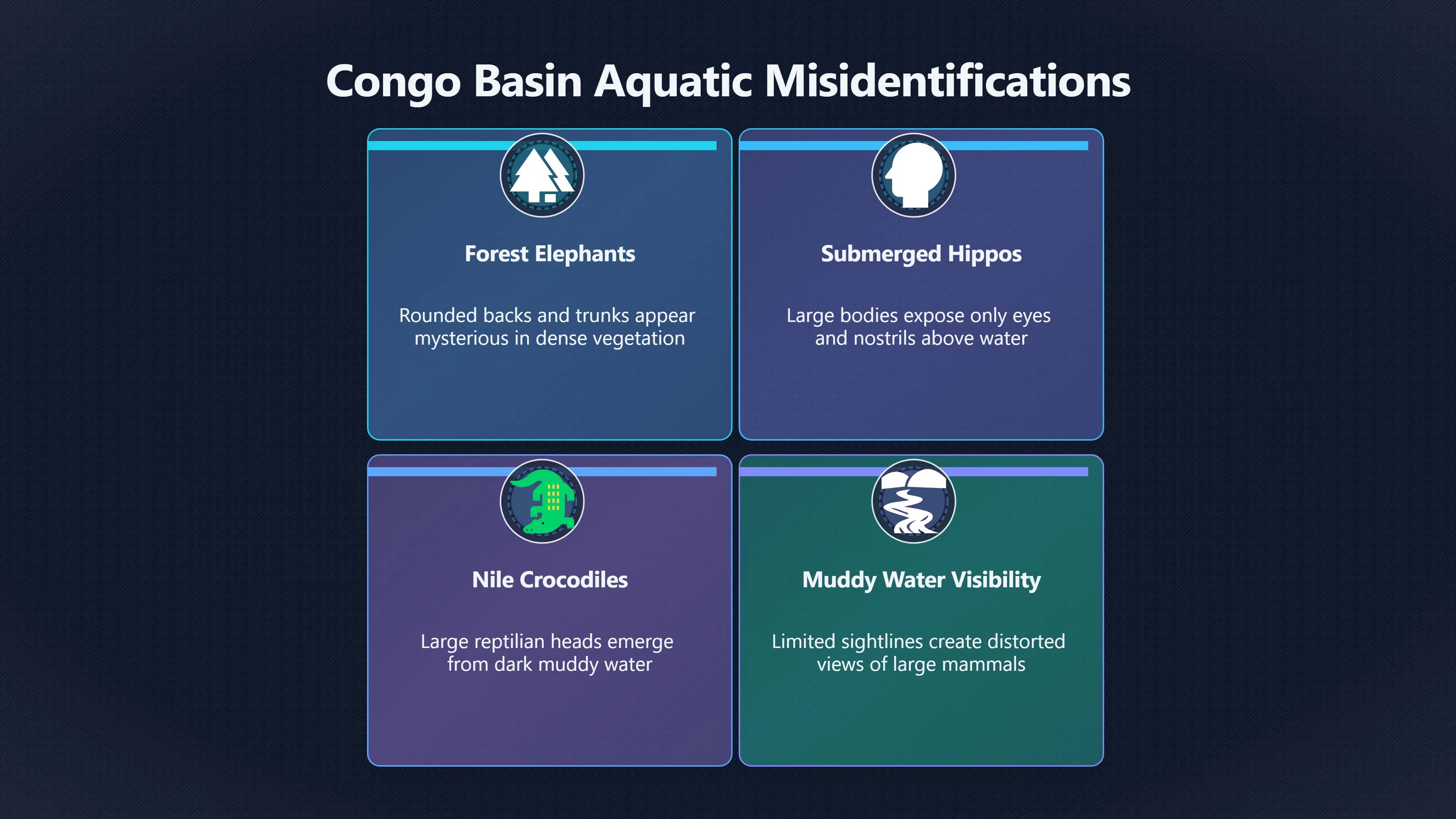
Many Congo monster reports involve rivers, lakes, marshes and flooded forests. These environments are notoriously difficult places to identify animals accurately. Visibility is often limited to a head, back, wake or splash. Large mammals can appear surprisingly strange when only part of the body is visible above muddy water.
Forest elephants are a good example. Unlike the larger savanna elephants familiar from wildlife documentaries, forest elephants move through dense vegetation and swampy habitats where observers may glimpse only a rounded back, trunk or moving silhouette. A large animal crossing a river can easily appear much more mysterious than it would on open ground. Modern researchers studying mokele-mbembe traditions have noted that elephants are still among the animals sometimes confused with legendary creatures in parts of the Congo Basin.[National Geographic]nationalgeographic.comZoonotic diseases, like Ebola,National GeographicWhat's behind the strange rash of 'dinosaur' sightings in…4 Feb 2025 — People are still confusing elephants and ape…
Hippos contribute to the same effect. An adult hippopotamus can weigh several tonnes, spend much of its time submerged, and expose only its nostrils, eyes and ears above the surface. Seen at a distance, a surfacing hippo can look unlike any familiar animal. Groups of hippos moving through reeds may create the impression of a single long-bodied creature, especially in poor light.
Large crocodiles add another layer of confusion. Nile crocodiles can reach impressive sizes, and only a small portion of the body is usually visible while swimming. Reports describing a reptilian head emerging from dark water naturally encouraged monster interpretations among people unfamiliar with the local fauna. Similar explanations have been proposed repeatedly for Congo Basin mystery-animal reports.[Facebook]facebook.comMokele-mbembe is a mythical water-dwelling cryptid…Misidentified known animals, like large crocodiles, hippos, or elephants. F…
What matters is not that every sighting was a misidentification, but that the region genuinely contains animals large enough and unusual enough to make misidentification plausible.
Rhino Memory and Horned Beast Motifs
One of the most interesting explanations for some Congo monster traditions involves rhinoceroses.
Several historians and sceptical researchers have suggested that descriptions later attached to mokele-mbembe may have been influenced by memories of rhinoceroses rather than by any dinosaur-like animal. Mainstream discussions of the legend frequently note the black rhinoceros as a possible source for some accounts.[Wikipedia]WikipediaOpen source on wikipedia.org.
The idea becomes more interesting when viewed historically. Wildlife ranges have changed dramatically over time. Black rhinoceroses once occupied much larger areas of Africa than they do today, and some historical sources place black rhino populations in parts of southern Democratic Republic of the Congo before hunting and habitat loss reduced their numbers.[Wikipedia]WikipediaBlack rhinocerosBlack rhinoceros
This creates a mechanism by which stories can outlive animals. A community may preserve memories of a powerful horned beast long after the animal itself becomes rare or disappears from a region. Later retellings can gradually transform those memories into something more mysterious. The process is common in folklore worldwide.
Rhinos also possess features that easily become legendary:
- Massive size.
- Prominent horns.
- Aggressive defensive behaviour.
- Poor visibility in thick vegetation.
- Short glimpses during encounters.
A witness describing a large animal charging through forest undergrowth might produce a story that sounds far more exotic after several rounds of retelling. By the time such reports reached European newspapers in the early twentieth century, the original animal could be difficult to recognise.
Importantly, the rhinoceros explanation does not account for every Congo monster story. Some reported creatures are aquatic rather than terrestrial, while others have very different descriptions. Yet the rhino remains one of the strongest examples of how a real animal can leave a long cultural shadow.[Wikipedia]WikipediaOpen source on wikipedia.org.
The Okapi and the African Unicorn Effect
No real animal influenced Congo monster culture more than the okapi.
Today the okapi is a well-known symbol of the Democratic Republic of the Congo, but around the turn of the twentieth century it was one of zoology’s great surprises. For years, Europeans heard reports of a strange forest animal that seemed part zebra and part giraffe. Because no specimen had been studied scientifically, the creature acquired a reputation as an “African unicorn” among explorers and journalists.[Wikipedia]WikipediaOpen source on wikipedia.org.
When the okapi was formally described by science in 1901, it appeared to confirm an exciting possibility: local people had been talking about a remarkable animal all along, and outsiders had simply failed to find it. The discovery became a powerful cultural lesson. If a large, unusual mammal could remain largely unknown to Western science until the twentieth century, perhaps other hidden animals existed as well.[Tetrapod Zoology]tetzoo.comthe discovery of the okapi part 1Tetrapod ZoologyThe Discovery of the Okapi, Part 1April 12, 2023 — 12 Apr 2023 — The story of the Okapi's discovery has been told several…
Cryptozoology writers repeatedly pointed to the okapi as evidence that reports of mysterious animals should not be dismissed too quickly. The argument was emotionally persuasive even when the comparison was weak. The crucial difference is that the okapi left abundant physical evidence. Local communities knew it well, hunters encountered it, skins and specimens existed, and scientists eventually examined those specimens directly. The animal was elusive, not invisible.[Tetrapod Zoology]tetzoo.comthe discovery of the okapi part 1Tetrapod ZoologyThe Discovery of the Okapi, Part 1April 12, 2023 — 12 Apr 2023 — The story of the Okapi's discovery has been told several…
Nevertheless, the okapi’s discovery transformed public expectations about Central Africa. It encouraged the belief that deep rainforest could still conceal large animals unknown to science. That atmosphere helped later monster stories gain attention far beyond the Congo Basin.
Why Real Wildlife Made the Legends Feel Plausible
The enduring appeal of Congo monster reports comes partly from the region’s genuine biological richness. The Congo Basin contains animals that already seem improbable to outsiders: forest elephants smaller than their savanna relatives, secretive okapis, great apes, giant crocodiles and immense hippos. In such an environment, stories about unknown creatures do not feel entirely impossible at first glance.[National Geographic]nationalgeographic.comZoonotic diseases, like Ebola,National GeographicWhat's behind the strange rash of 'dinosaur' sightings in…4 Feb 2025 — People are still confusing elephants and ape…
That does not mean the monster claims are true. Rather, it explains why they survived. The most successful Congo creature legends occupy a space between folklore and zoology. They borrow credibility from real animals that are difficult to observe, unusual in appearance, or remembered from an earlier era.
In many cases, the wildlife is as fascinating as the monster. The okapi really did seem mythical before science formally described it. Rhinoceroses really did leave traces in local memory. Hippos, crocodiles and elephants really can produce confusing sightings in rivers and swamps. Those realities helped create one of the world’s most famous landscapes for hidden-animal stories, even when no hidden animal was ever found.
Amazon book picks
Further Reading
Books and field guides related to Which Real Animals Fed Congo Monster Stories?. Use these as the next step if you want deeper reading beyond the article.
The Kingdon Field Guide to African Mammals
Covers the real animals often mistaken for mysterious creatures.
The Diversity of Life
Provides context for why rich ecosystems inspire discovery stories.
eBay marketplace picks
Marketplace Samples
Live-tested eBay searches with available results related to this page.



Endnotes
1.
Source: facebook.com
Link:https://www.facebook.com/johanegerkranspublic/posts/mokele-mbembe-is-a-mythical-water-dwelling-cryptid-rumoured-to-exist-in-the-cong/1301971888397055/
Source snippet
Mokele-mbembe is a mythical water-dwelling cryptid...Misidentified known animals, like large crocodiles, hippos, or elephants. F...
2.
Source: Wikipedia
Link:https://en.wikipedia.org/wiki/Mokele-mbembe
3.
Source: Wikipedia
Title: Black rhinoceros
Link:https://en.wikipedia.org/wiki/Black_rhinoceros
4.
Source: Wikipedia
Title: South-central black rhinoceros
Link:https://en.wikipedia.org/wiki/South-central_black_rhinoceros
5.
Source: Wikipedia
Link:https://en.wikipedia.org/wiki/Okapi
6.
Source: facebook.com
Link:https://www.facebook.com/columbuszoo/posts/for-years-the-okapi-was-considered-a-myth-because-of-the-difficulty-in-spotting-/10156036951762106/
Source snippet
Columbus Zoo and AquariumFor years, the okapi was considered a myth because of the difficulty in spotting them in the dense forests of th...
7.
Source: nationalgeographic.com
Title: Zoonotic diseases, like Ebola,
Link:https://www.nationalgeographic.com/environment/article/congo-basin-mokele-mbembe-deforestation
Source snippet
National GeographicWhat's behind the strange rash of 'dinosaur' sightings in...4 Feb 2025 — People are still confusing elephants and ape...
8.
Source: tetzoo.com
Title: the discovery of the okapi part 1
Link:https://tetzoo.com/blog/2023/4/11/the-discovery-of-the-okapi-part-1
Source snippet
Tetrapod ZoologyThe Discovery of the Okapi, Part 1April 12, 2023 — 12 Apr 2023 — The story of the Okapi's discovery has been told several...
Published: April 12, 2023
9.
Source: savetherhino.org
Link:https://www.savetherhino.org/rhino-info/rhino-species/black-rhinos/
Source snippet
Black Rhino | SpeciesBlack rhinos are the smaller of the African rhinos and are Critically Endangered. Learn more about this rhino specie...
10.
Source: ewt.org
Title: Black Rhinoceros
Link:https://ewt.org/wp-content/uploads/2022/11/2.-Black-Rhinoceros-Diceros-bicornis_EN.pdf
Source snippet
Diceros bicornisThere were an estimated 65,000 Black Rhino in. Africa in 1970 and so, at the continental level, current. Black Rhino numb...
11.
Source: edgeofexistence.org
Link:https://www.edgeofexistence.org/species/black-rhinoceros/
Source snippet
Black Rhinoceros | Diceros bicornisBlack Rhinoceros were once found throughout sub-Saharan Africa, with the exception of the Congo Basin...
12.
Source: worldwildlife.org
Link:https://www.worldwildlife.org/species/rhino/black-rhino/
Source snippet
ia, Kenya, and South Africa.Read more...
13.
Source: animals.fandom.com
Title: Black Rhinoceros
Link:https://animals.fandom.com/wiki/Black_Rhinoceros
Source snippet
Rhinoceros | Animal Database - FandomThe black rhinoceros was once widespread south of the Sahara. The word comes from Latin rhinoceros w...
Additional References
14.
Source: rhinoresourcecenter.com
Link:https://rhinoresourcecenter.com/library/species/black-rhino/
Source snippet
Black RhinoBlack rhinoceros is a medium-sized species, found across Africa, with two horns. It is a browser, living in a habitat with her...
15.
Source: reddit.com
Link:https://www.reddit.com/r/Awwducational/comments/2hm0h5/up_until_the_late_1800s_the_okapi_was_unknown_to/
Source snippet
Up until the late 1800's the Okapi was unknown to...For years, Europeans in Africa had heard of an animal that they came to call the 'Af...
16.
Source: reddit.com
Link:https://www.reddit.com/r/Cryptozoology/comments/1sk17am/whats_the_most_realistic_explanation_for/
Source snippet
living “dinosaur-like” animal with a long neck and massive...Read more...
17.
Source: idosi.org
Link:https://www.idosi.org/wasj/wasj10%285%29/10.pdf
Source snippet
e animal. Due to deforestation there is a decline in the population of...
18.
Source: instagram.com
Link:https://www.instagram.com/p/DXQ4y-6jsiq/
Source snippet
d in Congo after centuries called myth. THE "IMPOSSIBLE"...Read more...
19.
Source: cryptidzoo.com
Title: the legend of the mokele mbembe in congo
Link:https://www.cryptidzoo.com/post/the-legend-of-the-mokele-mbembe-in-congo?srsltid=AfmBOopMXHRA72XruehbOZw9oRrk7j9YwMpVGiDOeXR3lOVf57z4aUy2
Source snippet
The Legend of the Mokele-Mbembe in Congo6 Feb 2025 — This blog explores the legend behind this elusive creature, its origins, search effo...
20.
Source: nrdc.org
Title: new deal okapi africas unicorn
Link:https://www.nrdc.org/stories/new-deal-okapi-africas-unicorn
Source snippet
A New Deal for the Okapi, Africa's “Unicorn”13 Dec 2019 — How protecting the okapi could bring income, sanitation, health services, and s...
21.
Source: newlinesmag.com
Title: the congos dinosaur of discord
Link:https://newlinesmag.com/reportage/the-congos-dinosaur-of-discord/
Source snippet
New Lines MagazineThe Congo's Dinosaur of Discord21 Apr 2025 — Mokele-mbembe is the Congo Basin's bigfoot. Or that's what it's become, an...
22.
Source: jimconnors.net
Link:https://jimconnors.net/interesting-things-with-jc/2025/10/28/vnypbyk5y3bhtady5nrdn0cmh8n4td
Source snippet
1452: "Okapi – The African Unicorn"28 Oct 2025 — For years, people in the Congo Basin spoke of a secretive forest animal that looked part...
23.
Source: cryptidarchives.fandom.com
Title: Mokele mbembe
Link:https://cryptidarchives.fandom.com/wiki/Mokele-mbembe
Source snippet
fandom.comMokele-mbembe | Encyclopaedia of Cryptozoology - FandomThe mokele-mbembe is distinguished from many large animals by its suppos...
Topic Tree