Within Liechtenstein Beasts
Could Real Animals Explain the Legends?
Rare wolves, lynx, chamois and shadowy mountain sightings help explain why ordinary animals could become extraordinary tales.
On this page
- Animals that look strange at a distance
- The modern wolf return as a clue
- Misidentification without killing the story
Page outline Jump by section
Introduction
When people imagine the creatures behind Liechtenstein’s mountain legends, they often picture dragons, wild men or mysterious beasts lurking in remote valleys. Yet one of the most useful ways to understand these stories is to look at the real animals that inhabit the Alps. In a country where steep slopes, deep forests and changing weather can transform a brief glimpse into something uncanny, ordinary wildlife has long provided raw material for extraordinary tales.

Liechtenstein does not have a famous modern cryptid comparable to Nessie or Bigfoot. Instead, many strange-creature traditions developed in landscapes shared with chamois, ibex, deer, wolves, lynx and birds of prey. Modern wildlife research shows that some animals once thought absent from the region have returned, while others can appear surprisingly strange when seen at a distance. Rather than destroying the magic of local folklore, these natural explanations help show how legends grow from real encounters with a dramatic mountain environment.[Liechtenstein National Administration]llv.liLiechtenstein National Administration WolfLiechtenstein National AdministrationWolf - Liechtenstein National AdministrationDue to confirmed evidence of wolves and lynx in Liechten…
Animals That Look Strange at a Distance
The Alps are full of animals capable of creating misleading impressions, especially in poor light, fog, snow or rugged terrain.
A chamois, one of the most characteristic mountain animals of the region, can move across near-vertical rock faces with startling speed. Seen briefly from below, particularly at dawn or dusk, its dark silhouette can appear larger and more unusual than it really is. Chamois have been important enough in Alpine culture to enter folklore directly, with some mountain traditions portraying them as supernatural or even devilish creatures.[Wikipedia]WikipediaOpen source on wikipedia.org.
The Alpine ibex can be even more striking. Large males carry enormous curved horns and often stand on exposed ridges where their outline is exaggerated against the sky. Before wildlife photography and modern field guides became common, a fleeting sight of a horned animal on a distant cliff could easily become a story repeated and embellished over time. Today the ibex remains one of the iconic animals of the Alps.[Alpenwild]alpenwild.comAlps Wildlife | Wildlife Tours | Swiss AnimalsThe Swiss Alps feature many animals which can be easily spotted on mountain hikes…
Red deer also contribute to the atmosphere of mystery. Their calls during the autumn rut can echo across valleys and forests, producing eerie sounds that travellers unfamiliar with mountain wildlife might struggle to identify. Historically, red deer survived in Liechtenstein even when they had disappeared from many surrounding regions, giving local people continued contact with a large and impressive animal that neighbours rarely saw.[Alpenwild]alpenwild.comAlps Wildlife | Wildlife Tours | Swiss AnimalsThe Swiss Alps feature many animals which can be easily spotted on mountain hikes…
Large birds can create similar confusion. Golden eagles soaring above cliffs or appearing suddenly from mountain thermals may seem much larger than expected, particularly when viewed without a clear sense of scale. In folklore-rich landscapes, unusual sightings of powerful birds have often fed stories of monstrous winged creatures.[Visit Liechtenstein]en.tourismus.liVisit LiechtensteinAnimal experiences in LiechtensteinDiscover the animal diversity in Liechtenstein: ibexes, marmots, llamas and more aw…
The Modern Wolf Return as a Clue
One reason wildlife matters so much to Liechtenstein’s monster traditions is that the region still experiences genuine surprises from returning species.
For much of the twentieth century, wolves were absent from much of the Alps. Their return has shown how quickly a supposedly impossible animal can become a documented reality. In late 2018, a camera trap in Liechtenstein recorded a wolf, providing the first officially confirmed evidence of the species within the principality. Subsequent sightings and monitoring confirmed that wolves were once again moving through the country as part of a broader Alpine recovery.[European Wilderness Society]wilderness-society.orgfirst ever wolf visits liechtensteinEuropean Wilderness SocietyFirst ever wolf visits LiechtensteinJanuary 11, 2019 — 11 Jan 2019 — The first official records now prove the…
This is important because it demonstrates a pattern seen throughout cryptid history. People sometimes dismiss unusual reports because a particular animal is believed not to exist in a region. Yet wildlife distributions change. Wolves, once absent, are now an established management issue across the wider Alpine region, and Liechtenstein authorities actively address livestock protection and predator monitoring.[llv.li]llv.liLiechtenstein National Administration WolfLiechtenstein National AdministrationWolf - Liechtenstein National AdministrationDue to confirmed evidence of wolves and lynx in Liechten…
That does not mean every monster story hides a wolf. It does mean that local residents occasionally encounter large animals they do not expect. A brief nighttime glimpse of a travelling wolf, especially before confirmed records existed, could easily have generated speculation about an unknown beast. Reports from neighbouring Alpine regions show similar patterns whenever large predators reappear after long absences.[European Wilderness Society]wilderness-society.orgfirst ever wolf visits liechtensteinEuropean Wilderness SocietyFirst ever wolf visits LiechtensteinJanuary 11, 2019 — 11 Jan 2019 — The first official records now prove the…
Lynx, Shadows and the Wild-Man Problem
Eurasian lynx(#endnote-5 “Endnote 5”) lynx offers another intriguing example.[Wikipedia]WikipediaEurasian lynxEurasian lynx
Lynx are elusive, mostly nocturnal and rarely seen directly. Despite being a substantial predator, they often move through forests without attracting attention. When they are observed, witnesses may only catch a partial view: pointed ears, a short tail, glowing eyes in torchlight, or a fleeting shape disappearing into woodland. Such encounters can feel far stranger than a clear daytime sighting.[World Wildlife Fund]wwf.panda.orgwwf newsAdults weigh between 15–28kg, and the…Read more…
Liechtenstein’s government notes confirmed evidence of lynx in the country and their continuing presence within the wider region. For generations, however, many people would have known of such animals only through stories. An unfamiliar predator glimpsed briefly in difficult terrain can become the seed of a much larger narrative.[Liechtenstein National Administration]llv.liLiechtenstein National Administration WolfLiechtenstein National AdministrationWolf - Liechtenstein National AdministrationDue to confirmed evidence of wolves and lynx in Liechten…
This helps explain why Alpine wild-man traditions such as the Wildmannli occupy a grey area between folklore and observation. There is no evidence that the Wildmannli represents an undiscovered primate. Yet stories of mysterious figures in forests and mountain valleys may have been encouraged by encounters with poorly seen animals, fleeting shadows, unusual tracks or the natural tendency to interpret uncertain sights through existing local beliefs.
Misidentification Without Killing the Story
Modern wildlife explanations are sometimes presented as if they completely solve old mysteries. In practice, the relationship is more interesting.
Misidentification does not require dishonesty. Human perception is strongly influenced by distance, weather, expectation and fear. A chamois seen through fog, a wolf crossing a road at night, or a lynx slipping through woodland can appear dramatically different from the same animal viewed clearly in daylight.
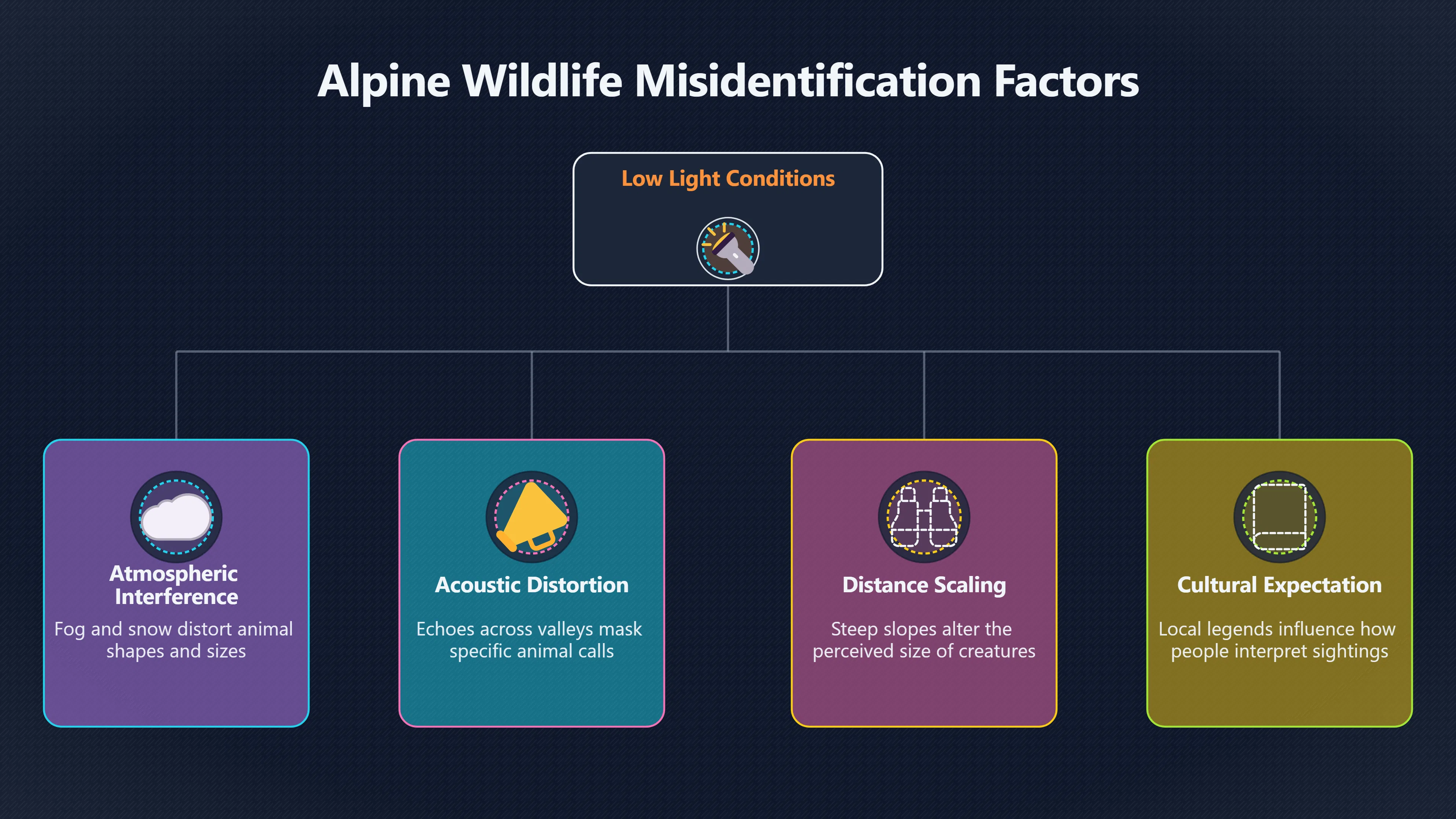
Mountain environments amplify these effects. Echoes distort sounds, steep slopes alter apparent size, and sudden weather changes reduce visibility. The same landscape that makes Liechtenstein attractive to hikers and nature enthusiasts also creates ideal conditions for memorable misunderstandings.[Alpenwild]alpenwild.comAlps Wildlife | Wildlife Tours | Swiss AnimalsThe Swiss Alps feature many animals which can be easily spotted on mountain hikes…
At the same time, folklore gives those experiences meaning. A strange sight in an anonymous landscape may be forgotten. A strange sight in a place already associated with wild men, dragons or mountain spirits becomes a story worth retelling.

Why the Wildlife Explanation Matters
The strongest lesson from Liechtenstein’s monster traditions is not that every mystery has a simple answer. It is that folklore and ecology often work together.
Real animals provide the sights, sounds and surprises. The landscape supplies atmosphere. Local traditions provide interpretation. Over generations, those elements blend into legends that feel larger than any single encounter.
Today, wolves and lynx are documented realities in the region, while chamois, ibex and deer remain among the most recognisable animals of the Alpine world. Understanding their behaviour helps explain how unusual sightings arise. It also reveals why a small mountain country with few modern cryptid reports still possesses a rich tradition of strange creatures and wild mountain beings. The legends may not describe unknown species, but they remain rooted in the genuine experience of sharing rugged Alpine terrain with remarkable wildlife.[llv.li]llv.liLiechtenstein National Administration WolfLiechtenstein National AdministrationWolf - Liechtenstein National AdministrationDue to confirmed evidence of wolves and lynx in Liechten…
Amazon book picks
Further Reading
Books and field guides related to Could Real Animals Explain the Legends?. Use these as the next step if you want deeper reading beyond the article.
Abominable Science!
Explores misidentification and natural explanations behind monster claims.
The World of Lore: Monstrous Creatures
Shows how folklore grows around unusual animal encounters.
The Secret History of Bigfoot
Illustrates how sightings and stories evolve into creature legends.
eBay marketplace picks
Marketplace Samples
Live-tested eBay searches with available results related to this page.


Endnotes
1.
Source: kora.ch
Link:https://www.kora.ch/en/species/wolf/distribution
Source snippet
DistributionThe monitoring of wolves in Switzerland and Liechtenstein is an ongoing process, in which the situation of the packs is regul...
2.
Source: Wikipedia
Link:https://en.wikipedia.org/wiki/Chamois
3.
Source: alpenwild.com
Link:https://www.alpenwild.com/staticpage/wildlife-in-the-alps/
Source snippet
Alps Wildlife | Wildlife Tours | Swiss AnimalsThe Swiss Alps feature many animals which can be easily spotted on mountain hikes...
4.
Source: wilderness-society.org
Title: first ever wolf visits liechtenstein
Link:https://wilderness-society.org/first-ever-wolf-visits-liechtenstein/
Source snippet
European Wilderness SocietyFirst ever wolf visits LiechtensteinJanuary 11, 2019 — 11 Jan 2019 — The first official records now prove the...
Published: January 11, 2019
5.
Source: Wikipedia
Title: Eurasian lynx
Link:https://en.wikipedia.org/wiki/Eurasian_lynx
6.
Source: llv.li
Title: Liechtenstein National Administration Wolf
Link:https://www.llv.li/en/individuals/recreational-environmental-and-animal-management/hunt-and-wildlife/wolf
Source snippet
Liechtenstein National AdministrationWolf - Liechtenstein National AdministrationDue to confirmed evidence of wolves and lynx in Liechten...
7.
Source: en.tourismus.li
Link:https://en.tourismus.li/entdecken/sommer-herbst/familien/tierische-erlebnisse.html
Source snippet
Visit LiechtensteinAnimal experiences in LiechtensteinDiscover the animal diversity in Liechtenstein: ibexes, marmots, llamas and more aw...
8.
Source: houseofswitzerland.org
Title: typical fauna swiss mountains
Link:https://houseofswitzerland.org/swissstories/environment/typical-fauna-swiss-mountains
Source snippet
Typical fauna from the Swiss mountains26 May 2021 — The marmot, the bearded vulture, the lynx, the wolf and the ibex are five creatures t...
Published: May 2021
9.
Source: wwf.panda.org
Title: wwf news
Link:https://wwf.panda.org/wwf_news/?82460%2FLooking-for-lynx-in-the-Swiss-Alps=
Source snippet
Adults weigh between 15–28kg, and the...Read more...
Additional References
10.
Source: animalia.bio
Link:https://animalia.bio/liechtenstein-animals/1000
Source snippet
Animals of LiechtensteinIt is Europe's third-largest predator after Brown bears and wolves and is the biggest of the species of lynx. The...
11.
Source: a-z-animals.com
Link:https://a-z-animals.com/animals/location/europe/liechtenstein/
Source snippet
LiechtensteinLiechtenstein sits within the broader Alpine recovery zone for large carnivores (notably wolf and lynx), so occasional occur...
12.
Source: wildbeimwild.com
Link:https://wildbeimwild.com/liechtenstein-wolf-nachgewiesen/
Source snippet
Liechtenstein: Wolf nachgewiesenLichtenstein: Im Fürstentum Liechtenstein ist der zweite Nachweis über die Anwesenheit eines Wolfes gelun...
13.
Source: wildbeimwild.com
Link:https://wildbeimwild.com/en/how-is-the-symbol-animal-of-the-alps-doing/
Source snippet
What is the state of the Alps' symbolic animal?The ibex, symbol of the Alps, faces new challenges. Climate change and hobby hunting are i...
14.
Source: nlwkn.niedersachsen.de
Link:https://www.nlwkn.niedersachsen.de/download/117526/Flyer_The_wolf_has_returned_to_Lower_Saxony_.pdf
Source snippet
Wolf Has Returned to Lower SaxonyWatch the wolf and keep a respectful distance - just like you would with other wild animals. Should you...
15.
Source: swisscommunity.org
Title: Swiss Review: The quartet of predators is complete again Wolves form first pack
Link:https://www.swisscommunity.org/en/news-media/swiss-revue/article/the-quartet-of-predators-is-complete-again
Source snippet
The first to return was the lynx. It did not come voluntarily but was instead brought back. Lynx were relocated in 1971 and have since...
16.
Source: landesspiegel.li
Link:https://landesspiegel.li/2026/05/wolf-in-liechtenstein-experten-erklaeren-situation-verhalten-und-management/
Source snippet
Wolf in Liechtenstein: Experten erklären Situation...11 May 2026 — Auf zehn Aufnahmen sind zwei Wölfe gleichzeitig zu sehen...
Published: May 2026
17.
Source: tierwelt.ch
Title: dritter nachweis eines wolfes in liechtenstein 405284
Link:https://www.tierwelt.ch/artikel/wildtiere/dritter-nachweis-eines-wolfes-in-liechtenstein-405284
Source snippet
Dritter Nachweis eines Wolfes in Liechtenstein30 Dec 2020 — In der Nacht vom 29. auf den 30. Dezember 2020 wurde ein Wolf in Liechtenstei...
18.
Source: florafaunafun.com
Link:https://florafaunafun.com/animals-of-liechtenstein/
Source snippet
Animals of Liechtenstein: The Complete List7 Dec 2025 — There are 40 Animals of Liechtenstein, ranging from Adder to Wild boar...
19.
Source: facebook.com
Link:https://www.facebook.com/savethealps/posts/liechtenstein-/938013735646057/
Source snippet
Liechtenstein 🐺 [https://www.finanznachrichten.de...However](https://www.finanznachrichten.de...However), the government cannot confirm whether the wolf is still in Luxembourg...
Topic Tree