Why Sweden's Lake Monster Legend Still Survives
Sweden’s mystery-animal tradition is dominated by one creature: the supposed monster of Lake Storsjön in Jämtland.
Page outline Jump by section
Introduction
That imbalance matters. Sweden has a rich folklore of forest spirits, water beings, trolls and shape-shifting animals, but these are usually traditional supernatural characters rather than creatures repeatedly reported as unidentified wildlife. The country therefore offers less of a cryptid catalogue than a revealing case study: one local lake legend has survived modern zoology, newspaper culture, official intervention, cameras, tourism and scepticism without becoming either proven fact or forgotten folklore.[Visit Sweden]visitsweden.comOpen source on visitsweden.com.
Sweden’s defining monster
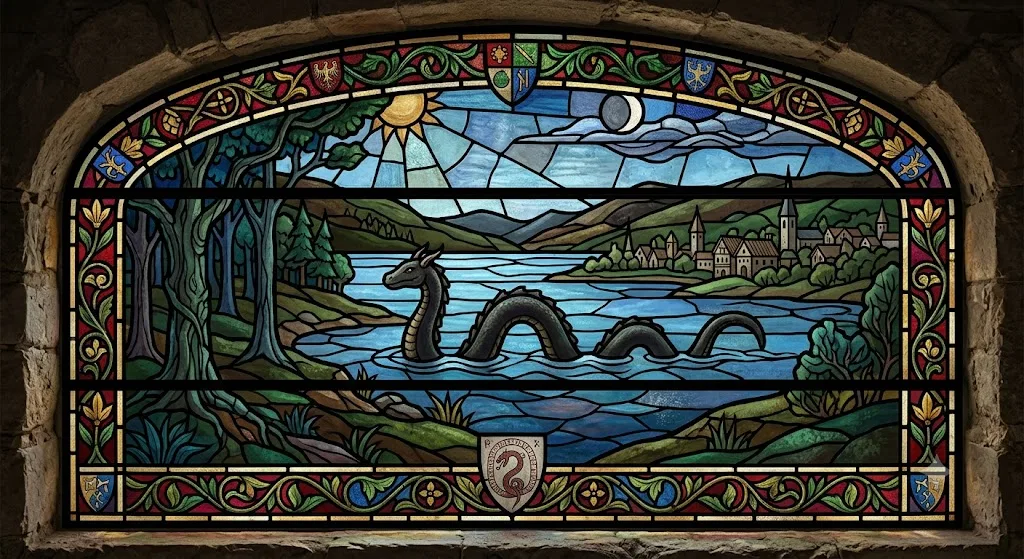
Lake Storsjön lies beside Östersund in the province of Jämtland. Its size, long shoreline, islands, changing weather and broad stretches of open water provide the kind of landscape in which distant animals, wakes and floating objects can be difficult to judge. The claimed inhabitant is commonly presented as a serpentine or many-humped creature, sometimes with ears, fins or a small mammal-like head. Descriptions vary enough that they do not form a dependable zoological profile.[Visit Östersund]visitostersund.seOpen source on visitostersund.se.
The earliest written tradition dates to 1635. In the best-known legend, a monstrous water serpent was magically bound beneath or within the lake through the power associated with the Frösö runestone. Another tale says that two trolls created a black, snake-bodied creature with a cat-like head while brewing beside the water. These are origin myths, not early biological field reports: the creature belongs to a world of spells, dangerous waters and beings attached to particular features of the landscape.[Wikipedia]WikipediaOpen source on wikipedia.org.
The runestone connection is especially revealing. The real Frösö stone bears a large serpent design, but its inscription concerns the Christianisation of Jämtland and the building of a bridge; it does not identify the carving as a lake monster. The later legend effectively recruited an existing monument into the story, giving the creature an ancient-looking physical anchor.[Visit Östersund]visitostersund.seVisit ÖstersundFrösö Runestone - The World's northernmostFurthermore, the serpent depicted on it, biting its own tail, is according to le…
By the nineteenth century, reports were increasingly framed as eyewitness observations rather than magical encounters. People described moving humps, elongated bodies, unusual wakes and dark heads above the surface. A reported 1857 sighting by workers near a lakeside ironworks became one of the early newspaper-era cases. In 1899, local naturalist Peter Olsson published a collection of 22 testimonies and suggested that an unknown aquatic mammal might explain them. The monster had crossed from folklore into the language of natural history.[Wikipedia]WikipediaOpen source on wikipedia.org.
Where reports cluster
Claims are distributed around Lake Storsjön rather than confined to one supposed lair. Modern visitor information identifies lookout points around Frösön, Vallsundet, Rödön, Trångsviken, Hackås and central Östersund. These are also places where roads, bridges, harbours, ferries and accessible shorelines give people long views across the water.[Visit Östersund]visitostersund.seOpen source on visitostersund.se.
Many sightings are said to occur in calm summer weather. That may sound favourable to observation, but smooth water can also make perspective deceptive. A line of swimming birds, an otter moving low in the water, a partially submerged branch or a boat wake continuing after the boat has passed can appear unusually distinct against an otherwise flat surface. Distance removes familiar scale cues, making a small object nearby and a large object farther away difficult to distinguish.
The reported creature also changes with the viewing conditions. Witnesses sometimes see only humps, sometimes a head and neck, and sometimes a long disturbance beneath the surface. Such fragments can be compelling to the observer without revealing what produced them. A cryptid account often begins not with a clearly viewed animal but with an object that behaved differently from what the witness expected.
Local promoters put the total at roughly 500 witnesses over the life of the tradition, although historical totals vary between sources and depend on what counts as a separate or adequately recorded sighting. This number shows that the story has generated a substantial testimony archive. It does not show that all witnesses observed the same type of animal.[Visit Östersund]visitostersund.seOpen source on visitostersund.se.

The hunt moves from harpoons to cameras
The most theatrical attempt to settle the question came during the surge of interest in the 1890s. Local enthusiasts formed an enterprise to capture the creature, constructed a large trap and reportedly attracted support from King Oscar II. Nothing identifiable was caught, but the surviving trap became part of the legend’s material history and is now associated with Jamtli, the regional museum in Östersund.[Wikipedia]WikipediaOpen source on wikipedia.org.
This episode marked an important change. The monster was no longer merely something encountered by chance; it became an object of organised search. Yet a capture campaign built around bait, hooks and waiting observers could test only a limited assumption — that the creature was a large, feeding animal that would approach the equipment. Failure neither proved nor disproved every version of the story, which helped the legend remain flexible.
Technology later replaced the trap. In 2008, an association operating surveillance cameras announced that it had filmed a living, serpent-like object underwater. Six cameras had been installed, including submerged equipment, and the organisers argued that a heat-sensitive system indicated biological activity. Contemporary reporting also noted that the project was intended to stimulate business around the lake.[ABC News]abc.net.auABC News Swedish 'Nessie' possibly caught on filmABC NewsSwedish 'Nessie' possibly caught on film - ABC News…
The footage did not establish a new species. It showed movement in murky water without providing the anatomical detail needed to identify the object, determine its scale or exclude ordinary animals. Claims that a camera recorded something alive are much weaker than evidence that it recorded an unknown animal. The case illustrates a recurring problem in monster investigations: improved equipment can produce more imagery without producing decisive identification.
No published programme has delivered the standard evidence zoologists would require for a large resident vertebrate — a specimen, diagnostic tissue, unambiguous close-range imagery, repeatable sonar traces or environmental DNA that cannot be assigned to known species. A 2024 Lund University study consequently describes the creature as scientifically unvalidated while examining its continuing cultural and environmental meaning.[Lund University Publications]lup.lub.lu.send University PublicationsStorsjöodjuret i ett kalejdoskop. Humanekologiska perspektiv på en svensk kryptid. | Lund University Publicat…
What witnesses may be seeing
There is unlikely to be one explanation for every report. Lake-monster traditions collect observations made by different people, in different weather, across decades or centuries. Several ordinary causes can therefore contribute to the same legend.
Swimming mammals are strong candidates for some low, fast-moving shapes. Otters can expose a small head and portions of the back while producing a surprisingly long wake. Several animals travelling in line may resemble one creature with multiple humps. A dog or deer crossing the water can also look unfamiliar when only its head and upper back are visible.
Birds and fish can generate sudden disturbances or repeated dark points on the surface. Lines of waterbirds may appear joined at long range, while large fish can roll or break the surface without revealing enough of their bodies for identification. An observer who sees only the aftermath may infer something much larger beneath the water.
Logs, vegetation and wakes can appear animate. Waterlogged timber may rise unevenly, rotate or be driven against currents by wind. Intersecting wakes can produce a series of travelling humps. The effect is particularly convincing when the boat responsible is no longer visible.
Perspective and expectation complete the picture. A witness looking across open water generally lacks a reliable measure of distance. Once Lake Storsjön’s monster is part of local knowledge, an unexplained shape is more likely to be interpreted through that story than as a generic object. This does not mean witnesses are dishonest. It means perception is an act of interpretation, especially when the view is brief or incomplete.
Hoaxes are possible, but they are not required to explain the tradition. A legend can persist through sincere mistakes, retellings, selective memory, publicity and a small number of deliberately playful incidents. The evidence does not support treating every claim as fabricated, but neither does it support combining all claims into a single zoological case.

Folklore creature or undiscovered animal?
The most useful distinction is between the monster as a cultural being and the monster as a proposed species.
As folklore, it is exceptionally well documented. It has named origin stories, a link to a runestone, generations of witnesses, capture attempts, museum displays, children’s characters and recognised lookout sites. It helps people describe the lake as mysterious, alive and locally distinctive. Recent research treats the legend as a meeting point between landscape, community, nature and personal experience rather than merely asking whether a monster exists.[Lund University Publications]lup.lub.lu.send University PublicationsStorsjöodjuret i ett kalejdoskop. Humanekologiska perspektiv på en svensk kryptid. | Lund University Publicat…
As zoology, the case is weak. The accounts do not converge on stable anatomy; no breeding population has been demonstrated; and the most publicised images lack identifying detail. A large air-breathing animal living in the lake over many generations would be expected to leave clearer traces than intermittent shapes and wakes.
The story has nevertheless absorbed scientific language whenever it became culturally useful. Nineteenth-century witnesses discussed unknown mammals and sea serpents. Twentieth-century depictions increasingly resembled the long-necked prehistoric reptiles popularised in books and films. Later searches used infrared cameras and electronic monitoring. Each era restyled the creature using its own image of what an undiscovered animal ought to look like.[Lund University Publications]lup.lub.lu.send University PublicationsStorsjöodjuret i ett kalejdoskop. Humanekologiska perspektiv på en svensk kryptid. | Lund University Publicat…
That evolution is not evidence of a changing biological species. It is evidence of a responsive legend.
The monster that received legal protection
In 1986, Jämtland’s county authorities placed the supposed creature, its offspring and nesting place under a protection order. The measure was eventually revoked in 2005 after its legal basis was challenged. Academic discussion of the episode presents it partly as an exercise in institutional play: officials could honour an important local tradition without necessarily declaring that zoology had recognised a real species.[ResearchGate]researchgate.netLek som strategi i fridlysningen av Storsjöodjuret 1985–2005December 1, 2022 — In 1985 the County Administrative Board of Jäm…
This is sometimes retold as proof that Sweden officially accepted the monster’s existence. That overstates what happened. Legal or ceremonial protection can acknowledge cultural value, encourage responsible behaviour or generate publicity without settling a biological question. The episode is interesting precisely because it blurred those categories.
It also reflects a wider conservation issue. Researchers have argued that culturally powerful or magical animals can affect how communities understand real species and habitats. A legendary creature may draw attention to a lake, reinforce local attachment and provide a memorable symbol for environmental care, even when the animal itself is not scientifically recognised.[Cambridge University Press & Assessment]cambridge.orgOpen source on cambridge.org.
Beyond Lake Storsjön
Sweden’s wider folklore is crowded with beings linked to woods, streams and mountains. Water spirits may lure people into danger; forest beings can reward respectful behaviour or punish intrusion; trolls and hidden folk inhabit wild or marginal spaces. These stories reveal how earlier communities interpreted hazardous landscapes and proper conduct within them.[Visit Sweden]visitsweden.comOpen source on visitsweden.com.
They should not all be labelled cryptids. A traditional shape-shifting water spirit is not the same kind of claim as a witness reporting an unidentified animal. The first belongs primarily to mythology and belief; the second can at least be examined as an observation, even when the identification remains uncertain.
Occasional online lists attach additional Swedish lakes or vaguely named creatures to the cryptid tradition, but most lack the historical documentation, sustained press record or regional cultural presence of the Lake Storsjön monster. Reports of unusually large cats are also less anomalous in Sweden than in countries without native large felines: Eurasian lynx are established Swedish wildlife, and poor views can exaggerate their size or distort their proportions. A claimed “panther” would require much stronger evidence than a dark shape or distant photograph.
The Swedish coast also belongs to the broader Scandinavian sea-serpent tradition, shaped in part by influential early-modern maps and writings about northern waters. Olaus Magnus’s sixteenth-century imagery helped spread spectacular depictions of Nordic marine monsters across Europe. Those pictures are culturally important, but they combine travellers’ tales, inherited bestiaries and symbolic geography rather than serving as field guides to Swedish fauna.[The Public Domain Review]publicdomainreview.orgolaus magnus sea serpentolaus magnus sea serpent
From feared serpent to friendly mascot
The Lake Storsjön monster is no longer presented mainly as a threat. Östersund’s tourism material encourages visitors to watch from bridges, church ruins, harbours and lakeside paths. Jamtli displays the old capture trap and monster-related material, while a child-friendly version named Birger appears in books, sweets, toys and public events.[Visit Östersund]visitostersund.seOpen source on visitostersund.se.
This softening is typical of a successful local monster. A creature that once explained danger can become a symbol of welcome. The uncertain sighting remains part of the appeal, but the modern legend also supports family activities, place branding and regional identity. Even the search itself becomes tourism: the point is not necessarily to find a biological specimen, but to look at familiar scenery with heightened attention.
Commercial use does not make the original witnesses fraudulent. It does, however, create a system in which ambiguity has value. A conclusively identified log or otter has less promotional power than a creature that might still be moving beneath the surface. The legend thrives because it can be treated seriously, jokingly or affectionately according to the occasion.
What the Swedish evidence really shows
The evidence supports the existence of a durable Swedish monster tradition, not a confirmed unknown species. Lake Storsjön has produced folklore, newspaper testimony, organised hunts, disputed recordings and modern tourism, but none has supplied a diagnostic animal. The most economical explanation is a layered one: old water-serpent stories created a framework into which later sightings of wakes, wildlife and ambiguous objects could be fitted.
Its survival is therefore not a failure of science to catch a monster. It is a demonstration of how local stories adapt. The creature endured the shift from magic to natural history, from print to surveillance video and from fearful legend to family mascot. It remains associated with Sweden because the landscape, the witnesses and the community have repeatedly renewed it.
For readers seeking Sweden’s answer to the Loch Ness Monster, Lake Storsjön provides it. For readers asking whether Sweden has evidence of a surviving prehistoric reptile or another undiscovered giant animal, the answer is far less dramatic: no persuasive physical evidence has emerged. The mystery that remains is cultural — why this particular shape in the water became one of Jämtland’s most recognisable inhabitants, whether or not it was ever an animal at all.
Amazon book picks
Further Reading
Books and field guides related to Why Sweden's Lake Monster Legend Still Survives. Use these as the next step if you want deeper reading beyond the article.
The Hero with a Thousand Faces
Helps explain why lake-monster legends endure across generations.
eBay marketplace picks
Marketplace Samples
Live-tested eBay searches with available results related to this page.

Endnotes
1.
Source: Wikipedia
Link:https://en.wikipedia.org/wiki/Storsj%C3%B6odjuret
2.
Source: researchgate.net
Link:https://www.researchgate.net/publication/383741916_Lansstyrelsen_och_o-djuret_Lek_som_strategi_i_fridlysningen_av_Storsjoodjuret
Source snippet
Lek som strategi i fridlysningen av Storsjöodjuret 1985–2005December 1, 2022 — In 1985 the County Administrative Board of Jäm...
Published: December 1, 2022
3.
Source: cambridge.org
Link:https://www.cambridge.org/core/journals/oryx/article/fantastic-beasts-and-why-to-conserve-them-animals-magic-and-biodiversity-conservation/467899EEDA175A8C86D4C1CFF606973E
4.
Source: Wikipedia
Link:https://en.wikipedia.org/wiki/Jamtli
5.
Source: Wikipedia
Title: List of lake monsters
Link:https://en.wikipedia.org/wiki/List_of_lake_monsters
6.
Source: Wikipedia
Title: Phantom cat
Link:https://en.wikipedia.org/wiki/Phantom_cat
7.
Source: researchgate.net
Link:https://www.researchgate.net/publication/318660879_Fantastic_beasts_and_why_to_conserve_them_animals_magic_and_biodiversity_conservation
8.
Source: jamtli.com
Link:https://www.jamtli.com/en/discover/
9.
Source: lup.lub.lu.se
Link:https://lup.lub.lu.se/record/ac9fc8cc-20ec-4bcb-94cf-60bf020d45c8
Source snippet
nd University PublicationsStorsjöodjuret i ett kalejdoskop. Humanekologiska perspektiv på en svensk kryptid. | Lund University Publicat...
10.
Source: visitostersund.se
Link:https://visitostersund.se/en/storsjoodjuret-the-great-lake-monster/
11.
Source: visitsweden.com
Link:https://visitsweden.com/what-to-do/culture-history-and-art/culture/mythological-creatures/
12.
Source: abc.net.au
Title: ABC News Swedish ‘Nessie’ possibly caught on film
Link:https://www.abc.net.au/news/2008-08-30/swedish-nessie-possibly-caught-on-film/494146
Source snippet
ABC NewsSwedish 'Nessie' possibly caught on film - ABC News...
13.
Source: visitostersund.se
Link:https://visitostersund.se/en/froso-runestone-the-worlds-northernmost/
Source snippet
Visit ÖstersundFrösö Runestone - The World's northernmostFurthermore, the serpent depicted on it, biting its own tail, is according to le...
14.
Source: journal.fi
Link:https://journal.fi/budkavlen/article/view/162364
Source snippet
Att fånga det som kanske inte finns?by S Händén-Svensson · 2025 — In 1986, the County Administrative Board of Jämtland enacted a controve...
15.
Source: publicdomainreview.org
Title: olaus magnus sea serpent
Link:https://publicdomainreview.org/essay/olaus-magnus-sea-serpent
16.
Source: visitostersund.se
Title: Sommarbroschyr 2025 28 sid EN webb
Link:https://visitostersund.se/wp-content/uploads/2025/04/Sommarbroschyr-2025_28-sid_EN_webb.pdf
17.
Source: visitostersund.se
Link:https://visitostersund.se/en/art-exhibitions/
18.
Source: visitostersund.se
Title: Sommarbroschyr 2026 32 sid EN webb
Link:https://visitostersund.se/wp-content/uploads/2026/04/Sommarbroschyr-2026_32-sid_EN_webb.pdf
19.
Source: visitostersund.se
Link:https://visitostersund.se/st-olavsleden-ostersund/
20.
Source: visitostersund.se
Link:https://visitostersund.se/
21.
Source: visitostersund.se
Link:https://visitostersund.se/en/outdoor-restaurants/
22.
Source: visitostersund.se
Title: Fotbollsfesten Östersund
Link:https://visitostersund.se/evenemang/c-barn-familj-or-litteratur-film-or-marknad-loppis-or-musik-konsert-or-stand-up-humor/?refcur=NOK
23.
Source: visitostersund.se
Title: Welcome to another land
Link:https://visitostersund.se/en/welcome-to-another-land-jamtli-historyland/
24.
Source: youtube.com
Link:https://www.youtube.com/watch?v=fye8GjUZDg0
25.
Source: roughguides.com
Link:https://www.roughguides.com/sweden/central-sweden/jamtland/
Additional References
26.
Source: youtube.com
Link:https://www.youtube.com/watch?v=jxS4Yng6log
Source snippet
The TERRIFYING Lake Monster of Sweden That No One Can Explain...
27.
Source: youtube.com
Title: The TERRIFYING Lake Monster of Sweden That No One Can Explain
Link:https://www.youtube.com/watch?v=kN6GqW1OVZI
Source snippet
The Mystery of Sweden's Great Lake Monster - Storsjöodjuret Explained...
28.
Source: instagram.com
Link:https://www.instagram.com/reel/DQfA5xmlD4q/
29.
Source: facebook.com
Link:https://www.facebook.com/TheUnXplainedZone/posts/a-mysterious-creature-in-norway-may-be-connected-to-scotlands-loch-ness-monster-/1314736234189139/
30.
Source: instagram.com
Link:https://www.instagram.com/p/DZmnHnijsEq/
31.
Source: facebook.com
Link:https://www.facebook.com/DailyHighlightmagazine/posts/after-52-years-of-dedicated-research-adrian-shinethe-worlds-leading-loch-ness-mo/900031869220154/
32.
Source: statskontoret.se
Link:https://www.statskontoret.se/contentassets/40d2369b8ddb45468a75ad870115d7b1/vardegrund_eng_tillg.pdf?v=8de5cc4dcbe6600
33.
Source: facebook.com
Link:https://www.facebook.com/100063703086121/posts/big-cat-sightings-revealed-in-the-welsh-countryside-after-official-documents-lea/1610880871045334/
34.
Source: reddit.com
Link:https://www.reddit.com/r/cryptids/comments/uzne76/cryptids_in_the_nordic_countries/
35.
Source: facebook.com
Link:https://www.facebook.com/groups/threestarvagabond/posts/1398493011233829/
Topic Tree
Follow this branch
Related pages 192
- Antigua Cryptids
- Maldives Monsters
- Malta Monsters
- Qatar Monsters
- Argentina Monsters
- +187 more in sidebar