Cryptids of Hungary's Wild Places
Hungary has a surprisingly modest modern cryptid scene. There is no nationally dominant lake monster on the scale of Scotland’s Nessie, and the strongest material sits in three overlapping zones: old creature folklore, a few modern mystery-beast reports, and real wildlife that can make odd sightings feel plausible.
Page outline Jump by section
Why Hungary’s monster map looks different
Hungary is landlocked, low-lying in much of the country, and shaped by the Danube, the Tisza, Lake Balaton and the northern hill country. That matters because monster traditions often follow habitat: deep lochs produce lake monsters; remote forests produce hairy wildmen; marshes and rivers produce lights, serpents and drowned spirits. Hungary has plenty of water and woodland, but it does not have a single remote, deep, cold-water monster stage that has become internationally famous. Lake Balaton, the country’s great inland water, is better known as Central Europe’s largest lake and a major holiday region than as a home for a named lake beast. Official tourism material emphasises its nearly 600 square kilometres of warm, shallow, family-friendly water, volcanic hills and visitor attractions rather than monster lore.[Visit Hungary]visithungary.comVisit Hungary BalatonVisit Hungary Balaton
That absence is useful. It shows that Hungary’s creature tradition is less about one famous animal and more about a spread of smaller claims and older supernatural categories. Folklore creatures such as the dragon and the nightmare spirit belong to a pre-modern world of storms, illness, household luck and dangerous night travel. Modern mystery animals, by contrast, tend to appear through video clips, local news, police concern, social media and the language of “escaped exotic pet” rather than sacred story. Hungary’s cryptid history is therefore a good example of how a country can have rich monster traditions without having one globally marketable monster.
The Mátranovák Treeskinner: Hungary’s internet-age Bigfoot
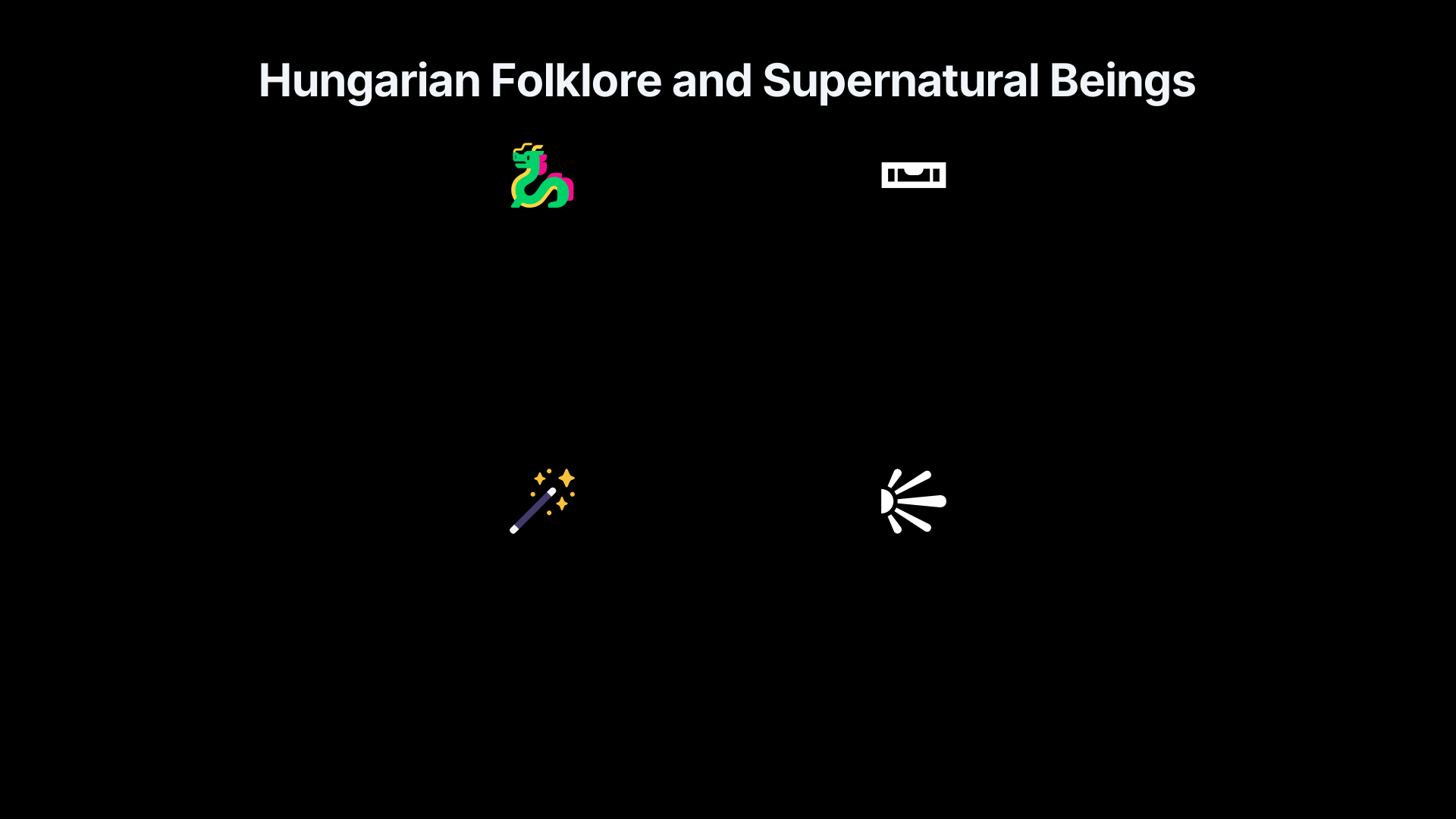
The creature most often presented as a Hungarian Bigfoot is the Mátranovák Treeskinner, also described in English as the Treetrembler and in Hungarian contexts as a local “tree-skinner” figure. The claim is centred on Mátranovák, a village in Nógrád County in northern Hungary, near the Mátra and other wooded uplands. Online cryptid summaries describe a thin, bipedal, pale or grey-white hairy creature, roughly human-sized or taller, with long limbs and a disturbing scream. The Pine Barrens Institute’s 2020 guest article, one of the more accessible English-language sources for the story, places it in the wider “European yeti” or “European Bigfoot” family and describes the animal as a shaggy, long-limbed hominid-like figure seen mostly around dusk, midnight or dawn.[THE PINE BARRENS INSTITUTE]pinebarrensinstitute.comTHE PINE BARRENS INSTITUTEhungary — Guest Articles — THE PINE BARRENS INSTITUTETHE PINE BARRENS INSTITUTEhungary — Guest Articles — THE PINE BARRENS INSTITUTE
The evidence is thin. The Treeskinner appears to be sustained mostly by local storytelling, hobby cryptozoology, social media pages, retellings and artwork rather than by a stable body of dated, primary witness reports. That does not make it worthless as folklore; it simply changes the question. Instead of asking “Has an unknown primate been proven in northern Hungary?”, the better question is “Why did this particular region become a believable stage for a Hungarian wildman?” The answer is partly environmental. Northern Hungary is where real large carnivores have returned most visibly, and where wooded, hilly terrain gives mystery stories room to breathe. WWF Hungary says wolves, lynx and brown bears were considered extinct by conservationists in Hungary until the 1980s, but have since begun returning, with the wolf, lynx and brown bear now recognised as Hungary’s three native large carnivore species.[WWF Magyarország]wwf.huMagyarország Large carnivoresMagyarország Large carnivores
That context does not explain the Treeskinner as a misidentified wolf or bear; the reported body shape does not neatly match either. It does explain why the north is such a good modern monster landscape. Once real predators are again crossing forests, leaving tracks, alarming livestock owners and entering public conversation, older fears and newer cryptid language have a stronger setting. The Treeskinner reads less like an established zoological mystery and more like a localised Hungarian version of the wider European wildman pattern: a forest-edge figure that borrows from Bigfoot, yeti, village rumour and local terrain.
The black panther flap: when a cryptid becomes an animal-control problem
Hungary’s strongest recent mystery-beast episode was not a ghostly forest man but a large black cat. In December 2021, Hungarian media reported that a black animal resembling a panther had been captured on camera near a construction site on the outskirts of Kiskunhalas in southern Hungary. Follow-up reports said many viewers and some commentators identified the animal as a black panther, and the explanation most often raised was not a hidden native species but an escaped or illegally kept exotic animal.[hungarytoday.hu]hungarytoday.huBlack Panther Seen in KiskunhalasBlack Panther Seen in Kiskunhalas
The story then took on the familiar rhythm of a phantom-cat flap. Further reports linked possible sightings to other places, including Kecskemét, while the animal remained elusive. This is exactly how “alien big cat” traditions often work: one piece of footage or one high-profile sighting becomes a temporary organising point for scattered reports, jokes, warnings and speculation. The difference between Hungary’s panther and a purely folkloric monster is that the escaped-pet explanation is genuinely plausible. Exotic cats can exist outside their natural range if privately kept, smuggled or escaped, and several European “panther” scares have followed that pattern.[hungarytoday.hu]hungarytoday.huOpen source on hungarytoday.hu.
The Kiskunhalas case is also a useful cautionary tale. A dark, cat-shaped animal on video can be real without proving a breeding population of panthers in Hungary. It might be a large domestic cat filmed in misleading scale, a melanistic exotic cat, a serval-like escapee, a hoax, or a genuine big cat whose origin is human rather than ecological. The cryptid value of the story lies in the uncertainty around what was filmed and where it went, not in any strong evidence that Hungary has an undiscovered native black panther.
Folklore creatures that shape the Hungarian monster imagination
Hungary’s older monster world is richer than its modern cryptid file. The Hungarian Ethnographic Lexicon, a major reference work on Hungarian folk culture, treats many beings not as “cryptids” in the modern animal sense but as supernatural figures embedded in belief, tale and custom. Its entry on the nightmare spirit describes it as one of the Hungarian folk-belief beings with the richest body of collected data, known in some form across the Hungarian-speaking area.[Hungarian Electronic Library]mek.oszk.huOpen source on oszk.hu.
The dragon is especially important because it straddles creature, weather and heroic story. The Hungarian Ethnographic Lexicon describes the dragon as a frequent, frightening human and supernatural being in Hungarian folk belief, legend and hero tales. In folk tradition, dragons are not just decorative reptiles. They are linked to storms, danger, treasure, combat and the testing of heroes. That makes them relevant to cryptid history because they show how Hungarians historically imagined powerful non-human beings in the sky, water and wild places long before modern “unknown animal” language arrived.[arcanum.com]arcanum.comOpen source on arcanum.com.
The storm-raising magician also matters. Hungarian folklore includes the wandering learned magician figure associated with storms and, in many popular retellings, dragon-riding. This does not produce a cryptid in the strict sense, because the central figure is a supernatural person rather than a mystery animal. But it helps explain why Hungarian monster tradition is so often weather-charged. A violent storm, a strange light, a damaged roof, a night scream or a sudden illness could be woven into a story-world of hostile beings and specialist magical actors rather than treated as an animal sighting.
Water monsters without a famous Hungarian Nessie
A reader coming to Hungary from Loch Ness or Lake Champlain may expect Lake Balaton to have a named monster. The evidence for that is weak. Balaton is vast by Central European standards, but it is shallow, warm and heavily used, with a tourism identity built around beaches, wine hills, sailing, cycling, family holidays and spas. Visit Hungary describes the lake as nearly 600 square kilometres, warming easily in summer and having a gradual depth attractive to bathers. That public identity leaves little room for the kind of deep, cold, mysterious-water narrative that helped make some lake monsters famous.[Visit Hungary]visithungary.comVisit Hungary BalatonVisit Hungary Balaton
Hungary’s more plausible “water monster” material is not a named plesiosaur-like beast but the ordinary strangeness of rivers and fish. The Danube and Tisza are major waterways, and Hungary has a long fishing tradition. FAO material on Hungarian fisheries notes roughly 70 fish species in Hungary, with many resident in the Danube and a substantial number in Lake Balaton. Large freshwater fish, especially wels catfish, can easily become monster-like in popular imagination because they are broad-headed, nocturnal, bottom-dwelling and capable of reaching impressive sizes in Europe.[FAOHome]fao.orgOpen source on fao.org.
This matters for sceptical interpretation. A huge catfish surfacing at night, a drifting log seen from a boat, a cormorant line, a wave pattern or a half-glimpsed animal in reeds can all become “something in the water” before it becomes a named monster. Hungary’s water lore therefore sits closer to river fear, fish exaggeration and supernatural belief than to a single modern lake-monster brand.
Real animals behind strange reports
Hungary’s actual wildlife does not confirm cryptids, but it gives many sightings a practical baseline. Wolves, lynx and brown bears are once again part of the Hungarian conservation conversation. WWF Hungary states that large carnivores have returned since the 1980s and that their reappearance has created public misconceptions and human-wildlife conflicts across Europe. The same source stresses coexistence measures such as dialogue, electric fences and guard dogs, which shows that these animals are not just symbols; they are real management issues.[WWF Magyarország]wwf.huMagyarország Large carnivoresMagyarország Large carnivores
The Eurasian lynx is particularly relevant to mystery-cat reports, although it is not a black panther. Lynx are secretive, spotted, short-tailed cats of forested country. A poor view of a lynx, wildcat, large domestic cat or dog in low light can easily distort size and shape. Wolves and bears can likewise become “unknown animals” when seen briefly by people not expecting them. In a country where conservationists once considered these predators locally gone, their return changes what witnesses think is possible.[WWF Magyarország]wwf.huMagyarország Large carnivoresMagyarország Large carnivores
There is also the escapee problem. The black panther episode shows that not every strange animal report belongs to folklore or misidentification. Some may involve illegally kept exotic animals, private collections, travelling animal businesses or pets released when they become inconvenient. That explanation is less romantic than a hidden species, but it is often more plausible than a breeding cryptid population.
How Hungarian legends change in modern media
Hungarian monster stories now move through several channels at once. Older beings survive through ethnographic collections, folk-tale publications, school culture, local memory and fantasy media. The Treeskinner circulates through cryptid wikis, blogs, hobby articles, YouTube discussions, social media pages and creature art. The black panther circulated through news sites, CCTV-style video, public warnings and speculation. Each channel changes the creature.
The shift is easiest to see with the Treeskinner. A local wildman story becomes more legible internationally when translated into Bigfoot terms: tall, hairy, bipedal, elusive, forest-dwelling. That framing helps English-speaking readers understand it quickly, but it may also flatten whatever local texture the story had. The creature becomes part of a global cryptid shelf rather than a specifically northern Hungarian rumour.[THE PINE BARRENS INSTITUTE]pinebarrensinstitute.comTHE PINE BARRENS INSTITUTEhungary — Guest Articles — THE PINE BARRENS INSTITUTETHE PINE BARRENS INSTITUTEhungary — Guest Articles — THE PINE BARRENS INSTITUTE
The panther story changes in the opposite direction. It begins as an apparently concrete animal report, then becomes folkloric through repetition. The more people discuss it without capture, carcass, DNA or clear close-up footage, the more it becomes a phantom animal: real enough to be searched for, vague enough to become a meme, and unresolved enough to be remembered as a “Hungarian panther” long after the original evidence has faded.

What is most credible, and what remains only a good story?
Hungary’s creature traditions are best sorted into four evidence categories.
Folklore with deep roots: Dragons, nightmare spirits and related beings are culturally important, but they are not evidence for unknown animals. Their value is historical and imaginative: they show how Hungarian communities explained storms, illness, fear, night pressure, household danger and wild places.[Hungarian Electronic Library]mek.oszk.huOpen source on oszk.hu.
Modern local cryptid lore: The Mátranovák Treeskinner is the clearest example. It is memorable, place-linked and visually distinctive, but public evidence is mostly secondary and hobbyist. It works better as a Hungarian wildman legend than as a zoological claim.[THE PINE BARRENS INSTITUTE]pinebarrensinstitute.comTHE PINE BARRENS INSTITUTEhungary — Guest Articles — THE PINE BARRENS INSTITUTETHE PINE BARRENS INSTITUTEhungary — Guest Articles — THE PINE BARRENS INSTITUTE
Mystery-animal flaps with plausible mundane causes: The black panther reports are stronger as animal-control mysteries than as cryptid evidence. The footage and public reaction make the case interesting, while the likely explanations include escaped exotic cat, misidentification or unresolved large-cat sighting rather than a native hidden species.[hungarytoday.hu]hungarytoday.huBlack Panther Seen in KiskunhalasBlack Panther Seen in Kiskunhalas
Real animals that feed the atmosphere: Wolves, lynx, bears, wildcats, boar and large fish can all make Hungary feel wilder than a casual visitor might expect. Their presence does not prove monsters, but it gives many strange reports a realistic starting point.[WWF Magyarország]wwf.huMagyarország Large carnivoresMagyarország Large carnivores
Hungary’s place in European cryptid culture
Hungary’s monster landscape is quieter than those of countries with famous lake monsters or long-running national phantom-cat archives, but that quietness is part of its character. The country sits in a Central European zone where folklore, Carpathian wildlife, river systems, rural memory and modern media overlap. Its creatures are often liminal: not fully animal, not fully ghost; not fully ancient, not fully invented; not fully local once the internet has translated them into global cryptid categories.
The most honest summary is that Hungary has few well-evidenced cryptids but many strong monster ingredients. It has a named modern wildman in the Mátranovák Treeskinner, a recent big-cat flap in the Kiskunhalas panther story, old supernatural beings with national folklore depth, and real returning predators that make the forests and hills feel less tame than they did a generation ago. For a reader interested in cryptids, Hungary is not a place to look for a confirmed hidden species. It is a place to watch how folklore, ecology and rumour keep making room for something seen briefly at the edge of the trees.
Amazon book picks
Further Reading
Books and field guides related to What Monsters Haunt Hungary's Wild Places?. Use these as the next step if you want deeper reading beyond the article.
The Element Encyclopedia of Magical Creatures
Relevant to Hungary's folklore creatures and monster traditions.
eBay marketplace picks
Marketplace Samples
Live-tested eBay searches with available results related to this page.

Endnotes
1.
Source: hungarytoday.hu
Title: Black Panther Seen in Kiskunhalas
Link:https://hungarytoday.hu/black-panther-kishunhalas-hungary-hungarian-hills-mountains-wild-big-cats-wildlife/
2.
Source: wwf.hu
Title: Magyarország Large carnivores
Link:https://wwf.hu/en/large-carnivores/
3.
Source: dailynewshungary.com
Title: attention a black panther is roaming the streets in hungary
Link:https://dailynewshungary.com/attention-a-black-panther-is-roaming-the-streets-in-hungary/
4.
Source: hungarytoday.hu
Link:https://hungarytoday.hu/black-panther-big-cats-in-hungary-hungarian-wildlife-wild-animals/
5.
Source: arcanum.com
Link:https://www.arcanum.com/hu/online-kiadvanyok/Lexikonok-magyar-neprajzi-lexikon-71DCC/s-739B6/sarkany-739E9/
6.
Source: fao.org
Link:https://www.fao.org/fishery/docs/CDrom/aquaculture/a0844t/docrep/009/T0377E/T0377E12.htm
7.
Source: police.hu
Link:https://www.police.hu/hu/koral/bejelento-urlap/eltunt-szemelyek/316691
8.
Source: ugyintezes.police.hu
Title: hu Közigazgatási bírság
Link:https://ugyintezes.police.hu/kozigazgatasi-birsag
9.
Source: police.hu
Link:https://www.police.hu/hu/koral/bejelento-urlap/eltunt-szemelyek/1001311
10.
Source: wwf.mg
Title: Everything You Ever Wanted to Know About Wolves
Link:https://www.wwf.mg/en/?364177%2FWWFHU-wolf-booklet=
11.
Source: hungarytoday.hu
Link:https://hungarytoday.hu/black-panther-in-danger-kishunhalas-hungary-wild-big-cats-wildlife/
12.
Source: hungarytoday.hu
Title: lake balaton still tops hungarys fishing rankings despite decline
Link:https://hungarytoday.hu/lake-balaton-still-tops-hungarys-fishing-rankings-despite-decline/
13.
Source: wels.net
Link:https://wels.net/serving-you/devotions/daily-devotions/
14.
Source: wels.net
Link:https://wels.net/
15.
Source: dailynewshungary.com
Title: mythical creatures hungarian culture
Link:https://dailynewshungary.com/mythical-creatures-hungarian-culture/
16.
Source: dailynewshungary.com
Title: wolf cub spotted in northeastern hungary video
Link:https://dailynewshungary.com/wolf-cub-spotted-in-northeastern-hungary-video/
17.
Source: youtube.com
Link:https://www.youtube.com/watch?v=YALjN8bL3wQ&vl=en
18.
Source: youtube.com
Link:https://www.youtube.com/shorts/bhJliZaTOEA
19.
Source: youtube.com
Title: The legend of the creature from Mátranovák00:00
Link:https://www.youtube.com/watch?v=ycNdNdQhdPE
20.
Source: youtube.com
Link:https://www.youtube.com/watch?v=KFqSPHbiP2s
21.
Source: youtube.com
Link:https://www.youtube.com/watch?v=hlSvgORZJ8I
22.
Source: youtube.com
Link:https://www.youtube.com/watch?v=m07YCaiJ9xw
23.
Source: youtube.com
Title: Balatonfüred, Hungary
Link:https://www.youtube.com/watch?v=xdvkLvLdrdU
24.
Source: youtube.com
Link:https://www.youtube.com/watch?v=qYT5N_zz3JY
25.
Source: youtube.com
Link:https://www.youtube.com/watch?v=9Xgl3GyNaNA
26.
Source: youtube.com
Link:https://www.youtube.com/watch?v=3cmjOy5n7aQ
27.
Source: youtube.com
Title: Lake Balaton’s 101
Link:https://www.youtube.com/watch?v=zOlyjxTmbBw
28.
Source: wwf.eu
Link:https://www.wwf.eu/?265311%2FRare-encounter-of-wolf-and-lynx-shows-return-of-wildlife-in-Europe=
29.
Source: arcanum.com
Link:https://www.arcanum.com/hu/online-kiadvanyok/Lexikonok-magyar-neprajzi-lexikon-71DCC/l-7316E/lidercfeny-73257/
30.
Source: arcanum.com
Link:https://www.arcanum.com/hu/online-kiadvanyok/Lexikonok-magyar-neprajzi-lexikon-71DCC/
31.
Source: wels.app
Link:https://wels.app/
33.
Source: youtube.com
Title: Liderc: Hungary’s Haunting Spirit of Fortune and Decay
Link:https://www.youtube.com/watch?v=nADpIEWESlI
Source snippet
Monsters and Mythical Creatures of Love and Lust...
34.
Source: youtube.com
Title: Monsters and Mythical Creatures of Love and Lust
Link:https://www.youtube.com/watch?v=9CqaxtBqaHY
Source snippet
3 Scariest Creatures in Hungary...
35.
Source: youtube.com
Title: 3 Scariest Creatures in Hungary
Link:https://www.youtube.com/watch?v=_sATu5WzA4s
Source snippet
The Legend of the Magical Deer...
36.
Source: youtube.com
Title: The Legend of the Magical Deer
Link:https://www.youtube.com/watch?v=vX0MVc0F4zY
37.
Source: pinebarrensinstitute.com
Title: THE PINE BARRENS INSTITUTEhungary — Guest Articles — THE PINE BARRENS INSTITUTE
Link:https://pinebarrensinstitute.com/guest-articles/tag/hungary
38.
Source: mek.oszk.hu
Link:https://mek.oszk.hu/02100/02115/html/3-1332.html
39.
Source: visithungary.com
Title: Visit Hungary Balaton
Link:https://visithungary.com/category/balaton
40.
Source: Wikipedia
Link:https://en.wikipedia.org/wiki/M%C3%A1tranov%C3%A1k
41.
Source: mek.oszk.hu
Title: Hungarian Electronic Library Magyar néprajzi lexikon
Link:https://mek.oszk.hu/02100/02115/
42.
Source: mek.oszk.hu
Link:https://mek.oszk.hu/02100/02115/html/5-578.html
43.
Source: Wikipedia
Title: Wels catfish
Link:https://en.wikipedia.org/wiki/Wels_catfish
44.
Source: cryptidz.fandom.com
Title: Lake Monsters
Link:https://cryptidz.fandom.com/wiki/Lake_Monsters
45.
Source: mek.oszk.hu
Link:https://mek.oszk.hu/02700/02790/html/176.html
46.
Source: mek.oszk.hu
Link:https://mek.oszk.hu/05100/05165/05165.pdf
47.
Source: mek.oszk.hu
Link:https://mek.oszk.hu/02100/02115/html/5-344.html
48.
Source: mek.oszk.hu
Link:https://mek.oszk.hu/07700/07707/07707.pdf
49.
Source: mek.oszk.hu
Link:https://mek.oszk.hu/20000/20077/20077.pdf
50.
Source: mek.oszk.hu
Link:https://mek.oszk.hu/11000/11060/11060.pdf
51.
Source: mek.oszk.hu
Link:https://mek.oszk.hu/14400/14442/14442.pdf
52.
Source: mek.oszk.hu
Link:https://mek.oszk.hu/13700/13713/13713.pdf
53.
Source: mek.oszk.hu
Link:https://mek.oszk.hu/02100/02115/html/index.html
54.
Source: mek.oszk.hu
Link:https://mek.oszk.hu/02100/02115/html/3-1334.html
55.
Source: mek.oszk.hu
Title: hupirituszpirics · TARTALOM · piritty. piritusz. → lidérc.Read more
Link:https://mek.oszk.hu/02100/02115/html/4-639.html
56.
Source: mek.oszk.hu
Title: hu Magyar Elektronikus Könyvtár
Link:https://mek.oszk.hu/
57.
Source: mek.oszk.hu
Title: hu Magyar néprajz
Link:https://mek.oszk.hu/02100/02152/
58.
Source: mek.oszk.hu
Link:https://mek.oszk.hu/00300/00355/html/
59.
Source: Wikipedia
Link:https://en.wikipedia.org/wiki/Hungary
60.
Source: Wikipedia
Link:https://hu.wikipedia.org/wiki/M%C3%A1tranov%C3%A1k
61.
Source: Wikipedia
Link:https://en.wikipedia.org/wiki/Lake
62.
Source: Wikipedia
Title: Lake Balaton
Link:https://en.wikipedia.org/wiki/Lake_Balaton
63.
Source: wwf.panda.org
Title: large carnivores
Link:https://wwf.panda.org/discover/knowledge_hub/where_we_work/black_sea_basin/danube_carpathian/our_solutions/large_carnivores
64.
Source: kids.nationalgeographic.com
Link:https://kids.nationalgeographic.com/geography/countries/article/Hungary
65.
Source: ebsco.com
Link:https://www.ebsco.com/research-starters/geography-and-cartography/hungary
66.
Source: pinebarrensinstitute.com
Title: guest articles
Link:https://pinebarrensinstitute.com/guest-articles
67.
Source: geofactbook.com
Link:https://geofactbook.com/countries/hungary
68.
Source: store.steampowered.com
Link:https://store.steampowered.com/app/1118240/Lake/
69.
Source: fieldsupport.dliflc.edu
Link:https://fieldsupport.dliflc.edu/products/cip/hungary/website/hungary.pdf
70.
Source: 2017-2021.state.gov
Link:https://2017-2021.state.gov/countries-areas/hungary/
71.
Source: visithungary.com
Link:https://visithungary.com/
72.
Source: fishtime.eu
Link:https://fishtime.eu/location/hungary/
73.
Source: dictionary.cambridge.org
Link:https://dictionary.cambridge.org/dictionary/english/lake
Additional References
74.
Source: instagram.com
Link:https://www.instagram.com/p/CfZL1m_FJyr/
75.
Source: academia.edu
Link:https://www.academia.edu/116195552/The_Hungarian_t%C3%A1ltos_and_the_shamanism_of_pagan_Hungarians_Questions_and_hypotheses
76.
Source: researchgate.net
Link:https://www.researchgate.net/publication/328115934_The_Hungarian_taltos_and_the_shamanism_of_pagan_Hungarians_Questions_and_hypotheses
77.
Source: researchgate.net
Link:https://www.researchgate.net/publication/325340453_Taltos_Witch_Incubus_Succubus_and_Other_Beings_in_Hungarian_Folklore_and_Mythology
78.
Source: hungarian-geography.hu
Link:https://hungarian-geography.hu/inmaps/pdf/Hungary-in-Maps_51.pdf
79.
Source: mywanderlust.pl
Link:https://www.mywanderlust.pl/visit-lake-balaton-hungary/
80.
Source: facebook.com
Link:https://www.facebook.com/timesofmalta/videos/a-large-feline-believed-by-activists-to-be-a-black-panther-was-caught-on-cctv-fa/1267741818882562/
81.
Source: facebook.com
Link:https://www.facebook.com/timesofmalta/videos/a-large-feline-believed-by-activists-to-be-a-black-panther-was-caught-on-cctv-fa/802798362862388/
82.
Source: instagram.com
Link:https://www.instagram.com/reel/DU8sGz5k0ee/
83.
Source: wildlifeworldwide.com
Link:https://www.wildlifeworldwide.com/locations/aggtelek-national-park
Topic Tree
Follow this branch
Related pages 192
- Antigua Cryptids
- Maldives Monsters
- Malta Monsters
- Qatar Monsters
- Argentina Monsters
- +187 more in sidebar