Within Yemen Cryptids
When Yemen's Monsters Turn Out to Be Real
The Yemen monitor shows how a real overlooked species can inspire mystery while rare predators fuel exaggerated reports.
On this page
- How the Yemen monitor was recognised from television
- Rare leopards, hyenas and lizards behind strange reports
- How zoologists separate discoveries from cryptid claims
Page outline Jump by section
Introduction
Yemen’s most instructive mystery-animal story is not about an undiscovered monster at all. It is about a real reptile that was hiding in plain sight. The Yemen monitor (Varanus yemenensis) entered scientific literature in the late 1980s after a zoologist noticed an unfamiliar monitor lizard in television footage filmed in Yemen. What looked like a cryptozoological tale turned out to be a genuine species that had been overlooked by science for decades.[Wikipedia]WikipediaYemen monitorYemen monitor
That story matters because it demonstrates the difference between a legitimate zoological discovery and a mystery-animal claim. Yemen also contains rare wildlife—including Arabian leopards, striped hyenas and large reptiles—that can generate exaggerated reports when sightings are brief, unexpected or filtered through local storytelling. In a country where some animals are genuinely elusive, separating discovery from misidentification becomes especially important.
How the Yemen monitor was recognised from television
The Yemen monitor is a large monitor lizard found in Yemen and neighbouring parts of south-western Saudi Arabia. Today it is an accepted species, but its path to recognition was unusually dramatic.[Wikipedia]WikipediaYemen monitorYemen monitor
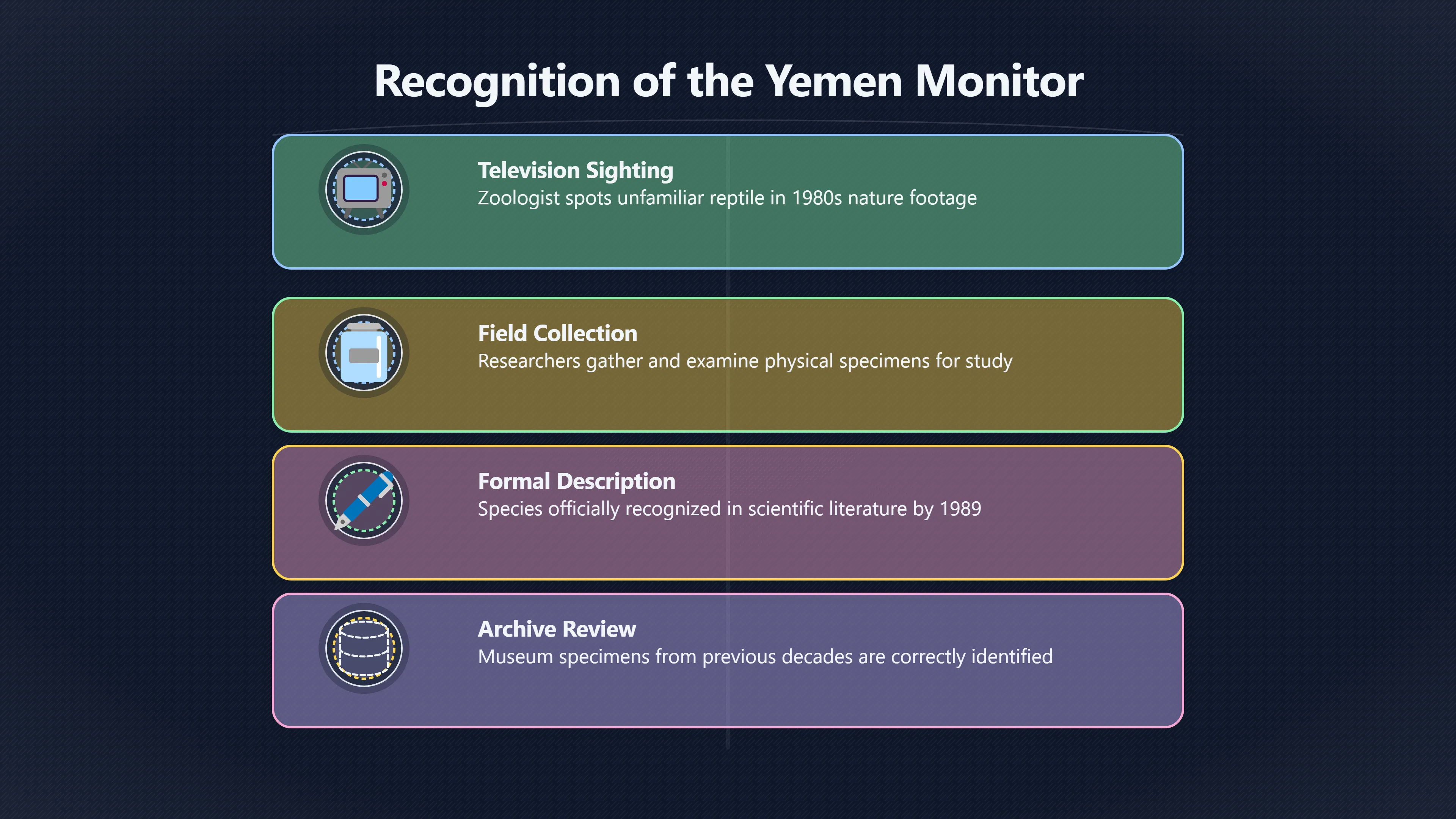
According to accounts from herpetologists who studied the animal, German zoologist Wolfgang Böhme spotted an unfamiliar monitor lizard while watching a television nature documentary filmed in Yemen during the mid-1980s. The reptile looked different from known African and Arabian monitor species. Further investigation followed, and within a few years specimens had been collected and examined scientifically. The species was formally described in 1989 and became known as the Yemen monitor. Because of its unusual origin story, researchers sometimes jokingly referred to it as the “TV monitor”.[wikipedia.org]WikipediaYemen monitorYemen monitor
The discovery became even more remarkable when researchers realised that museum specimens collected decades earlier had effectively been dismissed. Examples held in collections since the late nineteenth and early twentieth centuries had often been assumed to be incorrectly labelled African animals rather than evidence of a distinct Arabian species.[Wikipedia]WikipediaYemen monitorYemen monitor
For anyone interested in mystery animals, the lesson is striking: sometimes a seemingly unknown creature is real, but proving that requires specimens, taxonomy, peer review and comparison with existing collections rather than eyewitness stories alone.
Why the Yemen monitor looked mysterious
Part of the reason the species remained overlooked is that monitor lizards are not animals most people expect to encounter in Arabia.
The Yemen monitor can exceed a metre in length, has a powerful body, strong claws and a long tail. When seen briefly, especially by people unfamiliar with large lizards, it can appear surprisingly dragon-like. Its preferred habitat includes rocky terrain, dry river valleys and foothills where human encounters may be infrequent.[Wikipedia]WikipediaYemen monitorYemen monitor
Large reptiles often attract embellishment in folklore. A metre-long lizard glimpsed at a distance can become a giant reptile in retelling, particularly when the witness only sees movement, a tail disappearing into vegetation or an animal climbing among rocks. The Yemen monitor therefore occupies an interesting position in Yemen’s mystery-animal landscape: it was genuinely under-recognised, yet its eventual identification reduced rather than expanded the realm of the unknown.[Wikipedia]WikipediaYemen monitorYemen monitor
Rare predators behind many “monster” reports
While the Yemen monitor represents a real discovery, many reports of strange beasts in Yemen are more likely linked to rare but known animals.
Arabian leopards
The Arabian leopard is among the rarest big cats on Earth. Historically it occupied mountain regions across Yemen, but populations declined dramatically through hunting, habitat loss and prey depletion. By the late twentieth century it had become extremely scarce.[Wikipedia]WikipediaArabian leopardArabian leopard
Scarcity creates mystery. When very few people see an animal, sightings become difficult to verify and descriptions often grow more dramatic. A fleeting encounter with a leopard at dawn or dusk can easily evolve into stories of an unknown predator, especially in remote areas where photographic evidence is absent.
Because the species is so rare, even genuine leopard observations may initially sound implausible to outsiders. This is one reason zoologists treat reports carefully rather than automatically classifying them as evidence for unknown animals.[Wikipedia]WikipediaArabian leopardArabian leopard
Striped hyenas
The striped hyena is another animal capable of generating unusual stories. Yemen remains within its range, although sightings are uncommon.[Wikipedia]WikipediaList of mammals of YemenList of mammals of Yemen
Hyenas can look startling under poor lighting. Their sloping backs, shaggy manes and distinctive gait create silhouettes unlike those of dogs or wolves. At night, a witness may struggle to identify what they have seen. Across the Middle East and North Africa, hyenas have often accumulated folklore associations that exaggerate their size, intelligence or behaviour.
Large reptiles
Not every alarming reptile report requires an unknown species. Yemen already possesses substantial reptiles, including the Yemen monitor and several snake species. In landscapes where encounters are infrequent, estimates of length and size are notoriously unreliable.[Wikipedia]WikipediaYemen monitorYemen monitor
A startled observer may genuinely believe a snake was twice its actual length or that a lizard was far larger than it really was. Such errors are common in wildlife reporting worldwide and provide a straightforward explanation for many giant-reptile stories.
How zoologists separate discoveries from cryptid claims
The Yemen monitor is often cited as an example of an animal that was once unknown to science, but its discovery also highlights why most mystery-animal reports do not become recognised species.
Researchers look for several forms of evidence:
- Physical specimens or remains.
- Clear photographs or video showing diagnostic features.
- Repeated observations from identifiable locations.
- Genetic evidence.
- Consistency with known ecology and geography.
- Independent verification by specialists.
The Yemen monitor eventually met these standards. Scientists obtained specimens, compared them with related monitor lizards and formally described the species in scientific literature.[wikipedia.org]WikipediaYemen monitorYemen monitor
Most cryptid claims stop much earlier in the process. They may rely on a handful of eyewitness accounts, uncertain tracks or descriptions that change between retellings. Without stronger evidence, zoologists usually favour explanations involving known wildlife, mistaken identification or folklore.
A rare case where the mystery became science
Many countries have legends that enthusiasts hope will one day be validated by zoology. Yemen possesses a rare example where something similar actually happened.
The Yemen monitor was not a giant serpent, dragon or unknown predator. It was a real lizard that had escaped scientific recognition despite existing in museum collections and appearing on film. Its story shows that genuine discoveries can emerge from unexpected places, but it also demonstrates how rigorous the evidential standard must be before a mystery animal becomes an accepted species.[wikipedia.org]WikipediaYemen monitorYemen monitor
For Yemen’s broader tradition of strange-animal reports, that distinction is crucial. Rare leopards, hyenas and large reptiles can generate rumours and exaggerated descriptions, while folklore can add another layer of interpretation. The Yemen monitor stands apart because it moved from rumour and uncertainty into documented zoological fact—a reminder that the most fascinating answer is not always an unknown monster, but sometimes a real animal waiting to be recognised.[wikipedia.org]WikipediaYemen monitorYemen monitor
Amazon book picks
Further Reading
Books and field guides related to When Yemen's Monsters Turn Out to Be Real. Use these as the next step if you want deeper reading beyond the article.
Field Guide To Bigfoot, Yeti, & Other Mystery Primates Worldwide
Useful comparison between verified and unverified creature reports.
Abominable Science!
Illustrates the difference between real discoveries and cryptid claims.
eBay marketplace picks
Marketplace Samples
Live-tested eBay searches with available results related to this page.



Endnotes
1.
Source: Wikipedia
Title: Yemen monitor
Link:https://en.wikipedia.org/wiki/Yemen_monitor
2.
Source: varanidae.org
Link:https://www.varanidae.org/4-4_Koch_et_al.pdf
Source snippet
The Monitor Man: A Story of Stunning Discoveries and...by A KOCH · 2010 · Cited by 9 — Due to its extraordinary discovery many...
3.
Source: iucn-mlsg.org
Title: Varanus yemenensis
Link:https://iucn-mlsg.org/species/middle-east-arabian-species/varanus-yemenensis/
Source snippet
IUCN SSC MONITOR LIZARDVaranus yemenensis Yemen monitor. Distribution: Yemen & Saudi Arabia (see Auliya & Koch 2020); in Saudi Arabia is...
4.
Source: Wikipedia
Title: Arabian leopard
Link:https://en.wikipedia.org/wiki/Arabian_leopard
5.
Source: Wikipedia
Title: List of mammals of Yemen
Link:https://en.wikipedia.org/wiki/List_of_mammals_of_Yemen
6.
Source: Wikipedia
Title: Wildlife of Yemen
Link:https://en.wikipedia.org/wiki/Wildlife_of_Yemen
7.
Source: youtube.com
Title: Yemen’s Land Animals: A Journey Through Desert and Mountain Wildlife
Link:https://www.youtube.com/watch?v=A9bEp5615Ac
Source snippet
Witness - Saving the Leopard...
8.
Source: youtube.com
Link:https://www.youtube.com/watch?v=lA2yIaY4w4I
Source snippet
Yemen's Reptile Realm: Snakes, Lizards, and More...
9.
Source: observation.org
Title: Yemen Monitor
Link:https://observation.org/species/83603/
Additional References
10.
Source: reptile-database.reptarium.cz
Link:https://reptile-database.reptarium.cz/Varanus/yemenensis
Source snippet
Reptile DatabaseVaranus yemenensis | The Reptile DatabaseTaxonomic database that provides basic information about all living reptile spec...
11.
Source: inaturalist.org
Link:https://www.inaturalist.org/taxa/39468-Varanus-yemenensis
Source snippet
I was dicovered in 1985 in TV documentary...Read more...
12.
Source: pomposa.livejournal.com
Title: Who monitors the monitors?
Link:https://pomposa.livejournal.com/12355.html
Source snippet
LiveJournal24 Jan 2009 — It came to be known as the Yemen Monitor (Varanus yemenensis Böhme et al., 1989) though herpetological...
13.
Source: cryptidz.fandom.com
Title: Cryptid Wiki Yemeni Waran
Link:https://cryptidz.fandom.com/wiki/Yemeni_Waran
Source snippet
Cryptid WikiYemeni Waran - Cryptid Wiki - FandomThe Yemeni Waran (monitor) was the most magnificent discovery of the 1980s. Specimens had...
14.
Source: youtube.com
Link:https://www.youtube.com/watch?v=_0kC5ZOxg-c
Source snippet
Arabia's Last Great Cat: The Return of the Arabian Leopard...
15.
Source: youtube.com
Title: Arabia’s Last Great Cat: The Return of the Arabian Leopard
Link:https://www.youtube.com/watch?v=MTGuNXRPgIs
Source snippet
Yemen's Land Animals: A Journey Through Desert and Mountain Wildlife...
16.
Source: instagram.com
Link:https://www.instagram.com/p/CxwhgviPlor/
17.
Source: naturepl.com
Link:https://www.naturepl.com/stock-photo-yemen-monitor-varanus-yemenensis-portrait-arabian-wildlife-centre-nature-image01748159.html?srsltid=AfmBOoq1v7sH_-mheV1wVmyg8rWvUhKsFzTjQNOLPIMjcLY-q5lUC9uQ
18.
Source: researchgate.net
Link:https://www.researchgate.net/figure/aranus-yemenensis-the-new-monitor-spe_fig2_236013683
19.
Source: joelsartore.com
Link:https://www.joelsartore.com/ani089-00019/
Topic Tree