Within Comoros Creatures
Comoros' Real Monster Fish
The coelacanth turns Comoros into a rare real-world example of a creature that was locally known before science caught up.
On this page
- The fish local night fishers already knew
- How science rediscovered a deep time survivor
- Why the coelacanth matters to cryptid history
Page outline Jump by section
Introduction
For a country with relatively few famous monster stories tied to unknown animals, Comoros occupies a remarkable place in the history of mystery creatures. The islands became globally associated with the coelacanth, a deep-water fish that scientists believed had vanished tens of millions of years ago until living specimens were discovered in the twentieth century. Yet the strangest part of the story is that the fish was never truly “lost” in Comoros. Local fishers already knew it, had a name for it, and occasionally caught it during deep-water fishing long before international scientists understood what it was. In that sense, the coelacanth stands as one of the rare cases where local knowledge preceded a scientific rediscovery that stunned the world.[Natural History Museum]nhm.ac.ukNatural History MuseumCoelacanths: The fish that 'outdid' the Loch Ness MonsterWhile it was western science's second recorded living coel…

For readers interested in cryptids and mystery animals, the coelacanth is important because it shows how legends of hidden creatures can sometimes emerge from real but poorly understood wildlife. Unlike a lake monster or sea serpent, the coelacanth turned out to be entirely real. The surprise lay in who knew about it and who did not.[Natural History Museum]nhm.ac.ukNatural History MuseumCoelacanths: The fish that 'outdid' the Loch Ness MonsterWhile it was western science's second recorded living coel…
The Fish Local Night Fishers Already Knew
The coelacanth’s Comorian story begins not with a laboratory or museum, but with fishermen working the steep volcanic waters around the islands. In Comoros, the fish was known as the gombessa. It was not considered especially valuable as food and was only occasionally brought up during deep-water fishing, particularly when lines were set at considerable depths during night fishing. According to accounts preserved by natural-history researchers, local fishers had known the animal for generations before it attracted international scientific attention.[nhm.ac.uk]nhm.ac.ukNatural History MuseumCoelacanths: The fish that 'outdid' the Loch Ness MonsterWhile it was western science's second recorded living coel…
This detail is often overlooked in popular retellings. Many versions focus on the dramatic rediscovery of a supposedly extinct fish in 1938, creating the impression that the species had disappeared from human awareness altogether. In reality, the fish had disappeared mainly from scientific awareness. Around the Comoros archipelago it remained an occasional, familiar if unusual catch.[Natural History Museum]nhm.ac.ukNatural History MuseumCoelacanths: The fish that 'outdid' the Loch Ness MonsterWhile it was western science's second recorded living coel…
The geography of Comoros helped preserve this hidden population. The islands rise steeply from deep ocean waters, allowing a fish that normally inhabits great depths to live comparatively close to shore. That meant local fishers could occasionally encounter a creature that elsewhere remained largely beyond human reach.[ResearchGate]researchgate.netResearch Gate ConservationConservation - Biogeography of the Indonesian coelacanthsLiving coelacanths (Latimeria chalumnae) are normally found only in…
How Science Rediscovered a Deep-Time Survivor
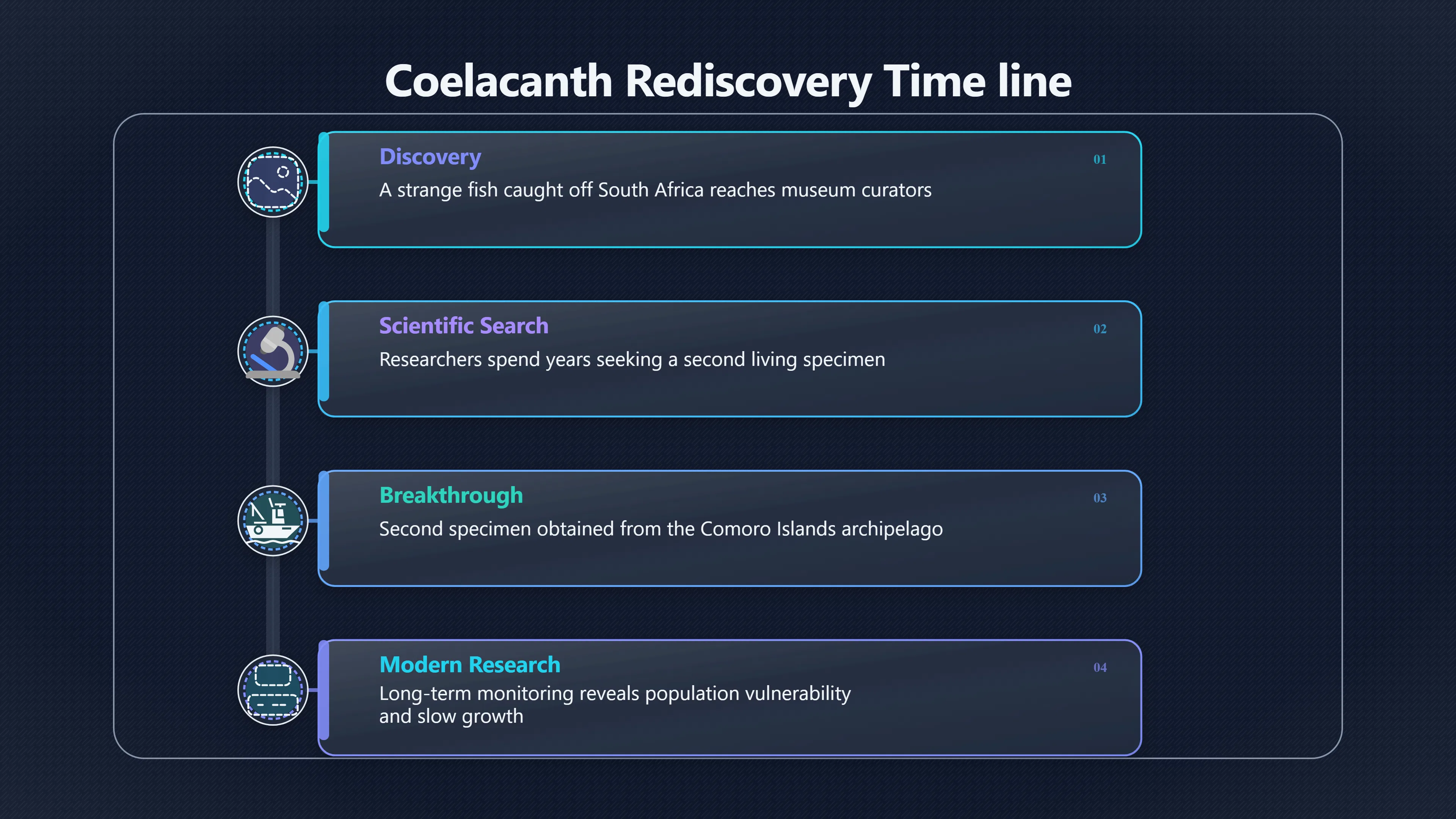
The scientific rediscovery began in 1938 when a strange fish caught off South Africa came to the attention of museum curator Marjorie Courtenay-Latimer. Specialists eventually identified it as a living coelacanth, a member of a group known previously only from fossils and believed extinct since the age of the dinosaurs. The find caused an international sensation.[Wikipedia]WikipediaOpen source on wikipedia.org.
Yet one specimen was not enough to convince everyone. Scientists spent years searching for another example. The breakthrough came in 1952 when a second specimen was obtained from the Comoro Islands. This discovery transformed Comoros from a remote island chain into the centre of coelacanth research. The islands suddenly became the key location for understanding one of the most extraordinary zoological discoveries of the twentieth century.[nhm.ac.uk]nhm.ac.ukNatural History MuseumCoelacanths: The fish that 'outdid' the Loch Ness MonsterWhile it was western science's second recorded living coel…
The contrast between scientific surprise and local familiarity became one of the most memorable aspects of the story. While newspapers around the world treated the coelacanth as a creature returned from prehistory, Comorian fishers recognised it as a fish they already knew. The rediscovery therefore became not just a scientific event but also a lesson in the value of local ecological knowledge.[Natural History Museum]nhm.ac.ukNatural History MuseumCoelacanths: The fish that 'outdid' the Loch Ness MonsterWhile it was western science's second recorded living coel…
Why the Coelacanth Felt Like a Monster
The coelacanth possesses many of the qualities that encourage monster stories. It lives in dark, deep water. It can reach impressive sizes. Its fleshy, limb-like fins look unusual compared with most familiar fish. For decades, very few people had seen one alive. Its appearance seemed almost prehistoric.[Nekton]nektonmission.orgNektonThe fish that came back from the dead - Nekton Mission23 Oct 2025 — Two extant species exist: Latimeria chalumnae (western Indian O…
Popular media quickly embraced the drama. The fish became known as a “living fossil”, a phrase that captured the public imagination even if scientists later argued that the term oversimplified its evolutionary history. To many readers, the idea sounded like something from a lost-world adventure novel: a creature from deep time surviving unnoticed in the modern ocean.[Nekton]nektonmission.orgNektonThe fish that came back from the dead - Nekton Mission23 Oct 2025 — Two extant species exist: Latimeria chalumnae (western Indian O…
Natural-history commentators have even compared the impact of the coelacanth’s rediscovery to famous monster legends. The discovery succeeded where many cryptid stories did not: the mysterious creature was actually found, examined and documented. The coelacanth became a real-world example of a seemingly impossible animal turning out to exist.[Natural History Museum]nhm.ac.ukNatural History MuseumCoelacanths: The fish that 'outdid' the Loch Ness MonsterWhile it was western science's second recorded living coel…
Why the Coelacanth Matters to Cryptid History
Cryptozoology often revolves around the hope that an animal dismissed by mainstream science might eventually be confirmed. The coelacanth is frequently cited because it appears to support that possibility. However, the details matter.
The coelacanth was not a legendary sea serpent, an unknown ape, or a creature known only from eyewitness reports. Scientists already knew coelacanths had existed because they possessed an extensive fossil record. The surprise was that one branch of the group had survived into modern times. The rediscovery therefore represents a “Lazarus taxon”—a species or lineage thought absent from the fossil record that later reappears—not proof that every monster story hides an undiscovered animal.[Wikipedia]WikipediaOpen source on wikipedia.org.
Even so, the case remains important because it demonstrates several themes that recur in mystery-animal history:
- Remote habitats can conceal remarkable species.
- Local communities may possess knowledge that scientists lack.
- Rare animals can generate myths simply because few people see them.
- Extraordinary claims become more credible when physical specimens exist.[Natural History Museum]nhm.ac.ukNatural History MuseumCoelacanths: The fish that 'outdid' the Loch Ness MonsterWhile it was western science's second recorded living coel…
For those reasons, the coelacanth is often invoked whenever discussions arise about hidden animals or reports from poorly explored environments.
From Monster Fish to Conservation Symbol
As research expanded, Comoros became recognised not merely as the place where coelacanths were found, but as one of their most important strongholds. Studies around Grande Comore and neighbouring islands identified populations living in deep underwater habitats, while long-term monitoring revealed how vulnerable these fish are to accidental capture and environmental change.[fao.org]agris.fao.orgFAO AGRISThe population biology of the living coelacanth studied over…by H Fricke · 2011 · Cited by 31 — One hundred and forty five co…
Modern research has also shown that coelacanths grow slowly, mature late, and may live for many decades. These traits make them especially sensitive to population losses. Conservation concerns have therefore become a major part of the fish’s modern story.[WIRED]wired.comThe Coelacanth May Live for a CenturyThat's Not Great NewsScientists have discovered that the African coelacanth, a species once thought extinct, can live up to nearly 100 ye…
The result is a fascinating transformation. A fish once regarded as an odd catch by local fishers became a global scientific celebrity. It moved from obscurity to museum displays, documentaries, conservation campaigns and popular culture. For Comoros, the coelacanth remains a rare example of a creature that bridges folklore-like mystery and established science. It is not a cryptid, yet it occupies a place in monster history because it fulfilled one of humanity’s oldest dreams: finding that a seemingly impossible creature was real all along.[nhm.ac.uk]nhm.ac.ukNatural History MuseumCoelacanths: The fish that 'outdid' the Loch Ness MonsterWhile it was western science's second recorded living coel…
Amazon book picks
Further Reading
Books and field guides related to Comoros' Real Monster Fish. Use these as the next step if you want deeper reading beyond the article.
A Fish Caught in Time
Directly covers the fish that made Comoros famous in natural-history circles.
Abominable Science!
"A sharp analysis of the quest for unreal critters―cryptids, as they are called―and the people who pursue them . . . entertaining and tho...
The Search for the Last Undiscovered Animals
Explores the possibility of remarkable animals surviving unnoticed.
eBay marketplace picks
Marketplace Samples
Live-tested eBay searches with available results related to this page.



Endnotes
1.
Source: facebook.com
Title: in 1938 a fish was discovered that was believed to have been extinct for 65 mill
Link:https://www.facebook.com/bbcworldservice/posts/in-1938-a-fish-was-discovered-that-was-believed-to-have-been-extinct-for-65-mill/1269214945232735/
Source snippet
In 1938, a fish was discovered that was believed..." Further investigation revealed that fishermen in the Comoros Islands had kn...
2.
Source: Wikipedia
Link:https://en.wikipedia.org/wiki/Coelacanth
3.
Source: researchgate.net
Title: Research Gate Conservation
Link:https://www.researchgate.net/publication/12675222Conservation-_Biogeography_of_the_Indonesian_coelacanths
Source snippet
Conservation - Biogeography of the Indonesian coelacanthsLiving coelacanths (Latimeria chalumnae) are normally found only in...
4.
Source: wired.com
Title: The Coelacanth May Live for a Century
Link:https://www.wired.com/story/the-coelacanth-may-live-for-a-century-thats-not-great-news
Source snippet
That's Not Great NewsScientists have discovered that the African coelacanth, a species once thought extinct, can live up to nearly 100 ye...
5.
Source: dinofish.com
Link:https://www.dinofish.com/exped.htm
Source snippet
itions in Search of the CoelacanthFrom 1938 until the discovery of the "second" coelacanth in 1952 in the Comoro islands, JLB Smith condu...
6.
Source: dinofish.com
Title: Coelacanth briefing
Link:https://www.dinofish.com/Coelacanth%20briefing.html
Source snippet
Using a reward poster, Smith continued the search for a second coelacanth which was finally identified in 1952 at the Comoro Islands...
7.
Source: agris.fao.org
Link:https://agris.fao.org/search/en/providers/122535/records/65de22f20f3e94b9e5caf669
Source snippet
FAO AGRISThe population biology of the living coelacanth studied over...by H Fricke · 2011 · Cited by 31 — One hundred and forty five co...
8.
Source: facebook.com
Link:https://www.facebook.com/coelacanth/
9.
Source: dinofish.com
Link:https://www.dinofish.com/Coelacanth%20Recollections2.html
Source snippet
Coelacanth RecollectionsOnce in the Comoros, they located an inlet where a fish could be sequestered once captured. They offered the fish...
10.
Source: researchgate.net
Link:https://www.researchgate.net/publication/350467942_Coelacanth_discoveries_in_Madagascar_with_recommendations_on_research_and_conservation
Source snippet
(PDF) Coelacanth discoveries in Madagascar, with...22 May 2026 — The paper provides the first comprehensive account of Madagascar coelac...
Published: May 2026
11.
Source: researchgate.net
Link:https://www.researchgate.net/publication/225423214_The_population_biology_of_the_living_coelacanth_studied_over_21_years
Source snippet
be 150–210 individuals; a saturated population would be 370–510 individuals.Read more...
12.
Source: Wikipedia
Title: West Indian Ocean coelacanth
Link:https://en.wikipedia.org/wiki/West_Indian_Ocean_coelacanth
Source snippet
West Indian Ocean coelacanthIt has a vivid blue pigment, and is the better known of the two extant species. The species has been asses...
13.
Source: Wikipedia
Title: Indonesian coelacanth
Link:https://en.wikipedia.org/wiki/Indonesian_coelacanth
Source snippet
Indonesian coelacanthIt is listed as vulnerable by the IUCN, and it was quickly given protected status under Indonesian National Law N...
14.
Source: nhm.ac.uk
Link:https://www.nhm.ac.uk/discover/coelacanths-the-fish-that-outdid-the-loch-ness-monster.html
Source snippet
Natural History MuseumCoelacanths: The fish that 'outdid' the Loch Ness MonsterWhile it was western science's second recorded living coel...
15.
Source: nektonmission.org
Link:https://nektonmission.org/news/the-fish-that-came-back-from-the-dead-ceolacanths-in-the-comoros/
Source snippet
NektonThe fish that came back from the dead - Nekton Mission23 Oct 2025 — Two extant species exist: Latimeria chalumnae (western Indian O...
16.
Source: conbio.onlinelibrary.wiley.com
Title: j.1523 1739.1998.97060.x
Link:https://conbio.onlinelibrary.wiley.com/doi/10.1111/j.1523-1739.1998.97060.x
Source snippet
Conservation BiologyPopulation Monitoring of the Coelacanth (Latimeria chalumnae)7 Jul 2008 — In 1991 the population size of the coelacan...
17.
Source: newsarchive.berkeley.edu
Link:https://newsarchive.berkeley.edu/news/berkeleyan/1998/1007/fish.html
Source snippet
Indonesia, Biologist Discovers Second Population of...Oct 7, 1998 — In the 60 years since the Comoran fish was discovered, the populatio...
18.
Source: ocean.si.edu
Link:https://ocean.si.edu/ocean-life/fish/coelacanth
Source snippet
Smithsonian OceanThe first living coelacanth was discovered in 1938 and bears the scientific name Latimeria chalumnae.... Coelacanths...
Additional References
19.
Source: fishbase.se
Link:https://fishbase.se/summary/Latimeria-chalumnae.html
Source snippet
Latimeria chalumnae, CoelacanthIndian Ocean: well known population off the islands of Grand Comoro and Anjouan in the Comoros. Other popu...
20.
Source: instagram.com
Link:https://www.instagram.com/reel/DMiG2bov6p1/?hl=en
Source snippet
HMSC | The story of the Coelacanth is certainly “stranger than...The coelacanth's fossil record goes back 400 million years, and the liv...
21.
Source: coelacanth.co.jp
Link:https://coelacanth.co.jp/?srsltid=AfmBOoqWgM-KWp14eTNFl5auOsV7o8IUNaeiJUiJmkjFIG3q2nNlWiQg
Source snippet
elacanth東京 青山近郊の雑居ビルで静かに佇む洋服屋。ANCELLM, barbell object, Fujimoto, satou, Urig, YANTOR, YAKO SAKAMOTO, YUTA MATSUOKA, Post Production, ça...
22.
Source: reddit.com
Title: in 1938 a south african museum curator discovered
Link:https://www.reddit.com/r/Damnthatsinteresting/comments/1m6f3cm/in_1938_a_south_african_museum_curator_discovered/
Source snippet
In 1938, a South African museum curator discovered...The coelacanth is a rare deep sea fish once thought to be extinct for 66 million years...
23.
Source: rris.biopama.org
Title: IUCN2020 ESA SoPACA Country Profile Comoros
Link:https://rris.biopama.org/sites/default/files/2020-12/IUCN2020%20ESA%20SoPACA%20Country%20Profile%20-%20Comoros.pdf
Source snippet
biopama.org8.3 ComorosComoros has eight protected areas covering 173 km2 of land and. 37 km2 of the ocean (UNEP-WCMC & IUCN, 2019d). Terr...
24.
Source: gombessa-expeditions.com
Link:https://gombessa-expeditions.com/en/meet-the-coelacanth-in-south-africa/
Source snippet
Meet the coelacanth in South AfricaThis fish, called “Gombessa” in the Comoros, is a true legend, a living fossil...
25.
Source: australian.museum
Title: coelacanth latimeria chalumnae smith 1939
Link:https://australian.museum/learn/animals/fishes/coelacanth-latimeria-chalumnae-smith-1939/
Source snippet
Coelacanth, Latimeria chalumnae Smith, 1939by M McGrouther — On July 30 1998, a Coelacanth was caught in a deep-water shark net by local...
26.
Source: travelssmart.blogspot.com
Title: Smart Travelsthe living ‘fossil fish’
Link:https://travelssmart.blogspot.com/2012/05/coelancth-fossil-fish.html
Source snippet
the living 'fossil fish' - CoelacanthMay 20, 2012 — It was 14 years before Captain Eric Hunt preserved a second specimen, from the Comoro...
Published: May 20, 2012
27.
Source: scubadiverlife.com
Title: the coelacanth a living fossil
Link:https://scubadiverlife.com/the-coelacanth-a-living-fossil/
Source snippet
The Coelacanth: A Living Fossil5 Nov 2015 — The Comoros population is estimated to be 1,000 animals; there are no estimates on the popula...
28.
Source: miragenews.com
Link:https://www.miragenews.com/150-year-old-specimen-unveils-ancient-fish-1659092/
Source snippet
il housed at London's Natural History Museum...
Topic Tree