Cryptid Reports from Andros' Blue Holes
The Bahamas has a small but distinctive cryptid tradition, and it is centred less on wandering monsters than on two places people already know can be dangerous or uncanny: the blue holes of Andros and the pine forests of Andros.
Page outline Jump by section
Introduction
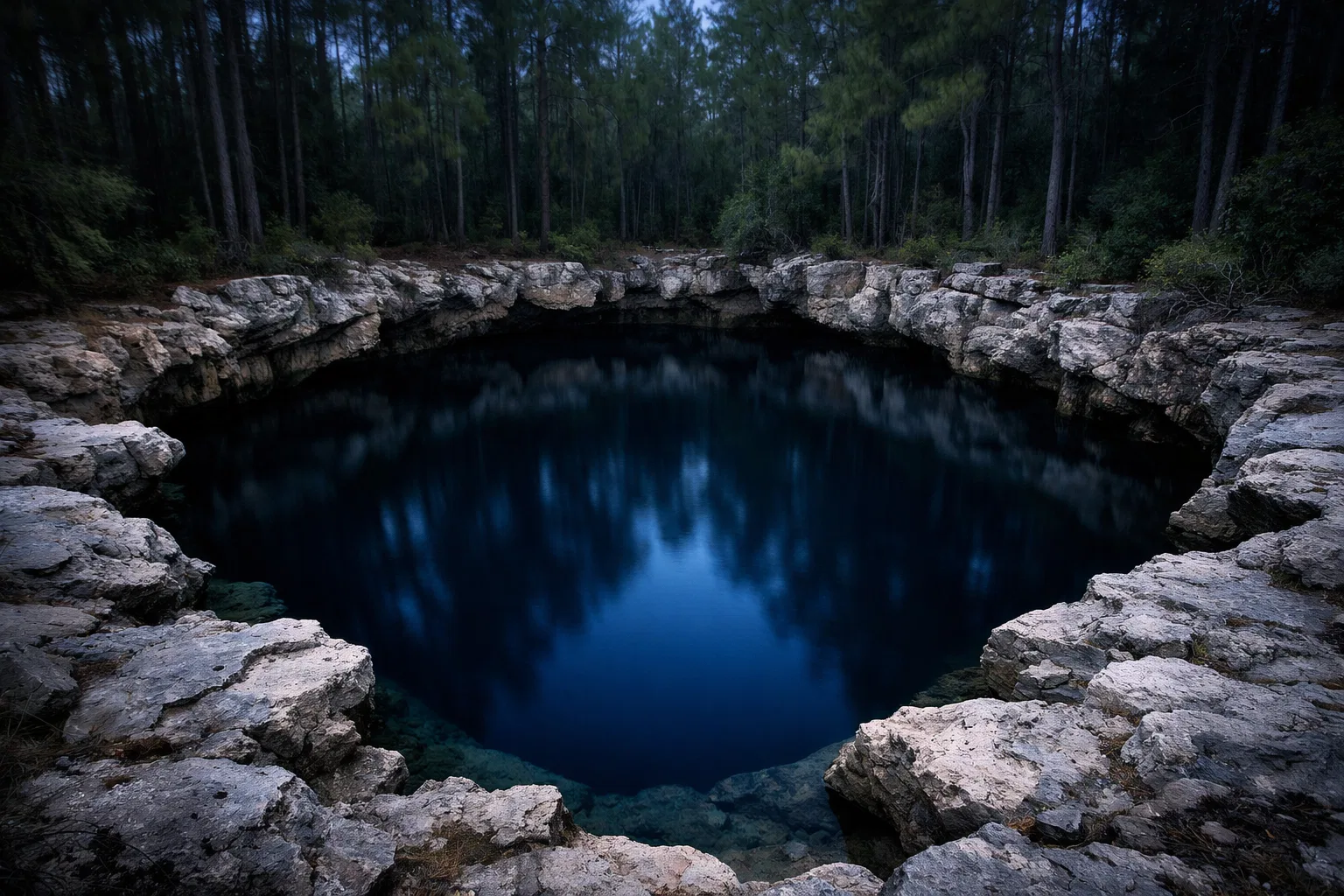
That makes The Bahamas unusually interesting in cryptid terms. Its creature stories are not just “something was seen somewhere”. They are tied to real landscapes that are genuinely distinctive. Andros is described by the Bahamas National Trust as having the highest concentration of blue holes in the world, while Blue Holes National Park protects 40,000 acres of blue holes, coppice and pine forest. Those same settings explain why Bahamian monster traditions keep returning to water, trees, caves, birds and the uneasy border between natural hazard and supernatural warning.[Bahamas National Trust]bnt.bsBahamas National Trust Blue Holes National ParkBahamas National Trust Blue Holes National Park
The Bahamas’ monster map is really an Andros map
Most country-level cryptid traditions scatter across many regions. In The Bahamas, the centre of gravity is unusually clear: Andros. The island is large, sparsely populated compared with the busier tourist islands, and ecologically dramatic. It has inland and oceanic blue holes, pine forests, coppice, wetlands and reef systems close together. The result is a landscape where stories can move easily between practical warning, local identity and full-blown monster lore.
The blue holes are the clearest example. Scientific work describes Bahamian blue holes as water-filled anchialine caves in carbonate rock, with many inland blue holes on Andros showing layered water: oxygenated freshwater above anoxic saline groundwater of marine origin. That sounds technical, but for folklore it matters because layered, deep, partly connected water systems can behave in ways that feel alive: cold upwelling, dark openings, odd smells, changing clarity and tidal movement. A monster that “breathes” through the caves is not a random invention; it is a story-shaped explanation for a landscape that visibly moves and changes.[gambusia.zo.ncsu.edu]gambusia.zo.ncsu.eduOpen source on ncsu.edu.
The pine forests create a different kind of mystery. Blue Holes National Park is not just a water site; the Bahamas National Trust also emphasises its coppice and pineland forests, with rare and range-restricted birds including the Bahama Oriole and the Great Lizard Cuckoo. A forest creature such as the Chickcharney fits that setting neatly: it is arboreal, bird-like, easily imagined in high trees, and strongly associated with how travellers behave in the woods.[Bahamas National Trust]bnt.bsBahamas National Trust Blue Holes National ParkBahamas National Trust Blue Holes National Park
The Lusca: the blue-hole monster of Bahamian folklore
The Lusca is usually described as the creature of the Bahamian blue holes, especially around Andros. Popular retellings vary: sometimes it is a giant octopus, sometimes a giant cuttlefish, sometimes half shark and half octopus, and occasionally something more spirit-like than zoological. Children’s and tourism-oriented summaries often present the core image plainly: a half-shark, half-octopus being that lurks in underwater caves, tunnels and blue holes, especially around Andros, and can pull divers, explorers or boats into the dark water.[bahamas4kids.com]bahamas4kids.comBahamas Myths and Legends For KidsBahamas Myths and Legends For Kids
The strongest version of the legend links the monster directly to water movement. In one common telling, the tidal currents of inland blue holes are said to be the Lusca’s breath: when it inhales, water pours into the caverns and may form a whirlpool; when it exhales, cold clear water rises back to the surface. This is exactly the kind of folklore that grows around hazardous geography. It does not need a confirmed monster to be culturally useful. It marks blue holes as places to respect.[bahamas4kids.com]bahamas4kids.comBahamas Myths and Legends For KidsBahamas Myths and Legends For Kids
A more cryptozoological version makes the Lusca physically huge, with arms supposedly reaching extraordinary lengths and enough strength to seize boats or people. Folklore catalogues preserve details such as the alternative name “giant scuttle”, with “scuttle” glossed as a Bahamian term for octopus, and “Him of the Hands”, a phrase that makes the animal sound both cephalopod and uncanny. Those details are vivid, but they should be read as legend, not measurement. A monster with 75-foot arms belongs to story tradition unless physical evidence appears.[A Book of Creatures]abookofcreatures.comA Book of Creatures Lusca | A Book of CreaturesA Book of Creatures Lusca | A Book of Creatures
The sceptical reading is not that the story is meaningless. It is that the real source of danger is probably environmental. Blue holes can be deep, dark, disorientating and connected to cave systems. The Bahamas National Trust notes that Andros’ limestone bedrock eroded into underwater cave systems, and scientific surveys of inland blue holes show unusual chemistry, stratification and low-oxygen layers below the halocline. Those are not “monster facts”, but they help explain why a swimmer, fisher or diver might experience a blue hole as a living trap.[Bahamas National Trust]bnt.bsBahamas National Trust Blue Holes National ParkBahamas National Trust Blue Holes National Park
Could the Lusca be a real animal?
A real animal explanation is tempting because the Lusca’s body plan borrows from animals that do exist. The Bahamas and wider Caribbean have octopuses, sharks, groupers, lobsters and other creatures that use reefs, caves and rocky shelters. The Caribbean reef octopus inhabits reefs and grass beds in the western Atlantic, Bahamas, Caribbean and northern South America, and it can use hidden lairs under rocks, docks and wreckage. That makes an octopus-like basis plausible in the ordinary sense: people in the region really do encounter intelligent, colour-changing, armoured-looking cephalopods.[Lamar.edu]lamar.educaribbean reef octopusLamar University…
The problem is scale. The Caribbean reef octopus is not a boat-dragging giant. Even the giant Pacific octopus, the largest living octopus species, is a North Pacific animal rather than a Bahamian one, and an Alaska Department of Fish and Game profile gives typical weights of 22 to 110 pounds and an adult arm span up to about 16 feet, with a 156-pound animal recorded by Canadian researchers. That is impressive, but it is still far from the Lusca’s legendary proportions, and in the wrong ocean.[Alaska Department of Fish and Game]adfg.alaska.govOpen source on alaska.gov.
Sharks may account for some of the fear around sudden attacks, shadows and large animals near blue holes or reefs. Tiger sharks and reef sharks are part of the broader Bahamian marine world, and some folklore summaries explicitly mention real blue-hole inhabitants such as grouper, lobster and reef sharks. Yet a shark does not explain tentacles, and an octopus does not explain a shark’s body. The hybrid description is a clue that the Lusca is less likely to be a hidden species than a composite: the strength of a shark, the grasping arms of an octopus, and the swallowing darkness of a cave.[bahamas4kids.com]bahamas4kids.comBahamas Myths and Legends For KidsBahamas Myths and Legends For Kids
A fair assessment is therefore: the Lusca is a Bahamian blue-hole legend built from real marine fear, real cave hazards and real animals, but there is no strong mainstream evidence for a giant undiscovered cephalopod or shark-octopus living in Bahamian blue holes. Its best evidence is cultural persistence, not biological proof.
The Chickcharney: Andros’ owl-like forest being
If the Lusca belongs to the holes, the Chickcharney belongs to the trees. It is usually placed in the pine forests of Andros and described as owl-like, bird-like or partly humanoid. Common details include red eyes, three fingers or toes, a tail, and a habit of living in or around pine trees. Some versions say Chickcharnies build nests by joining the tops of pine trees together. Others make them more like elfin forest beings than ordinary birds.[bahamas4kids.com]bahamas4kids.comBahamas Myths and Legends For KidsBahamas Myths and Legends For Kids
The behavioural pattern is just as important as the appearance. Chickcharnies are not usually described as random predators. They are moral weather: treat them respectfully and good luck may follow; mock, harm or disturb them and misfortune may come. In that sense, the Chickcharney resembles many forest beings worldwide whose stories teach caution, politeness and respect for places where humans are not fully in control. It is a creature of etiquette as much as anatomy.
One reason the Chickcharney has travelled beyond local folklore is a famous political afterlife. In 1947, Time magazine ran a playful article linking the creature to Neville Chamberlain’s youthful time on his father’s sisal plantation in Andros, joking that the misfortune associated with Chamberlain could be traced to angered Chickcharnies disturbed by tree-cutting. The article described Chickcharnies as tree-dwelling beings of Andros and leaned into the comic curse angle. That is not evidence for the creature, but it is evidence that the legend had become recognisable enough to be used in international media by the mid-20th century.[Time]content.time.comTHE BAHAMAS: Chickcharneys at MunichTHE BAHAMAS: Chickcharneys at Munich
Was the Chickcharney inspired by an extinct giant owl?
The most intriguing natural explanation for the Chickcharney is the extinct Bahamian barn owl, Tyto pollens. This is where Bahamian cryptid lore becomes more than a spooky tale, because there really was a large extinct owl in the Bahamian fossil record. Smithsonian material on fossil and subfossil birds from The Bahamas identifies Tyto pollens among the archipelago’s fossil birds, and a Smithsonian repository record gives Olson and Hilgartner’s 1982 study as a formal source for Bahamian fossil birds.[Smithsonian Research Online]repository.si.eduSmithsonian Research Online
That does not prove that living Chickcharnies survived into recent times. It also does not prove that every detail of the folklore comes from an owl. Tails, humanoid behaviour, curses and luck belong to storytelling. But the extinct-owl hypothesis is attractive because it offers a bridge between zoology and folklore: a large, startling bird, remembered or reimagined over generations, could become a forest spirit with owl traits.
There are cautions. Some popular retellings overstate the case by treating Tyto pollens as a recently living, flightless Andros bird that exactly matches the Chickcharney. The fossil record is more complicated. Smithsonian work emphasises that Bahamian fossil vertebrates were still poorly known, and later summaries note uncertainty around distribution and timing. The safest wording is not “the Chickcharney was Tyto pollens”, but “the legend may preserve, exaggerate or reinvent memories of large owls and vanished Bahamian birdlife”.[Smithsonian Research Online]repository.si.eduSmithsonian Research Online
That cautious version is still fascinating. Many cryptid traditions collapse under scrutiny because no plausible animal ever existed nearby. The Chickcharney is different: its folklore does not confirm a surviving creature, but it sits beside a real palaeontological fact — The Bahamas once had a much stranger bird fauna than it does today.
Why Bahamian cryptids are warnings, not just monsters
The most useful way to read Bahamian cryptids is as place-based warning stories. The Lusca warns people not to underestimate blue holes. The Chickcharney warns people not to mock or damage the forest. Both creatures turn environmental risk into a memorable personality.
That matters because the hazards are real even when the monsters are not. Blue holes can be deep cave systems with unusual water chemistry and hidden vertical structure. Andros’ blue holes are scientifically important, but they are also places where casual confidence can be dangerous. A monster that drags the careless down is a dramatic way of saying: do not treat this water like an ordinary pond.[gambusia.zo.ncsu.edu]gambusia.zo.ncsu.eduOpen source on ncsu.edu.
The Chickcharney performs a similar function on land. A bird-like being that punishes disrespect makes the forest socially charged. It encourages travellers to behave carefully, pay attention, and treat the living landscape as something more than timber or empty space. The Time magazine Chamberlain anecdote is comic, but its underlying theme is serious folklore logic: cut down the wrong trees, disturb the wrong home, and consequences follow.[Time]content.time.comTHE BAHAMAS: Chickcharneys at MunichTHE BAHAMAS: Chickcharneys at Munich
This is why Bahamian cryptid stories should not be flattened into “true or false”. As zoological claims, they are weak. As cultural maps of danger, memory and respect, they are strong.
Hoaxes, misidentifications and modern retellings
The Bahamas does not have the same thick archive of monster flaps, staged photographs or newspaper-driven beast panics found in some larger countries. Its cryptid material is more often repeated through folklore pages, travel writing, children’s cultural explainers, monster books and online retellings. That creates a problem for researchers: the stories are easy to find, but the original eyewitness trail is often thin.
For the Lusca, misidentification may involve ordinary marine animals, shadows, cave currents, floating debris or frightening diving experiences. A folklore catalogue notes that George J. Benjamin and Jacques-Yves Cousteau were warned about the Lusca but did not find evidence of a giant octopus, and that one supposed monster-lost outboard motor was recovered. Such anecdotes are useful because they show the story already being tested against the physical world, not merely repeated as a campfire tale.[A Book of Creatures]abookofcreatures.comA Book of Creatures Lusca | A Book of CreaturesA Book of Creatures Lusca | A Book of Creatures
For the Chickcharney, misidentification is less about a single mistaken animal and more about blending categories: owl, forest spirit, goblin, extinct bird, local cautionary tale and tourist-friendly mascot. Some descriptions make it a three-foot owl-like creature; others make it an 18-inch tree being; others turn it into a humanoid bird-person. That variation is a sign of folklore in motion. A stable biological species usually becomes more precise under investigation. A legend often becomes more vivid.
Modern tourism and web culture have also softened both creatures. The Lusca can be presented not only as a killer but as a guardian of the blue holes, with tidal movement feeding real cave and reef life. The Chickcharney can be frightening, comic, cute or heritage-rich depending on the audience. That flexibility is part of their survival. A monster that can be a warning, a mascot and a mystery will travel further than one locked into a single scary story.[bahamas4kids.com]bahamas4kids.comBahamas Myths and Legends For KidsBahamas Myths and Legends For Kids
The evidential limits around The Bahamas’ cryptid traditions
The evidence supports two strong conclusions and one weak one. The strong conclusions are that The Bahamas has a recognisable creature-folklore tradition centred on Andros, and that the Lusca and Chickcharney are deeply tied to real Bahamian environments. The weak conclusion would be that either creature is a confirmed unknown animal.
For the Lusca, the environmental basis is excellent: Andros really is exceptional for blue holes, and these systems really are deep, unusual, layered and scientifically distinctive. The animal evidence is poor: no verified giant octopus, shark-octopus hybrid or blue-hole monster has been documented.[Bahamas National Trust]bnt.bsBahamas National Trust Blue Holes National ParkBahamas National Trust Blue Holes National Park
For the Chickcharney, the folklore basis is strong and the extinct-owl comparison is genuinely interesting. The Bahamas really does have a fossil record including large extinct birds, and Tyto pollens gives the legend a plausible natural shadow. But the leap from fossil owl to surviving forest cryptid remains unsupported.[Smithsonian Research Online]repository.si.eduSmithsonian Research Online
The best final reading is evidence-aware rather than dismissive. Bahamian cryptids are not confirmed animals hiding just beyond science. They are stories rooted in places where nature already feels strange: blue holes that breathe with tides, forests full of bird calls and shadows, and an island landscape where the boundary between warning and wonder has always been easy to cross.
Amazon book picks
Further Reading
Books and field guides related to What Lurks in Andros' Blue Holes?. Use these as the next step if you want deeper reading beyond the article.
Field Guide to Lake Monsters, Sea Serpents, and Other Mystery...
Directly relevant to Bahamian sea-monster traditions.
Encyclopedia of Things that Never Were
Broad overview of legendary creatures and folklore.
eBay marketplace picks
Marketplace Samples
Live-tested eBay searches with available results related to this page.
Endnotes
1.
Source: bahamas.com
Title: The Islands of The Bahamas Blue Holes National Park
Link:https://www.bahamas.com/natural-wonders/blue-holes-national-park
2.
Source: gambusia.zo.ncsu.edu
Link:https://gambusia.zo.ncsu.edu/Bjorneras%20et%20al%202020.pdf
3.
Source: bahamas4kids.com
Title: Bahamas Myths and Legends For Kids
Link:https://www.bahamas4kids.com/stories/stories-myths.html
4.
Source: lamar.edu
Title: caribbean reef octopus
Link:https://www.lamar.edu/arts-sciences/biology/study-abroad-belize/marine-critters/marine-critters-1/caribbean-reef-octopus.html
Source snippet
Lamar University...
5.
Source: adfg.alaska.gov
Link:https://www.adfg.alaska.gov/index.cfm?adfg=giantpacificoctopus.printerfriendly
6.
Source: content.time.com
Title: THE BAHAMAS: Chickcharneys at Munich
Link:https://content.time.com/time/subscriber/article/0%2C33009%2C887342%2C00.html
7.
Source: time.com
Link:https://time.com/archive/6823528/the-bahamas-chickcharneys-at-munich/
8.
Source: repository.si.edu
Title: Smithsonian Research Online
Link:https://repository.si.edu/bitstream/handle/10088/15601/vz_Bahamas_fossils.pdf?isAllowed=y&sequence=1
9.
Source: content.time.com
Link:https://content.time.com/time/covers/0%2C16641%2C19330619%2C00.html
10.
Source: content.time.com
Link:https://content.time.com/time/magazine/0%2C9263%2C7601470407%2C00.html
11.
Source: archive.org
Link:https://archive.org/details/fossilvertebrat48olso
12.
Source: bahamas.com
Title: dive deeper into wildlife adventures
Link:https://www.bahamas.com/blog/dive-deeper-into-wildlife-adventures
13.
Source: bnt.bs
Title: Bahamas National Trust Blue Holes National Park
Link:https://bnt.bs/explore/andros/blue-holes-national-park/
14.
Source: abookofcreatures.com
Title: A Book of Creatures Lusca | A Book of Creatures
Link:https://abookofcreatures.com/2020/06/15/lusca/
15.
Source: repository.si.edu
Title: Smithsonian Research Online Fossil and subfossil birds from the Bahamas
Link:https://repository.si.edu/items/8d214744-e03e-47cf-866b-b16a60b392e1
16.
Source: Wikipedia
Link:https://en.wikipedia.org/wiki/Lusca
17.
Source: Wikipedia
Link:https://en.wikipedia.org/wiki/Chickcharney
18.
Source: Wikipedia
Title: Blue Holes National Park
Link:https://en.wikipedia.org/wiki/Blue_Holes_National_Park
19.
Source: Wikipedia
Title: Tyto pollens
Link:https://en.wikipedia.org/wiki/Tyto_pollens
20.
Source: Wikipedia
Title: Giant Pacific octopus
Link:https://en.wikipedia.org/wiki/Giant_Pacific_octopus
21.
Source: Wikipedia
Title: Blue hole
Link:https://en.wikipedia.org/wiki/Blue_hole
22.
Source: Wikipedia
Title: Caribbean reef octopus
Link:https://en.wikipedia.org/wiki/Caribbean_reef_octopus
23.
Source: bnt.bs
Link:https://bnt.bs/explore/andros/
24.
Source: bnt.bs
Link:https://bnt.bs/storage/2019/06/blueholes.pdf
25.
Source: repository.si.edu
Link:https://repository.si.edu/bitstreams/518ddad3-d25c-4bdb-a572-4bfff904004c/download
26.
Source: repository.si.edu
Link:https://repository.si.edu/bitstreams/7ed3a377-484c-4f8e-90c8-e2802be44c6b/download
27.
Source: recentlyextinctspecies.com
Title: tyto pollens
Link:https://recentlyextinctspecies.com/strigiformes-owls/tyto-pollens
28.
Source: facebook.com
Link:https://www.facebook.com/photo.php?fbid=2745068462371642&id=1471805236364644&set=a.1472492439629257
29.
Source: youtube.com
Title: The Chickcharney | The Fate Changing Owls of the Bahamas-The Chickcharney
Link:https://www.youtube.com/watch?v=9cYjqNCmbdM
30.
Source: biodiversitylibrary.org
Link:https://www.biodiversitylibrary.org/bibliography/159193
31.
Source: nixillustration.com
Title: tyto pollens
Link:https://nixillustration.com/tag/tyto-pollens/
32.
Source: lonelyplanet.com
Link:https://www.lonelyplanet.com/points-of-interest/blue-holes-national-park/1555378
33.
Source: cryptidz.fandom.com
Link:https://cryptidz.fandom.com/wiki/Chickcharney
34.
Source: cryptidarchives.fandom.com
Link:https://cryptidarchives.fandom.com/wiki/Lusca
35.
Source: sciifii.fandom.com
Title: Tyto pollens
Link:https://sciifii.fandom.com/wiki/Tyto_pollens
36.
Source: warriorsofmyth.fandom.com
Link:https://warriorsofmyth.fandom.com/wiki/Chickcharney
37.
Source: caribbeanfolkloremonth.wordpress.com
Link:https://caribbeanfolkloremonth.wordpress.com/2025/09/15/lusca/
38.
Source: animalia.bio
Title: Tyto pollens
Link:https://animalia.bio/tyto-pollens
39.
Source: caseagrant.ucsd.edu
Title: giant pacific octopus
Link:https://caseagrant.ucsd.edu/seafood-profiles/giant-pacific-octopus
Additional References
40.
Source: youtube.com
Title: The Chickcharney (Andros Island, Bahamas)
Link:http://www.youtube.com/watch?v=IugjHWi_oQg
Source snippet
Bahamas Chickcharney mystery folklore Andros island The Curse of Chickcharney: The Dark Tale of This Bahamian Cryptid Cryptids Across the...
41.
Source: youtube.com
Title: Jeremy May Have Found The Lusca Monster Of The Blue Holes | River Monsters
Link:http://www.youtube.com/watch?v=bnWg7hM07Qg
Source snippet
The Curse of Chickcharney: The Dark Tale of This Bahamian Cryptid...
42.
Source: youtube.com
Title: Chimera Of The Bahamas: The Legend Of The Lusca
Link:http://www.youtube.com/watch?v=F9EWy8pDYOM
Source snippet
The Chickcharney (Andros Island, Bahamas) - History With a Twist...
43.
Source: facebook.com
Link:https://www.facebook.com/NOAAFisheries/videos/climatescience-tiger-shark-habitats-are-shifting-north-because-of-climate-change/1575254822867780/
44.
Source: researchgate.net
Link:https://www.researchgate.net/publication/347395430_Source_of_saline_groundwater_on_tidally_influenced_blue_holes_on_San_Salvador_Island_Bahamas
45.
Source: academia.edu
Link:https://www.academia.edu/107771887/Studies_on_Fossil_and_Extant_Vertebrates_from_San_Salvador_Watlings_Island_Bahamas
46.
Source: ewdr.com
Link:https://ewdr.com/en/dive-inspiration/5-blue-holes-that-belong-on-the-bucket-list-of-every-diver/
47.
Source: octonation.com
Link:https://octonation.com/caribbean-reef-octopus-facts/
48.
Source: inaturalist.org
Link:https://www.inaturalist.org/taxa/543556-Tyto-pollens
49.
Source: discoverbahamas.com
Link:https://discoverbahamas.com/directory/the-chickcharney-of-andros-bahamas-folklore-giant-owl-legend-cultural-heritage-article-1023.aspx
Topic Tree
Follow this branch
Related pages 192
- Antigua Cryptids
- Maldives Monsters
- Malta Monsters
- Qatar Monsters
- Argentina Monsters
- +187 more in sidebar