Are Maldives Monsters Folklore or Cryptids?
The Maldives does not have a Loch Ness-style cryptid tradition built around repeated modern sightings, photographs, expedition claims, or newspaper “monster flaps”.
Page outline Jump by section
Introduction
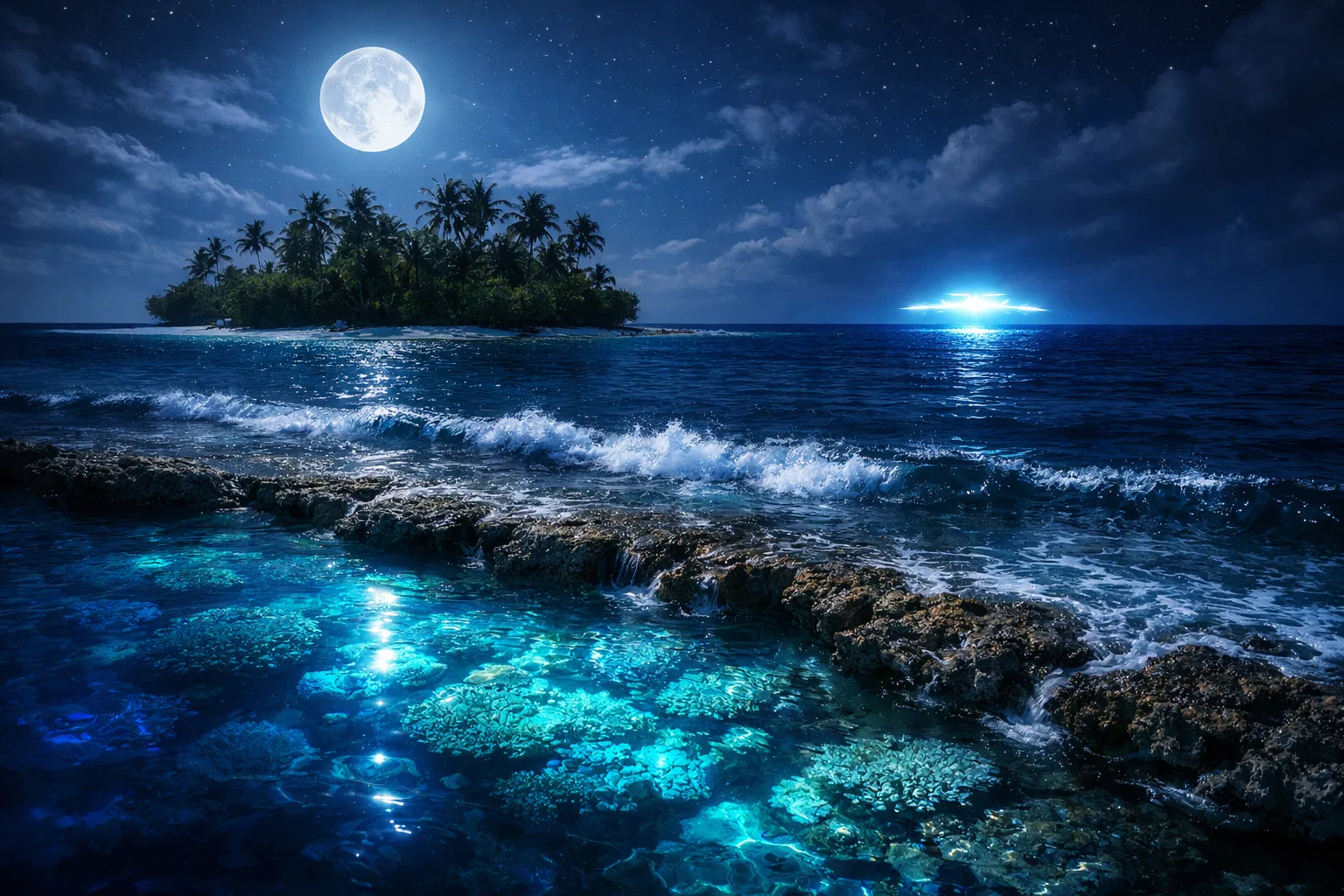
The most important figure is Rannamaari, the sea demon said to have appeared near Malé and demanded human sacrifice until a Muslim holy man defeated it by reciting the Qur’an. The tale was recorded in a version by the fourteenth-century traveller Ibn Battuta, but modern readers should treat it as a legend about fear, religious change, and the ocean’s power, not as evidence for a real monster. The Maldives’ reef setting also produced stories of reef spirits or monsters, including Faru Fureytha, linked to reefs, channels, sailors, and fishing life.[Internet Archive]archive.orgInternet Archive Full text of "The Rehla of Ibn BattutaInternet Archive Full text of "The Rehla of Ibn Battuta[visitmaldives]visitmaldives.comVisit Maldives> Reimagining the ocean through Maldivian eyes…
The monster at the heart of Maldivian legend
Rannamaari is the Maldives’ clearest country-level monster tradition. In Ibn Battuta’s account, local informants told him that, before Islam, a being from the sea appeared each month “like a ship full of lamps”. The islanders would leave a chosen young woman in a coastal idol-house overnight; by morning, she was said to be dead. The story then introduces Abul Barakat, a Muslim visitor from the west, who takes the girl’s place, recites the Qur’an, and drives the demon away. The king converts, the idol-house is destroyed, and Islam spreads through the islands.[Internet Archive]archive.orgInternet Archive Full text of "The Rehla of Ibn BattutaInternet Archive Full text of "The Rehla of Ibn Battuta
That is the tale’s dramatic shape, but its importance is not simply that it has a monster. It works as a conversion narrative: a frightening sea-being represents the old order, the recitation represents Islamic authority, and the defeat of the monster gives the religious change a memorable human story. A recent Brill chapter on the archaeology of Buddhism in the Maldives identifies AD 1153 as the historically attested date for the official conversion, while noting that another version of the Rannamaari story is told by Ibn Battuta after his visit in the fourteenth century.[Brill]brill.comOpen source on brill.com.
For cryptid readers, the key point is the evidence category. Rannamaari is not a modern biological claim with tracks, bodies, sonar returns, or a chain of eyewitness reports. It is a legendary sea demon embedded in national religious memory. Even in Ibn Battuta’s text, the story is presented as something he was told by local jurists and teachers, not as a creature he personally captured or examined. Later in the same passage, he describes seeing what people identified as the demon — a distant lighted shape on the sea — and the islanders’ ritual response to it.[Internet Archive]archive.orgInternet Archive Full text of "The Rehla of Ibn BattutaInternet Archive Full text of "The Rehla of Ibn Battuta

Where the reports cluster: Malé, reefs, and the edge of the sea
The Rannamaari story is strongly associated with Malé, the capital island. In the classic version, the sacrificial site is a coastal idol-house or temple on the seafront, giving the legend a precise kind of landscape: not deep wilderness, but the threshold between settlement, worship, and the open ocean. That setting matters. Maldivian monster stories often begin where human order meets dangerous water: beaches, reef passages, channels, lagoons, and night seas.[Internet Archive]archive.orgInternet Archive Full text of "The Rehla of Ibn BattutaInternet Archive Full text of "The Rehla of Ibn Battuta
The wider geography makes that unsurprising. The Maldives consists of low coral islands and atolls in the Indian Ocean; the official Atolls of Maldives site describes about 1,200 islands, roughly 200 inhabited, spread across 22 geographical atolls and divided into 20 administrative units. It also stresses that the Maldives is more sea than land, with coral reefs central to food, transport, tourism, fisheries, and cultural life.[atollsofmaldives.gov.mv]atollsofmaldives.gov.mvOpen source on atollsofmaldives.gov.mv.
In that environment, “monster territory” is not a remote mountain cave or dark forest. It is the reef edge. Official Maldives tourism writing describes Faru Fureytha as supernatural beings said to inhabit reefs and surrounding waters, especially meaningful for sailors crossing dangerous channels and fishermen heading beyond the reef. This places Maldivian creature folklore in a practical seascape: stories cluster around the places where tides, currents, darkness, and reef hazards could turn ordinary travel into danger.[visitmaldives]visitmaldives.comVisit Maldives> Reimagining the ocean through Maldivian eyes…
Faru Fureytha and reef-beings
Faru Fureytha is less internationally famous than Rannamaari, but it may be more typical of local sea-monster thinking. Rather than one grand demon attached to a national conversion story, it belongs to the class of reef-haunting beings that make sense in a coral-atoll world. Visit Maldives describes these beings as part of the old relationship between Maldivians and the ocean: the sea was not just a view or a resource, but a place of mystery, discipline, and respect.[visitmaldives]visitmaldives.comVisit Maldives> Reimagining the ocean through Maldivian eyes…
This matters because it keeps the tradition grounded. A reef monster in the Maldives is not necessarily imagined as a single zoological species waiting to be classified. It may be a spirit, warning figure, localised danger story, or narrative shorthand for the sea’s unpredictability. The Maldives’ own marine vocabulary reflects close environmental observation: official tourism writing notes different Dhivehi terms for reefs, underwater pinnacles, lagoons, deeper lagoon waters, and open sea, showing how finely island communities distinguished marine spaces.[visitmaldives]visitmaldives.comVisit Maldives> Reimagining the ocean through Maldivian eyes…
For a reader used to “cryptid” meaning Bigfoot, giant cats, or lake monsters, that can feel slippery. But it is exactly the point. In the Maldives, many creature traditions sit between folklore and environmental knowledge. A story about a reef being may preserve caution about a dangerous passage, a taboo about going out at the wrong time, or a social lesson about humility before the sea. It does not need to be a mistaken report of an unknown animal to be worth studying.
Are there plausible animal explanations?
Some Maldivian monster imagery may have been encouraged by real animals, optical effects, or frightening encounters at sea, but there is no need to force every tale into a single zoological explanation. The Maldives has spectacular marine megafauna: manta rays, whale sharks, reef sharks, tiger sharks, dolphins, turtles, eels, rays, and large reef fish. To a night-time observer, a large shape in shallow water, a glowing boat, bioluminescence, surf over reef, or a dangerous shark encounter could all become part of a sea-demon vocabulary.[atollsofmaldives.gov.mv]atollsofmaldives.gov.mvOpen source on atollsofmaldives.gov.mv.
Modern conservation sources show how real “monster-sized” animals still define Maldivian waters. The Convention on Migratory Species notes that Baa Atoll’s Hanifaru Bay receives seasonal large numbers of manta rays and whale sharks and has been a Marine Protected Area since 2009, with rules limiting visitors, visit duration, scuba diving, and fishing. The Maldives Whale Shark Research programme describes itself as a Maldivian NGO studying whale shark population dynamics and supporting community conservation.[Sharks]sharks.cms.intSharks Elasmobranch Tourism FactsheetsSharks Elasmobranch Tourism Factsheets[Maldives Whale Shark Research]maldiveswhalesharkresearch.orgMaldives Whale Shark Research HomeMaldives Whale Shark Research Home
Those animals are not cryptids; they are known species. But they help explain why Maldivian folklore is so marine-heavy. In a place where immense animals genuinely move through clear lagoons and reef channels, the boundary between awe, fear, and story is easy to understand. A manta ray does not become Rannamaari, but living beside mantas, sharks, whale sharks, and deep channels makes sea-monster storytelling culturally natural.
Why Rannamaari changed over time
Rannamaari has survived because it is useful to different audiences in different ways. In religious memory, it explains the triumph of Islam over a terrifying old practice. In folklore, it gives Maldivians a dramatic sea-demon story tied to Malé. In tourism and popular culture, it offers a vivid legend that can be retold to visitors looking for something stranger than beaches and villas. Visit Maldives still identifies Rannamaari as among the most enduring Maldivian legends and directly links it to the twelfth-century conversion story.[visitmaldives]visitmaldives.comVisit Maldives> Reimagining the ocean through Maldivian eyes…
The story’s details also reveal how legends travel. Ibn Battuta’s version names Abul Barakat as a western, Moroccan or Berber figure, while later discussions of Maldivian conversion traditions sometimes debate whether the conversion saint was better understood as North African, Persian, or otherwise differently remembered. That dispute affects historical interpretation, but not the central folklore point: the monster becomes the hinge on which a complex religious transition is turned into one unforgettable night.[Internet Archive]archive.orgInternet Archive Full text of "The Rehla of Ibn BattutaInternet Archive Full text of "The Rehla of Ibn Battuta[Wikipedia]WikipediaIslam in the MaldivesIslam in the Maldives
A sceptical reading does not have to mock the tale. It can recognise that oral traditions often compress slow social change into symbolic episodes. The Rannamaari legend may preserve memories of pre-Islamic ritual space, fear of the sea, older spirit beliefs, political change, or retrospective religious storytelling. What it does not provide is firm evidence for a literal sea creature demanding victims.
The Maldives’ cryptid profile in one view
The Maldives’ mystery-creature tradition is distinctive because it is not built around modern hunts for hidden animals. It is built around an oceanic imagination.
Creature or traditionWhere it belongsBest readingRannamaariMalé, coastal temple or idol-house, conversion legendSea-demon folklore tied to religious changeFaru FureythaReefs, channels, surrounding watersReef spirit or monster tradition expressing respect for dangerous marine placesUnnamed sea demons and spiritsIsland oral tradition more broadlyFolkloric beings shaped by seafaring, fishing, night travel, and ocean fearWhale sharks, mantas, sharks, raysReal Maldivian marine lifePlausible sources of awe, misidentification, or monster-like imagery, but not cryptids
The result is a country where “cryptid history” needs a careful vocabulary. These are not confirmed animals, and most are not even framed locally as animals in the modern biological sense. They are legends, spirits, conversion memories, reef warnings, and sea stories.
What readers should take away
The Maldives’ best-known monster is Rannamaari: a sea demon from a conversion legend, remembered as appearing from the sea near Malé and defeated by Qur’anic recitation. Its strongest early textual anchor is Ibn Battuta’s account, but that account records local tradition rather than biological evidence. The story is therefore historically important as folklore, not zoology.[Internet Archive]archive.orgInternet Archive Full text of "The Rehla of Ibn BattutaInternet Archive Full text of "The Rehla of Ibn Battuta
The broader pattern is equally important. Maldivian monster lore belongs to a low-lying coral country where reefs, lagoons, currents, and the open ocean shape daily life. Official cultural and tourism sources still describe Maldivian folklore as full of sea demons, spirits, Rannamaari, and reef beings such as Faru Fureytha.[Visit Maldives]old.visitmaldives.comVisit Maldives Culture | Visit MaldivesVisit Maldives Culture | Visit Maldives[visitmaldives]visitmaldives.comVisit Maldives> Reimagining the ocean through Maldivian eyes…
So the honest cryptid conclusion is this: the Maldives offers a rich sea-monster folklore tradition, but very little evidence for a modern mystery animal. Its creatures are most valuable as stories about how island communities understood danger, faith, memory, and the sea.
Amazon book picks
Further Reading
Books and field guides related to Are Maldives Monsters Folklore or Cryptids?. Use these as the next step if you want deeper reading beyond the article.
The Mythology Book
Explains how myths and monster traditions function within cultures.
The World of Lore: Monstrous Creatures
Focuses on how monster stories emerge and persist.
Encyclopedia of Things that Never Were
Provides context for distinguishing folklore beings from alleged cryptids.
eBay marketplace picks
Marketplace Samples
Live-tested eBay searches with available results related to this page.

Endnotes
1.
Source: old.visitmaldives.com
Title: Visit Maldives Culture | Visit Maldives
Link:https://old.visitmaldives.com/culture/
2.
Source: archive.org
Title: Internet Archive Full text of “The Rehla of Ibn Battuta”
Link:https://archive.org/stream/TheRehlaOfIbnBattuta/231448482-The-Rehla-of-Ibn-Battuta_djvu.txt
3.
Source: visitmaldives.com
Title: Visit Maldives
Link:https://visitmaldives.com/en/experience/reimagining-the-ocean-through-maldivian-eyes
Source snippet
> Reimagining the ocean through Maldivian eyes...
4.
Source: brill.com
Link:https://brill.com/display/book/9789004729469/BP000007.xml?language=en&srsltid=AfmBOoohph7FA5Vri02Mm_Q8U7j5wMCOKaMX-0bvbU7qBXgg1k6JrNKH
5.
Source: atollsofmaldives.gov.mv
Link:https://www.atollsofmaldives.gov.mv/
6.
Source: Wikipedia
Title: Islam in the Maldives
Link:https://en.wikipedia.org/wiki/Islam_in_the_Maldives
7.
Source: Wikipedia
Link:https://en.wikipedia.org/wiki/Rannamaari
8.
Source: Wikipedia
Title: Folklore of the Maldives
Link:https://en.wikipedia.org/wiki/Folklore_of_the_Maldives
9.
Source: Wikipedia
Link:https://en.wikipedia.org/wiki/Maldives
10.
Source: Wikipedia
Title: History of the Maldives
Link:https://en.wikipedia.org/wiki/History_of_the_Maldives
11.
Source: protectedareas.environment.gov.mv
Link:https://protectedareas.environment.gov.mv/storage/uploads/7jqJ6xq5/efr0ibbu.pdf
12.
Source: brill.com
Link:https://brill.com/display/book/9789004729469/BP000007.xml?language=en&srsltid=AfmBOoqqCVGId_i8BD6q9JWLrz7JQgZN98EoHQA0gbk0NfXYhjxsy-S0
13.
Source: sharks.cms.int
Title: Sharks Elasmobranch Tourism Factsheets
Link:https://sharks.cms.int/publication/elasmobranch-tourism-factsheets-maldives
14.
Source: maldiveswhalesharkresearch.org
Title: Maldives Whale Shark Research Home
Link:https://maldiveswhalesharkresearch.org/
15.
Source: instagram.com
Link:https://www.instagram.com/reel/DQ55zRYkf7r/
16.
Source: facebook.com
Link:https://www.facebook.com/ScienceandMuslimCommunity/photos/the-12th-century-transition-of-the-maldives-from-a-buddhist-kingdom-to-an-islami/1192781072973040/
17.
Source: scholarworks.iu.edu
Link:https://scholarworks.iu.edu/journals/index.php/jfrr/article/view/38938
Additional References
18.
Source: youtube.com
Title: Ancient Religion of the Maldives
Link:https://www.youtube.com/watch?v=dOLth30485o
Source snippet
HOW ISLAM SAVED MALDIVES FROM A MYTHICAL SEA DEMON (RANNAMAARI)...
19.
Source: atoleajewelry.com
Link:https://atoleajewelry.com/blogs/waterproof-jewelry-blog/mythical-sea-creatures?srsltid=AfmBOopHKmUK1JsKhS0Gxx9SV_1rA3nFWeHRjAbI-BAuiW91p3pfh0Kt
20.
Source: researchgate.net
Link:https://www.researchgate.net/publication/342527135_From_Cryptozoology_to_Conservation_Biology_An_Earlier_Baseline_for_Entanglement_of_Marine_Fauna_in_the_Western_Pacific_Revealed_from_Historic_Sea_Serpent_Sightings
21.
Source: researchgate.net
Link:https://www.researchgate.net/publication/388881106_Religion_Power_and_National_Identity_The_Dual_Role_of_Islam_in_the_History_and_Modernization_of_the_Maldives
22.
Source: history.co.uk
Link:https://www.history.co.uk/articles/strange-sea-serpent-sightings-from-history
23.
Source: facebook.com
Link:https://www.facebook.com/groups/maldivesmo/posts/4084373828506182/
24.
Source: maldiveshighcommission.uk
Link:https://www.maldiveshighcommission.uk/index.php/maldives/destination-profile
25.
Source: instagram.com
Link:https://www.instagram.com/p/DJgmoaCxDf9/
26.
Source: scribd.com
Link:https://www.scribd.com/document/452332721/Folk-Tales-of-the-Maldives
27.
Source: amazon.de
Link:https://www.amazon.de/Folk-Tales-Maldives-Xavier-Romero-Frias/dp/8776941051?tag=searcht-20
Topic Tree
Follow this branch
Related pages 192
- Antigua Cryptids
- Malta Monsters
- Qatar Monsters
- Argentina Monsters
- Austria Monsters
- +187 more in sidebar