What Makes Iran's Monster Lore So Strange?
Iran is a country with strong monster traditions, but not a country with many well-documented modern “cryptid” flaps in the Loch Ness or Bigfoot sense.
Page outline Jump by section
Why Iran’s Monster Lore Looks Different From Modern Cryptozoology
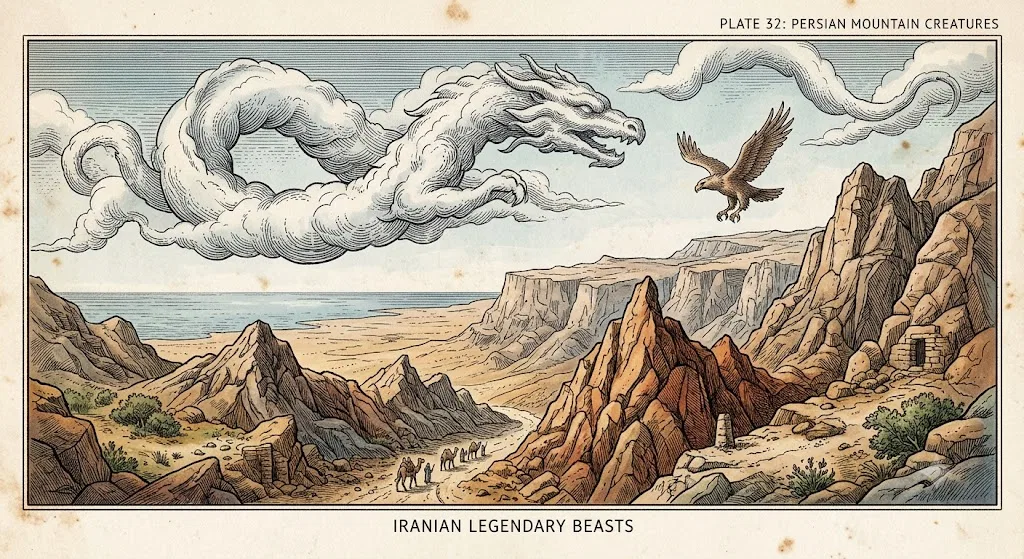
Readers looking for a single Iranian equivalent of Nessie or the Yeti may be surprised by the shape of the evidence. Iran has lakes, mountains, deserts, dense northern forests and long coastlines, all of which are excellent settings for mystery-beast traditions. Yet the best-attested creature material tends to come from literature, folklore, religious cosmology and animal misidentification rather than from repeated modern sighting files.
That does not make the subject less interesting. It means the main question changes. Instead of asking, “What hidden animal is being tracked?”, the better question is, “Why did particular animals and landscapes become monster-making machines?” In Iran, dragons live in air, earth and sea; a fabulous bird nests on a cosmic tree; demonic beings take animal shape; hyenas and big cats sit on the boundary between real danger and supernatural dread. Encyclopaedia Iranica’s entries on the Persian dragon, the Simurgh and demons show that these creatures were embedded in older Iranian literary and religious traditions rather than emerging as modern newspaper mysteries.[Iranica Online]iranicaonline.orgOpen source on iranicaonline.org.
This matters for any evidence-aware cryptid page on Iran. Treating these beings as “undiscovered animals” would flatten them. Treating them only as abstract mythology would also miss the point. The most convincing reading is that Iran’s monster tradition sits between ecology and imagination: real snakes, cats, hyenas, raptors, deserts, salt lakes and sea creatures gave people the raw material, while epic poetry and local belief gave the beasts their memorable forms.
The Persian Dragon: A Monster For Mountains, Seas And Hero Tales
The strongest Iranian monster type is the dragon: a giant, snake-like being that can belong to the sky, land or sea. Encyclopaedia Iranica defines the Persian dragon as a class of gigantic, mostly serpentine monsters living “in the air, on earth, or in the sea”, which is exactly the kind of flexibility that lets one creature tradition attach itself to many landscapes.[Iranica Online]iranicaonline.orgOpen source on iranicaonline.org.
In heroic literature, dragon stories are usually tests of courage rather than eyewitness reports. The dragon is the kind of adversary a hero must defeat to restore order. That makes it different from a cryptid reported by modern witnesses, but it still belongs on an Iran mystery-beast page because the image is animal-shaped, place-friendly and persistent. It can be imagined as a giant snake, a sea creature, a winged monster, or a destructive power sleeping in the land.
The dragon also has a modern afterlife. The Iranian film A Dragon Arrives! uses Qeshm Island, a shipwreck, a cemetery, buried violence, local supernatural belief and the idea of a monster under the earth to create a modern, cinematic version of older dragon imagery. Encyclopaedia Iranica’s cinema entry describes the film’s setting on Qeshm in the Persian Gulf and its use of a “strange monster living at the heart of the earth”, while also connecting the story to local beliefs around spirits and ritual practice.[Cinema Iranica]cinema.iranicaonline.orga dragon arrives azhdaha varid mishavada dragon arrives azhdaha varid mishavad
For cryptid readers, the useful distinction is this: Iran’s dragon is not supported by zoological evidence, but it is not random fantasy either. It grows naturally from a landscape where large snakes, earthquakes, coastal stories, mountain caves and epic combat all lend themselves to the idea of a hidden, dangerous creature.

The Simurgh: Iran’s Great Bird Is Not A Thunderbird, But It Plays A Similar Role
The Simurgh is one of Iran’s great fabulous creatures: a huge, wise, healing bird rather than a monster in the hostile sense. Encyclopaedia Iranica traces it back to the Avestan idea of a great bird and explains that later texts place its nest on a cosmic tree associated with seeds, medicine and renewal.[Iranica Online]iranicaonline.orgIranica Online SIMORḠIranica Online SIMORḠ
In cryptid terms, it is tempting to compare the Simurgh with “giant bird” traditions elsewhere. That comparison can help a reader, but only up to a point. The Simurgh is not mainly a modern winged-beast sighting tradition. It belongs to myth, epic and cosmology. It is closer to a sacred or fabulous bird than to a hidden raptor reported over a particular valley.
Still, the creature’s shape matters. Iran has real large birds of prey, mountain habitats and ancient associations between raptors and power. Encyclopaedia Iranica notes that the name is connected with an old word for a raptor, likely an eagle or falcon, and later interpretation associated the bird with rain, healing and the scattering of plant seeds.[Iranica Online]iranicaonline.orgIranica Online SIMORḠIranica Online SIMORḠ
That makes the Simurgh a useful example of how a natural animal impression can be enlarged into a mythic creature. A cryptid reader should not look for the Simurgh as an undiscovered bird. The more interesting question is how a recognisable bird-of-prey image became a cosmic helper, a healer and a symbol that still feels creature-like rather than purely symbolic.
The Manticore: The Persian “Man-Eater” That Became More Famous Abroad
The Manticore is probably the Iranian-linked creature best known to fantasy readers outside Iran. Its classic form is a man-eating hybrid: human face, lion-like body, and a scorpion-like tail or missile-spines. The ancient evidence is awkward, because the story reached Greek and later European literature through reports associated with Persia and India rather than through a neat surviving Iranian folk tradition. Theoi’s summary presents it as a Persian man-eating monster with a lion body, human face and arrow-shooting tail, while World History Encyclopedia notes the divided tradition over whether it should be treated as Persian, Indian, or a creature transmitted through Persian courtly channels.[Theoi]theoi.comMANTICORE (MantikhorasMANTICORE (Mantikhoras
The most sensible explanation is that the Manticore is a travel-report monster. A frightening predator became exaggerated through distance, translation and literary repetition. Ancient sceptics already suspected that the Manticore might be a distorted account of a tiger or another dangerous animal rather than a real hybrid beast; the tradition’s “man-eater” meaning and predator imagery make that plausible.[World History Encyclopedia]worldhistory.orgOpen source on worldhistory.org.
For Iran’s country-level cryptid history, the Manticore is important for two reasons. First, it shows how Persian reputation, courtly reporting and foreign curiosity helped export a monster into European bestiaries. Second, it reminds us that some “cryptids” begin as confused natural history. A dangerous cat, described at second or third hand, can become a human-faced, scorpion-tailed killer once it passes through enough languages, manuscripts and imaginations.
Big Cats, Phantom Beasts And The Memory Of Lost Predators
Iran’s most plausible “mystery beast” explanations often involve real cats rather than unknown monsters. The country still has Persian leopards, while the Caspian tiger and Asiatic lion have disappeared from Iran. A 2008 conservation report described the Persian leopard as the only “big cat” still surviving in Iran after the extinction there of the Caspian tiger and Asiatic lion.[media.rufford.org]media.rufford.orgWildlife Middle East 4 Volume 3 • Issue 3 • December 2008 • ISSNWildlife Middle East 4 Volume 3 • Issue 3 • December 2008 • ISSN
That matters because predator memory lingers. In regions where tigers once lived, later reports of a large, striped, cat-like animal can become hard to assess: is it a genuine late survival claim, a leopard seen badly, a dog, a hoax, or a memory of an animal people know used to exist? Search snippets and older summaries of Caspian tiger records refer to late Iranian reports and claimed sightings into the second half of the twentieth century, but the mainstream conservation position is that the Caspian tiger is extinct.[Wikipedia]WikipediaCaspian tigerCaspian tiger
Leopards create a different kind of ambiguity. The Persian leopard is rare, elusive and wide-ranging, and the IUCN Cat Specialist Group describes the subspecies as largely depleted and threatened across much of its range.[IUCN CatSG]catsg.orgOpen source on catsg.org. A fleeting night sighting near a village, a livestock kill, tracks in rough country, or a glimpse of a long-tailed animal on a slope can easily become a local “beast” story before anyone confirms the species.
The Asiatic cheetah adds another layer, though it is less monster-like. Iran is the last stronghold of this critically endangered cat, with the remaining animals living mainly in desert-like mountain areas in the eastern half of the country.[IUCN NL]iucn.nlhope for asiatic cheetah in iranhope for asiatic cheetah in iran Its rarity makes it almost ghostly in public imagination: not a cryptid, but a real animal so scarce that many Iranians will never see one. Recent reporting has put the known population in the dozens, underlining how thin the line can be between an elusive species and a vanished one.[Le Monde.fr]lemonde.frLe Monde.fr In wartime Iran, the Asiatic cheetahDespite a relaunch of Iran’s cheetah protection efforts in 2025, the war and Iran’s ongoing economic crisis threaten to derail conservati…
Hyenas, Night Fear And “Monster” Misidentification
The striped hyena is one of the best real-world candidates for Iranian night-monster folklore. It occurs across parts of the Middle East and Asia, including Iran, and it has a long record of being treated as uncanny in regional belief. IUCN-linked and conservation sources describe the striped hyena as widely distributed but patchy and near-threatened, with records across Iran and neighbouring regions.[IUCN Portals]portals.iucn.orgOpen source on iucn.org.
Hyenas are perfect folklore engines. They are nocturnal, strange-looking, bone-crushing, scavenging animals with eerie calls and a reputation far larger than their usual behaviour warrants. In wider Middle Eastern and West Asian folklore, striped hyenas have been associated with spirits, magical body parts, graveyards, charms and human transformation stories.[Wikipedia]WikipediaStriped hyenaStriped hyena
This does not mean every Iranian hyena tale is a cryptid report. It means many “monster” elements can arise from real encounters with an animal that already looks wrong to people who meet it at night. A striped hyena glimpsed at a rubbish dump, cemetery edge, goat pen or desert road could become a half-human scavenger, a spirit animal or a supernatural omen. The same pattern appears in other countries too: ordinary carnivores become extraordinary when seen briefly, feared culturally, and retold after dark.
Lakes And Sea Monsters: Why Iran Has The Settings, But Not A Strong Nessie Tradition
Iran has the geography for lake-monster stories, especially Lake Urmia in the north-west. At its greatest extent, Lake Urmia was one of the world’s major hypersaline lakes and a significant protected wetland. The University of Stuttgart notes that it was designated a Ramsar Wetland of International Importance in 1971 and a UNESCO Biosphere Reserve in 1976.[gis.uni-stuttgart.de]gis.uni-stuttgart.deOpen source on uni-stuttgart.de.
Yet Lake Urmia is not a strong candidate for a classic hidden large-animal tradition. Its extreme salinity and ecological stress make it very different from deep freshwater lake-monster settings. Scientific work on the lake’s brine shrimp shows a hypersaline ecosystem rather than a place likely to conceal a large unknown vertebrate.[PMC]pmc.ncbi.nlm.nih.govOpen source on nih.gov. NASA reported that after a temporary recovery, the lake had nearly dried out again by autumn 2023, turning much of it into a salt flat.[NASA Science]science.nasa.govScience Lake Urmia Shrivels AgainScience Lake Urmia Shrivels Again
The Persian Gulf and Gulf of Oman offer a more plausible source for “sea serpent” impressions, but again the best explanations are ordinary marine animals. A 2016 review of sea snakes in the Persian Gulf and Gulf of Oman notes that the Persian Gulf is the westernmost distribution limit for most sea snakes, and a related report described a rarely seen Günther’s sea snake taken by a trawler in Iranian coastal waters off the western Gulf of Oman.[Zookeys]zookeys.pensoft.netZookeys Sea snakes (Elapidae, Hydrophiinae) in theirZookeys Sea snakes (Elapidae, Hydrophiinae) in their
Large fish, whale sharks, rays, oarfish-like rumours, floating carcasses, sea snakes and decomposing marine animals can all produce “what is that?” moments at sea. Iran’s coast has the right ingredients for occasional monster talk, but the publicly available evidence points more towards misidentified marine life and folklore than towards a repeated, named sea-serpent cryptid.
Qeshm Island And Southern Coastal Folklore
Qeshm Island is one of Iran’s most atmospheric monster settings because it combines sea, desert, caves, shipwreck imagery, old cemeteries and local spirit traditions. It has also become more visible to outside audiences through A Dragon Arrives!, which uses Qeshm’s landscape as a place where political mystery, buried bodies, tremors and a hidden monster blur together.[Cinema Iranica]cinema.iranicaonline.orga dragon arrives azhdaha varid mishavada dragon arrives azhdaha varid mishavad
The important point is that Qeshm’s monster atmosphere is not simply imported horror decoration. Encyclopaedia Iranica’s discussion of the film connects the island setting with southern Iranian beliefs around harmful winds, spirit possession and ritual practice, and explains how the film uses these traditions to blur the visible and invisible worlds.[Cinema Iranica]cinema.iranicaonline.orga dragon arrives azhdaha varid mishavada dragon arrives azhdaha varid mishavad
For cryptid readers, Qeshm is best treated as a folklore landscape rather than a sighting hotspot. The “monster under the island” is a cultural and cinematic expression of older ideas: the earth can hide power, the sea can bring strange forces, and local ritual knowledge can explain what outsiders misread. That is not zoological evidence, but it is exactly how many durable monster traditions work.
What Counts As Evidence In Iran’s Creature Traditions?
Iran’s creature stories need a sliding scale of evidence. Some belong firmly to literature and religion. Some belong to local folklore. Some may begin in real animal encounters. A few modern claims may circulate online, but many lack enough detail to be useful: no named witness, no date, no location, no photograph, no independent follow-up.
A practical way to read Iranian monster claims is to sort them into four groups:
- Mythic creatures: dragons, the Simurgh, heroic demons and the Manticore belong mainly to old literature, cosmology and bestiary traditions. They are culturally important, not zoologically evidenced.
- Folklore animals: hyenas, snakes, large birds and sea creatures can become supernatural through storytelling, charms, fear and night encounters.
- Misidentified wildlife: leopards, cheetahs, hyenas, wolves, sea snakes and marine carcasses can explain many “unknown beast” impressions without needing an undiscovered species.
- Extinction-memory claims: stories of surviving tigers or other vanished predators are emotionally powerful, but they need hard evidence because conservation science treats those animals as extinct in Iran.
This sorting does not drain the strangeness from the stories. It makes them more interesting. The Persian dragon tells us how people imagined danger in mountains, seas and underworld spaces. The Manticore shows how predator reports mutate through empires and texts. Hyena lore reveals how a real animal can become almost supernatural. Leopard and tiger memory show how vanished wildlife can haunt a landscape long after the animals themselves are gone.
The Best Sceptical Explanations
The strongest sceptical explanations for Iranian cryptid-style claims are not dismissive; they are grounded in the country’s real ecology and history. Iran has rare large carnivores, difficult terrain and old literary monster traditions, so strange reports do not need to be invented from nothing.
For land beasts, the leading explanations are leopards, wolves, hyenas, feral dogs, livestock panic, tracks distorted by mud or snow, and stories reshaped by older demon or dragon motifs. For big-cat rumours, Persian leopards and the memory of the Caspian tiger are especially important. For coastal monsters, sea snakes, rays, sharks, large fish, floating carcasses and low-quality phone footage are more likely than a hidden sea serpent. For giant-bird impressions, raptors and mythic memory explain more than an unknown Thunderbird-like animal.
The environmental context also matters. Lake Urmia’s collapse, Iran’s water stress, fragmented carnivore habitats and conflict between people and predators all change how animals are seen. A rare animal appearing near a village may feel like an omen or monster because it is out of place, hungry, displaced or simply unfamiliar. NASA’s Lake Urmia observations and recent reporting on Iran’s water crisis show that environmental change is not a background detail; it is part of the modern landscape in which old creature stories are reinterpreted.[NASA Science]science.nasa.govScience Lake Urmia Shrivels AgainScience Lake Urmia Shrivels Again
Why Iran Still Matters To Cryptid Readers
Iran’s creature tradition is valuable precisely because it resists the usual cryptid template. There is no single national monster with a tidy trail of sightings, souvenir shops and blurry photographs. Instead, Iran offers a deeper pattern: ancient dragons, fabulous birds, man-eating hybrids, hyena magic, lost tigers, elusive leopards, sea-snake waters and island folklore all overlapping in one country-level monster map.
The result is a richer, stranger and more honest page than a forced hunt for one “Iranian Bigfoot”. Iran’s mystery beasts are best read as a conversation between real animals and old imagination. Some creatures are plainly mythic. Some are probably misidentified wildlife. Some are cultural memories of predators that once made the landscape more dangerous. Together, they show how a country can be full of monsters even when the evidence for literal unknown animals remains sparse.
Amazon book picks
Further Reading
Books and field guides related to What Makes Iran's Monster Lore So Strange?. Use these as the next step if you want deeper reading beyond the article.
The Hero with a Thousand Faces
Helps readers understand recurring monster and hero motifs.
eBay marketplace picks
Marketplace Samples
Live-tested eBay searches with available results related to this page.


Endnotes
1.
Source: theoi.com
Title: MANTICORE (Mantikhoras)
Link:https://www.theoi.com/Thaumasios/Mantikhoras.html
2.
Source: Wikipedia
Link:https://en.wikipedia.org/wiki/Manticore
3.
Source: media.rufford.org
Title: Wildlife Middle East 4 Volume 3 • Issue 3 • December 2008 • ISSN 1990 8237 0
Link:https://media.rufford.org/media/project_reports/Wildlife%20Middle%20East%204%20Volume%203%20%E2%80%A2%20Issue%203%20%E2%80%A2%20December%202008%20%E2%80%A2%20ISSN%201990-8237_0.pdf
Published: December 2008
4.
Source: Wikipedia
Title: Caspian tiger
Link:https://en.wikipedia.org/wiki/Caspian_tiger
5.
Source: catsg.org
Link:https://www.catsg.org/persianleopard
6.
Source: iucn.nl
Title: hope for asiatic cheetah in iran
Link:https://www.iucn.nl/en/news/hope-for-asiatic-cheetah-in-iran/
7.
Source: portals.iucn.org
Link:https://portals.iucn.org/library/sites/library/files/documents/1998-013.pdf
8.
Source: Wikipedia
Title: Striped hyena
Link:https://en.wikipedia.org/wiki/Striped_hyena
9.
Source: gis.uni-stuttgart.de
Link:https://www.gis.uni-stuttgart.de/en/research/projects/urmia/
10.
Source: science.nasa.gov
Title: Science Lake Urmia Shrivels Again
Link:https://science.nasa.gov/earth/earth-observatory/lake-urmia-shrivels-again-151913/
11.
Source: Wikipedia
Title: A Dragon Arrives!
Link:https://en.wikipedia.org/wiki/A_Dragon_Arrives%21
12.
Source: Wikipedia
Title: List of legendary creatures by type
Link:https://en.wikipedia.org/wiki/List_of_legendary_creatures_by_type
13.
Source: Wikipedia
Title: Persian mythology
Link:https://en.wikipedia.org/wiki/Persian_mythology
14.
Source: Wikipedia
Link:https://en.wikipedia.org/wiki/Azhdaha
15.
Source: Wikipedia
Title: Lake monster
Link:https://en.wikipedia.org/wiki/Lake_monster
16.
Source: Wikipedia
Title: List of cryptids
Link:https://en.wikipedia.org/wiki/List_of_cryptids
17.
Source: Wikipedia
Link:https://en.wikipedia.org/wiki/Simurgh
18.
Source: Wikipedia
Title: Lake Urmia
Link:https://en.wikipedia.org/wiki/Lake_Urmia
19.
Source: Wikipedia
Title: Hydrophis lapemoides
Link:https://en.wikipedia.org/wiki/Hydrophis_lapemoides
20.
Source: Wikipedia
Title: Asiatic cheetah
Link:https://en.wikipedia.org/wiki/Asiatic_cheetah
21.
Source: Wikipedia
Title: Beast of Gévaudan
Link:https://en.wikipedia.org/wiki/Beast_of_G%C3%A9vaudan
22.
Source: science.nasa.gov
Title: reviving the shriveled lake urmia 144848
Link:https://science.nasa.gov/earth/earth-observatory/reviving-the-shriveled-lake-urmia-144848/
23.
Source: iucn.org
Link:https://iucn.org/news/protected-areas/202104/wetlands-around-irans-lake-urmia-one-most-important-habitats-breeding-white-headed-ducks
24.
Source: iucn.org
Link:https://iucn.org/sites/default/files/2023-09/2020-cat-sg-report_publication.pdf
25.
Source: iucn.org
Link:https://iucn.org/our-union/commissions/group/iucn-ssc-hyaena-specialist-group
26.
Source: catsg.org
Title: Living Species
Link:https://www.catsg.org/living-species-leopard
27.
Source: iranicaonline.org
Link:https://www.iranicaonline.org/articles/azdaha/
28.
Source: iranicaonline.org
Title: Iranica Online SIMORḠ
Link:https://www.iranicaonline.org/articles/simorg/
29.
Source: iranicaonline.org
Title: Iranica Online DĪV
Link:https://www.iranicaonline.org/articles/div/
30.
Source: cinema.iranicaonline.org
Title: a dragon arrives azhdaha varid mishavad
Link:https://cinema.iranicaonline.org/article/a-dragon-arrives-azhdaha-varid-mishavad/
31.
Source: worldhistory.org
Link:https://www.worldhistory.org/Manticore/
32.
Source: lemonde.fr
Title: Le Monde.fr In wartime Iran, the Asiatic cheetah
Link:https://www.lemonde.fr/en/environment/article/2026/05/18/in-wartime-iran-the-asiatic-cheetah-a-critically-endangered-species-faces-an-uncertain-fate_6753570_114.html
Source snippet
Despite a relaunch of Iran’s cheetah protection efforts in 2025, the war and Iran’s ongoing economic crisis threaten to derail conservati...
33.
Source: pmc.ncbi.nlm.nih.gov
Link:https://pmc.ncbi.nlm.nih.gov/articles/PMC6611446/
34.
Source: zookeys.pensoft.net
Title: Zookeys Sea snakes (Elapidae, Hydrophiinae) in their
Link:https://zookeys.pensoft.net/articles.php?id=9939
35.
Source: iranicaonline.org
Link:https://www.iranicaonline.org/articles/azdaha/azdaha-i-in-old-and-middle-iranian/
36.
Source: iranicaonline.org
Link:https://www.iranicaonline.org/articles/akvan-e-div-the-demon-akvan-who-was-killed-by-rostam/
37.
Source: iranicaonline.org
Link:https://www.iranicaonline.org/articles/gul/
38.
Source: iranicaonline.org
Title: az iranian demon
Link:https://www.iranicaonline.org/articles/az-iranian-demon/
39.
Source: iranicaonline.org
Link:https://www.iranicaonline.org/articles/haft-kan/
40.
Source: iranicaonline.org
Link:https://www.iranicaonline.org/articles/mazan/
41.
Source: iranicaonline.org
Link:https://www.iranicaonline.org/articles/gayomard/
42.
Source: iranicaonline.org
Link:https://www.iranicaonline.org/articles/shahnameh/v-excursus/
43.
Source: iranicaonline.org
Title: manicheism pandaemonium
Link:https://www.iranicaonline.org/articles/manicheism-pandaemonium/
44.
Source: cinema.iranicaonline.org
Title: iranian horror cinema
Link:https://cinema.iranicaonline.org/article/iranian-horror-cinema/
45.
Source: facebook.com
Link:https://www.facebook.com/groups/2671851939515450/posts/9915795441787694/
46.
Source: mythus.fandom.com
Link:https://mythus.fandom.com/wiki/Simurgh
47.
Source: rlebling.blogspot.com
Title: the manticore
Link:https://rlebling.blogspot.com/2012/08/the-manticore.html
48.
Source: worldhistory.org
Title: twelve ancient persian mythological creatures
Link:https://www.worldhistory.org/article/1484/twelve-ancient-persian-mythological-creatures/
49.
Source: pubmed.ncbi.nlm.nih.gov
Link:https://pubmed.ncbi.nlm.nih.gov/27843383/
50.
Source: pmc.ncbi.nlm.nih.gov
Link:https://pmc.ncbi.nlm.nih.gov/articles/PMC10409376/
51.
Source: lemonde.fr
Link:https://www.lemonde.fr/en/environment/article/2026/05/18/in-wartime-iran-the-asiatic-cheetah-a-critically-endangered-species-faces-an-uncertain-fate_6753570_114.html?srsltid=AfmBOorpr2C81v0OEuFPRH1crrIlf2d2SmFao_qblI2j6XDj7ld6_brn
52.
Source: endangeredtigers.org
Title: caspian tiger
Link:https://endangeredtigers.org/tiger-species/caspian-tiger/
53.
Source: irantourismer.com
Title: Lake Urmia | Ultimate Guide | Photos
Link:https://irantourismer.com/lake-urmia/
Additional References
54.
Source: theguardian.com
Link:https://www.theguardian.com/environment/2025/sep/21/we-must-change-how-drought-and-overextraction-of-water-has-run-iran-dry
Source snippet
Former and current officials acknowledge the crisis, citing water mismanagement such as placing water-intensive industries and agricultur...
55.
Source: facebook.com
Link:https://www.facebook.com/kashmirsquarein/videos/watch-villagers-panic-after-leopard-sighted-in-kralgund-village-of-qaziabadrepor/4066996206871916/
56.
Source: researchgate.net
Link:https://www.researchgate.net/publication/275546677_Integrated_watershed_management_to_save_the_UNESCO_Biosphere_Reserve_Lake_Urmia_Iran
57.
Source: academia.edu
Link:https://www.academia.edu/115084678/The_Iranian_Dragon_slaying_Myth_Dragons_the_Avestan_sao%C5%A1iiant_and_Possible_Connections_to_the_Iranian_Water_Goddess
58.
Source: researchgate.net
Link:https://www.researchgate.net/publication/321278667_Imaginary_Zoology_Mysterious_Fauna_in_the_Reports_of_Ancient_Travelers_and_Chroniclers
59.
Source: cms.int
Link:https://www.cms.int/sites/default/files/document/Overview%20Report%20and%20Draft%20Range_wide%20Strategy%20for%20the%20Persian%20Leopard_Cat%20Specialist%20Group.pdf
60.
Source: mythlok.com
Link:https://mythlok.com/blogs/persian-mythical-beings/
61.
Source: linkedin.com
Link:https://www.linkedin.com/posts/iranoment_a-persian-leopard-was-spotted-near-a-village-activity-7278733514382954496–qQU
62.
Source: instagram.com
Link:https://www.instagram.com/reel/DVt0PWIilKz/
63.
Source: instagram.com
Link:https://www.instagram.com/reel/DRCyFrDDFab/
Topic Tree
Follow this branch
Related pages 192
- Antigua Cryptids
- Maldives Monsters
- Malta Monsters
- Qatar Monsters
- Argentina Monsters
- +187 more in sidebar