Strange Creatures of El Salvador's Roads and Waters
El Salvador has a rich monster tradition, but it is not a country with one famous “proof case” like a lake monster photograph or a trail-camera mystery. Its strongest creature lore sits between oral tradition, local moral tales, tourism storytelling, and occasional modern animal panics.
Page outline Jump by section
Introduction
The evidence picture is uneven. El Salvador’s best-known “creatures” are not documented as unknown animals; they are better understood as legends, cautionary tales, identity markers, and sometimes explanations for ambiguous events in the landscape. Where modern mystery-animal claims do appear, such as Chupacabra stories or “phantom cat” rumours, ordinary explanations — diseased canids, domestic dogs, coyotes, known wild cats, poor night visibility, and media repetition — usually fit better than an undiscovered beast. That does not make the stories unimportant. It makes them cultural cryptids: creatures that survive because people keep finding new ways to tell, perform, commercialise and localise them.
What counts as a Salvadoran cryptid?
For El Salvador, “cryptid” needs a careful definition. Some creatures in the country’s monster tradition are not alleged biological animals at all. The Siguanaba is a supernatural woman of rivers and roads; the Cipitío is a mythic child; the Cadejo is a spectral dog; and El Tabudo belongs to the mythic life of Lake Coatepeque. These are not zoological candidates in the way a mystery cat, giant snake or unknown ape might be. They are legendary beings that behave like animals, appear in animal-like settings, or get discussed in the same reader space as cryptids.
The most useful way to sort the material is by evidence type:
- Folklore creatures: Cadejo, Siguanaba, Cipitío and Cuyancúa, transmitted through oral tradition, festivals, cultural education and popular retellings.
- Place-based lake or river beings: El Tabudo at Lake Coatepeque and Cuyancúa around Izalco’s waterways.
- Modern media cryptids: Chupacabra reports, especially from the 1990s onward, tied to livestock deaths and sensational regional coverage.
- Misidentification candidates: known animals such as dogs, coyotes, foxes, ocelots, jaguarundis, margays and pumas, especially in night-time or damaged-carcass stories.
- Tourism and pop-culture afterlives: festival masks, museum activities, lakeside routes, AI imagery, children’s books, murals, branding and social-media folklore.
That mix matters because Salvadoran monster lore is less about a single hidden animal and more about the meeting point of rural memory, Indigenous and post-colonial story patterns, Christian moral warnings, changing ecosystems and modern media. UNESCO’s description of oral traditions as a field of intangible cultural heritage is a useful frame here: these are living forms that change as communities retell them, rather than fixed “specimens” waiting in a cabinet.[UNESCO Intangible Cultural Heritage]ich.unesco.orgOpen source on unesco.org.
The Cadejo: El Salvador’s night dog
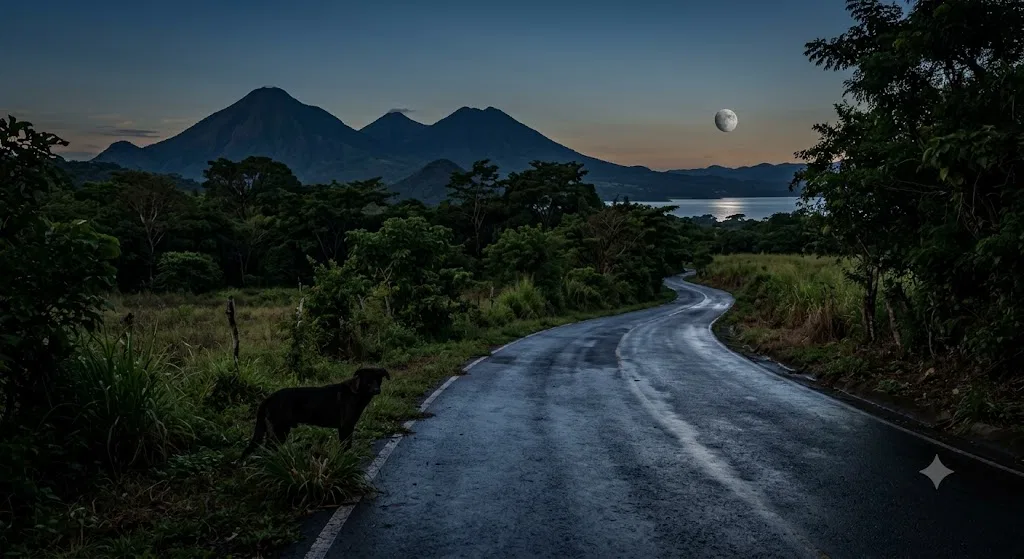
The Cadejo is one of the most recognisable animal-like beings in Salvadoran folklore. It is usually imagined as a mysterious dog that appears to people travelling at night, especially those walking lonely roads, returning late, drinking, courting, or otherwise crossing social boundaries after dark. Salvadoran retellings commonly distinguish between a white Cadejo and a black Cadejo: one protective, one dangerous, though the exact moral arrangement varies by storyteller. A 2024 Salvadoran culture article described the legend as involving two dog-like figures, one associated with protection and goodness, the other with danger and unease.
The Cadejo’s power comes from its ordinary shape. A dog at night is plausible enough to be half-seen, heard, feared and reinterpreted. Red eyes, shining fur, a sudden presence on a road, or a following animal can all become part of a story. That makes the Cadejo a classic “threshold” monster: it belongs to roads, darkness, alcohol, danger, and the journey home.
There is also a deeper regional background. The Cadejo is not exclusive to El Salvador; variants are known across Central America. Broader Mesoamerican traditions include animal companions, spirit doubles and dog figures connected with death, protection and the journey beyond life. The Salvadoran form, however, has become strongly local through repeated telling, school culture, festivals and official cultural programming. The Ministry of Culture has included the black and white Cadejo alongside the Siguanaba and Cipitío in community storytelling and folklore activities, showing that the creature remains part of public cultural memory rather than a dead museum item.[Cultura]cultura.gob.svCultura Mitos y tradiciones de San Antonio Abad se conocieron enCultura Mitos y tradiciones de San Antonio Abad se conocieron en
As a cryptid claim, the Cadejo is weak: there is no serious biological case for an unknown dog species behind the legend. As folklore, it is extremely strong. It gives shape to real fears: unsafe roads, night travel, drunkenness, rural isolation, and the uneasy feeling that something is following just beyond the light.
The Siguanaba and Cipitío: monsters that police rivers, roads and desire
The Siguanaba is often presented as one of El Salvador’s most famous legendary figures. In many versions, she appears near water, washing, combing her hair, or luring men who are out late. From a distance she may seem beautiful; when approached or revealed, she becomes terrifying. The story is not usually a cryptozoological claim, but it belongs in a country-level cryptid guide because it is one of the main “apparition creatures” associated with Salvadoran landscape, especially rivers, ravines and night paths.
Ministry of Culture accounts show how these stories function as remembered warnings. In a San Antonio Abad event, a community elder recalled being told not to go out late because the Siguanaba might “play” with him — a phrasing that captures the legend’s mix of fear, mischief and discipline. The same article places the Siguanaba beside the Cadejo, Cipitío and beliefs in people transforming into animals, showing how the creature sits inside a wider world of night beings and shapeshifting talk.[Cultura]cultura.gob.svCultura Mitos y tradiciones de San Antonio Abad se conocieron enCultura Mitos y tradiciones de San Antonio Abad se conocieron en
The Cipitío is usually linked to the Siguanaba cycle as a childlike trickster figure. He is commonly imagined as a boy with an odd appearance, often playful rather than purely threatening. The Cipitío has become especially adaptable in modern Salvadoran culture: a 2021 profile in elsalvador.com described him as an icon of Salvadoran legends and as a figure used in fiction to symbolise Central American childhood and migration.[historico.elsalvador.com]historico.elsalvador.comOpen source on elsalvador.com.
That modern use is important. The Cipitío is not just a spooky character from old stories; he has become a flexible cultural symbol. In festivals and performance, he can be funny, nostalgic or unsettling. In children’s literature and diaspora storytelling, he can stand for Salvadoran identity. In a cryptid page, he reminds readers that not every “monster” is a huntable animal. Some are vessels for memory.
Cuyancúa: the pig-serpent of Izalco and the sound of coming rain
Cuyancúa is one of El Salvador’s most creature-like legends and therefore one of the closest things in the country’s folklore to a classic monster-beast. The usual description is startling: a large being with the upper body of a pig and the lower body of a snake. It is especially associated with Izalco in the department of Sonsonate and with rivers, streams, ravines and rain. Several retellings say it announces rainfall or stirs fear through strange cries and underground rumbling.[guanacos.com]guanacos.comLa Leyenda de la Cuyancúa, Herencia de los Mayas | GuanacosLa Leyenda de la Cuyancúa, Herencia de los Mayas | Guanacos
This creature has older textual roots than many web summaries suggest. Leonhard Schultze Jena’s collection of Pipil material from Izalco, later circulated in Spanish and Nahuatl editions, is a key reference point for discussions of Izalco mythology and language. Archive and library records identify Mitos y leyendas de los Pipiles de Izalco as a compilation of stories from the Izalco people, while later academic work has treated Schultze Jena’s material as part of the corpus of Pipil myth.[Internet Archive]archive.orgl. schultze jena mitos y leyendas de los pipiles de izalcol. schultze jena mitos y leyendas de los pipiles de izalco
Cuyancúa also has a strong place-based afterlife. Salvadoran tourism reporting has described a Cuyancúa figure at Atecozol, near Izalco, where the creature becomes part of the visitor experience among vegetation and natural pools. This is exactly how many local monster traditions survive: not as courtroom evidence, but as statues, route names, festival images, family stories and landmarks.[elsalvador.com]elsalvador.comLa Cuyancúat: la leyenda viva que habita en Atecozol, IzalcoLa Cuyancúat: la leyenda viva que habita en Atecozol, Izalco
A sceptical reading does not need to flatten the legend. The sounds of water, frogs, pigs, landslips, storms, underground movement and night animals can all feed a rain-beast tradition. The hybrid body — pig and snake — may encode the meeting of land animal, mud, water and seasonal weather. The useful point is not that a literal pig-serpent has been documented around Izalco. It is that Cuyancúa turns weather, sound and water into a memorable creature.
El Tabudo: Lake Coatepeque’s local monster
El Tabudo is El Salvador’s clearest lake-monster-style tradition. It is tied to Lake Coatepeque, a volcanic crater lake in the west of the country. Tourism sources describe Coatepeque as a volcanic lake known for birds, fishing, kayaking, diving and other water activities, while regional tourism material places it south of Santa Ana and gives it a substantial area and depth.[El Salvador Travel]elsalvador.travelEl Salvador Travel Coatepeque LakeEl Salvador Travel Coatepeque Lake
The legend of El Tabudo usually centres on a man connected to the lake who disappears or is taken beneath the water and returns as a strange aquatic being. Modern retellings describe him as a figure with red eyes and unusually long lower limbs who appears around rafts or boats. A 2024 Revista La Brújula article is especially valuable because it treats El Tabudo not merely as a web legend but as part of the cultural and ancestral heritage of Lake Coatepeque, including local testimony from a woman who said she saw him as a child and remembered his connection with fishing luck.[Revista la Brújula]revistalabrujula.comOpen source on revistalabrujula.com.
This is where El Tabudo becomes more than a “Salvadoran Nessie” comparison. He is not usually described as a giant unknown animal cruising the lake. He is a human-water being, a guardian or omen associated with fishermen, abundance, fear and respect for the lake. Some versions say brave fishermen are rewarded with good catches, while fearful ones fare badly.[omarnipolan.com]omarnipolan.comla leyenda de el tabudola leyenda de el tabudo
Lake Coatepeque itself helps the story. Volcanic lakes can look dramatic even without monsters. Coatepeque is known for striking colour changes, and recent scientific and official discussion has linked some water changes to cyanobacteria, microalgae, natural mineralisation, heat, sunlight and nutrients. NASA’s Earth Observatory noted in 2026 that scientists had reported pigments from microalgae and cyanobacteria can affect the lake’s colour, while turquoise episodes may also involve natural mineralisation. El Salvador’s Ministry of Environment has separately reported cyanobacteria increases affecting colour and water quality.[nasa.gov]science.nasa.govScience Lake CoatepequeScience Lake Coatepeque
Those environmental facts do not “explain away” El Tabudo directly, but they show why Coatepeque is fertile ground for legend. A deep volcanic lake that changes colour, smells different in bloom periods, hides currents and supports fishing communities is exactly the kind of place where a water guardian can feel believable.
Chupacabra in El Salvador: imported panic, local livestock fear
The Chupacabra is not originally Salvadoran. The modern legend is usually traced to Puerto Rico in the mid-1990s, then spreading quickly through Latin America and Spanish-language media. El Salvador became part of that regional wave, with local newspapers later looking back on Chupacabra scares that frightened Salvadorans in the 1990s and returned in later animal-death stories.[historico.elsalvador.com]historico.elsalvador.comel chupacabras la criatura que aterrorizo a los salvadorenos en los anos 90el chupacabras la criatura que aterrorizo a los salvadorenos en los anos 90
The Salvadoran cases fit the broader pattern: dead livestock or domestic animals, rumours of blood loss, strange wounds, and rapid media amplification. Reports rarely produce verifiable biological evidence. In many countries, alleged Chupacabra carcasses have turned out to be ordinary animals with disease, especially canids suffering from mange. Salvadoran reporting on “the truth behind the Chupacabra” cited explanations involving animals that had lost hair because of sarcoptic mange, a skin disease caused by mites.[historico.elsalvador.com]historico.elsalvador.comla verdad detras del chupacabrasla verdad detras del chupacabras
This explanation is not a lazy dismissal. Mange can make dogs, coyotes, foxes or similar animals look shockingly unnatural: hairless skin, gaunt bodies, exposed teeth, odd movement and a sickly appearance. Predator kills can also be misunderstood. Domestic dogs and wild canids may kill without fully eating prey, and puncture wounds from teeth can be interpreted as “blood-draining” marks after the fact. Broader sceptical treatments of the Chupacabra have made the same point: the legend persists partly because normal scavenging, disease, decomposition and predator behaviour look strange when seen unexpectedly.[Wikipedia]WikipediaOpen source on wikipedia.org.
In El Salvador, the Chupacabra is best read as a media cryptid rather than a deep local creature. It arrived through the Spanish-speaking news ecosystem, attached itself to real rural anxieties, and then entered pop culture. The name is now flexible enough to be used beyond monster scares: a 2025 Salvadoran surf report noted that elite surfers named a powerful wave “La Chupacabra” because it felt mysterious, heavy and dangerous.[elsalvador.com]elsalvador.comSurfistas de élite hallan olas top mundial en El SalvadorSurfistas de élite hallan olas top mundial en El Salvador
Phantom cats and real wild cats: when folklore meets ecology
El Salvador once had a stronger large-cat landscape than it does today. The jaguar is generally treated as extirpated in the country, while puma status has been more complicated. A 2011 study on public perceptions discussed jaguars and pumas as extinct in El Salvador in the context of possible conservation and reintroduction debates, but a 2020 paper reported the first photographic records of puma in the country and noted that limited recent records had led some researchers to think pumas were extinct or nearly so.[JSTOR]jstor.orgOpen source on jstor.org.
That uncertainty matters for monster stories. In countries where large carnivores are rare, people may misread brief sightings. A puma seen at dusk can become an impossible “black panther”; an ocelot, margay or jaguarundi glimpsed on a road can become a strange cat; a coyote or fox with mange can become a Chupacabra. El Salvador’s known or historically present carnivore fauna gives enough real animal texture for misidentification, but not enough evidence to support a hidden population of giant unknown cats.
Modern conservation research also complicates old assumptions. A 2024 University of El Salvador-linked study addressed knowledge gaps around resident wild cats and described the puma as the country’s largest terrestrial mammal.[sic.ues.edu.sv]sic.ues.edu.svOpen source on edu.sv. That does not mean every big-cat rumour is credible. It means that the sceptical explanation should begin with documented fauna, habitat fragmentation, local knowledge and camera-trap evidence — not with either instant belief or instant ridicule.
For readers, the practical distinction is simple: a reported large cat in El Salvador may be ecologically interesting, but it is not automatically a cryptid. The right questions are: where was it seen, what size estimate was possible, were tracks or images collected, are known felids present nearby, and did the witness see a cat clearly or only a moving shape in poor light?
Why Salvadoran monster stories cluster around water, roads and night
The geography of Salvadoran creature lore is not random. Many of the strongest stories live in places where ordinary perception is already unstable: riverbanks, ravines, volcanic lakes, rural tracks, dark streets, and the edge between settlement and wild vegetation. These are settings where sound carries strangely, visibility drops, animals move unseen, and social rules become more tense.
The pattern is especially clear in three figures:
- The Cadejo belongs to the road at night. Its story makes sense in a world where walking home after dark could mean danger from animals, people, alcohol, weather or accident.
- The Siguanaba belongs to rivers, ravines and sexual temptation. Her legend turns risky desire and night wandering into a frightening encounter.
- Cuyancúa and El Tabudo belong to water. One is associated with rivers, rain and Izalco; the other with Coatepeque’s fishing culture and volcanic lake landscape.
These stories also carry social information. They warn children not to wander, men not to chase strangers at night, drinkers to return home carefully, and communities to respect water sources. The supernatural element makes the lesson memorable. A warning about a dangerous ravine is useful; a warning about the Siguanaba waiting there is unforgettable.
Festivals, museums and tourism keep the creatures alive
El Salvador’s monster tradition is not only whispered at home. It is performed. The Ministry of Culture has supported activities where children and community groups engage with figures such as the Siguanaba, Cipitío, Cadejo and other popular characters. Official cultural reporting has also described these mythological figures appearing in folklore groups, museum events, storytelling activities and seasonal displays.[Cultura]cultura.gob.svministerio de cultura entrego vestuario a grupos folkloricos de primera infanciaministerio de cultura entrego vestuario a grupos folkloricos de primera infancia
One of the clearest public afterlives is La Calabiuza in Tonacatepeque, a festival often described as a Salvadoran alternative or response to Halloween. Local media coverage presents it as a night when figures such as the Siguanaba and Cipitío appear among torches, illuminated pumpkins and traditional characters.[elsalvador.com]elsalvador.comtonacatepeque festivales culturales halloween el salvadortonacatepeque festivales culturales halloween el salvador
Tourism does similar work. At Lake Coatepeque, El Tabudo is not just a frightening being but a story that boat operators, restaurants and local guides can use to give the lake personality. Around Izalco and Atecozol, Cuyancúa becomes a sculptural and place-based marker of local myth. These uses do not necessarily preserve an “original” version. They create new versions for visitors, children, diaspora audiences and social media.
That is why Salvadoran cryptid history should not be judged only by whether a creature can be proven real. In practice, the country’s monsters remain alive because they are useful: they teach, scare, entertain, brand places, organise festivals and help people recognise a shared cultural world.
What evidence would change the assessment?
For most Salvadoran folklore creatures, biological evidence is not the right standard. No photograph will “prove” the Siguanaba in a zoological sense, because the story is not built as a zoological claim. The better evidence is cultural: oral histories, older printed collections, festival continuity, place names, local testimony, and how the legend changes across generations.
For modern animal claims, however, stronger standards are fair. A credible Salvadoran mystery-beast case would need:
- clear location, date and witness details;
- photographs or video with scale and context;
- tracks, hair, scat or carcass evidence preserved for expert review;
- veterinary or wildlife analysis of killed livestock;
- comparison with known animals in the area;
- caution about viral reposts, staged images and recycled regional Chupacabra claims.
So far, the strongest evidence supports a cultural-folkloric reading rather than an undiscovered-animal reading. The Cadejo, Siguanaba, Cipitío, Cuyancúa and El Tabudo are best understood as Salvadoran legendary beings rooted in oral tradition and landscape. Chupacabra stories are better understood as imported media folklore shaped by livestock anxiety and misidentified animals. Phantom-cat claims sit in the middle: they may sometimes involve real but rare wild cats, but the leap from rare animal to unknown cryptid requires evidence that public reports usually do not provide.
The useful way to read El Salvador’s monsters
El Salvador’s creature lore is strongest when read as a map of fear and memory. Roads produce the Cadejo. Rivers and ravines produce the Siguanaba. Izalco’s rain and waterways produce Cuyancúa. Coatepeque’s volcanic lake culture produces El Tabudo. Modern media produces the Chupacabra panic, then recycles it into jokes, branding and pop culture.
The country’s cryptid tradition is therefore not thin; it is simply different from a “hunt the monster” file. It is a living folklore system where animal forms, supernatural warnings and local landscapes overlap. The evidence-aware conclusion is that El Salvador has no confirmed unknown beast behind its major legends, but it does have one of Central America’s most vivid collections of creature stories — stories that still walk roads, sit by lakes, appear in festivals, and give strange shape to ordinary places after dark.
Amazon book picks
Further Reading
Books and field guides related to What Haunts El Salvador's Roads and Waters?. Use these as the next step if you want deeper reading beyond the article.
Latin American Folktales
Introduces folklore themes closely related to Salvadoran monster stories.
The Mythology Book
Offers broad comparative mythology useful for understanding folklore creatures.
Gods of Jade and Shadow
Appeals to readers interested in mythic creatures and Latin American legends.
eBay marketplace picks
Marketplace Samples
Live-tested eBay searches with available results related to this page.



Endnotes
1.
Source: cultura.gob.sv
Title: Cultura Mitos y tradiciones de San Antonio Abad se conocieron en
Link:https://www.cultura.gob.sv/mitos-y-tradiciones-de-san-antonio-abad-se-conocieron-en-maquilishuat-bajo-la-luna/
2.
Source: cultura.gob.sv
Title: ministerio de cultura entrego vestuario a grupos folkloricos de primera infancia
Link:https://www.cultura.gob.sv/ministerio-de-cultura-entrego-vestuario-a-grupos-folkloricos-de-primera-infancia/
3.
Source: ich.unesco.org
Link:https://ich.unesco.org/es/tradiciones-y-expresiones-orales-00053
4.
Source: historico.elsalvador.com
Link:https://historico.elsalvador.com/historico/847500/randy-jurado-escritor-salvadoreno-en-estados-unidos-personas-mitologicos-migracion-centroamericana.html
5.
Source: guanacos.com
Title: La Leyenda de la Cuyancúa, Herencia de los Mayas | Guanacos
Link:https://guanacos.com/leyenda-[cuyancua
6.
Source: Wikipedia
Link:https://es.wikipedia.org/wiki/Cuyanc%C3%BAa
7.
Source: archive.org
Title: l. schultze jena mitos y leyendas de los pipiles de izalco
Link:https://archive.org/details/l.-schultze-jena-mitos-y-leyendas-de-los-pipiles-de-izalco
8.
Source: elsalvador.com
Title: La Cuyancúat: la leyenda viva que habita en Atecozol, Izalco
Link:https://www.elsalvador.com/turismo/cultura-viva/turismo-izalco/1251547/2025/
9.
Source: elsalvador.travel
Title: El Salvador Travel Coatepeque Lake
Link:https://elsalvador.travel/destination/coatepeque-lake/en/
10.
Source: omarnipolan.com
Title: la leyenda de el tabudo
Link:https://omarnipolan.com/2024/02/la-leyenda-de-el-tabudo/
11.
Source: guanacos.com
Title: leyenda el tabudo del lago coatepeque
Link:https://guanacos.com/leyenda-el-tabudo-del-lago-coatepeque/
12.
Source: science.nasa.gov
Title: Science Lake Coatepeque
Link:https://science.nasa.gov/earth/earth-observatory/lake-coatepeque/
13.
Source: ambiente.gob.sv
Title: incremento de cianobacterias en el lago de coatepeque
Link:https://www.ambiente.gob.sv/incremento-de-cianobacterias-en-el-lago-de-coatepeque/
14.
Source: ambiente.gob.sv
Title: incremento de cianobacterias en lago de coatepeque
Link:https://www.ambiente.gob.sv/incremento-de-cianobacterias-en-lago-de-coatepeque/
15.
Source: historico.elsalvador.com
Title: el chupacabras la criatura que aterrorizo a los salvadorenos en los anos 90
Link:https://historico.elsalvador.com/historico/507326/el-chupacabras-la-criatura-que-aterrorizo-a-los-salvadorenos-en-los-anos-90.html
16.
Source: historico.elsalvador.com
Title: las veces que el chupacabres atemorizo salvador
Link:https://historico.elsalvador.com/historico/845333/las-veces-que-el-chupacabres-atemorizo-salvador.html
17.
Source: historico.elsalvador.com
Title: la verdad detras del chupacabras
Link:https://historico.elsalvador.com/historico/210727/la-verdad-detras-del-chupacabras.html
18.
Source: Wikipedia
Link:https://es.wikipedia.org/wiki/Chupacabras
19.
Source: elsalvador.com
Title: Surfistas de élite hallan olas top mundial en El Salvador
Link:https://www.elsalvador.com/deportes/surf/la-paz-rio-lempa-surf/1247512/2025/
20.
Source: jstor.org
Link:https://www.jstor.org/stable/41240500
21.
Source: sic.ues.edu.sv
Link:https://www.sic.ues.edu.sv/Minerva/user/setLocale/en_US?source=%2FMinerva%2Farticle%2Fview%2F295
22.
Source: cultura.gob.sv
Title: muna de noche clausuro talleres y celebro la navidad
Link:https://www.cultura.gob.sv/muna-de-noche-clausuro-talleres-y-celebro-la-navidad/
23.
Source: cultura.gob.sv
Title: arte cultura y diversion ofrecio el muna
Link:https://www.cultura.gob.sv/arte-cultura-y-diversion-ofrecio-el-muna/
24.
Source: elsalvador.com
Title: tonacatepeque festivales culturales halloween el salvador
Link:https://www.elsalvador.com/turismo/cultura-viva/tonacatepeque-festivales-culturales-halloween-el-salvador/1249021/2025/
25.
Source: guanacos.com
Title: La Leyenda del Cadejo: Su origen y significado
Link:https://guanacos.com/leyenda-del-cadejo-cuando-se-creo-que-significado-tiene/
26.
Source: Wikipedia
Link:https://en.wikipedia.org/wiki/Sisimito
27.
Source: Wikipedia
Link:https://en.wikipedia.org/wiki/Cipit%C3%ADo
28.
Source: Wikipedia
Link:https://en.wikipedia.org/wiki/Sihuanaba
29.
Source: Wikipedia
Title: Salvadoran folklore
Link:https://en.wikipedia.org/wiki/Salvadoran_folklore
30.
Source: Wikipedia
Link:https://es.wikipedia.org/wiki/Leyenda
31.
Source: Wikipedia
Link:https://en.wikipedia.org/wiki/Chupacabra
32.
Source: Wikipedia
Link:https://en.wikipedia.org/wiki/Jaguar
33.
Source: Wikipedia
Link:https://es.wikipedia.org/wiki/Cadejo
34.
Source: biblioteca.asamblea.gob.sv
Title: asamblea.gob.sv Tradición oral de El Salvador
Link:https://biblioteca.asamblea.gob.sv/3716_tradicin-oral-de-el-salvador?q=
35.
Source: omarnipolan.com
Title: la cuyuncua leyenda
Link:https://omarnipolan.com/2023/06/la-cuyuncua-leyenda/
36.
Source: elsalvador.com
Title: leyendas tradiciones el salvador mitos juego
Link:https://www.elsalvador.com/entretenimiento/arte-y-cultura/leyendas-tradiciones-el-salvador-mitos-juego/1236672/2025/
37.
Source: historico.elsalvador.com
Title: viejos de agosto una divertida tradicion salvadorena que se niega a desaparecer
Link:https://historico.elsalvador.com/historico/626659/viejos-de-agosto-una-divertida-tradicion-salvadorena-que-se-niega-a-desaparecer.html
38.
Source: elsalvador.com
Link:https://www.elsalvador.com/
39.
Source: elsalvador.com
Title: leyendas dia de los difuntos el salvador
Link:https://www.elsalvador.com/h-entretenimiento/h-cultura/leyendas-dia-de-los-difuntos-el-salvador/1178697/2024/
40.
Source: historico.elsalvador.com
Title: la calabiuza cuando el espanto se apodera de tonacatepeque
Link:https://historico.elsalvador.com/historico/654579/la-calabiuza-cuando-el-espanto-se-apodera-de-tonacatepeque.html
41.
Source: elsalvador.com
Link:https://www.elsalvador.com/h-entretenimiento/h-turismo/tonacatepeque-calabiuza-festival-leyendas-salvadorenas-ayote-miel-espantos-celebrar/1011238/2022/
42.
Source: elsalvador.com
Title: halloween cual es su origen
Link:https://www.elsalvador.com/entretenimiento/escena/halloween-cual-es-su-origen/1249079/2025/
43.
Source: historico.elsalvador.com
Title: leyendas en verapaz
Link:https://historico.elsalvador.com/historico/408182/leyendas-en-verapaz.html
44.
Source: historico.elsalvador.com
Title: habitantes del municipio de el congo celebran el dia de la ceniza
Link:https://historico.elsalvador.com/historico/114952/habitantes-del-municipio-de-el-congo-celebran-el-dia-de-la-ceniza.html
45.
Source: elsalvador.com
Title: en tonacatepeque estan listos para realizar el festival de la calabiuza
Link:https://www.elsalvador.com/h-entretenimiento/h-turismo/en-tonacatepeque-estan-listos-para-realizar-el-festival-de-la-calabiuza/1176508/2024/
46.
Source: elsalvador.com
Title: texas criatura zoologico foto viral
Link:https://www.elsalvador.com/h-entretenimiento/h-viral-entretenimiento/texas-criatura-zoologico-foto-viral/965222/2022/
47.
Source: historico.elsalvador.com
Title: video pareja captura supuesto chupacabras en texas
Link:https://historico.elsalvador.com/historico/126593/video-pareja-captura-supuesto-chupacabras-en-texas.html
48.
Source: elsalvador.com
Title: viral emu granja aves florida tiktok
Link:https://www.elsalvador.com/h-entretenimiento/h-viral-entretenimiento/viral-emu-granja-aves-florida-tiktok/980301/2022/
49.
Source: elsalvador.com
Title: nace ternero con dos cabezas
Link:https://www.elsalvador.com/h-noticias/h-internacional/nace-ternero-con-dos-cabezas/968390/2022/
50.
Source: historico.elsalvador.com
Title: johnny depp confiesa que fue atacado por el chupacabras
Link:https://historico.elsalvador.com/historico/143444/johnny-depp-confiesa-que-fue-atacado-por-el-chupacabras.html
51.
Source: cultura.gob.sv
Title: muna recibio a ministros de cultura y educacion de la cecc sica
Link:https://www.cultura.gob.sv/muna-recibio-a-ministros-de-cultura-y-educacion-de-la-cecc-sica/
52.
Source: cultura.gob.sv
Title: Revista identidades 19-Digital_c
Link:https://www.cultura.gob.sv/wp-content/uploads/2025/02/Revista-identidades-19-Digital_c.pdf
53.
Source: udb.edu.sv
Link:https://www.udb.edu.sv/editorial/pdf/es/coleccioninvestigacion/serieinvestigacion/mitos-de-la-lengua-materna-de-los-pipiles.pdf
54.
Source: chileparaninos.gob.cl
Link:https://www.chileparaninos.gob.cl/639/articles-350035_archivo_01.pdf
55.
Source: libreria.ues.edu.sv
Title: leyendas del mundo
Link:https://libreria.ues.edu.sv/leyendas-del-mundo.html
56.
Source: unidadambiental.ues.edu.sv
Link:https://unidadambiental.ues.edu.sv/lago-de-coatepeque-declarado-bajo-condicion-de-emergencia-ambiental-por-proliferacion-de-cianobacterias/
57.
Source: revistas.utec.edu.sv
Link:https://revistas.utec.edu.sv/index.php/koot/article/view/865/1161
58.
Source: revistalabrujula.com
Link:https://revistalabrujula.com/2024/09/24/el-tabudo-y-otras-historias-patrimonio-cultural-y-ancestral-del-lago-de-coatepeque/
59.
Source: mitologia.fandom.com
Link:https://mitologia.fandom.com/es/wiki/Cuyanc%C3%BAa
60.
Source: mitologia.fandom.com
Link:https://mitologia.fandom.com/es/wiki/Tabudo
61.
Source: ultimatepopculture.fandom.com
Link:https://ultimatepopculture.fandom.com/wiki/Chupacabra
62.
Source: mythfolks.com
Title: salvadoran folklore
Link:https://www.mythfolks.com/salvadoran-folklore
63.
Source: ocelotworkinggroup.wixsite.com
Link:https://ocelotworkinggroup.wixsite.com/website/copia-de-brasil
64.
Source: curiositlan.com.sv
Title: el tabudo
Link:https://curiositlan.com.sv/el-tabudo/
65.
Source: blog.walkingwithelsalvador.org
Title: the legend of el tabudo
Link:https://blog.walkingwithelsalvador.org/2012/08/the-legend-of-el-tabudo.html
66.
Source: alilorraine.blogspot.com
Title: salvadoran folklore
Link:https://alilorraine.blogspot.com/2011/06/salvadoran-folklore.html
Additional References
67.
Source: youtube.com
Title: Leyendas Centroamericanas: El Cipitio, La Siguanaba, El Cadejo
Link:https://www.youtube.com/watch?v=d-MXmF6jDOg
Source snippet
La Siguanaba: The Legend of the Horse Lady...
68.
Source: youtube.com
Title: Katharine’s Creatures Episode 215: Sihuanaba
Link:https://www.youtube.com/watch?v=9WveIihjPIM
Source snippet
Leyendas Centroamericanas: El Cipitio, La Siguanaba, El Cadejo...
69.
Source: youtube.com
Title: The Cadejo: A Legendary Battle Between Light and Shadow
Link:https://www.youtube.com/watch?v=VzvOd-uYzBM
Source snippet
Katharine's Creatures Episode 215: Sihuanaba...
70.
Source: facebook.com
Link:https://www.facebook.com/groups/343876915649930/posts/4093263814044536/
71.
Source: facebook.com
Link:https://www.facebook.com/PD.AhoraNoticias/posts/ahoranoticias-el-ministerio-de-medio-ambiente-reporta-una-proliferaci%C3%B3n-de-ciano/967140955909673/
72.
Source: academia.edu
Link:https://www.academia.edu/115789918/Estudio_del_Patrimonio_Cultural_Inmaterial_del_%C3%A1mbito_tradiciones_y_expresiones_orales_sub%C3%A1mbito_leyendas_y_expresiones_orales_para_la_creaci%C3%B3n_de_una_gu%C3%ADa_en_la_parroquia_Aan_Juan_de_Pastocalle_cant%C3%B3n_Latacunga_provincia_de_Cotopaxi
73.
Source: academia.edu
Link:https://www.academia.edu/5886305/Mitos_de_lengua_materna_pipil_en_izalco
74.
Source: researchgate.net
Link:https://www.researchgate.net/publication/230325443_Public_perceptions_of_jaguars_Panthera_onca_pumas_Puma_concolor_and_coyotes_Canis_latrans_in_El_Salvador
75.
Source: researchgate.net
Link:https://www.researchgate.net/publication/350119512_Mitologia_en_las_cosmovisiones_Izalquenas_universo_simbolico_de_nahuales_y_contra_nahuales
76.
Source: researchgate.net
Link:https://www.researchgate.net/publication/367546066_Facultad_de_Ciencias_Sociales_Relatos_Relacionados_a_la_Fauna_de_El_Salvador_Importancia_de_la_Tradicion_Oral
Topic Tree
Follow this branch
Related pages 192
- Antigua Cryptids
- Maldives Monsters
- Malta Monsters
- Qatar Monsters
- Argentina Monsters
- +187 more in sidebar