Cryptids of Kuwait's Folklore
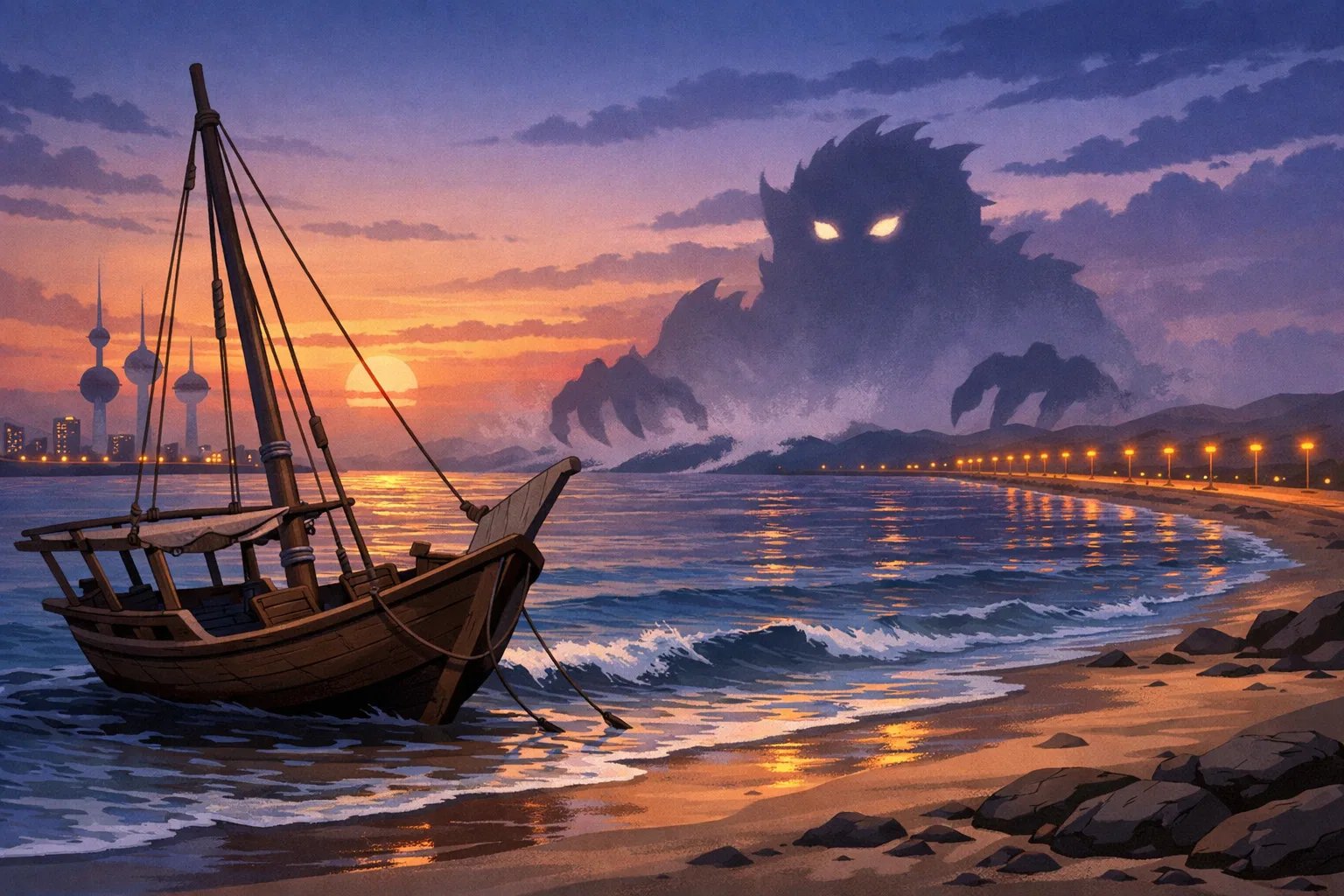
Kuwait has a richer monster tradition than its small size might suggest, but it is not a country of Loch Ness-style lake monsters or well-documented mystery-beast flaps.
Page outline Jump by section
Why Kuwait’s monsters are mostly folklore, not field reports
Kuwait’s creature tradition sits at the meeting point of desert, coast and old maritime life. The country is largely arid and flat, with a long relationship to the north-western Arabian Gulf; before oil, pearling, fishing, boatbuilding and trade gave the sea an everyday importance that naturally produced danger stories. Official tourism material still presents pearl diving as a defining pre-oil livelihood and notes that annual pearl-diving festivals now preserve the memory of that hardship for younger generations.[eGov Kuwait]e.gov.kwOpen source on e.gov.kw.
That matters because many Kuwaiti monsters are not “animals glimpsed in the woods” in the North American cryptid sense. They are social warnings in creature form. A child is told not to go outside at noon because Hemarat Al-Gayla might be waiting. A sailor hears a cry at night and remembers Bu Darya, the deceptive sea being that lures rescuers. A moving ember becomes Edaida, warning children away from the dark. These figures work like memorable safety devices: they turn heatstroke, drowning, road danger and disobedience into stories that are hard to forget.[Kuwait Times]kuwaittimes.comOpen source on kuwaittimes.com.
The modern record also suggests caution. Kuwait has no strong public archive of repeated ape-man reports, phantom big-cat waves or lake-monster sightings comparable with better-known cryptid countries. Where a recent “monster” style claim does appear online, such as the so-called Al-Fintas carcass discussed in cryptozoology circles, the available public account frames it as a misidentified ray rather than an unknown species. That does not make the folklore unimportant; it simply means the best way to read Kuwait’s monster tradition is as cultural history first and zoological mystery second.[Reddit]reddit.comThe so called "Al-Fintas Monster", a mysterious carcassThe so called "Al-Fintas Monster", a mysterious carcass
The noon donkey-woman: Hemarat Al-Gayla
Hemarat Al-Gayla is probably the clearest Kuwaiti example of a monster with a practical purpose. Heritage researcher Salem Abdullatif Al-Misbah told Kuwait Times that the name combines the idea of a female donkey with “al-gayla”, noon, and that people described a creature that could harm anyone who met it on the road at midday. Children were warned about it so they would stay indoors during the hottest part of the day.[Kuwait Times]kuwaittimes.comOpen source on kuwaittimes.com.
Older and newer summaries vary in the details. A 2015 KUNA/Kuwait Times account describes a frightening hybrid with the face of an old woman and donkey feet, used by parents to scare unruly children. A 2023 local culture write-up similarly presents her as a half-woman, half-donkey child-eating figure whose real-world function was to keep children from wandering into dangerous heat. The core is stable even when the body changes: this is a heat monster, tied to Kuwait’s climate and the daily rhythm of old neighbourhood life.[Kuwait Times]kuwaittimes.comOpen source on kuwaittimes.com.
For a cryptid reader, the important point is that Hemarat Al-Gayla is not best treated as a literal hidden animal. Her animal features are symbolic and instructional. The donkey body makes the figure grotesque and memorable; the noon timing makes the warning precise. She belongs beside other child-safety monsters around the world, where the creature is less a species claim than a compact lesson: do not go where adults know the danger is real.
Bu Darya: Kuwait’s sea monster of sailors and pearl divers
Bu Darya is the most cryptid-like figure in Kuwaiti folklore because it is attached to a real habitat, the sea, and to a dangerous occupation, seafaring. Kuwait Times describes Bu Darya as a human-like water demon believed to climb aboard ships, seize sailors and drag them underwater. The same account notes a related Arabic literary creature, Al-Atoom, described with fish-like tails and arms but no legs.[Kuwait Times]kuwaittimes.comOpen source on kuwaittimes.com.
The 2015 KUNA/Kuwait Times version gives the tale a classic maritime-horror shape. Bu Darya appears as a half-human, half-fish being in the high seas, shrieking at night as though someone is drowning. When a sailor approaches to rescue the supposed victim, the creature grabs and drowns him. This is a powerful story because it twists an honourable instinct — saving someone in distress — into a trap.[Kuwait Times]kuwaittimes.comOpen source on kuwaittimes.com.
The setting is essential. Pearl divers and sailors faced drowning, exhaustion, bad weather and marine animals. Gulf maritime reporting and cultural histories regularly stress the danger of traditional pearling, including deep repeated dives and long periods at sea; modern Kuwaiti heritage festivals preserve the memory of that difficulty rather than presenting pearling as an easy romance. In that world, Bu Darya makes emotional sense: he personifies the sea as a place that can call, deceive and take people without warning.[eGov Kuwait]e.gov.kwOpen source on e.gov.kw.
Bu Darya is also not uniquely Kuwaiti. Similar “Lord of the Sea” traditions appear elsewhere in the Arabian Gulf, especially in pearling cultures. That regional spread does not weaken the Kuwaiti connection; it helps explain it. Kuwait’s version belongs to a wider Gulf seafaring imagination, but it became locally meaningful because Kuwait’s own history was deeply tied to boats, fish, pearls and the dangers of night water.[Academia]academia.eduPDF) A Tale of “The Lord of the Sea” in Qatari FolklorePDF) A Tale of “The Lord of the Sea” in Qatari Folklore
Night roads, palm noise and phantom fire
Not every Kuwaiti monster lives at sea. Several are tied to night travel, household discipline and uncanny sounds or lights.
Tantal is described in Kuwait Times as a very tall, strange figure with long arms, a large head and intimidating eyes, said to appear on roads at night. People were said to frighten it away with a long needle. The creature’s value is partly atmospheric — a looming shape on a dark road — but it also fits a practical pattern: old stories made night wandering feel risky, especially for children.[Kuwait Times]kuwaittimes.comOpen source on kuwaittimes.com.
Umm al-Sa’af and al-Leef is stranger and more localised. One modern account describes her as a frightening old woman with messy hair and wings, used to threaten children into sleeping at night. Misbah’s explanation is especially useful because it gives a natural trigger: the figure may have been inspired by a type of palm tree whose fronds made noise during dark, windy nights, leading children to imagine a creature. The older KUNA/Kuwait Times account similarly describes her as an unkempt woman who could fly using a palm frond.[Kuwait Times]kuwaittimes.comOpen source on kuwaittimes.com.
Edaida, or the glowing ember figure, is another example where a “monster” may begin as an environmental perception. Kuwait Times describes it as appearing like fire or moving embers that retreat when approached, a character used to scare children from going out at night. The 2015 account calls Al-Duaidea a mythological figure that made a person see a burning cinder that shifted position when approached. The folklore explanation is supernatural; the sceptical reading is that distant lights, heat shimmer, small fires, reflections or simple childhood fear could be shaped into a moving phantom.[Kuwait Times]kuwaittimes.comOpen source on kuwaittimes.com.
Al-Seolu and the 1910 drowning memory
Al-Seolu is one of the darker Kuwaiti figures because it is attached, in reported folklore, to a specific remembered incident. The 2015 KUNA/Kuwait Times article says Kuwaiti historian Yousef Al-Qenaie referred to Al-Seolu in Pages from the History of Kuwait, describing him as a tall Nubian slave with elongated teeth who kidnapped and ate children. The same article says fear of Al-Seolu intensified in 1910 after a young boy drowned by the seashore and was not found, leading some people to believe the creature had eaten him.[Kuwait Times]kuwaittimes.comOpen source on kuwaittimes.com.
This is exactly the kind of episode where an evidence-aware reading matters. The underlying event, as retold, is a drowning and disappearance, not proof of a man-eating monster. Folklore can attach a face to a tragedy, especially when a body is not recovered and a community needs a story that explains fear, grief and uncertainty. Al-Seolu therefore belongs less to biological cryptozoology than to social memory: a monster formed around child safety, shore danger and the horror of vanishing.
The figure also shows how old folklore can preserve uncomfortable social material. Descriptions that racialise or enslave the monster reflect the prejudices and social hierarchies of the period in which the story circulated. A modern public-facing account can record that such descriptions exist without repeating them as neutral truth. The useful question is not “was Al-Seolu real?” but “what fears did people project into this figure, and why did the story become credible to them after a child disappeared?”
The Al-Fintas “monster” and the ray problem
Modern cryptid culture often begins with an image: a carcass, a blurry video, a strange thing pulled from water. Kuwait’s recent example is the so-called Al-Fintas Monster, discussed online as a mysterious carcass dredged up in Kuwait. The publicly visible cryptozoology discussion says Dr Manaf Behbehani identified it as a stingray, and commenters compared the shape to “Jenny Haniver” curios made from dried rays.[Reddit]reddit.comThe so called "Al-Fintas Monster", a mysterious carcassThe so called "Al-Fintas Monster", a mysterious carcass
That explanation is plausible because Kuwait’s waters do contain rays. A scientific review of Kuwait’s marine biodiversity notes that the country’s fish checklist includes 348 fish species, with sharks and rays represented by dozens of species; it also states that Kuwait has historically provided habitat for a large share of the shark and ray species known from the Gulf region.[IUCN Portals]portals.iucn.orgOpen source on iucn.org.
This case is useful because it shows how a real animal can become briefly monstrous through condition and context. Rays have flat bodies, wing-like fins and odd-looking undersides. When damaged, dried, decomposed or viewed out of water, they can look less like familiar fish and more like masks, goblins or sea-devils. That does not require a hoax; it only requires an unfamiliar carcass, a dramatic photo and an audience primed for mystery.
What real animals could sit behind Kuwaiti monster stories?
Kuwait’s biodiversity gives sceptics several ordinary starting points, especially for sea and desert reports. The IUCN/EPA biodiversity review records Kuwait as a small country with a rich fauna and notes surviving mammals, reptiles, marine mammals, fish, sharks and rays. It lists 29 mammal species, 45 reptile species, and marine mammals reported from Kuwait or the Gulf, including Indo-Pacific humpback dolphin, finless porpoise and dugong.[IUCN Portals]portals.iucn.orgOpen source on iucn.org.
For sea stories, rays, sharks, dolphins, turtles and dugongs are the most relevant. A surfacing dolphin at night, a ray carcass, a turtle in poor visibility or a large fish glimpsed from a boat could all produce reports that feel larger and stranger in retelling. Kuwait’s marine environment is also genuinely complex: a 2021 Marine Pollution Bulletin study describes a range of habitats including coral reefs and seagrass meadows, while also noting that fine-scale knowledge of biodiversity distribution remains incomplete.[ScienceDirect]sciencedirect.comOpen source on sciencedirect.com.
For land stories, Kuwait’s fauna is less suited to large mystery beasts today. The IUCN/EPA review records extinct or locally lost large mammals such as wolf, caracal, cheetah and Arabian oryx, while surviving mammals are more likely to be smaller desert species, bats, rodents, foxes and hedgehogs. Reptiles are more numerous, with 45 recorded species, including lizards, snakes and marine turtles. That ecological picture makes repeated reports of large hidden land animals unlikely, but it leaves room for misread night encounters with foxes, feral dogs, reptiles, birds or moving vegetation.[IUCN Portals]portals.iucn.orgOpen source on iucn.org.
The best sceptical explanations for Kuwaiti creature lore are therefore not dismissive. They are layered:
- Folklore as safety teaching: Hemarat Al-Gayla, Tantal and Edaida warn children away from heat, roads and night wandering.
- Sea danger made personal: Bu Darya turns drowning, night cries and pearling risk into a being with motives.
- Misidentified animals: Rays, sharks, turtles, dolphins and dugongs can look uncanny when glimpsed briefly or found dead.
- Environmental triggers: Wind in palms, distant lights, mirage-like effects and darkness can help create a creature before a story gives it a name.
- Community memory: Al-Seolu shows how a tragic disappearance can be absorbed into a monster tradition.

How Kuwaiti monster lore survives today
Kuwait’s old monsters now survive less through alleged sightings than through heritage writing, journalism, art and online rediscovery. Kuwait Times has repeatedly revisited these figures, including through interviews with heritage researchers and coverage of artworks by Kuwaiti artists such as Nawaf Al-Hmeli. The 2024 article explicitly frames the stories as tales passed through generations and as part of Kuwait’s heritage, while the 2015 KUNA-sourced feature says such characters have receded with modern education.[Kuwait Times]kuwaittimes.comOpen source on kuwaittimes.com.
That shift changes the creatures. A monster once used to keep a child indoors becomes a subject for paintings, nostalgia pieces, cultural explainers and social-media posts. The fear softens into curiosity. Readers can enjoy Hemarat Al-Gayla or Bu Darya as spooky national folklore without needing to believe a donkey-woman roams Kuwait at noon or a fish-man still boards ships in the Gulf.
For a country-level cryptid page, Kuwait is therefore best understood as a folklore-rich but evidence-thin cryptid landscape. Its most important creatures are not hidden apes or lake monsters, but cautionary beings shaped by heat, sea, night, childhood and memory. The mystery is not whether a new species is waiting in the desert. It is how everyday dangers became unforgettable monsters — and why those monsters still cast a spell long after the world that made them has changed.
Amazon book picks
Further Reading
Books and field guides related to What Monsters Haunt Kuwait's Folklore?. Use these as the next step if you want deeper reading beyond the article.
The Element Encyclopedia of Magical Creatures
Explores folklore creatures from many cultures, including related supernatural themes.
The Lore of the Land
Illustrates how local environments generate enduring monster traditions.
Encyclopedia of Things that Never Were
Covers legendary creatures and folklore motifs comparable to Kuwait's monsters.
Arabian Mythology
Provides regional context for supernatural beings, monsters and folklore across the Arab world.
eBay marketplace picks
Marketplace Samples
Live-tested eBay searches with available results related to this page.


Endnotes
1.
Source: reddit.com
Title: The so called “Al-Fintas Monster”, a mysterious carcass
Link:https://www.reddit.com/r/Cryptozoology/comments/1qd8mzt/the_so_called_alfintas_monster_a_mysterious/
2.
Source: academia.edu
Title: (PDF) A Tale of “The Lord of the Sea” in Qatari Folklore
Link:https://www.academia.edu/34106946/A_Tale_of_The_Lord_of_the_Sea_in_Qatari_Folklore_and_Tradition
3.
Source: academia.edu
Link:https://www.academia.edu/82472974/Maritime_Folklore_of_Kuwait
4.
Source: portals.iucn.org
Link:https://portals.iucn.org/library/sites/library/files/documents/2021-030-En.pdf
5.
Source: sciencedirect.com
Link:https://www.sciencedirect.com/science/article/pii/S0025326X2031033X
6.
Source: reddit.com
Link:https://www.reddit.com/r/Kuwait/comments/gspc6g/does_anyone_know_of_any_urban_legends_from_kuwait/
7.
Source: kuwaittimes.com
Link:https://kuwaittimes.com/article/18387/lifestyle/art-fashion/kuwaiti-mythical-creatures-that-can-still-cast-a-spell/
8.
Source: kuwaittimes.com
Link:https://kuwaittimes.com/mythical-characters-abound-in-old-kuwaiti-folk-tales/
9.
Source: e.gov.kw
Link:https://e.gov.kw/sites/kgoenglish/Pages/Visitors/TourismInKuwait/ActivitiesInKuwaitTouristicActivities.aspx
10.
Source: kuwaittimes.com
Link:https://kuwaittimes.com/kuwaits-favorite-historical-folktales/
11.
Source: epaper.kuwaittimes.com
Link:https://epaper.kuwaittimes.com/article?article=43972&date=2024-08-30&page=11
12.
Source: kuwaittimes.com
Link:https://kuwaittimes.com/uploads/imported_images/pdf/2015/dec/28/kt.pdf
13.
Source: epa.gov.kw
Title: Enivronment Public Authority
Link:https://epa.gov.kw/en-us/NewsArchive/Id/2389
Additional References
14.
Source: youtube.com
Title: Can you be Scared to Death?
Link:https://www.youtube.com/watch?v=4c_DjF8XbhI
Source snippet
Noura Al-Taqaqa who sang at Jinns Wedding - Kuwait 1997...
15.
Source: instagram.com
Link:https://www.instagram.com/p/DZA-pOpAPEg/
16.
Source: researchgate.net
Link:https://www.researchgate.net/publication/348048231_Kuwait%27s_marine_biodiversity_Qualitative_assessment_of_indicator_habitats_and_species
17.
Source: instagram.com
Link:https://www.instagram.com/reel/DZOK-WHqZHx/
18.
Source: skyjems.ca
Link:https://skyjems.ca/pages/encyclopedia-pearl-of-kuwait?srsltid=AfmBOopfZzLwmUz43pBbBgdgsv7FFwNcqxOZwswBrNiNoULiOEzkkQF4
19.
Source: skyjems.ca
Link:https://skyjems.ca/pages/encyclopedia-pearl-of-kuwait?srsltid=AfmBOoqBvZIRiKNUns2nMUYHrOZKVhfUv-BSCgzrQPAAvlFE9dFQ8XV8
20.
Source: kufpec.com
Link:https://www.kufpec.com/getattachment/publications/CSR/coral-reefs-of-kuwait/CRoK-RGB-low-WML.pdf?lang=en-US
21.
Source: iflscience.com
Link:https://www.iflscience.com/tags/cryptozoology
22.
Source: facebook.com
Link:https://www.facebook.com/usacemed/posts/culture-corner-pearl-diving-heritagelong-before-the-discovery-of-oil-transformed/1466220768868839/
23.
Source: instagram.com
Link:https://www.instagram.com/p/DSLU9scjCNk/
Topic Tree
Follow this branch
Related pages 192
- Antigua Cryptids
- Maldives Monsters
- Malta Monsters
- Qatar Monsters
- Argentina Monsters
- +187 more in sidebar