Does Moldova Really Have a Famous Cryptid?
Moldova does not have a well-documented national cryptid comparable with Scotland’s Loch Ness Monster or the Himalayan yeti. Searches of Moldovan news, folklore collections, scientific literature and wildlife reporting reveal no enduring series of sightings tied to one named unknown animal.
Page outline Jump by section
Introduction
The useful distinction is therefore between traditional story creatures, isolated modern animal scares and genuine zoological mysteries. Moldova is strongest in the first category. Its monster tradition lives mainly in collected folk tales, where dragons steal celestial bodies, giant creatures guard the otherworld and magical animals guide heroes through dangerous forests. Modern reports are usually brief, lack physical evidence and are more convincingly approached through known snakes, dogs, jackals, large fish or escaped captive animals.
Does Moldova have a famous cryptid?
No single creature dominates Moldovan mystery-animal culture. There is no well-established “Moldovan lake monster”, ape-like forest beast or recurring phantom-cat case supported by a recognisable archive of witness reports. Nor is there a famous hotspot where investigators have repeatedly gathered photographs, tracks, biological material or consistent testimony.
That absence matters. A sustained cryptid tradition normally develops through repetition: several witnesses report similar features, newspapers give the creature a memorable name, later sightings copy or challenge earlier descriptions, and the location becomes part of the story. Moldova’s surviving material does not show that pattern. Instead, alleged monsters tend to be scattered stories or folklore figures without a continuous chain of claimed real-world encounters.
One apparent example shows how easily country labels can become confused online. A 2011 article on the Moldova.org website described a village supposedly haunted by a black, wolf-like being that left no footprints and vanished when witnesses prayed. Despite appearing on a Moldovan news platform and being introduced from Chișinău, the village in the article was Poeni in Romania’s Poiana Ruscă Mountains. It was a Romanian curse legend, not a Moldovan cryptid case.[Moldova.org]moldova.orgVillage Haunted by the Man-WolfVillage Haunted by the Man-Wolf
This is a recurring research problem. “Moldavia” may refer to a historical region extending into modern Romania, while “Moldova” usually means the present-day Republic of Moldova. Romanian folklore pages, Transylvanian werewolf stories and tales from the Romanian part of historical Moldavia are therefore sometimes relabelled as Moldovan material. A credible country-level account must keep those traditions separate unless a source clearly places the story within today’s Moldova.
Where Moldova’s monsters actually live
The country’s best-attested strange creatures belong to fairy tales rather than witness files. An important English-language source is Moldavian Folk-Tales, a collection prepared by folklorist Grigore Botezatu and published in Chișinău during the Soviet period. The collection preserves stories in which dragons, magical horses, enchanted birds, giant adversaries and animal helpers occupy a landscape of distant kingdoms, dark forests and entrances to the underworld.[Internet Archive]archive.orgMoldavian FolktalesInternet ArchiveMOLDAVIAN FOLKTALES: GRIGORE BOTEZATU7 Jan 2016 — RUSSIAN FAIRY TALES ILLUSTRATED. MOLDAVIAN FOLKTALES. Free Download, B…
These are not failed zoological reports. They follow the logic of wonder tales: creatures speak, transform, steal the sun or carry heroes across impossible distances. Their value to a cryptid history lies in showing which animal shapes already carried fear and meaning before modern monster culture arrived.
Several recurring patterns stand out:
- Dragons as kidnappers and cosmic thieves. In tales collected by Botezatu, dragons abduct royal daughters or steal the sun, moon and stars. Heroes travel into the underworld, cross symbolic bridges and defeat the creatures to restore order. One recorded Moldavian story follows a hero who retrieves the stolen heavenly lights after confronting three dragons; another has a young hero release the imprisoned sun and survive pursuit by the dragons’ monstrous mother.[Wikipedia]WikipediaOpen source on wikipedia.org.
- Predatory creatures at the edge of the forest. Dragons threaten stags, travellers and young women, often appearing where the ordinary world gives way to a deep forest or supernatural kingdom. In one Moldavian tale, a disguised princess kills a dragon that is about to devour a white stag; the rescued animal then becomes her guide through a series of quests.[Wikipedia]WikipediaIleana SimzianaIleana Simziana
- Magical animals as allies rather than monsters. Horses, stags, birds and dogs frequently possess human intelligence or supernatural powers. A Moldavian story about a heroine and her horse ends with the animal’s body transforming into a castle, orchard, servants and protective hounds.[Wikipedia]WikipediaThe Horse LurjaThe Horse Lurja
- Monsters linked with darkness and disorder. Dragons and underworld rulers remove light, imprison brides or block the hero’s return home. Defeating them restores daylight, family and social order. That role is closer to symbolic folklore than to the modern idea of a hidden animal awaiting scientific discovery.
Such tales also reflect wider European folk-zoological patterns. Research comparing hundreds of animal tales has found that stories often preserve recognisable relationships between predators, prey and domestic animals, even when the plots are fantastical. The wolf deceives, the horse assists, the bird escapes and the dangerous creature occupies marginal ground. Folklore can therefore combine environmental observation with imaginative storytelling without functioning as literal natural history.[arXiv]arxiv.orgSystematic quantitative analyses reveal the folk-zoological knowledge embedded in folktalesJuly 9, 2019…

Wolves, black dogs and the werewolf problem
Wolf-like beings are the easiest Moldovan material to misclassify as cryptids. Across Romanian-speaking folklore, large wolves, cursed people and returning dead may overlap in stories about transformation. Yet most detailed modern accounts circulating in English originate in Romania, not the Republic of Moldova.
The Poeni “man-wolf” story is a clear example. Witnesses supposedly described a huge black dog with untidy fur, supernatural movement and no tracks. Villagers interpreted it as the restless spirit of a dead person or the product of a family curse. The report supplied no photographs, veterinary evidence, police documentation, carcass or independently verified attack record. More importantly, its stated setting was Romanian territory.[Moldova.org]moldova.orgVillage Haunted by the Man-WolfVillage Haunted by the Man-Wolf
Even when similar stories are genuinely told in Moldova, several ordinary sources could feed them. Domestic dogs may roam in rural areas, appear unexpectedly at night and look much larger under poor lighting. Red foxes can produce disturbing cries. Golden jackals have expanded through much of eastern and south-eastern Europe and can be mistaken for small wolves or unfamiliar dogs, particularly by observers who have never knowingly seen one. Scientific reviews describe the jackal’s major European range expansion since the late twentieth century, although precise national population data remain uneven.[uvt.nl]pure.uvt.nlTrouwborst legal implicationsgolden jackal (Canis aureus)—a new mammal species in the Czech. Republic. Lynx (Praha) 38:103–106. Krofel M (2008a) Jackals in Slovenia…
Fear also changes perception. A dark-coated dog seen briefly on a road can appear unusually tall; two animals moving together may be remembered as one elongated creature; reflected light can make eyes seem to glow. Once a witness has heard a curse or werewolf story, ambiguous features are more likely to be fitted into that familiar shape.
This does not make the folklore unimportant. It explains why the same experience can be described in three different ways:
Folklore interpretation: a cursed person, returning spirit or supernatural wolf.
Witness interpretation: an abnormally large black animal behaving strangely.
Zoological interpretation: a dog, dog hybrid, jackal, fox or briefly seen wild canid.
Without tracks, clear images, measurements or biological material, none of these stories establishes an unknown species.
Could Moldova produce a lake or river monster?
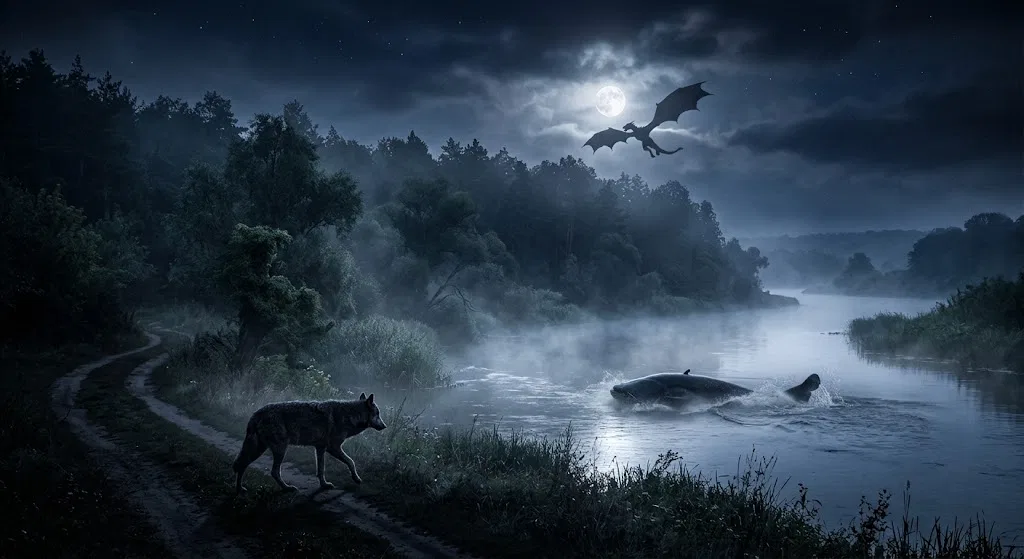
Moldova has plausible scenery for water-monster stories. The Dniester and Prut systems include reservoirs, reed beds, floodplains, side channels and stretches of turbid water where an animal’s size and shape can be difficult to judge. The Lower Dniester is particularly rich in aquatic life, with research recording dozens of fish species in the Moldovan section of the river basin.[crimsonpublishers]crimsonpublishers.comOpen source on crimsonpublishers.com.
Yet there is no well-supported Moldovan equivalent of Nessie. Searches for a Dniester monster produce tourism material, fishing content and generic descriptions of large fish rather than a coherent series of named sightings. The absence of an established case is striking because the river passes settlements including Soroca, Rîbnița, Bender and Tiraspol and has long supported transport, fishing and recreation. A genuinely recurring large-animal phenomenon would have many opportunities to enter local reporting.[Wikipedia]WikipediaOpen source on wikipedia.org.
The most obvious candidate for a brief “monster” encounter is the European catfish. This is a real, very large freshwater predator with a broad head, long body and whisker-like barbels. When it rolls at the surface, follows hooked fish or is glimpsed through muddy water, separate parts of its body may appear as humps or a serpent-like shape. Angling accounts from Moldova describe the Dniester and Dubăsari Reservoir as catfish waters, including reports of specimens weighing tens of kilograms. Such claims vary in reliability, but the species itself is entirely expected there.[FishingWorldGuide.com]fishingworldguide.comfishing in moldovafishing in moldova
Other likely causes of monster-like impressions include:
- several large fish surfacing close together;
- floating branches turning in a current;
- swimming otters, beavers or water birds viewed at distance;
- wakes created by boats outside the observer’s field of view;
- carcasses distorted by decomposition;
- exaggerated estimates made without a fixed object for scale.
A convincing Dniester monster case would require repeated observations from independent witnesses, clear photographs or video with reliable scale, sonar records that exclude ordinary fish, or recoverable biological evidence. None has emerged as a recognised Moldovan case.
Snakes, giant animals and sudden scares
Snakes are more likely than unknown monsters to generate immediate public alarm. Moldova has several native snake species, and warm weather can bring them close to gardens, houses and outbuildings. In June 2026, Radio Moldova reported that emergency services had handled only two cases that year involving snakes entering residential properties. Wildlife specialists stressed that encounters should be handled calmly and that animals should be relocated rather than killed.[Radio Moldova]radiomoldova.mdwildlife experts and igsu address snake sightings in moldovawildlife experts and igsu address snake sightings in moldova
The importance of such reports is not that Moldova harbours giant serpents. It is that ordinary wildlife can become newsworthy when encountered outside its expected setting. A snake crossing a courtyard looks more threatening than the same animal in grassland. Perspective can enlarge it, while fear encourages rounded-up estimates of length. Social-media reposting may then remove the original scale, location and species identification.
Large exotic-animal reports deserve similar caution. Across Europe, supposed black panthers have repeatedly produced searches, blurred photographs and online rumours. Confirmed cases elsewhere sometimes involve escaped captive animals, while others resolve into large domestic cats, dogs, shadows or images stripped of context. The 2025 black-cat scare in Bulgaria demonstrated how a plausible escape hypothesis could coexist with dubious photographs, memes and artificially generated images.[euronews]euronews.comfact checking claims about the panther on the loose in bulgariafact checking claims about the panther on the loose in bulgaria
Moldova’s location does not make an escaped exotic animal impossible. Private ownership and illegal wildlife trade can place unfamiliar species far outside their natural range. But an escapee would be an out-of-place known animal, not evidence of a hidden native population. Claims should be checked against zoo records, police notices, veterinary reports, tracks and high-quality images before acquiring a cryptid label.
Why no Moldovan monster has become nationally famous
Moldova’s landscape helps explain the shape of its tradition. It lies across forest-steppe and steppe environments rather than remote mountain wilderness or enormous deep lakes. Its natural areas include forest reserves, wetlands and river corridors, but much of the country is agricultural and closely settled. The combination leaves relatively little inaccessible habitat in which a breeding population of large unknown vertebrates could remain undetected.[Wikipedia]WikipediaOpen source on wikipedia.org.
Media history also matters. Famous cryptids usually depend on an archive that survives and circulates: dated newspaper stories, named witnesses, photographs, maps and later retellings. Moldova’s twentieth-century folklore was often preserved as literature and ethnography, while sensational local animal reports did not develop into a strong international monster industry. The resulting public image is dominated by fairy-tale dragons and magical animals rather than modern expeditions or cryptozoological tourism.
There is also no obvious commercial centre comparable with Loch Ness, where a monster identity is reinforced through museums, boat tours, statues and souvenirs. Moldova promotes wine routes, monasteries, rural culture, wetlands and historic landscapes; no major destination appears to market itself around a nationally recognised mystery beast. The Lower Dniester’s visitor appeal, for example, centres on biodiversity, river scenery and birdlife rather than monster hunting.[lower-dniester.org]lower-dniester.orgOpen source on lower-dniester.org.
Digital culture may eventually change this. A striking animal video can now be detached from its source, reposted under a Moldovan location and transformed into a “local legend” within hours. Artificially generated pictures make visual verification still more important. Future Moldovan cryptid stories may therefore begin not with an old village tradition but with an ambiguous clip, an invented caption and repeated social-media attribution.
How to judge a Moldovan creature claim
Because the evidence base is thin, location and provenance matter more than dramatic description. A useful assessment begins with five questions.
- Did the event occur inside the present Republic of Moldova? Material from Romanian Moldavia, Transylvania or the wider Balkans is often mislabelled.
- Is the creature part of a traditional tale or presented as a physical animal? Dragons that steal the sun belong to folklore, even when the stories were collected from real communities.
- Is there a contemporary primary source? A dated local report, named witness, official statement or original photograph is stronger than a modern summary repeating an unattributed legend.
- Does known wildlife fit the description? Dogs, jackals, foxes, snakes, large catfish and swimming mammals should be considered before an unknown species.
- Did the story grow after publication? Later versions often add size, glowing eyes, supernatural behaviour or repeated sightings absent from the earliest account.
On that standard, Moldova presently has no compelling case for an undiscovered large animal. Its most memorable “monsters” are cultural creatures: dragons of darkness, enchanted predators and wolf-shaped embodiments of danger or wrongdoing. Modern mystery-animal reports remain isolated and poorly documented.
Moldova’s real cryptid identity
Moldova is best understood not as a country with one signature cryptid, but as a meeting place between traditional monster folklore and ordinary wildlife misperception. The dragons and magical beasts preserved in Moldavian tales reveal a vigorous imaginative tradition, yet they were never meant to serve as field guides to hidden species.[archive.org]archive.orgMoldavian FolktalesInternet ArchiveMOLDAVIAN FOLKTALES: GRIGORE BOTEZATU7 Jan 2016 — RUSSIAN FAIRY TALES ILLUSTRATED. MOLDAVIAN FOLKTALES. Free Download, B…
The modern record is quieter. No stable lake-monster chronology, ape-creature flap, winged-being scare or phantom-cat tradition can presently be demonstrated from strong Moldovan sources. Reports that appear promising often belong to neighbouring Romania, collapse into generic folklore or lack the documentation needed for serious assessment.
That thin evidence is itself the central finding. Moldova’s mystery-beast history is less about an animal waiting to be discovered than about the way old dragon tales, wolf fears, unfamiliar wildlife and internet misattribution can blur together. Its monsters remain worth exploring, but chiefly as folklore, cultural memory and examples of how people turn uncertain encounters into stories.
Amazon book picks
Further Reading
Books and field guides related to Does Moldova Really Have a Famous Cryptid?. Use these as the next step if you want deeper reading beyond the article.
The Vampire Book
Covers Eastern European monster traditions that provide context for Moldovan creature lore.
The Element Encyclopedia of Magical Creatures
Places Moldovan dragons and supernatural beasts within wider European traditions.
Mythical Monsters
Helps compare Moldovan legendary creatures with better-known monsters.
Mysteries of the Unexplained
Explores the distinction between folklore, sightings and unexplained reports.
eBay marketplace picks
Marketplace Samples
Live-tested eBay searches with available results related to this page.
Endnotes
1.
Source: moldova.org
Title: Village Haunted by the Man-Wolf
Link:https://www.moldova.org/en/village-haunted-by-the-man-wolf-227008-eng/
2.
Source: archive.org
Title: Moldavian Folktales
Link:https://archive.org/details/MoldavianFolktales
Source snippet
Internet ArchiveMOLDAVIAN FOLKTALES: GRIGORE BOTEZATU7 Jan 2016 — RUSSIAN FAIRY TALES ILLUSTRATED. MOLDAVIAN FOLKTALES. Free Download, B...
3.
Source: Wikipedia
Link:https://en.wikipedia.org/wiki/Greuceanu
4.
Source: Wikipedia
Title: Ileana Simziana
Link:https://en.wikipedia.org/wiki/Ileana_Simziana
5.
Source: Wikipedia
Title: The Horse Lurja
Link:https://en.wikipedia.org/wiki/The_Horse_Lurja
6.
Source: arxiv.org
Link:https://arxiv.org/abs/1907.03969
Source snippet
Systematic quantitative analyses reveal the folk-zoological knowledge embedded in folktalesJuly 9, 2019...
Published: July 9, 2019
7.
Source: onlinelibrary.wiley.com
Title: j.1365 2907.2011.00185.x
Link:https://onlinelibrary.wiley.com/doi/abs/10.1111/j.1365-2907.2011.00185.x
Source snippet
Wiley Online LibraryCurrent status and distribution of golden jackals Canis...by J ARNOLD · 2012 · Cited by 315 — Spassov N (1989) The p...
8.
Source: Wikipedia
Title: European jackal
Link:https://en.wikipedia.org/wiki/European_jackal
9.
Source: crimsonpublishers.com
Link:https://crimsonpublishers.com/boj/fulltext/BOJ.000561.php
10.
Source: Wikipedia
Link:https://en.wikipedia.org/wiki/Dniester
11.
Source: fishingworldguide.com
Title: fishing in moldova
Link:https://www.fishingworldguide.com/en/blog/fishing-in-moldova
12.
Source: euronews.com
Title: fact checking claims about the panther on the loose in bulgaria
Link:https://www.euronews.com/my-europe/2025/06/25/fact-checking-claims-about-the-panther-on-the-loose-in-bulgaria
13.
Source: Wikipedia
Link:https://en.wikipedia.org/wiki/Moldova
14.
Source: lower-dniester.org
Link:https://lower-dniester.org/
15.
Source: Wikipedia
Title: Lake monster
Link:https://en.wikipedia.org/wiki/Lake_monster
16.
Source: Wikipedia
Title: Wolves in folklore, religion and mythology
Link:https://en.wikipedia.org/wiki/Wolves_in_folklore%2C_religion_and_mythology
17.
Source: Wikipedia
Link:https://en.wikipedia.org/wiki/Pricolici
18.
Source: Wikipedia
Title: Golden jackal
Link:https://en.wikipedia.org/wiki/Golden_jackal
19.
Source: pure.uvt.nl
Title: Trouwborst legal implications
Link:https://pure.uvt.nl/ws/files/16863484/Trouwborst_legal_implications.pdf
Source snippet
golden jackal (Canis aureus)—a new mammal species in the Czech. Republic. Lynx (Praha) 38:103–106. Krofel M (2008a) Jackals in Slovenia...
20.
Source: radiomoldova.md
Title: wildlife experts and igsu address snake sightings in moldova
Link:https://radiomoldova.md/p/78415/wildlife-experts-and-igsu-address-snake-sightings-in-moldova
Additional References
21.
Source: europeanproceedings.com
Link:https://www.europeanproceedings.com/article/10.15405/epsbs.2021.05.191
Source snippet
European ProceedingsArchetype Of Power In Folklore: Russian And Moldovan...by NV Shalaeva — The authors have carried out the comparative...
22.
Source: youtube.com
Link:https://www.youtube.com/watch?v=I7yfg32YfiM
Source snippet
Pricolici & Strigoi - A Meet-cute From Hell - European - Extra Mythology...
23.
Source: youtube.com
Title: Pricolici & Strigoi
Link:https://www.youtube.com/watch?v=gT4ZkqDY7qg
Source snippet
Demons & Monsters from (almost) EVERY COUNTRY IN THE WORLD...
24.
Source: science.org
Link:https://www.science.org/content/article/these-snakes-strike-half-blink-eye
25.
Source: youtube.com
Title: Mythical Creatures and Monsters of Romanian Folklore
Link:https://www.youtube.com/watch?v=3OXMYLbyHFM
Source snippet
8 Mythical creatures from Romanian Folklore You've Never Heard Of...
26.
Source: instagram.com
Link:https://www.instagram.com/p/DLKeKmsoDC6/
27.
Source: ukrinform.net
Link:https://www.ukrinform.net/rubric-polytics/4102474-moldovas-mfa-presents-russian-ambassador-with-bottle-of-contaminated-water-from-dniester-river.html
28.
Source: facebook.com
Link:https://www.facebook.com/euronews/posts/a-black-panther-was-reportedly-spotted-in-the-bulgarian-village-of-dupnitsa-spar/1152302060278456/
29.
Source: ebay.com
Link:https://www.ebay.com/itm/204487291789?mkevt=1&mkcid=1&mkrid=710-53481-19255-0&campid=5339151051&customid=endnote-source&toolid=10001
30.
Source: hungarytoday.hu
Link:https://hungarytoday.hu/black-panther-hungary-hungarian-wildlife-wild-animals-big-cats/
Topic Tree
Follow this branch
Related pages 192
- Antigua Cryptids
- Maldives Monsters
- Malta Monsters
- Qatar Monsters
- Argentina Monsters
- +187 more in sidebar