Within Macedonian Mystery Beasts
Which Monsters Haunted Macedonian Folklore?
Macedonian folklore filled storms, springs, forests and mountains with dragons, destructive serpents and unstable animal apparitions.
On this page
- Storm bearing serpent monsters and crop destruction
- Protective dragons in human and animal form
- Fairy beings and shape shifting apparitions
Page outline Jump by section
Introduction
North Macedonia’s folklore is crowded with dragons, giant serpents and shape-shifting beings, but these creatures were rarely imagined as simple monsters. In village traditions across the region, dragons could be protectors of crops, serpent-demons could bring destructive storms, and supernatural beings might move between human, animal and cloud-like forms. These stories grew from a mixture of Slavic beliefs, Balkan folklore and later Christian influences, creating a landscape where weather, harvests and unexplained events were explained through battles between powerful supernatural forces. Rather than representing reports of hidden animals in the modern cryptid sense, these legends reveal how people interpreted dangerous storms, droughts, illness and strange experiences long before scientific explanations became widespread.[ResearchGate]researchgate.netResearchGate(PDF) Supernatural Beings in Macedonian BeliefsApril 22, 2020 — 28 Feb 2023 — They include the vampire, the specter, the fair…
Which Monsters Haunted Macedonian Folklore?
Among the many supernatural beings found in North Macedonian tradition, three stand out for their connection to monster lore: the dragon-like zmey, the destructive lamia, and a wider family of shape-shifting storm demons and fairy beings. These creatures were not confined to one village or valley. Variations of the stories appear across Macedonia and throughout the wider Balkan region, suggesting centuries of shared storytelling and adaptation.[Wikipedia]WikipediaMacedonian Slavic mythologyMacedonian Slavic mythology
Unlike many Western European dragon legends, Macedonian dragon stories often place the creature in direct relationship with ordinary communities. A dragon might defend a district, fall in love with a human woman, or fight weather demons threatening local harvests. The result is a folklore tradition where dragons are not always villains and where the line between guardian and danger is often blurred.[Wikipedia]WikipediaSlavic dragonSlavic dragon
Storm-Bearing Serpent Monsters and Crop Destruction
One of the most important monster traditions concerns the lamia and related serpent-like storm demons. In Macedonian folklore, the lamia is typically imagined as a huge reptilian creature associated with destruction, drought and chaos. Some traditions describe it as multi-headed or covered in scales, while others portray it as a gigantic serpent dwelling in caves, lakes or remote wilderness.[wikipedia.org]WikipediaMacedonian Slavic mythologyMacedonian Slavic mythology
The lamia’s role was practical as well as mythical. In agricultural communities, violent storms, hail and failed harvests could ruin an entire year’s food supply. Folklore transformed these threats into visible enemies. When crops were devastated by severe weather, people could explain the disaster as the work of a serpent monster attacking the land.[Wikipedia]WikipediaAla (demonAla (demon
Closely related was the ala or hala, a supernatural being associated with hail clouds, whirlwinds and destructive storms. In Macedonian and neighbouring Balkan traditions, this creature could appear as a giant serpent, a dragon-like monster, a black cloud, a whirlwind or an indistinct dark shape moving through the sky. Its purpose was often to destroy crops by steering hailstorms over fields and orchards.[Wikipedia]WikipediaAla (demonAla (demon
These stories reveal an important pattern in Macedonian monster lore: many feared creatures are effectively personifications of dangerous weather. Instead of a hidden beast lurking in a forest, the monster was often the storm itself.
Protective Dragons in Human and Animal Form
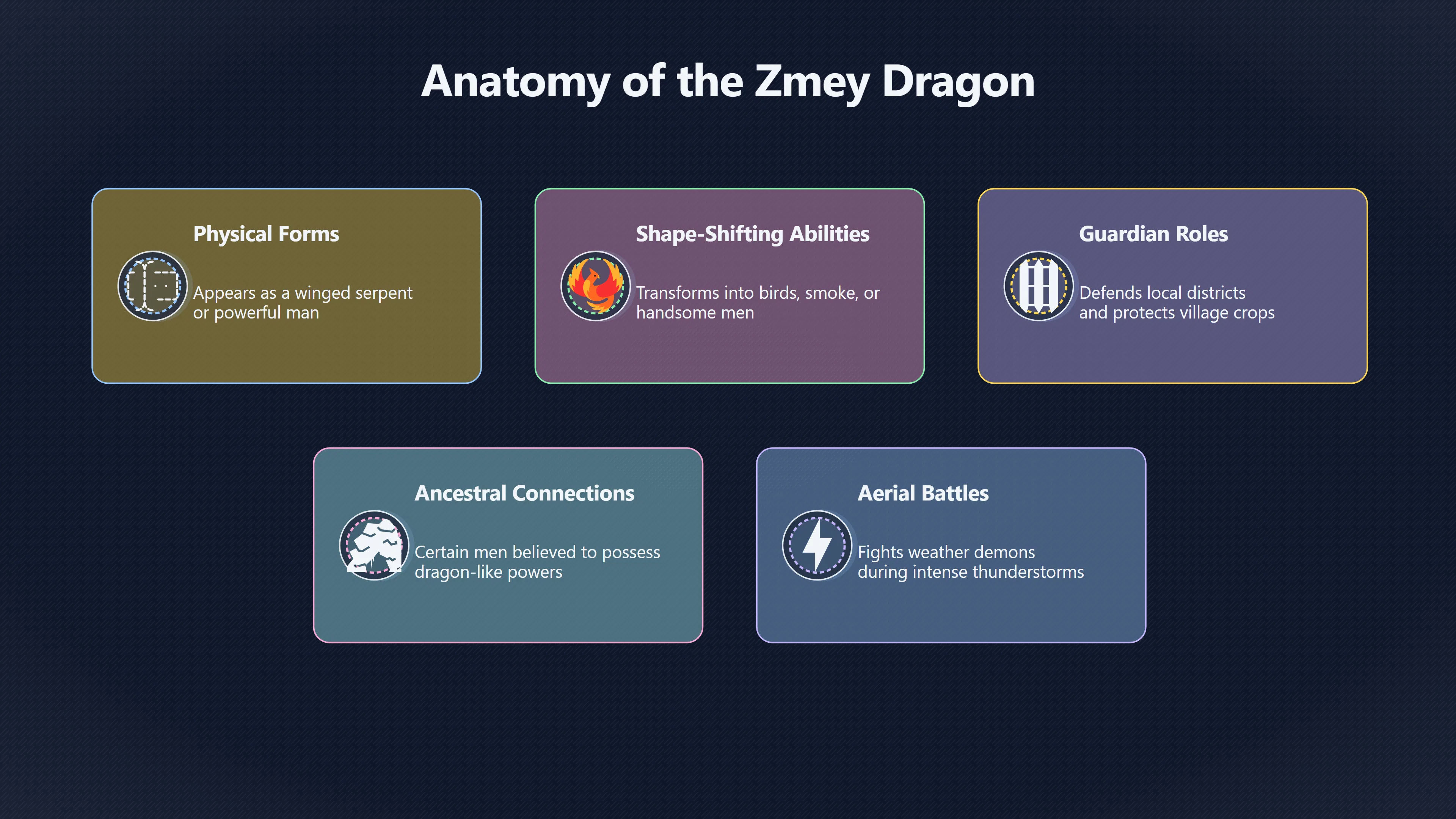
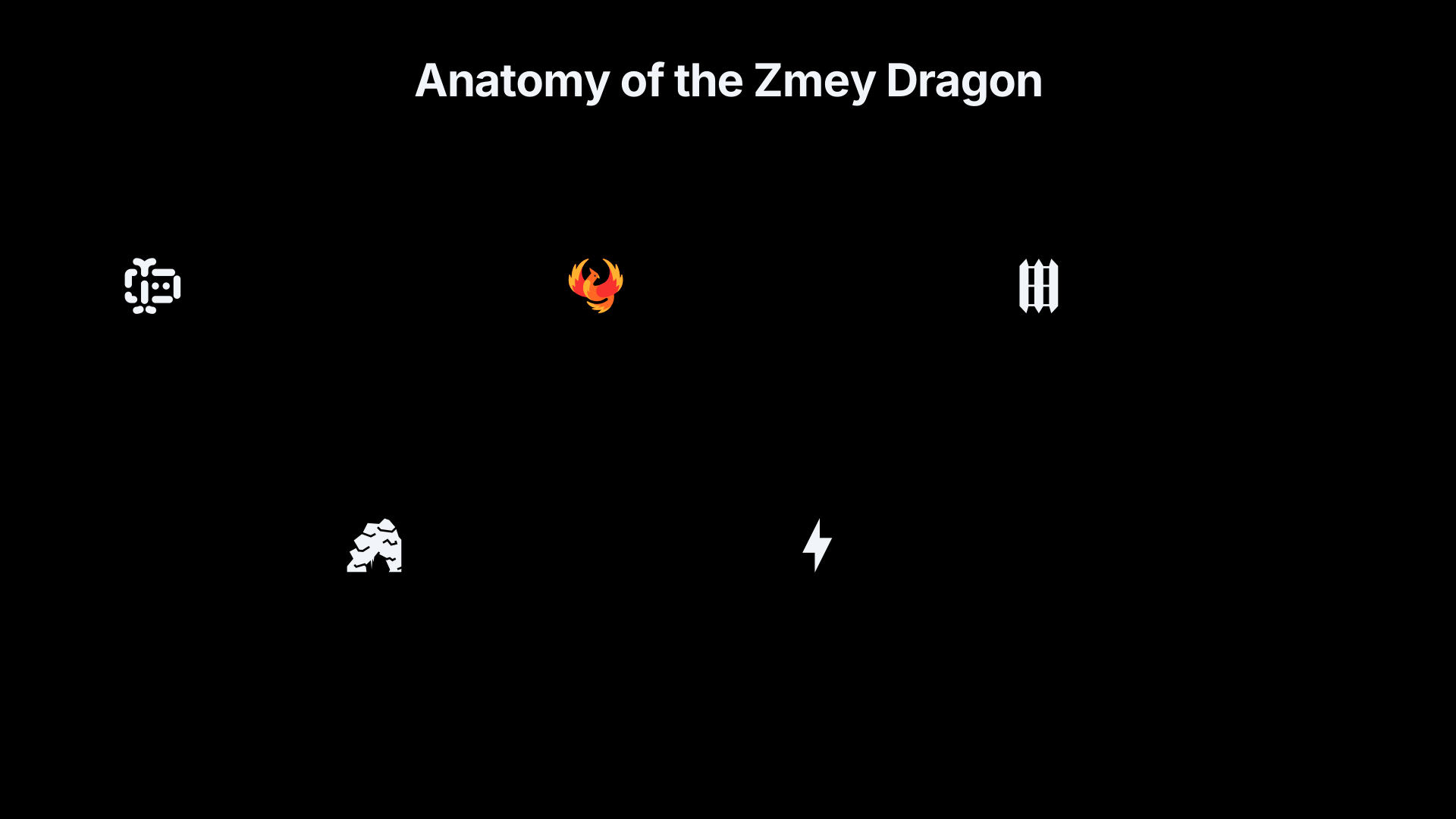
Standing against the storm demons was the zmey, the dragon most frequently associated with Macedonian folklore. Unlike the destructive lamia, the zmey was often portrayed as a guardian. It watched over a specific territory, protected villages and fought supernatural enemies that threatened local harvests. Thunderstorms were sometimes interpreted as evidence that such battles were taking place overhead.[Wikipedia]WikipediaSlavic dragonSlavic dragon
Descriptions of the zmey vary considerably. Some traditions portray it as a winged serpent with immense strength. Others describe a being with both human and dragon features, possessing a snake-like tail but otherwise resembling a powerful man. It was said to dwell in caves, mountains, springs or hidden wilderness locations.[Wikipedia]WikipediaMacedonian Slavic mythologyMacedonian Slavic mythology
One particularly distinctive feature of Macedonian dragon lore is shape-shifting. The zmey could reportedly appear as:
- A handsome young man.
- A serpent.
- A fiery bird.
- Smoke or flame.
- A cloud or spark in the sky.
These transformations allowed dragons to interact with humans while remaining part of the supernatural world. Folklore frequently depicts them pursuing romances with mortal women, sometimes leading to tales of abduction, enchanted relationships or tragic love affairs.[Wikipedia]WikipediaSlavic dragonSlavic dragon
The dragon’s role as a protector also extended into beliefs about extraordinary individuals. Some traditions held that certain men possessed dragon ancestry or dragon-like powers. During storms, their souls were believed to leave their sleeping bodies and battle weather demons in the sky. Villagers interpreted exhausted behaviour after sleep as evidence that these invisible aerial battles had taken place.[Wikipedia]WikipediaOpen source on wikipedia.org.
Fairy Beings and Shape-Shifting Apparitions
North Macedonian folklore contains numerous stories of supernatural beings capable of changing form. Among the best known are the samovili, often translated as fairy-like beings. These creatures were associated with mountains, springs and wild places and were frequently described as beautiful women possessing magical abilities.[Wikipedia]WikipediaMacedonian Slavic mythologyMacedonian Slavic mythology
According to traditional stories, removing a samovila’s wings could transform her into an ordinary woman. This idea of shifting between supernatural and human states appears repeatedly in Balkan folklore and reflects a broader fascination with unstable identities and hidden natures.[Wikipedia]WikipediaMacedonian Slavic mythologyMacedonian Slavic mythology
Shape-shifting also appears in accounts of the ala and related storm beings. Rather than possessing a fixed appearance, these entities could take many forms depending on circumstance. Witnesses might perceive them as animals, clouds, serpents or even humans. Such flexibility made them useful explanations for unusual events, strange weather phenomena or frightening encounters in isolated landscapes.[Wikipedia]WikipediaAla (demonAla (demon
In folklore terms, these were not merely monsters but embodiments of uncertainty. They represented the possibility that familiar surroundings could suddenly become dangerous and that appearances could not always be trusted.
Why Dragons Became Heroes Instead of Villains
One of the most unusual aspects of Macedonian folklore is the relatively positive reputation of dragons. In much of Western Europe, dragons became symbols of evil to be slain by saints or heroes. Macedonian traditions preserved older ideas in which dragons could act as defenders of communities and allies of humanity.[Wikipedia]WikipediaEuropean dragonEuropean dragon
This difference likely reflects the agricultural concerns of the societies that produced the stories. A supernatural being that protected crops from hailstorms had obvious value. Dragons therefore became guardians of fertility, rainfall and local prosperity, while serpent-demons and storm monsters occupied the role of destroyers.[Wikipedia]WikipediaOpen source on wikipedia.org.
Christian influence did alter some narratives. In later traditions, saints such as Elijah increasingly appeared as opponents of destructive weather demons. Yet older dragon-versus-monster themes often survived beneath the newer religious framework.[Wikipedia]WikipediaAla (demonAla (demon

Folklore, Memory and Modern Interpretation
Today these dragons, serpent monsters and shape-shifters are remembered primarily as folklore rather than as creatures believed to inhabit North Macedonia’s landscapes. Unlike modern lake-monster claims or alleged mystery-animal sightings, the legends rarely depend on eyewitness evidence in the contemporary sense. Instead, they preserve older explanations for weather, misfortune and the unpredictable forces of nature.[ResearchGate]researchgate.netResearchGate(PDF) Supernatural Beings in Macedonian BeliefsApril 22, 2020 — 28 Feb 2023 — They include the vampire, the specter, the fair…
Even so, the stories continue to influence how the country’s strange-creature traditions are understood. The image of a dragon fighting storm demons, a giant serpent lurking in a cave, or a supernatural being shifting between human and animal forms remains one of the most distinctive features of North Macedonia’s monster heritage. In a region where folklore often explains what science once could not, these creatures occupy the space between myth, memory and the enduring human desire to give shape to the unknown.[wikipedia.org]WikipediaMacedonian Slavic mythologyMacedonian Slavic mythology
Amazon book picks
Further Reading
Books and field guides related to Which Monsters Haunted Macedonian Folklore?. Use these as the next step if you want deeper reading beyond the article.

The Penguin Book of Dragons
Dragon and serpent beings are central to Macedonian folklore.
Russian Fairy Tales (Illustrated by Ivan Bilibin)
Contains related Slavic supernatural motifs and creatures.
Slavic Folklore
Provides context for dragons, spirits, and shape-shifting beings in the Balkans.
The Mythology Book
Helps readers place Macedonian monster lore within wider myth traditions.
eBay marketplace picks
Marketplace Samples
Live-tested eBay searches with available results related to this page.


Endnotes
1.
Source: researchgate.net
Link:https://www.researchgate.net/publication/368849241_Supernatural_Beings_in_Macedonian_Beliefs
Source snippet
ResearchGate(PDF) Supernatural Beings in Macedonian BeliefsApril 22, 2020 — 28 Feb 2023 — They include the vampire, the specter, the fair...
Published: April 22, 2020
2.
Source: Wikipedia
Title: Macedonian Slavic mythology
Link:https://en.wikipedia.org/wiki/Macedonian_Slavic_mythology
3.
Source: Wikipedia
Title: Slavic dragon
Link:https://en.wikipedia.org/wiki/Slavic_dragon
4.
Source: Wikipedia
Link:https://en.wikipedia.org/wiki/Zduha%C4%87
5.
Source: Wikipedia
Title: Ala (demon)
Link:https://en.wikipedia.org/wiki/Ala_%28demon%29
6.
Source: Wikipedia
Title: European dragon
Link:https://en.wikipedia.org/wiki/European_dragon
7.
Source: dergipark.org.tr
Link:https://dergipark.org.tr/en/pub/jiees/article/732893
Source snippet
They include the vampire, the...Read more...
8.
Source: dergipark.org.tr
Link:https://dergipark.org.tr/tr/download/article-file/1163759
Source snippet
Supernatural Beings in Macedonian Beliefsby A Kechan · Cited by 2 — The lamia of Greek mythology - a woman who became a child-ea...
Additional References
9.
Source: facebook.com
Link:https://www.facebook.com/groups/281886105961506/posts/991793368304106/
Source snippet
The dragon is a fiery bird with a long tail, which threw sparks around itself during...Read more...
10.
Source: youtube.com
Title: What are the Creatures and Monsters of Slavic Mythology and Folklore?
Link:https://www.youtube.com/watch?v=Z-siWa2-epI
Source snippet
Macedonian folklore zmey lamia myth What Are The Different Types Of Mythology In Macedonian Folklore? - TalkingSoutheastEurope Talking So...
11.
Source: brendan-noble.com
Link:https://brendan-noble.com/zmij-zmey-dragons-of-slavic-mythology-slavic-saturday/
Source snippet
Żmij/Zmey – Dragons of Slavic Mythology – Slavic SaturdayIt was believed that these storms were brought by an Ala/Chała, a demon sometime...
12.
Source: youtube.com
Title: What Are The Different Types Of Mythology In Macedonian Folklore?
Link:https://www.youtube.com/watch?v=e29eSrUHlkA
Source snippet
Zmey – The Terrible Dragon of Slavic Mythology...
13.
Source: youtube.com
Title: Every Monster in Balkan Folklore Explained in 14 Minutes
Link:https://www.youtube.com/watch?v=dgPojk7emP4
Source snippet
What are the Creatures and Monsters of Slavic Mythology and Folklore?...
14.
Source: youtube.com
Link:https://www.youtube.com/watch?v=eGmO40F8Kmg
Source snippet
Every Monster in Balkan Folklore Explained in 14 Minutes...
15.
Source: youtube.com
Title: Zmey – The Terrible Dragon of Slavic Mythology
Link:https://www.youtube.com/watch?v=wl2yD9Cygkk
Source snippet
Żmij/Zmey - Dragons of Slavic Mythology - Slavic Saturday...
16.
Source: mythlok.com
Link:https://mythlok.com/ala/
17.
Source: scribd.com
Link:https://www.scribd.com/document/689362622/Bosnian-Mythical-Creatures
18.
Source: facebook.com
Link:https://www.facebook.com/groups/559459704725410/posts/783135559024489/
Topic Tree