Within Somali Creatures
Why Does Qori Ismaris Become a Hyena?
Qori Ismaris turns familiar hyena behaviour into a disturbing story about hidden identities, night danger and mistrust.
On this page
- How the magical transformation works
- Why hyenas shaped the legend
- Werewolf comparisons and Somali differences
Page outline Jump by section
Introduction
Qori Ismaris is Somalia’s most famous shape-shifting figure: a person said to transform into a hyena at night and return to human form before dawn. Unlike reports of unknown animals or mystery beasts, Qori Ismaris belongs firmly to folklore, yet it occupies an important place in Somalia’s wider tradition of strange creatures and supernatural beings. The legend is often compared to the European werewolf, but its roots are distinctly Somali. Instead of wolves, the story centres on the hyena, an animal that has long lived alongside people across the Horn of Africa and inspired both fear and fascination. Traditional accounts describe the transformation as being triggered by a magical stick, making the creature less a wild beast and more a hidden human living a double life.[Wikipedia]WikipediaOpen source on wikipedia.org.
The story matters because it reveals how real encounters with a powerful nocturnal scavenger became woven into ideas about secrecy, danger, mistrust and hidden identities. In Somalia’s monster traditions, Qori Ismaris is not simply a frightening creature. It is a warning that the person beside you may not be what they seem.[ArcAdiA]arcadia.sba.uniroma3.itQori-ismaris) and thenThe Somalies call all genres of folk-lore prose either tales orby G Kapchits · 1993 · Cited by 2 — The tale "Hyena's cows" tells a…
How the Magical Transformation Works
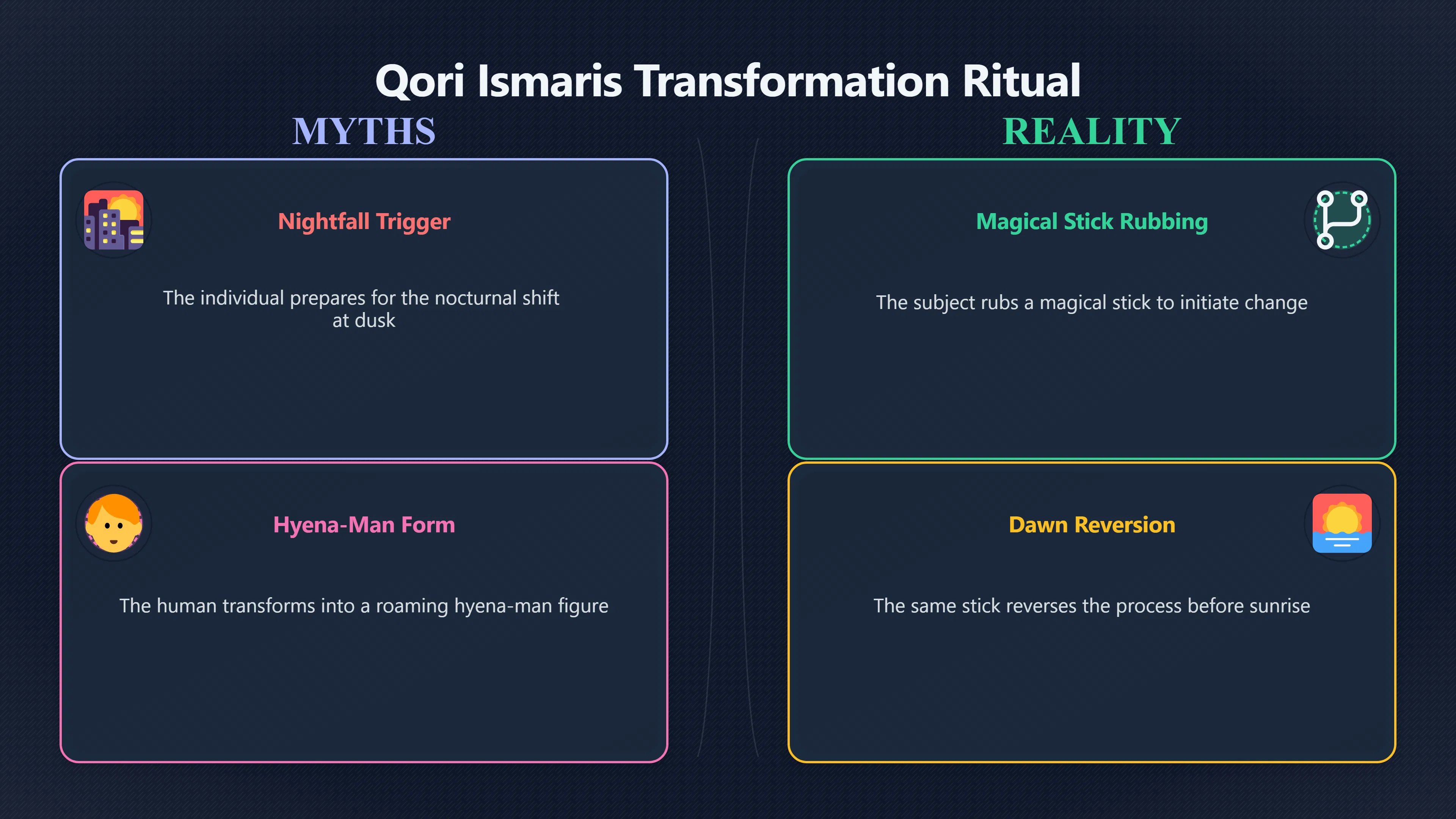
The defining feature of Qori Ismaris is the method of transformation. Traditional descriptions state that the individual rubs himself with a magical stick at nightfall and changes into a hyena-man. Before sunrise, the process is reversed by using the same object again, allowing the person to resume an ordinary human appearance. The name itself is commonly interpreted as “one who rubs himself with a stick”, directly linking the creature to this ritual act.[x.com]x.comX (formerly Twitter)In Somali mythology Qori ismaris ("One who rubs himself…In Somali mythology Qori ismaris ("One who rubs himself wi…
Unlike many European werewolf tales, the transformation is not usually portrayed as an uncontrollable curse. Instead, it is often presented as a deliberate action. The shape-shifter chooses when to change and when to return. That distinction is important because it shifts the story’s focus from loss of control to deception. The frightening possibility is not that someone becomes a monster accidentally, but that they secretly choose to become one.
In many retellings, the transformed figure roams after dark, moving through the landscape in hyena form while neighbours remain unaware of the creature’s human identity. The transformation therefore acts as a narrative device that explains unexplained nocturnal events: missing livestock, strange sounds, tracks in the darkness or unsettling encounters on isolated paths.[Tell Your Story]andreweagle.comQori Ismaris is traditionally a man whoTell Your StoryEpisode 14 - Werehyenas — Tell Your Story - Andrew EagleApr 29, 2019 — The Qori Ismaris, translated as “One who rubs himse…
The magical stick itself is also significant. Folklore around the world often uses an object, garment, ointment or ritual to trigger shape-shifting. In the Somali version, the stick serves as a simple but memorable mechanism that allows listeners to imagine exactly how the transformation occurs. It gives the legend a practical detail that helps the story feel concrete even though it remains supernatural.
Why Hyenas Shaped the Legend
Qori Ismaris makes far more sense when viewed through the realities of Somali life than when treated as an isolated fantasy.
Hyenas have long been among the most visible large carnivores living near human settlements across the Horn of Africa. They are primarily active at night, produce eerie vocalisations and are capable of travelling considerable distances under cover of darkness. Throughout many cultures that share landscapes with hyenas, the animals have become associated with grave-robbing, witchcraft, scavenging and unsettling behaviour.[Wikipedia]WikipediaOpen source on wikipedia.org.
Several characteristics of real hyenas helped make them ideal candidates for transformation stories:
- They emerge after dark, when visibility is poor and imagination fills gaps in observation.
- Their calls can sound strange or almost human, making them natural subjects for supernatural explanations.
- They frequently live close to settlements, creating regular opportunities for encounters.
- They are both predator and scavenger, blurring the boundary between hunter and cleaner of the landscape.
- They are intelligent and adaptable, traits that folklore often reinterprets as cunning or magical ability.[Wikipedia]WikipediaOpen source on wikipedia.org.
The result is a creature that sits between the human and animal worlds. A hyena already seemed unusual enough to invite stories. Turning a hyena into a disguised human, or a human into a hyena, pushed that ambiguity even further.
The legend also reflects social anxieties. A lion is dangerous, but everyone knows it is a lion. A shape-shifter is more troubling because its true identity is hidden. The story transforms ordinary concerns about theft, malice or betrayal into something supernatural. The threat comes not only from the beast but from the possibility that the beast is someone you know.
Hidden Identities and Night-Time Fear
One reason the tradition survived is that it addresses recurring human fears rather than a single monster encounter.
Many folklore creatures represent dangers that cannot easily be identified. Qori Ismaris belongs to this category. The shape-shifter embodies uncertainty about who can be trusted, particularly after dark. In traditional rural settings where travel at night could be genuinely dangerous, stories about hyena-transformers reinforced caution and vigilance.
The legend also allows blame to be assigned to a human source behind unexplained misfortune. Livestock losses, frightening noises or suspicious events can be interpreted not merely as the work of an animal but as the actions of a person acting through supernatural means. In this way, the tale functions as a story about social relationships as much as a story about monsters.
Modern Somali discussions frequently treat Qori Ismaris as a childhood tale or a traditional supernatural story rather than a literal belief. Nevertheless, memories of the legend remain widespread enough that many Somalis recognise the character immediately when folklore is discussed.[Reddit]reddit.comResearch on Qori Ismaris: r/SomaliaResearch on Qori Ismaris: r/SomaliaSeptember 25, 2022 — It is a mythical creature. Where are they found? In children's story books…
Werewolf Comparisons and Somali Differences
The easiest comparison for many international readers is the werewolf, but the similarities only go so far.
Both traditions involve a human-animal transformation and both connect the transformed being with danger, fear and night-time activity. Yet the differences reveal much about the societies that produced them.
European WerewolfQori IsmarisUsually transforms into a wolfTransforms into a hyena-manOften linked to curses or infectionUsually linked to magic and deliberate actionFrequently associated with loss of controlOften associated with secrecy and choiceRooted in landscapes where wolves were feared predatorsRooted in landscapes where hyenas were familiar nocturnal animalsEmphasises the beast within the humanEmphasises hidden identity and deception
The Somali tradition therefore reflects local ecology rather than simply reproducing a universal shape-shifter story. Wolves were not the defining large carnivore of everyday life in Somalia. Hyenas were. The legend adapts a widespread human fascination with transformation to a specifically Somali environment.[Wikipedia]WikipediaOpen source on wikipedia.org.
Is There Any Evidence Behind the Legend?
From a cryptozoological perspective, there is no evidence that Qori Ismaris represents a real undiscovered species or a documented phenomenon of human transformation. The figure appears in folklore collections and discussions of Somali mythology rather than in zoological records. Scholars who catalogue Somali traditional narratives place Qori Ismaris among stories involving supernatural beings and mythological characters.[ArcAdiA]arcadia.sba.uniroma3.itQori-ismaris) and thenThe Somalies call all genres of folk-lore prose either tales orby G Kapchits · 1993 · Cited by 2 — The tale "Hyena's cows" tells a…
This does not make the legend unimportant. Folklore can preserve valuable information about how communities understand danger, animals and the landscape. In the case of Qori Ismaris, the story may reveal more about human attitudes toward hyenas than about the animals themselves.
Modern reports occasionally circulate online claiming encounters with werehyenas or shape-shifters, but these accounts generally lack verifiable evidence and are best understood as contemporary retellings of an older tradition rather than documented creature sightings.[Reddit]reddit.comResearch on Qori Ismaris: r/SomaliaResearch on Qori Ismaris: r/SomaliaSeptember 25, 2022 — It is a mythical creature. Where are they found? In children's story books…
Why Qori Ismaris Endures
Qori Ismaris survives because it combines several powerful ideas in a single memorable image: a familiar animal, a secret transformation and a hidden threat moving through the darkness.
The legend turns an ordinary hyena into something far stranger without losing contact with the realities of Somali life. Listeners recognise the animal, understand why it inspires unease and can easily imagine it emerging from the night. The magical stick provides the mechanism, but the emotional force comes from the possibility that the creature was human all along.
For that reason, Qori Ismaris remains one of Somalia’s most distinctive monster traditions. It is less a mystery animal than a story about the thin boundary between the known and the unknown, the neighbour and the beast, daylight certainty and night-time suspicion.[Wikipedia]WikipediaOpen source on wikipedia.org.
Amazon book picks
Further Reading
Books and field guides related to Why Does Qori Ismaris Become a Hyena?. Use these as the next step if you want deeper reading beyond the article.

PIETER HUGO THE HYENA AND OTHER MEN /ANGLAIS
First published 1999. Subjects: Portrait photography, Hyenas, Monkeys, Zoology, africa.
eBay marketplace picks
Marketplace Samples
Live-tested eBay searches with available results related to this page.
Endnotes
1.
Source: Wikipedia
Link:https://en.wikipedia.org/wiki/Werehyena
2.
Source: Wikipedia
Title: Somali mythology
Link:https://en.wikipedia.org/wiki/Somali_mythology
3.
Source: Wikipedia
Link:https://en.wikipedia.org/wiki/Hyena
4.
Source: Wikipedia
Title: Striped hyena
Link:https://en.wikipedia.org/wiki/Striped_hyena
5.
Source: reddit.com
Title: Research on Qori Ismaris: r/Somalia
Link:https://www.reddit.com/r/Somalia/comments/xnwlma/research_on_qori_ismaris/
Source snippet
Research on Qori Ismaris: r/SomaliaSeptember 25, 2022 — It is a mythical creature. Where are they found? In children's story books...
Published: September 25, 2022
6.
Source: reddit.com
Link:https://www.reddit.com/r/Somalia/comments/k7ai4q/do_you_guys_have_some_folktalesfolklorelocal/
7.
Source: reddit.com
Link:https://www.reddit.com/r/Somalia/comments/72ekc2/somali_myths_and_legends/
8.
Source: Wikipedia
Link:https://en.wikipedia.org/wiki/Shapeshifting
9.
Source: arcadia.sba.uniroma3.it
Title: (Qori-ismaris) and then
Link:https://arcadia.sba.uniroma3.it/bitstream/2307/3100/1/On%20types%20of%20Somali%20folk-tales.pdf
Source snippet
The Somalies call all genres of folk-lore prose either tales orby G Kapchits · 1993 · Cited by 2 — The tale "Hyena's cows" tells a...
10.
Source: x.com
Link:https://x.com/FinnFolklorist/status/1526530517306429441?lang=en
Source snippet
X (formerly Twitter)In Somali mythology Qori ismaris ("One who rubs himself...In Somali mythology Qori ismaris ("One who rubs himself wi...
11.
Source: andreweagle.com
Title: Qori Ismaris is traditionally a man who
Link:https://www.andreweagle.com/through-the-veil-transcripts/2019/4/29/episode-14-werehyenas
Source snippet
Tell Your StoryEpisode 14 - Werehyenas — Tell Your Story - Andrew EagleApr 29, 2019 — The Qori Ismaris, translated as “One who rubs himse...
12.
Source: mythus.fandom.com
Link:https://mythus.fandom.com/wiki/Werehyena
13.
Source: kids.kiddle.co
Title: Somali mythology
Link:https://kids.kiddle.co/Somali_mythology
Additional References
14.
Source: marefa.org
Title: المعرفةالأساطير الصومالية
Link:https://www.marefa.org/%D8%A7%D9%84%D8%A3%D8%B3%D8%A7%D8%B7%D9%8A%D8%B1_%D8%A7%D9%84%D8%B5%D9%88%D9%85%D8%A7%D9%84%D9%8A%D8%A9
Source snippet
المعرفةQori-ismaris ("One who rubs himself with a stick"), Qori-ismaris was a man who could transform himself into a "Hyena-man" by rubbi...
15.
Source: youtube.com
Title: Episode 66: Legend Of The Werehyena Pt.1 w/Gina Hyena
Link:https://www.youtube.com/watch?v=Jyz-jGayX9M
Source snippet
Animated Journey Into Powerful Mythological Creatures Of Africa...
16.
Source: youtube.com
Link:https://www.youtube.com/watch?v=mD2MedFDcdc
Source snippet
Human or Beast? The African Legends of the Fearsome Hyena-Men...
17.
Source: youtube.com
Title: Monsters from African Mythology
Link:https://www.youtube.com/watch?v=AAhCDfGzGuQ
Source snippet
Episode 66: Legend Of The Werehyena Pt.1 w/Gina Hyena...
18.
Source: youtube.com
Link:https://www.youtube.com/watch?v=Ba19Lemgu2U
19.
Source: youtube.com
Title: Human or Beast? The African Legends of the Fearsome Hyena-Men
Link:https://www.youtube.com/watch?v=4cI4xBPvbHo
Source snippet
Monsters from African Mythology...
20.
Source: youtube.com
Title: Animated Journey Into Powerful Mythological Creatures Of Africa!
Link:https://www.youtube.com/watch?v=e8NOXTsN35U
21.
Source: persee.fr
Title: ista 0000 0000 1993 act 495 1 2881
Link:https://www.persee.fr/doc/ista_0000-0000_1993_act
22.
Source: exilian.co.uk
Title: Realms of Myth: Somalia
Link:https://exilian.co.uk/forum/index.php?topic=5522.0
Topic Tree