Within Norway Monsters
Why Norway Shaped Europe's Sea Monster Myths
Sailors, mapmakers and naturalists helped turn Norwegian marine reports into Europe's enduring image of northern sea monsters.
On this page
- Sailors' reports and the creatures of northern waters
- Olaus Magnus and the illustrated sea serpent
- Pontoppidan, the kraken and early natural history
Page outline Jump by section
Introduction
Norway occupies a special place in the history of sea monsters. Long before modern cryptozoology existed, stories from Norwegian waters helped create Europe’s enduring image of giant serpents lurking offshore and colossal creatures rising from the deep. Sailors, fishermen, clergymen and early naturalists all contributed to a tradition that blurred the boundary between folklore, eyewitness testimony and natural history.
What makes Norway unusual is not simply the number of monster stories associated with its coastline. It is the fact that several of those stories entered influential books, maps and scientific discussions that circulated across Europe. By the eighteenth century, the Norwegian sea serpent and the kraken were no longer just local tales. They had become internationally recognised creatures that shaped how generations imagined the northern oceans.[publicdomainreview.org]publicdomainreview.orgolaus magnus sea serpentThe Public Domain ReviewOlaus Magnus' Sea Serpent5 Feb 2014 — The terrifying Great Norway Serpent, or Sea Orm, is the most famous of the…
Sailors’ Reports and the Creatures of Northern Waters
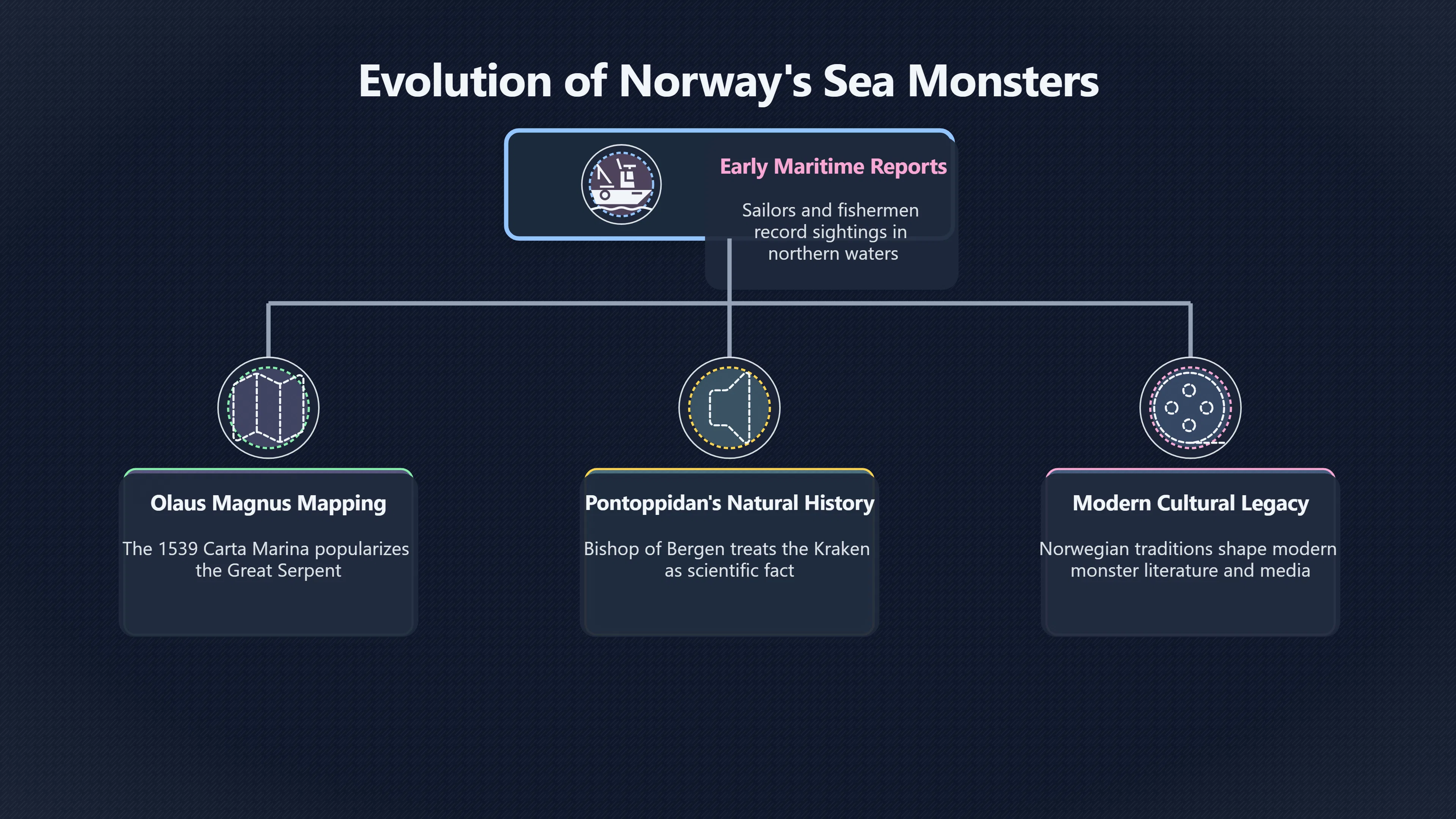
For centuries, Norway’s coastline was among the most heavily travelled maritime regions in northern Europe. Fishing fleets, trading vessels and coastal communities depended on waters that could be dangerous, remote and difficult to navigate. In such settings, reports of unusual animals were common.
Many accounts described enormous serpentine creatures seen moving through the sea in a series of humps or coils. Witnesses often reported seeing only part of an animal before it disappeared beneath the surface. The combination of rough weather, changing light conditions and encounters with unfamiliar marine life created ideal conditions for dramatic stories to develop.
Importantly, these reports were not always treated as folklore. Early modern Europeans often regarded sailors as valuable observers of the natural world. A strange animal reported repeatedly by experienced seafarers could be recorded as a genuine zoological possibility rather than dismissed outright. This attitude helped sea-serpent traditions move from oral storytelling into printed works.[cam.ac.uk]hist.cam.ac.ukHistory at Cambridge Monsters, Myths and Methodsory at CambridgeMonsters, Myths and Methods - Faculty of HistoryPontoppidan, for all his insistence on verifiability included long se…
Some later Norwegian reports continued well into the modern era. Accounts collected from lakes and coastal regions described long-bodied animals with multiple humps, horse-like heads or unusual wakes. Such reports were never consistent enough to establish the existence of an unknown species, but they demonstrate how deeply the sea-serpent image remained embedded in Norwegian culture.[Reddit]reddit.comA curious story about a large sea worm in lake Mjøsa from…August 19, 2022 — In Åfjordvatnet (Finnmark) west of Hammerfest, a sea…
Olaus Magnus and the Illustrated Sea Serpent
No individual did more to popularise Norway’s sea monsters than the sixteenth-century writer and cartographer Olaus Magnus. His famous 1539 map, the Carta Marina, became one of the most influential depictions of northern Europe ever produced.
The map is filled with whales, strange marine animals and sea monsters. Among them is the creature that became known as the Great Norway Serpent, shown attacking a ship off the Norwegian coast. The image was memorable, dramatic and widely copied by later mapmakers. For many Europeans, it became the definitive visual representation of a northern sea monster.[publicdomainreview.org]publicdomainreview.orgolaus magnus sea serpentThe Public Domain ReviewOlaus Magnus' Sea Serpent5 Feb 2014 — The terrifying Great Norway Serpent, or Sea Orm, is the most famous of the…
Olaus Magnus did not present the serpent as pure fantasy. In accompanying descriptions, he claimed that mariners working along the Norwegian coast agreed on the existence of an enormous serpent inhabiting coastal caves and rocky shores near Bergen. He repeated reports describing a creature of extraordinary length and thickness that emerged during calm summer nights.[Orkney Council Museums]orkneymuseums.co.ukthe carta marina of olaus magnus 1539the carta marina of olaus magnus 1539
Modern historians generally view these descriptions as a mixture of folklore, travellers’ tales and observations filtered through the worldview of the time. Yet their impact was enormous. Through maps, books and illustrations, the Norwegian sea serpent entered European imagination as a creature that might genuinely inhabit the far northern seas.[publicdomainreview.org]publicdomainreview.orgolaus magnus sea serpentThe Public Domain ReviewOlaus Magnus' Sea Serpent5 Feb 2014 — The terrifying Great Norway Serpent, or Sea Orm, is the most famous of the…
Why the Image Endured
Several factors helped the Great Norway Serpent survive for centuries:[mythosanthology.com]mythosanthology.comSource details in endnotes.
- The image appeared on a widely circulated map rather than in a local folktale.
- Norway’s dramatic coastline seemed like a plausible habitat for unknown marine animals.
- Large whales, basking sharks and other marine species could occasionally produce confusing sightings.
- Few Europeans had direct experience of northern waters and therefore relied on published accounts.[uchicago.edu]press.uchicago.eduUniversity of Chicago PressA VoyAge Around the World's Most Beguiling MApTheir ancestry can be traced back to the best-known and most inf…
As a result, the sea serpent became more than a local legend. It became part of Europe’s geographical imagination.
Pontoppidan, the Kraken and Early Natural History
If Olaus Magnus gave Europe its most famous Norwegian sea serpent, Erik Pontoppidan helped make the kraken legendary.
Pontoppidan, Bishop of Bergen, published The Natural History of Norway in the 1750s. Unlike medieval storytellers, he saw himself as a serious observer of the natural world. His work covered geology, animals, fisheries and Norwegian society. Yet it also included lengthy discussions of sea serpents and the kraken.[biodiversitylibrary.org]biodiversitylibrary.orgOpen source on biodiversitylibrary.org.
The kraken described by Pontoppidan was not the tentacled movie monster familiar today. Instead, it was an immense sea creature so large that sailors sometimes mistook it for an island. He collected testimony from fishermen and mariners who claimed to have encountered such beings in Norwegian waters. Pontoppidan believed enough of these reports to argue that giant sea serpents and the kraken were real animals.[quaritch.com]quaritch.comPontoppidan argues for the existence of sea serpents … the kraken ('the largest sea-monster in the world' (II, p. 210))…
His descriptions were extraordinary. The kraken was portrayed as one of the largest creatures on Earth, capable of creating dangerous currents when it submerged and posing a threat to ships. Although modern readers recognise the exaggeration, Pontoppidan’s work was influential because it placed these creatures within a supposedly scientific framework rather than a purely mythical one.[theguardian.com]theguardian.comOpen source on theguardian.com.
Historians of science often point to Pontoppidan as an example of a transitional figure. He valued observation and testimony but worked during a period when reliable marine biology was still developing. As a result, he treated reports of extraordinary creatures more seriously than most modern scientists would.[History at Cambridge]hist.cam.ac.ukHistory at Cambridge Monsters, Myths and Methodsory at CambridgeMonsters, Myths and Methods - Faculty of HistoryPontoppidan, for all his insistence on verifiability included long se…
Did the Kraken Have a Real Animal Behind It?
One reason the kraken legend remains fascinating is that parts of it may have been inspired by genuine marine animals.
The most frequently suggested candidate is the giant squid. Giant squids inhabit deep northern waters and can reach impressive lengths. Before modern specimens were recovered, occasional encounters with tentacles, floating remains or wounded animals could easily have generated stories about enormous unseen creatures beneath the sea.[wikipedia.org]WikipediaOpen source on wikipedia.org.
Other possibilities include:
- Large squid or octopus observed briefly at the surface.
- Groups of whales creating unusual disturbances in the water.
- Dense shoals of fish producing strange surface effects.
- Floating masses of seaweed or marine debris mistaken for living creatures.
- Exaggeration of genuine encounters as stories spread between ports and generations.[Havforskningsinstituttet]hi.nosea monsters and the natural explanations for themPhoto: Carta marina by cartographer Olaus…Read more…
None of these explanations fully accounts for every historical description, but they offer more plausible interpretations than the existence of a gigantic unknown monster capable of swallowing ships.
How Norway Shaped Europe’s Sea Monster Imagination
Norway’s importance lies less in proving that sea monsters existed and more in showing how such ideas travelled. Reports from Norwegian waters moved through sailors’ networks into books, maps and natural histories. Once published, they reached readers across Europe and influenced later depictions of sea serpents, giant squid and oceanic monsters.
The Great Norway Serpent of Olaus Magnus and the kraken of Pontoppidan became reference points for centuries of storytelling. Nineteenth-century sea-serpent sightings, Victorian monster literature and modern popular culture all inherited elements of these earlier Norwegian traditions.[publicdomainreview.org]publicdomainreview.orgolaus magnus sea serpentThe Public Domain ReviewOlaus Magnus' Sea Serpent5 Feb 2014 — The terrifying Great Norway Serpent, or Sea Orm, is the most famous of the…
Today, historians generally treat the stories as a mixture of folklore, maritime experience, misunderstanding and sincere attempts to explain unusual observations. Yet their cultural influence remains remarkable. Few countries contributed more to Europe’s enduring vision of mysterious creatures inhabiting the northern seas than Norway.
eBay marketplace picks
Marketplace Samples
Live-tested eBay searches with available results related to this page.
Endnotes
1.
Source: quaritch.com
Link:https://www.quaritch.com/books/pontoppidan-erich/the-natural-history-of-norway-containing-a-particular-and-accurate-account-of-the-temperature-of-the-air-the-different-soils-waters-vegetables-metals-minerals-stones-beasts-birds-and-fishes-together-with-the-dispositions-customs-and-manner-of-living-of-the-inhabitants-in-two-parts-illustrated-with-copper-plates-and-a-general-map-of-norway/T5058.392/
Source snippet
Pontoppidan argues for the existence of sea serpents … the kraken ('the largest sea-monster in the world' (II, p. 210))...
2.
Source: reddit.com
Link:https://www.reddit.com/r/Norway/comments/wsjg8n/a_curious_story_about_a_large_sea_worm_in_lake/
Source snippet
A curious story about a large sea worm in lake Mjøsa from...August 19, 2022 — In Åfjordvatnet (Finnmark) west of Hammerfest, a sea...
Published: August 19, 2022
3.
Source: Wikipedia
Title: Carta marina
Link:https://en.wikipedia.org/wiki/Carta_marina
4.
Source: nightbringer.se
Title: lair kraken
Link:https://nightbringer.se/nightbringer/lair_kraken.html
5.
Source: Wikipedia
Link:https://en.wikipedia.org/wiki/Kraken
6.
Source: kraken.com
Link:https://www.kraken.com/
7.
Source: Wikipedia
Title: Erik the Red
Link:https://en.wikipedia.org/wiki/Erik_the_Red
8.
Source: reddit.com
Link:https://www.reddit.com/r/norsemythology/comments/1kz4njp/need_help_with_info_on_the_kraken/
9.
Source: youtube.com
Link:https://www.youtube.com/watch?v=DrZo_pJ93jk
Source snippet
The Kraken - Exploring the Origins Behind the Legendary Sea Monster...
10.
Source: youtube.com
Title: The Kraken
Link:https://www.youtube.com/watch?v=Pd5VaGILAo8
11.
Source: publicdomainreview.org
Title: olaus magnus sea serpent
Link:https://publicdomainreview.org/essay/olaus-magnus-sea-serpent
Source snippet
The Public Domain ReviewOlaus Magnus' Sea Serpent5 Feb 2014 — The terrifying Great Norway Serpent, or Sea Orm, is the most famous of the...
12.
Source: press.uchicago.edu
Link:https://press.uchicago.edu/dam/ucp/books/pdf/9780226925165_blad.pdf
Source snippet
University of Chicago PressA VoyAge Around the World's Most Beguiling MApTheir ancestry can be traced back to the best-known and most inf...
13.
Source: rct.uk
Link:https://www.rct.uk/collection/1090500/the-natural-history-of-norway-in-two-parts-bound-together-translated-from-the
Source snippet
Royal Collection TrustErik Pontoppidan (1698-1764) - The natural history of...In addition to describing the history, landscape, flora an...
14.
Source: hist.cam.ac.uk
Title: History at Cambridge Monsters, Myths and Methods
Link:https://www.hist.cam.ac.uk/project/monsters-myths-and-methods
Source snippet
ory at CambridgeMonsters, Myths and Methods - Faculty of HistoryPontoppidan, for all his insistence on verifiability included long se...
15.
Source: hi.no
Title: sea monsters and the natural explanations for them
Link:https://www.hi.no/en/hi/news/2021/april/sea-monsters-and-the-natural-explanations-for-them
Source snippet
Photo: Carta marina by cartographer Olaus...Read more...
16.
Source: mapmyths.com
Title: carta marina
Link:https://mapmyths.com/blog/carta-marina/
Source snippet
Map MythsFear and loathing for sea monsters28 Sept 2025 — The most iconic of Olaus Magnus's monsters is the terrifying Great Norway Serpe...
17.
Source: orkneymuseums.co.uk
Title: the carta marina of olaus magnus 1539
Link:https://orkneymuseums.co.uk/the-carta-marina-of-olaus-magnus-1539/
18.
Source: blog.biodiversitylibrary.org
Title: the quest for sea serpent oarfish or
Link:https://blog.biodiversitylibrary.org/2014/10/the-quest-for-sea-serpent-oarfish-or
19.
Source: biodiversitylibrary.org
Link:https://www.biodiversitylibrary.org/item/131226
20.
Source: theguardian.com
Link:https://www.theguardian.com/science/2006/mar/02/g2
21.
Source: reconsequence.com
Title: The Kraken
Link:https://www.reconsequence.com/the-kraken/
22.
Source: jculibrarynews.blogspot.com
Title: JCU Library News Discovering the Yonge Collection
Link:https://jculibrarynews.blogspot.com/2018/12/discovering-yonge-collection.html
Additional References
23.
Source: youtube.com
Title: Kraken, the Multiple Tentacled Sea Creature
Link:https://www.youtube.com/watch?v=89iy5wt_yQA
Source snippet
"The 1539 Map That Shouldn't Exist: 37 Anomalies Found" MYTHICAL CREATURES Olaus Magnus Carta Marina...
24.
Source: youtube.com
Title: The Kraken: Sea Monster of Legend for Kids | History Made Easy
Link:https://www.youtube.com/watch?v=KHRdMynSx70
Source snippet
The Kraken Exposed: Decoding Norse Mythology's Most Enigmatic Creature...
25.
Source: youtube.com
Title: The Kraken Exposed: Decoding Norse Mythology’s Most Enigmatic Creature
Link:https://www.youtube.com/watch?v=CVB3sHRTRSs
Source snippet
Colossal Sea Monster | The Kraken's Documented Attacks...
26.
Source: youtube.com
Title: Colossal Sea Monster | The Kraken’s Documented Attacks
Link:https://www.youtube.com/watch?v=yuM0NBnr_Uc
Source snippet
Kraken, the Multiple Tentacled Sea Creature - Norwegian Folklore...
27.
Source: mythosanthology.com
Link:https://mythosanthology.com/kraken/
28.
Source: instagram.com
Link:https://www.instagram.com/p/DYZshtdjcHv/
29.
Source: facebook.com
Link:https://www.facebook.com/spectacularnorway/posts/[seljord-serpent
30.
Source: abebooks.co.uk
Link:https://www.abebooks.co.uk/first-edition/Natural-History-Norway-Containing-accurate-Account/32460851579/bd
31.
Source: instagram.com
Link:https://www.instagram.com/p/DaLkW5SgQ7d/
32.
Source: scirp.org
Link:https://www.scirp.org/journal/paperinformation?paperid=146720
Topic Tree