Within Azerbaijan Monsters
Why Tepegoz Still Feels Like a Cryptid
Tepegoz is not a reported animal, but the one-eyed giant gives Azerbaijan a powerful monster vocabulary before modern cryptids arrive.
On this page
- The one eyed giant in Dede Korkut
- Caves, sheep skins and heroic cunning
- How epic monsters shape later creature lore
Page outline Jump by section
Introduction
Tepegoz is not a cryptid in the modern sense. Nobody is filing contemporary sighting reports of a one-eyed giant roaming the Caucasus. Yet for anyone exploring Azerbaijan’s monster traditions, Tepegoz occupies a place remarkably similar to that held by famous cryptids elsewhere. He is the great monster of the national imagination: a man-eating giant, dwelling beyond the safety of ordinary society, whose story has been told for centuries through the epic tradition of Dede Korkut. The tale provides Azerbaijan with a powerful monster vocabulary long before newspaper monster reports, Bigfoot-style legends, or modern cryptozoology entered the picture. Tepegoz survives because he feels both ancient and strangely familiar—a creature halfway between folklore, mythic memory, and the enduring human fascination with hidden monsters.[UNESCO Intangible Cultural Heritage]ich.unesco.orgUNESCO Intangible Cultural HeritageHeritage of Dede Qorqud/Korkyt Ata/Dede Korkut, epic…The epic culture, folk tales and music of Dede…
Why Tepegoz Still Feels Like a Cryptid
The best-known account of Tepegoz appears in the Book of Dede Korkut, one of the foundational epic traditions of the Oghuz Turkic world and a cultural heritage shared by Azerbaijan, Turkey, and Kazakhstan. The Dede Korkut cycle preserves heroic narratives that remained influential across generations and was recognised by UNESCO as part of the world’s intangible cultural heritage.[UNESCO Intangible Cultural Heritage]ich.unesco.orgUNESCO Intangible Cultural HeritageHeritage of Dede Qorqud/Korkyt Ata/Dede Korkut, epic…The epic culture, folk tales and music of Dede…
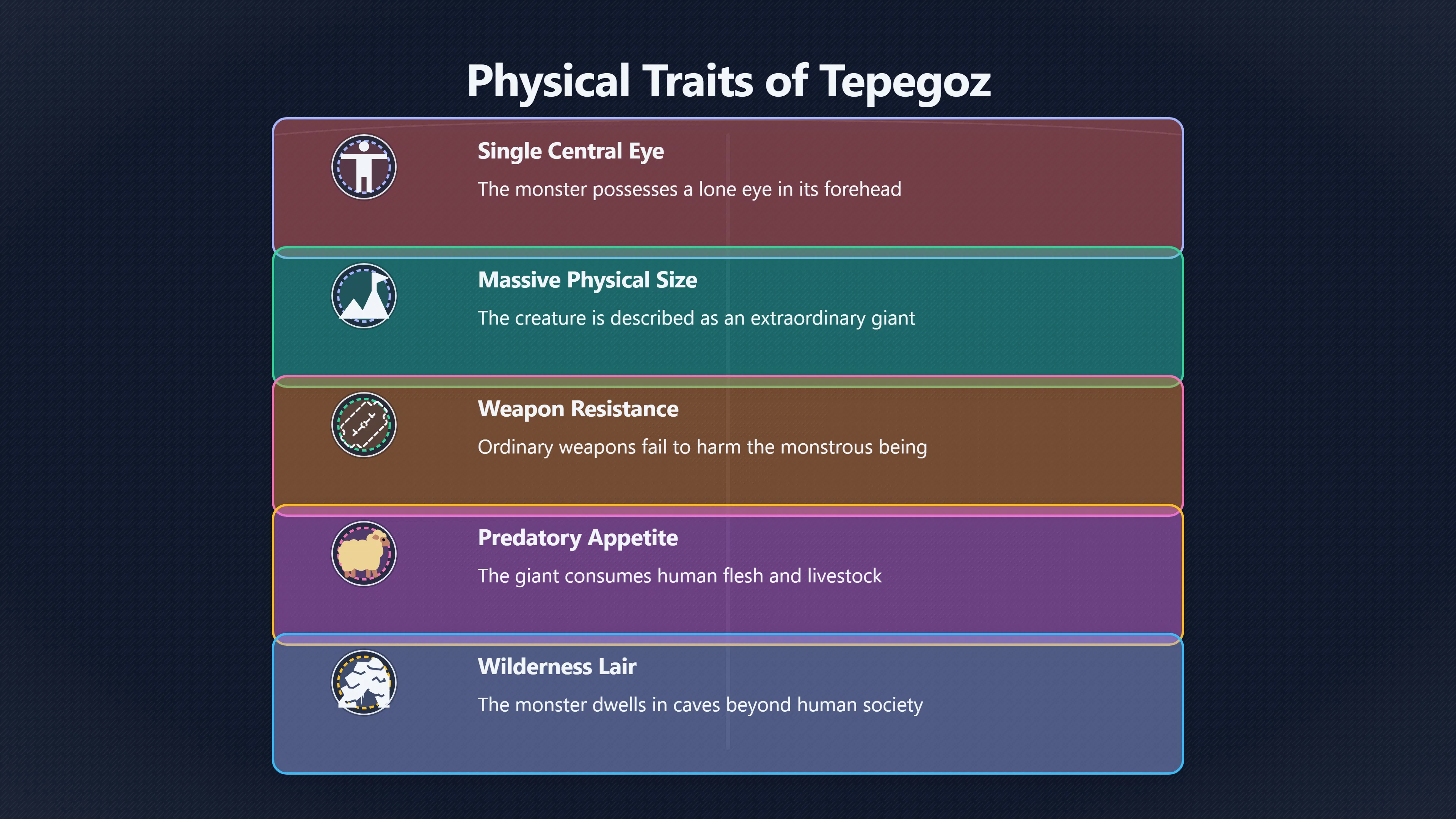
Within that tradition, Tepegoz is a terrifying one-eyed giant whose single eye sits in the middle of his forehead. He is not merely large; he is presented as a near-unstoppable predator. Warriors fail to defeat him, ordinary weapons prove ineffective, and entire communities live under the threat of his appetite. In many retellings he demands regular human victims and vast numbers of sheep, turning survival itself into a negotiation with a monster.[Wikipedia]WikipediaOpen source on wikipedia.org.
This is one reason Tepegoz still resonates with readers interested in cryptids. Modern monster stories often ask what might be hiding beyond civilisation. The Tepegoz episode asks the same question in epic form. The answer is not an undiscovered animal but a monstrous being occupying the dangerous space beyond the community’s boundaries.[JSTOR]jstor.orgThe Dede Korkut Ethicby ME Meeker · 1992 · Cited by 59 — The first of these tells of a young man who saves all the Oghuz from the on…
The One-Eyed Giant in Dede Korkut
The central Tepegoz narrative is usually known as the story of Basat and the one-eyed giant. Basat, one of the epic’s heroes, becomes the figure capable of confronting the creature when stronger warriors cannot. The contrast is important: the tale is not fundamentally about physical strength. It is about intelligence overcoming brute force.[Wikipedia]WikipediaAzerbaijani folkloreAzerbaijani folklore
Descriptions of Tepegoz emphasise qualities familiar from monster lore across many cultures:
- Extraordinary size.
- A single central eye.
- A taste for human flesh.[kureansiklopedi.com]kureansiklopedi.comturkish mythology 6b5ddTurkish Mythology | KÜRE Encyclopedia17 Jan 2026 — Tepegöz is a giant with a single eye on his forehead who devours human flesh. The Oğuz…
- Resistance to ordinary weapons.
- Isolation from normal society.
- A lair associated with wilderness and danger.[Wikipedia]WikipediaAzerbaijani folkloreAzerbaijani folklore
Eventually Basat discovers the giant’s vulnerability. Rather than defeating him through direct combat alone, he attacks the single eye that makes Tepegoz unique. The monster is then killed and the Oghuz people are freed from his terror. The story celebrates cunning and strategy rather than simple heroics.[Wikipedia]WikipediaAzerbaijani folkloreAzerbaijani folklore
Scholars have long noted similarities between Tepegoz and the Cyclops Polyphemus from Homer’s Odyssey. Both are one-eyed giants linked to caves, both threaten travellers or communities, and both are overcome through intelligence directed at their single eye. Researchers disagree on whether one tradition directly influenced the other or whether both emerged from older storytelling patterns circulating across Anatolia and neighbouring regions. What matters for Azerbaijan’s monster tradition is that Tepegoz stands as the local expression of a wider and remarkably durable giant-monster archetype.[wikipedia.org]WikipediaBook of Dede KorkutBook of Dede Korkut

Caves, Sheep-Skins and Heroic Cunning
One reason the Tepegoz story feels unusually vivid is its use of concrete details rather than abstract supernatural imagery. The giant is not an invisible spirit or distant cosmic force. He inhabits recognisable landscapes, demands livestock, traps victims, and threatens everyday life. The story repeatedly links the monster to caves, grazing animals, and the frontier between settled communities and wild terrain.[Wikipedia]WikipediaOpen source on wikipedia.org.
These details matter because they make the monster feel tangible. In many traditional monster narratives, caves function as places outside normal social order. They are hidden spaces where ordinary rules break down. Tepegoz’s cave therefore operates much like the remote lake, forest, or mountain valley of a modern cryptid legend: a location where something dangerous might lurk beyond human control.[Wikipedia]WikipediaOpen source on wikipedia.org.
The giant’s appetite is equally important. Some versions emphasise impossible demands for people and sheep, transforming him into a force that consumes the resources of an entire society. The threat is not merely physical attack; it is the gradual destruction of communal life.[Wikipedia]WikipediaOpen source on wikipedia.org.
Because of this, Basat’s victory carries symbolic weight. The tale presents civilisation surviving not through greater violence but through ingenuity, self-control, and knowledge of the monster’s weakness.[Wikipedia]WikipediaAzerbaijani folkloreAzerbaijani folklore
How Epic Monsters Shape Later Creature Lore
Tepegoz is separated from modern cryptid reports by centuries, yet he helps explain why monster stories remain compelling in Azerbaijan. The giant established a template that appears again and again in regional folklore: an extraordinary being living beyond ordinary society, threatening humans, and forcing communities to interpret the unknown.[UNESCO Intangible Cultural Heritage]ich.unesco.orgUNESCO Intangible Cultural HeritageHeritage of Dede Qorqud/Korkyt Ata/Dede Korkut, epic…The epic culture, folk tales and music of Dede…
Later Azerbaijani traditions include wild-men, forest beings, desert monsters, and other legendary creatures. These figures are not direct descendants of Tepegoz, but they occupy similar imaginative territory. They blur the boundary between the human world and the wilderness beyond it. The difference is that Tepegoz belongs clearly to epic literature, whereas some later creatures drift closer to reported encounters and cryptid-style claims.[Wikipedia]WikipediaAzerbaijani folkloreAzerbaijani folklore
This distinction is important. Tepegoz is not supported by eyewitness evidence, zoological traces, or claims of survival into the present. He belongs firmly to the realm of epic storytelling. Yet his continued popularity shows that modern interest in monsters did not appear from nowhere. Long before people discussed hidden hominins or mystery animals, audiences in Azerbaijan were already fascinated by stories of dangerous beings living at the edge of the known world.[UNESCO Intangible Cultural Heritage]ich.unesco.orgUNESCO Intangible Cultural HeritageHeritage of Dede Qorqud/Korkyt Ata/Dede Korkut, epic…The epic culture, folk tales and music of Dede…
More Than a Giant
For readers approaching Azerbaijan through the lens of cryptids and monster lore, Tepegoz is best understood as a cultural ancestor rather than a candidate species. He is the country’s most famous named monster, a one-eyed giant whose story has endured because it combines fear, adventure, and heroic ingenuity. The tale links Azerbaijan to a wider tradition of cyclops legends while remaining deeply rooted in the Dede Korkut epic cycle that helped shape regional identity.[unesco.org]ich.unesco.orgUNESCO Intangible Cultural HeritageHeritage of Dede Qorqud/Korkyt Ata/Dede Korkut, epic…The epic culture, folk tales and music of Dede…
That is why Tepegoz still feels strangely modern. He may not be a cryptid, but he occupies the same imaginative space that cryptids do: the place where people wonder what might exist just beyond the limits of the familiar world.[JSTOR]jstor.orgThe Dede Korkut Ethicby ME Meeker · 1992 · Cited by 59 — The first of these tells of a young man who saves all the Oghuz from the on…
Amazon book picks
Further Reading
Books and field guides related to Why Tepegoz Still Feels Like a Cryptid. Use these as the next step if you want deeper reading beyond the article.

eBay marketplace picks
Marketplace Samples
Live-tested eBay searches with available results related to this page.


Endnotes
1.
Source: ich.unesco.org
Link:https://ich.unesco.org/en/RL/heritage-of-dede-qorqud-korkyt-ata-dede-korkut-epic-culture-folk-tales-and-music-01399
Source snippet
UNESCO Intangible Cultural HeritageHeritage of Dede Qorqud/Korkyt Ata/Dede Korkut, epic...The epic culture, folk tales and music of Dede...
2.
Source: Wikipedia
Title: Book of Dede Korkut
Link:https://en.wikipedia.org/wiki/Book_of_Dede_Korkut
3.
Source: Wikipedia
Link:https://en.wikipedia.org/wiki/Tepeg%C3%B6z
4.
Source: Wikipedia
Title: Azerbaijani folklore
Link:https://en.wikipedia.org/wiki/Azerbaijani_folklore
5.
Source: jstor.org
Link:https://www.jstor.org/stable/164622
Source snippet
The Dede Korkut Ethicby ME Meeker · 1992 · Cited by 59 — The first of these tells of a young man who saves all the Oghuz from the on...
6.
Source: researchgate.net
Title: 276062955 A Mythic Journey to Polyphemus Tepegz and Grendal
Link:https://www.researchgate.net/publication/276062955_A_Mythic_Journey_to_Polyphemus_Tepegz_and_Grendal
Source snippet
A Mythic Journey to Polyphemus, Tepeg?z and Grendal24 Apr 2015 — Human shaped, huge sized, sometimes one eyed, three or seven headed gian...
7.
Source: Wikipedia
Title: Dede Korkut
Link:https://de.wikipedia.org/wiki/Dede_Korkut
8.
Source: Wikipedia
Title: Azerbaijani fairy tales
Link:https://en.wikipedia.org/wiki/Azerbaijani_fairy_tales
9.
Source: researchgate.net
Link:https://www.researchgate.net/publication/270835412_The_Revenge_Of_Raped_Nature_One-Eyed_GiantTepegoz
Source snippet
The Revenge Of Raped Nature: One-Eyed Giant/TepegozThe most typical representative of this threat is Tepegöz (One-Eyed Giant), who appear...
Additional References
10.
Source: unesco.org.tr
Link:https://unesco.org.tr/Home/Page/1980?slug=List-of-the-Intangible-Cultural-Heritage-of-T%C3%BCrkiye
Source snippet
List of the Intangible Cultural Heritage of TürkiyeThe epic culture, folk tales and music of Dede Qorqud/Korkyt Ata/Dede Korkut are based...
11.
Source: erdem.gov.tr
Link:https://erdem.gov.tr/tam-metin-pdf/964/eng
Source snippet
THE USE OF THE SUPERNATURAL IN THE TURKİSH...The Book of Dede Korkut, consisting of 12 epic tales, recounting the heroic exploits of the...
12.
Source: unesco.preslib.az
Link:https://unesco.preslib.az/en/page/yzm6CkPpGj
Source snippet
UNESCO AzerbaijanHeritage of the “Kitabi-Dede Gorgud”: Epic culture, folk...The epic culture, folk tales and music of the “Kitabi-Dede G...
13.
Source: dailysabah.com
Link:https://www.dailysabah.com/life/2018/11/28/turkish-national-epic-dede-korkut-added-to-unesco-intangible-cultural-heritage-list
Source snippet
Turkish national epic Dede Korkut added to UNESCO...28 Nov 2018 — The epic tales of Dede Korkut, passed on for centuries by the Oguz Tur...
14.
Source: sino-platonic.org
Link:https://sino-platonic.org/complete/spp249_cyclopes.pdf
Source snippet
whether they possessed a name similar to pre-existing Near Eastern monsters already termed...Read more...
15.
Source: instagram.com
Link:https://www.instagram.com/reel/DWa-acASmQf/?hl=en
Source snippet
Think again! Swipe... He appears in the Book of Dede Korkut, a foundational epic in Azerbaijani and...
16.
Source: turkishstudies.net
Link:https://turkishstudies.net/turkishstudies?makale_id=14195&mod=makale_ing_ozet
Source snippet
pears as a result of the pollution of Perili Pınar caused by a shepherd's...Read more...
17.
Source: kureansiklopedi.com
Title: turkish mythology 6b5dd
Link:https://kureansiklopedi.com/en/detay/turkish-mythology-6b5dd
Source snippet
Turkish Mythology | KÜRE Encyclopedia17 Jan 2026 — Tepegöz is a giant with a single eye on his forehead who devours human flesh. The Oğuz...
18.
Source: youtube.com
Link:https://www.youtube.com/watch?v=aXslapPOymM
Source snippet
ede Korkut Efsanesi'nde, Oğuz obasını bu kıskaçtan sadece Basat...
19.
Source: kureansiklopedi.com
Title: tepegoz c8944
Link:https://kureansiklopedi.com/en/detay/tepegoz-c8944
Source snippet
Tepegöz | KÜRE Encyclopedia3 Dec 2025 — Tepegöz is a significant character mentioned in Dede Korkut Kitabı, one of the foundational works...
Topic Tree