Cryptids of Fiji's Reefs
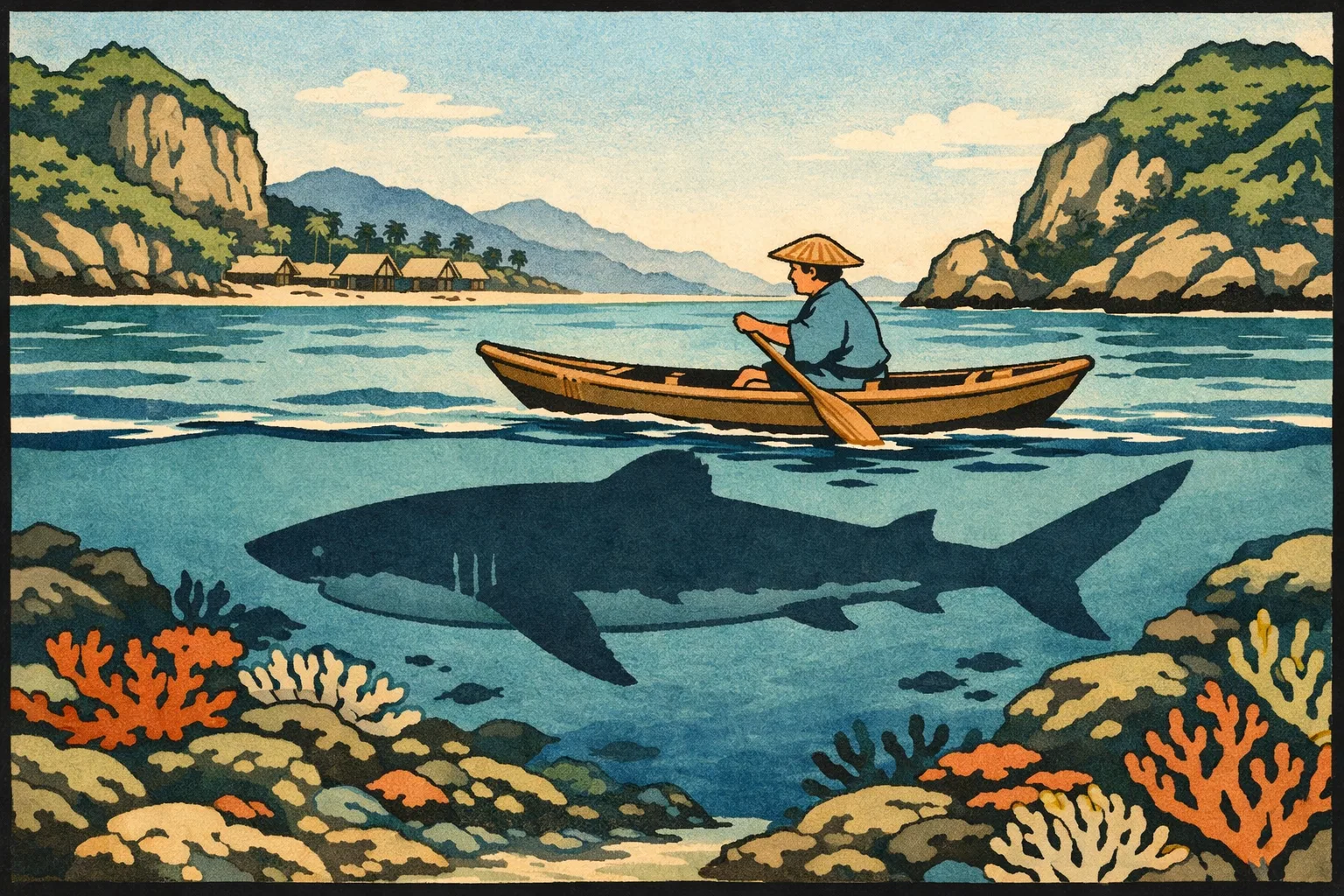
Fiji is not a country with a thick modern record of lake monsters, hairy hominids or newspaper-driven “beast flaps”. Its mystery-creature tradition is much more oceanic. The strongest and most distinct Fijian figure is Dakuwaqa, the shark-god and reef guardian whose story sits between mythology, sea-lore, moral tale and modern conservation symbol.
Page outline Jump by section
Why Fiji’s monsters come mostly from the sea
Fiji’s geography makes the pattern easy to understand. The country consists of more than 300 islands, with Viti Levu and Vanua Levu making up most of the land area, and its biodiversity profile is dominated by marine and island ecosystems: coral reefs, lagoons, mangroves, estuaries, seagrass beds and reef slopes. The Convention on Biological Diversity profile records 1,198 fish species, 1,056 marine invertebrates and around 1,000 coral reefs, while also noting that Fiji’s marine biodiversity is still not fully known. That is exactly the kind of environment where everyday danger, partial sightings and inherited stories can turn sharks, eels, rays, turtles and octopuses into beings with personalities and powers.[Convention on Biological Diversity]cbd.intConvention on Biological Diversity Main DetailsConvention on Biological Diversity Main Details
The land side gives a different clue. Fiji’s only indigenous mammals are bats; introduced mammals include rats, mongoose, pigs, cats, dogs and other familiar species. That does not rule out land folklore, but it does make the classic “large unknown land mammal” pattern less plausible than in continental forests. Fiji’s most compelling mystery-beast material is therefore not a hidden big cat or ape-like creature, but the sea creature as guardian, punisher, omen and explanation for dangerous coastal experience.[Convention on Biological Diversity]cbd.intConvention on Biological Diversity Republic of FijiConvention on Biological Diversity Republic of Fiji
This also helps separate Fijian material from imported cryptozoology. A “monster” in Fiji is often not a disputed zoological specimen at all. It may be a local god associated with a reef passage, a moral story about respecting the sea, a remembered encounter with a large shark, or a colonial-era anecdote retold through European categories such as “sea serpent” or “mermaid”.
Dakuwaqa: Fiji’s shark-god and its closest thing to a national sea monster
Dakuwaqa is the central creature in any evidence-aware account of Fiji’s cryptid traditions. In accessible modern summaries he is described as a shark deity, sea guardian and protector of people at sea, especially fishers. The Australian Museum’s shark-culture material notes two ancestral shark gods in Fiji and identifies Dakuwaqa as one of them; contemporary conservation writing likewise describes him as an ancient shark god reputed to protect people when they are at sea.[The Australian Museum]australian.museumThe Australian Museum FijiThe Australian Museum Fiji
The story is not one single fixed plot. Common retellings present Dakuwaqa as a fierce, shape-shifting shark-being who travelled through Fiji’s reefs and channels, challenging other guardians. A well-known version links him with Kadavu, where he is checked or defeated by an octopus figure and becomes a protector rather than a conqueror. Digital Pasifik’s record for Myths and Legends of Fiji and Rotuma lists “Dakuwaqa the shark god” among the book’s Fijian legend chapters, alongside Degei, snake legends, fish legends, animal legends, giants, monsters and supernatural creatures, showing that Dakuwaqa belongs to a wider Fijian story-world rather than to a modern cryptid invention.[Digital Pasifik]digitalpasifik.orgMyths and legends of Fiji and Rotuma / | Digital Pasifik…
For cryptid readers, Dakuwaqa matters because he sits on the border between three categories:
Folklore figure: Dakuwaqa is primarily a mythological and religious sea-being, not a verified unknown animal.
Possible experience-anchor: the story clearly draws power from real encounters with sharks, reefs, storms, currents and the fear of open water.
Modern conservation symbol: in recent writing, the shark-god has been reimagined as a reminder that sharks now need protection from humans, rather than humans needing protection from sharks.[The Guardian]theguardian.comdiving for dakuwaqa giving fijis shark god a helping handdiving for dakuwaqa giving fijis shark god a helping hand
That last point is not decorative. Fiji’s waters have at least 75 shark and ray species, and conservation groups have reported that roughly two-thirds are globally threatened or near threatened. The old guardian now inhabits a modern debate about shark finning, reef protection, ecotourism and whether traditional respect for sharks can support conservation.[Pew Charitable Trusts]pew.orgOpen source on pew.org.
Where Dakuwaqa stories cluster
Dakuwaqa is strongly associated with seafaring communities, reef passages and particular islands rather than with one “sighting spot” in the modern monster-hunting sense. Several recurring place-links appear in retellings and secondary summaries: Kadavu, Levuka, Taveuni, Cakaudrove, Natewa, Somosomo Strait and river or reef entrances. One account preserved in summaries of Fijian religious material says Dakuwaqa took the form of a great shark and lived on Benau Island opposite Somosomo Strait, and that he was highly respected by people of Cakaudrove and Natewa as a god of seafaring and fishing communities.[Wikipedia]WikipediaReligion in FijiReligion in Fiji
The Kadavu version is the most story-shaped for general readers because it turns a monster of appetite and conquest into a guardian. In that telling, the shark-god’s power is checked by an octopus, after which he promises not to attack Kadavu and becomes its protector. Whether read religiously, symbolically or ecologically, the tale makes sense in an island world where reefs are both food source and danger zone: a passage can feed a community, wreck a boat, hide a shark or produce a story that teaches caution.[Oceania Folktales]oceanianfolktales.comdakuwaqa the fijian shark goddakuwaqa the fijian shark god
The river associations are especially interesting because they overlap with real shark biology. Modern research on young bull sharks in Fiji’s three largest river systems — the Rewa, Sigatoka and Navua — found young bull sharks in all three, with the Rewa River likely providing essential habitat for newly born bull sharks. The study captured 172 young bull sharks between January 2016 and April 2018, most of them neonates, and linked their occurrence to a seasonal summer birth period.[Wiley Online Library]onlinelibrary.wiley.comOpen source on wiley.com.
That does not prove any Dakuwaqa story. It does show why shark traditions can feel rooted in lived observation. In Fiji, sharks are not only offshore silhouettes; some species enter river mouths and estuaries, where people fish, travel and tell stories.
The “great fish” encounter: sighting claim or myth retold?
One of the most cryptid-like Dakuwaqa anecdotes concerns a large fish said to have come up under a cutter travelling from Wainunu, nearly capsizing it. In the account repeated in summaries of Pacific Irishman, the creature was described as nearly 60 feet long, brown-spotted and mottled, with the head of a shark and the tail of a whale; the Fijian crew reportedly identified it as Dakuwaqa and poured kava into the sea to placate it.[Wikipedia]WikipediaReligion in FijiReligion in Fiji
This is the kind of story that tempts a cryptozoological reading, but it needs careful handling. It is not a modern documented biological record with photographs, measurements and specimens. It is an anecdote filtered through memory, colonial writing and religious interpretation. Its details could reflect exaggeration, a real encounter with a large shark or whale shark, confusion during a near-capsize, or a narrative shaped to demonstrate that Dakuwaqa remained “real” to local crews.
The most evidence-aware reading is therefore layered:
As testimony, it records that people at sea interpreted a large animal encounter through Dakuwaqa.
As zoology, it is too thin to identify a new species.
As folklore, it is valuable because it shows how a sea creature claim could become meaningful: the animal was not just “large”; it belonged to a known moral and ritual world.
That distinction is important across the Fiji page. Many monster traditions are not failed science; they are successful local explanations for danger, power and respect.
Eels, snakes, octopuses and other Fijian creature traditions
Dakuwaqa is not alone. Fijian and wider Melanesian traditions include powerful eels, snakes, fish, birds, insects, giants and other supernatural creatures. Digital Pasifik’s catalogue description for Myths and Legends of Fiji and Rotuma lists chapters on Degei and the spirit world, Katu-Mai-Bulu the snake god, Dakuwaqa the shark god, legends of giants, monsters and supernatural creatures, snakes, fish, birds and animals.[Digital Pasifik]digitalpasifik.orgMyths and legends of Fiji and Rotuma / | Digital Pasifik…
A few patterns stand out for cryptid readers.
First, serpent and eel figures matter because islands often turn reptiles, rivers and deep water into origin stories. Degei, commonly described in summaries of Fijian mythology as a serpent-like supreme god associated with creation, death, earthquakes and seasons, belongs more to religion and cosmology than to monster-report literature. Still, he shows how snake form could carry cosmic weight in Fiji.[Wikipedia]WikipediaOpen source on wikipedia.org.
Second, the octopus is not merely a sea monster but a counter-power. In the Dakuwaqa-Kadavu story, the octopus figure is the one capable of restraining the shark-god. That pairing feels biologically vivid: both sharks and octopuses are real reef animals, both inspire awe, and both can become symbols of intelligence, danger and territorial power.[Oceania Folktales]oceanianfolktales.comdakuwaqa the fijian shark goddakuwaqa the fijian shark god
Third, Fiji’s freshwater and reef creatures are often better understood as “mystery-animal folklore” than as cryptids in the strict sense. They are not usually framed as animals awaiting scientific recognition. They are beings embedded in social rules: do not disrespect a place, do not take too much, do not treat the sea as empty space.
The “Feejee Mermaid” problem
No Fiji cryptid page should ignore the “Feejee Mermaid”, but it should also be clear about what it is: not a Fijian mermaid tradition in any straightforward sense. The famous Feejee Mermaid was a nineteenth-century sideshow hoax promoted by P. T. Barnum, usually described as a manufactured creature combining fish and mammal-like parts. Harvard’s Peabody Museum notes that its own “Feejee” example is one of several versions believed to have been created around the same time, made from monkey and fish parts with reptile claws, teeth, clay and papier mâché filler.[Harvard Gazette]news.harvard.eduGazette Feejee Mermaid offers haunting image at Harvard museum — Harvard GazetteGazette Feejee Mermaid offers haunting image at Harvard museum — Harvard Gazette
The name did cultural work. “Feejee” or “Fiji” sounded remote and exotic to nineteenth-century audiences, helping sellers imply that the object came from a faraway sea where ordinary rules might not apply. Live Science summarises the Feejee Mermaid as a Barnum-promoted hoax of the 1840s, the most famous of several fake mermaids exhibited in that century.[Live Science]livescience.comLive Science The Feejee Mermaid: Early Barnum HoaxLive Science The Feejee Mermaid: Early Barnum Hoax
For Fiji itself, the Feejee Mermaid is therefore an afterlife of colonial showmanship, not a good guide to local belief. It belongs on the page because readers may search for “Fiji mermaid” expecting a national monster. The honest answer is that the best-known “Fiji mermaid” is mainly an American and transoceanic museum hoax using Fiji as a marketing label. It tells us more about Victorian spectacle than about Fijian sea-lore.

Sea serpents and newspaper monsters around Fiji
The wider Pacific has many sea-serpent reports, and nineteenth-century newspapers often treated long, unfamiliar marine animals as sensations. Fiji appears in this archive mostly as a route, setting or exotic reference point rather than as the centre of a repeated local sea-serpent flap. One 1891 newspaper item archived by Trove, headed “The Sea Serpent Mystery Solved”, referred to a trip to Fiji and back by the steamship Ovalau. The available archive snippet is enough to show the Fiji-route connection, but not enough to build a strong Fijian case history from it.[Trove]trove.nla.gov.auOpen source on nla.gov.au.
That thinness matters. A country-level cryptid history should not inflate every passing newspaper phrase into a tradition. Fiji’s strongest creature material is not a run of Victorian sea-serpent sightings with named witnesses, repeated locations and physical traces. It is the older, deeper and better-attested world of shark gods, reef guardians and animal-linked sacred geography.
Possible explanations for scattered “sea monster” language around Fiji are familiar from other maritime settings:
Large known animals: whale sharks, manta rays, whales, large sharks, oarfish-like forms elsewhere in the Pacific, or groups of animals seen in broken water.
Surface effects: currents, floating logs, whale backs, waves over reefs and phosphorescence can all look animate in low light.
Story translation: local sea-being traditions may be reframed by outsiders as “monsters”, “fish-gods” or “sea serpents”.
Press style: nineteenth-century newspapers often made sea-animal stories more dramatic than the evidence justified.
What sceptical explanations fit Fiji best?
The most plausible explanations in Fiji are not debunking in the blunt sense. They are translations between kinds of evidence.
For Dakuwaqa, the base layer is religious and folkloric, not zoological. The shark-god is not a claim that a single unknown shark species patrols Fiji. He is a named being in a cultural system where animals, ancestors, places and powers could overlap. Modern writers who use Dakuwaqa as a shark-conservation symbol are not proving the old story literally true; they are showing that the story remains useful for thinking about humans and sharks.[The Guardian]theguardian.comdiving for dakuwaqa giving fijis shark god a helping handdiving for dakuwaqa giving fijis shark god a helping hand
For large-animal encounters, known sharks provide a strong explanation. Fiji has many shark and ray species, and scientific work confirms that bull sharks use river systems such as the Rewa, Sigatoka and Navua when young. A surprising shark in a river mouth, a large animal under a boat, or a reef encounter at dusk can become extraordinary without requiring an unknown animal.[Pew Charitable Trusts]pew.orgOpen source on pew.org.
For land-monster claims, Fiji’s ecology argues for caution. With bats as the only native land mammals, and with many larger land mammals introduced by people, claims of unknown mammalian beasts need stronger evidence than they often receive. Introduced species such as mongoose, rats, cats and pigs can still generate local fear, strange tracks and night encounters, but they are not cryptids in the strict sense.[Convention on Biological Diversity]cbd.intConvention on Biological Diversity Republic of FijiConvention on Biological Diversity Republic of Fiji
For mermaids, the explanation is hoax and museum spectacle. The Feejee Mermaid is one of the clearest examples anywhere of a fake creature becoming more famous than many genuine local traditions.[Harvard Gazette]news.harvard.eduGazette Feejee Mermaid offers haunting image at Harvard museum — Harvard GazetteGazette Feejee Mermaid offers haunting image at Harvard museum — Harvard Gazette
Tourism, pop culture and conservation afterlives
Fiji’s creature traditions now live in several modern settings. Tourism writing often foregrounds reefs, sharks, manta rays, turtle conservation and marine protected areas, which means the old shark-god sits comfortably beside dive culture and conservation messaging. Fiji’s natural environment is a major attraction, and the CBD profile notes that tourism relies heavily on natural resources and pristine marine waters.[Convention on Biological Diversity]cbd.intConvention on Biological Diversity Main DetailsConvention on Biological Diversity Main Details
Shark-diving culture has particularly reshaped Dakuwaqa for outside audiences. Conservation campaigns and dive writing present Fiji as a place where sharks are not only feared but respected, researched and economically valuable alive. Pew’s Fiji shark-conservation material reports at least 75 shark and ray species in Fijian waters, while a Guardian science piece explicitly frames conservation as “giving Fiji’s shark god a helping hand”.[Pew Charitable Trusts]pew.orgOpen source on pew.org.
Pop culture has also borrowed the name. Dakuwaqa appears in modern media references, creature lists and fantasy contexts, but those afterlives often flatten him into a generic shark monster. A better public-facing Fiji page should resist that flattening. The interesting part is not simply “shark god scary”. It is the shift from feared sea power to protector, from local reef guardian to conservation icon, and from mythic shark to a way of talking about real threatened animals.
How to read Fiji’s cryptids without losing the story
Fiji’s monster tradition is strongest when read as a reef-and-ocean tradition rather than a catalogue of unverified animals. Dakuwaqa is the key figure: a shark-god, sea guardian and cultural memory of the power of reefs and sharks. Around him are serpent, eel, octopus, fish and giant traditions that belong to Fijian and wider Melanesian storytelling. The “Feejee Mermaid”, by contrast, is mainly an imported sideshow hoax that used Fiji’s name to sell a fake marvel.
The evidence does not support a confident claim that Fiji hides a recognised modern cryptid species. It does support something more culturally interesting: in Fiji, real animals and dangerous places became moral beings. Sharks entered rivers and reefs; octopuses guarded passages; eels and serpents carried sacred force; foreign showmen turned “Fiji” into a mermaid label; and modern conservationists now ask whether the old shark-god’s protective role can be returned in reverse, with people protecting the sharks.
Amazon book picks
Further Reading
Books and field guides related to What Monsters Haunt Fiji's Reefs?. Use these as the next step if you want deeper reading beyond the article.
Myths and Legends of the Pacific
Covers the cultural setting from which Fijian sea-creature stories emerge.
eBay marketplace picks
Marketplace Samples
Live-tested eBay searches with available results related to this page.

Endnotes
1.
Source: cbd.int
Title: Convention on Biological Diversity Main Details
Link:https://www.cbd.int/countries/profile/?country=fj
2.
Source: onlinelibrary.wiley.com
Link:https://onlinelibrary.wiley.com/doi/full/10.1002/ece3.5304
3.
Source: digitalpasifik.org
Title: Digital Pasifik
Link:https://digitalpasifik.org/items/792570
Source snippet
Myths and legends of Fiji and Rotuma / | Digital Pasifik...
4.
Source: cbd.int
Title: Convention on Biological Diversity Republic of Fiji
Link:https://www.cbd.int/doc/world/fj/fj-nr-01-en.pdf
5.
Source: australian.museum
Title: The Australian Museum Fiji
Link:https://australian.museum/publications/sharks/fiji/
6.
Source: pew.org
Link:https://www.pew.org/en/research-and-analysis/articles/2011/10/shark-conservation-in-fiji
7.
Source: Wikipedia
Title: Religion in Fiji
Link:https://en.wikipedia.org/wiki/Religion_in_Fiji
8.
Source: Wikipedia
Link:https://en.wikipedia.org/wiki/Degei
9.
Source: Wikipedia
Title: Fijian mythology
Link:https://en.wikipedia.org/wiki/Fijian_mythology
10.
Source: news.harvard.edu
Title: Gazette Feejee Mermaid offers haunting image at Harvard museum — Harvard Gazette
Link:https://news.harvard.edu/gazette/story/2017/10/feejee-mermaid-offers-haunting-tale-at-harvard-museum/
11.
Source: Wikipedia
Link:https://en.wikipedia.org/wiki/Dakuwaqa
12.
Source: Wikipedia
Link:https://en.wikipedia.org/wiki/Fiji
13.
Source: Wikipedia
Title: On (company)
Link:https://en.wikipedia.org/wiki/On_%28company%29
14.
Source: Wikipedia
Title: Fiji mermaid
Link:https://en.wikipedia.org/wiki/Fiji_mermaid
15.
Source: archive.org
Link:https://archive.org/stream/kingandpeoplefi00wategoog/kingandpeoplefi00wategoog_djvu.txt
16.
Source: archive.org
Link:https://archive.org/stream/kingandpeoplefi00josegoog/kingandpeoplefi00josegoog_djvu.txt
17.
Source: archive.org
Link:https://archive.org/stream/bub_gb_fopBioQ4HY4C/bub_gb_fopBioQ4HY4C_djvu.txt
18.
Source: cbd.int
Link:https://www.cbd.int/doc/world/fj/fj-nr-05-en.pdf
19.
Source: cbd.int
Title: CB D Strategy and Action Plan
Link:https://www.cbd.int/doc/world/fj/fj-nbsap-v2-en.pdf
20.
Source: onlinelibrary.wiley.com
Link:https://onlinelibrary.wiley.com/doi/10.1002/ece3.5304
21.
Source: onlinelibrary.wiley.com
Link:https://onlinelibrary.wiley.com/doi/abs/10.1002/ece3.5304
22.
Source: fiji.travel
Link:https://www.fiji.travel/
23.
Source: coral.org
Title: shark awareness campaign fiji
Link:https://coral.org/en/blog/shark-awareness-campaign-fiji/
24.
Source: theguardian.com
Title: diving for dakuwaqa giving fijis shark god a helping hand
Link:https://www.theguardian.com/science/blog/2017/sep/14/diving-for-dakuwaqa-giving-fijis-shark-god-a-helping-hand
25.
Source: oceanianfolktales.com
Title: dakuwaqa the fijian shark god
Link:https://oceanianfolktales.com/dakuwaqa-the-fijian-shark-god/
26.
Source: opus.lib.uts.edu.au
Link:https://opus.lib.uts.edu.au/handle/10453/162888
27.
Source: livescience.com
Title: Live Science The Feejee Mermaid: Early Barnum Hoax
Link:https://www.livescience.com/56037-feejee-mermaid.html
28.
Source: trove.nla.gov.au
Link:https://trove.nla.gov.au/newspaper/article/12728685
29.
Source: hoaxes.org
Title: the feejee mermaid
Link:https://hoaxes.org/archive/permalink/the_feejee_mermaid
30.
Source: mythus.fandom.com
Link:https://mythus.fandom.com/wiki/Dakuwaqa
31.
Source: new-cryptozoology.fandom.com
Link:https://new-cryptozoology.fandom.com/wiki/Dakuwaqa
32.
Source: facebook.com
Link:https://www.facebook.com/SharkGuardianWorldWide/photos/today-is-sharkfactsmonday-less-factual-more-fascination-as-were-talking-fijian-s/3344220142323583/
33.
Source: mowe.gov.fj
Title: National Biodiversity Strategy Action Plan
Link:https://www.mowe.gov.fj/wp-content/uploads/2020/06/National-Biodiversity-Strategy-Action-Plan.pdf
34.
Source: books.google.com
Title: Myths and Legends of Fiji and Rotuma
Link:https://books.google.com/books/about/Myths_and_Legends_of_Fiji_and_Rotuma.html?id=D-ob0QEACAAJ
35.
Source: youtube.com
Link:https://www.youtube.com/watch?v=P47ajHTqN48
36.
Source: loot.co.za
Title: Fijian Mythology
Link:https://www.loot.co.za/product/fijian-mythology/dlhx-1291-g500?srsltid=AfmBOooqh0wRI5jdkUq1D_Zv3606K2w-_w0EKyx8cn5xbb-8MNPz1KTd
37.
Source: hero.epa.gov
Link:https://hero.epa.gov/reference/8671457/
38.
Source: thecommonwealth.org
Link:https://thecommonwealth.org/our-member-countries/fiji
39.
Source: digitalpasifik.org
Link:https://digitalpasifik.org/items/482756
40.
Source: GOV.UK
Link:https://www.gov.uk/foreign-travel-advice/fiji
41.
Source: ouci.dntb.gov.ua
Link:https://ouci.dntb.gov.ua/en/works/4rQjrEG7/
42.
Source: environment.gov.vu
Link:https://environment.gov.vu/images/Vanuatu_NBSAP_2018-2030.pdf
43.
Source: iucngisd.org
Link:https://www.iucngisd.org/gisd/species.php?sc=86+
44.
Source: kuoni.co.uk
Link:https://www.kuoni.co.uk/destinations/australasia-and-pacific/fiji/
45.
Source: dfat.gov.au
Link:https://www.dfat.gov.au/geo/fiji/fiji-country-brief
Additional References
46.
Source: youtube.com
Link:https://www.youtube.com/watch?v=7I3_RtbvsJk
Source snippet
Hunting for the myth of the FIJIAN shark God DAKUWAQA in 6.11 minutes...
47.
Source: youtube.com
Title: The Fijian myth of the greedy god
Link:https://www.youtube.com/watch?v=CBWgOe8HsV0
Source snippet
Uncovering Fiji's Shark God - The Real Legend of Dakuwaqa...
48.
Source: facebook.com
Link:https://www.facebook.com/thefijitimes/posts/discoveringfiji-last-week-in-our-discovering-fiji-episode-we-visited-the-tukaves/920703970099413/
49.
Source: researchgate.net
Link:https://www.researchgate.net/publication/333780131_Essential_waters_Young_bull_sharks_in_Fiji%27s_largest_riverine_system
50.
Source: academia.edu
Link:https://www.academia.edu/169859128/The_Indigeneity_of_Archaeological_Research_in_Fiji_Issues_and_Opportunities
51.
Source: georgehbalazs.com
Link:https://georgehbalazs.com/wp-content/uploads/2019/02/ReedHames_1967_MythsLegendsFijiRotuma_ChapterXIIILegendsTreesPlants.pdf
52.
Source: researchgate.net
Link:https://www.researchgate.net/publication/363259808_Community-driven_shark_monitoring_for_informed_decision_making_A_case_study_from_Fiji
53.
Source: tropicalsky.co.uk
Link:https://www.tropicalsky.co.uk/south-pacific-holidays/fiji/a-first-timer-s-guide-to-holidaying-in-fiji
54.
Source: hai.swiss
Link:https://hai.swiss/en/projects/completed/bull-sharks-fiji
55.
Source: macbio-pacific.info
Link:https://macbio-pacific.info/wp-content/uploads/2017/08/Lomaiviti-Report-final.pdf
Topic Tree
Follow this branch
Related pages 192
- Antigua Cryptids
- Maldives Monsters
- Malta Monsters
- Qatar Monsters
- Argentina Monsters
- +187 more in sidebar