The Creatures Behind Saudi Arabia's Monster Stories
Saudi Arabia does not have a single nationally famous cryptid comparable to the Loch Ness Monster or Bigfoot.
Page outline Jump by section
Introduction
The creatures most likely to generate “monster” stories are the striped hyena, Arabian wolf and Arabian leopard. All are nocturnal or elusive, and the leopard may now be absent from the Saudi wild despite continuing reports from remote western and south-western mountains. Ancient rock art shows that Arabia once supported an even richer collection of large predators, including lions and cheetahs. That vanished ecological world helps explain why stories of formidable beasts remain plausible in the imagination, even when modern evidence is weak.[cambridge.org]cambridge.orgCambridge University Press & Assessmenta comprehensive survey for the Arabian leopard Panthera…by CE Dunford · 2024 · Cited by 15 — We…
The result is a country where the boundary between monster, memory and misidentified animal is unusually fluid. The most useful question is therefore not “Which Saudi cryptids are real?” but “Which stories preserve folklore, which may reflect surviving wildlife, and which have been enlarged by distance, darkness and social media?”
Why Saudi Arabia has no neat cryptid canon
Cryptid traditions usually flourish around repeated reports attached to a memorable place: a lake, forest, cave system or mountain range. Saudi Arabia has abundant dramatic landscapes, but its creature stories have rarely been collected into a stable, widely published national catalogue. Much of the relevant material instead survives in oral storytelling, regional animal lore, classical Arabic literature, travellers’ accounts and modern videos labelled only as a “strange creature”.
This makes classification difficult. A shape-changing desert being is a folkloric entity, not an alleged undiscovered species. A large cat seen briefly in the mountains may be a wildlife report. A glowing object crossing a desert road is an anomalous-light story. Online retellings frequently place all three in the same “mystery” category, even though they require very different kinds of evidence.
Saudi geography encourages ambiguity. Vast deserts contain few visual reference points, while volcanic fields, caves, ravines and highland wadis provide cover for nocturnal animals. The western mountains also formed part of the historical range of the Arabian leopard, and wolves, caracals, foxes and striped hyenas still produce unfamiliar silhouettes. Research on Saudi carnivores repeatedly finds that detections are concentrated at night and around wadis, precisely the conditions in which witnesses are most likely to see an animal briefly and incompletely.[ResearchGate]researchgate.netDiversity and Conservation of Carnivores in Saudi ArabiaDecember 25, 2024 — 17 Dec 2024 — Six species were detected: the red…
There is also a powerful element of ecological memory. Rock art from sites such as Shuwaymis records lions, leopards, hyenas and other animals living in Arabia during wetter periods. An analysis of 1,903 engravings found that the represented species changed alongside the region’s transition from humid landscapes to increasingly arid conditions. Saudi stories of dangerous wilderness animals therefore developed in a country that genuinely possessed a more formidable predator community than it does today.[aip.org]aip.orgWhat Ancient Rock Art Reveals About A Wetter ArabiaWhat Ancient Rock Art Reveals About A Wetter ArabiaJuly 7, 2016 — 7 Jul 2016 — The research reveals that lions, leopards, hyenas and c…
The ghoul: Saudi Arabia’s oldest desert monster
The ghoul is the clearest monster figure associated with the wider Arabian tradition. It is commonly described as a dangerous being of deserted places: a shapeshifter, deceiver or flesh-eating creature that approaches travellers and leads them towards death. Some tales place it near burial grounds or abandoned settlements; others make it a desert predator able to appear as a person or animal.
Scholars generally treat the ghoul as folklore rather than cryptozoology. Its roots lie in pre-modern Arabian storytelling and literature, where it served several purposes at once. It made the hazards of travelling alone imaginable, warned against trusting unfamiliar figures and gave supernatural form to real dangers such as exposure, disorientation, robbery and animal attack. The creature later entered European popular culture through translations and adaptations, becoming the corpse-eating cemetery monster familiar from modern fantasy.[researchgate.net]researchgate.netResearch Gate(PDF) The Mythical Ghoul in Arabic CultureResearch Gate(PDF) The Mythical Ghoul in Arabic Culture
Saudi Arabia is central to the ghoul’s cultural landscape because the western and central Arabian deserts supplied the settings associated with early Arabic wilderness tales. That does not mean every ghoul story can be assigned specifically to the modern Saudi state. Many belong to a shared Arabian tradition that long predates present borders.
The most interesting naturalistic connection is the striped hyena. Hyenas are nocturnal, powerfully built scavengers that use caves and may carry large bones over considerable distances. Historical writers and storytellers sometimes blurred hyenas, ghouls and other feared night beings. One later account even describes a hyena attack near Mecca in 1667 in which local people reportedly referred to the animal as a ghoul. The incident does not establish that ghoul belief began with hyenas, but it demonstrates how a real predator could be interpreted through an existing monster tradition.[Wikipedia]WikipediaOpen source on wikipedia.org.
The striped hyena behind the monster mask
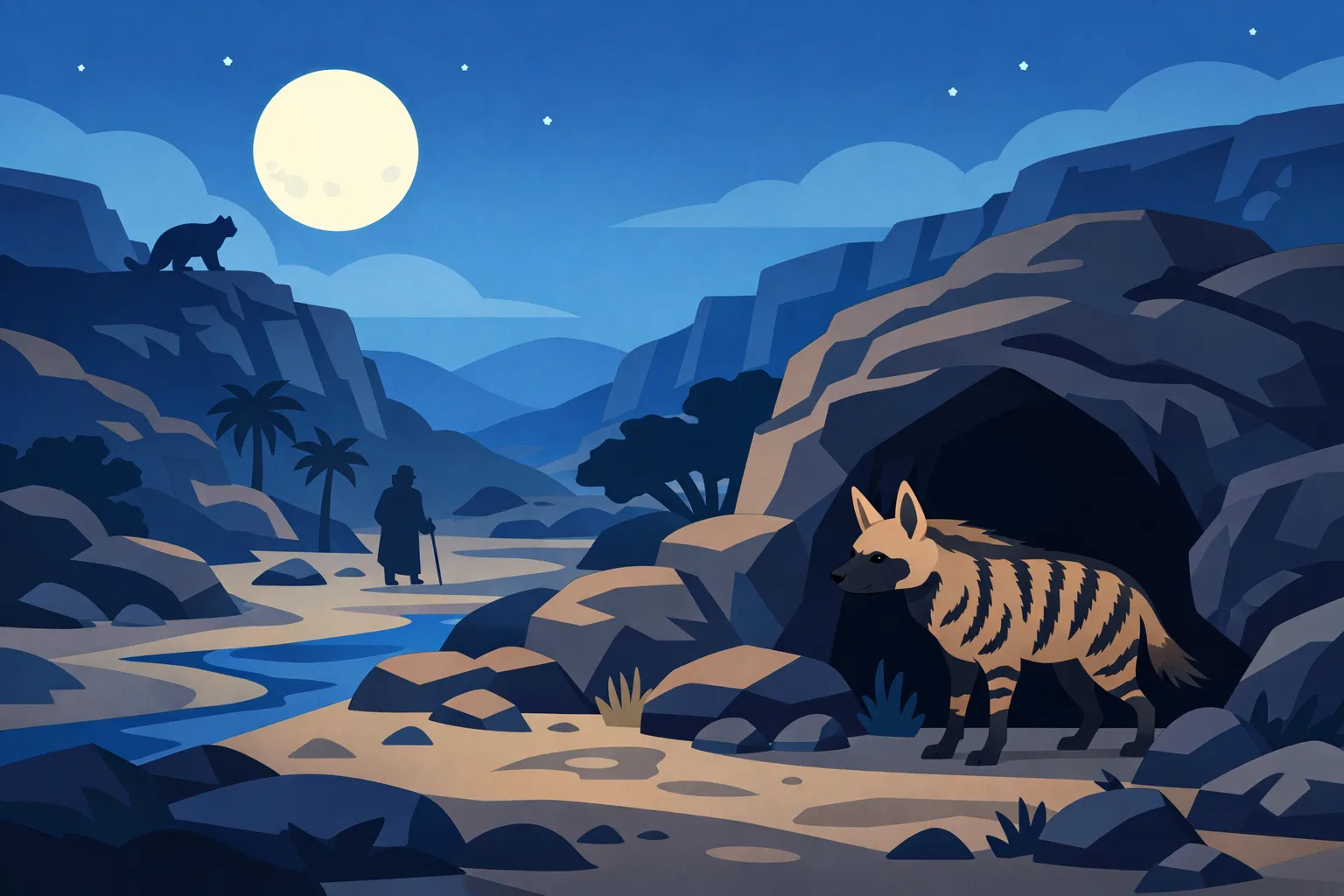
Of all Saudi animals, the striped hyena has perhaps the strongest claim to being a real-life source of monster reports. It has a sloping back, a dark mane that can stand erect, a heavy head and strongly striped legs. Seen in poor light, it can appear larger and stranger than it is. Unlike the more familiar spotted hyena of African wildlife films, the striped species is usually solitary, secretive and primarily active at night.[Springer Nature Link]link.springer.comOpen source on springer.com.
Its behaviour also fits old stories remarkably well. Striped hyenas scavenge carcasses, drag bones into dens and possess jaws capable of breaking large limb bones. They sometimes use caves, rocky cavities and lava tubes, reinforcing their association with desolate underground places. None of this requires supernatural powers, but it provides unusually rich raw material for frightening stories.
The most dramatic Saudi example comes from Umm Jirsan, a lava-tube system in the Harrat Khaybar volcanic field north of Medina. Researchers discovered an enormous accumulation of animal bones, together with hyena remains and fossilised droppings. Taphonomic analysis — the study of what happens to remains after death — indicated that striped hyenas had gathered much of the material over a long period. The assemblage included bones from livestock and wild animals, as well as fragments of human skull.[springer.com]link.springer.comOpen source on springer.com.
A cavern containing thousands of broken bones would look like convincing evidence of a monster’s den to anyone encountering it without archaeological explanation. In reality, Umm Jirsan shows how ordinary animal behaviour can create a scene more macabre than most legends.
Hyena folklore also affects conservation. Across parts of the Middle East and Asia, striped hyenas have been accused of grave robbing, mesmerising people or possessing magical properties. Studies outside Saudi Arabia have found that superstition and fear can encourage persecution, while recent Saudi field research reports that public attitudes often associate hyenas with danger and livestock loss despite recognition of their ecological role as scavengers.[nrdc.org]nrdc.orgstriped hyenas dont have magical powers their disappearing act realstriped hyenas dont have magical powers their disappearing act real
This is where the distinction between folklore and cryptid claim matters most. The striped hyena is not an unknown creature. It is a threatened, poorly observed animal whose real appearance and habits have repeatedly been transformed into something monstrous.
Is the Arabian leopard Saudi Arabia’s phantom cat?
The Arabian leopard is the most credible explanation for reports of a large, mysterious cat in western Saudi Arabia. Historically, it occupied mountainous country along much of the western side of the kingdom. Today it is classified as Critically Endangered, with an estimated global wild population of roughly 100–120 animals, mainly in Oman and Yemen. A very small number may survive in Saudi Arabia, but that remains unconfirmed.[Cambridge University Press & Assessment]cambridge.orgCambridge University Press & Assessmenta comprehensive survey for the Arabian leopard Panthera…by CE Dunford · 2024 · Cited by 15 — We…
This uncertainty creates ideal phantom-cat territory. The mountains of Asir, Hejaz and the southern border region contain rugged escarpments, caves and wadis that are difficult to survey. People may report a large spotted cat, tracks, livestock losses or distant movement, while physical confirmation remains absent.
Researchers have tested these claims more thoroughly than most cryptid stories ever receive. A major survey deployed 586 camera-trap stations across 13 sites, accumulating more than 82,000 camera-trap nights. It also gathered information from 843 local residents. Despite this enormous effort, no leopard was photographed, and the study noted that Saudi Arabia had produced no confirmed sighting since 2014.[Cambridge University Press & Assessment]cambridge.orgCambridge University Press & Assessmenta comprehensive survey for the Arabian leopard Panthera…by CE Dunford · 2024 · Cited by 15 — We…
That negative result does not prove that no leopard survives anywhere in the country. Camera traps sample particular locations, and a tiny population could evade detection. Nevertheless, the scale of the survey substantially weakens claims of a widespread hidden population.
A smaller investigation near the Yemeni border in 2023 found four possible leopard scrape marks in mountainous terrain, including one inside a cave. The cameras recorded no leopard. Scrapes are suggestive but not decisive because other animals or natural disturbance can produce ambiguous marks. They are best treated as potential evidence requiring confirmation through photographs, genetic material or unmistakable tracks.[Cambridge University Press & Assessment]cambridge.orgOpen source on cambridge.org.
Several animals can also generate false leopard reports. Caracals are large, long-legged cats with prominent ear tufts. Wolves and hyenas can look cat-like when only the rear body is visible. Feral dogs vary greatly in size and colour. Distance makes scale difficult to judge against bare rock, especially without a familiar object nearby.
The Arabian leopard therefore occupies an unusual position: it is not a cryptid, because science recognises the animal and surviving populations exist elsewhere. Yet within Saudi Arabia it functions culturally like a phantom cat — remembered, reported and searched for, but not reliably documented in the wild.

Wolves, baboons and other likely misidentifications
Not every strange Saudi animal report points towards a leopard or hyena. The country supports several species capable of producing startling encounters, especially around rubbish sites, farms, roads and expanding settlements.
Arabian wolves remain distributed across parts of Saudi Arabia, although populations have declined. They are smaller and leaner than many northern wolves, and they may travel alone or in small groups. A thin wolf seen at night can be mistaken for an unusually large fox, dog or hyena. Bedouin wolf stories have also attributed exceptional cunning and almost human intelligence to the animal, giving ordinary sightings a ready-made legendary frame.[ljmu.ac.uk]researchonline.ljmu.ac.ukLJMU Research OnlineDistribution update of the Arabian wolf (Canis lupus pallipes…by PL Cunningham · 2010 · Cited by 4 — The aim of th…
Hamadryas baboons occur in south-western Saudi Arabia, including areas around Taif, Al-Baha and the mountains south of Mecca. A large male has a heavy mane, a dog-like muzzle and an almost human posture when seated. Brief footage of a baboon climbing, standing or moving through poor light can easily be presented online as an ape-like creature, even though the species is well established in the region.[Wikipedia]WikipediaWildlife of Saudi ArabiaWildlife of Saudi Arabia
Caracals and sand cats produce a different sort of confusion. A caracal can appear surprisingly large because of its long limbs, while the much smaller sand cat is so well adapted to desert conditions that it is rarely seen. Its fur-covered feet, low posture and avoidance behaviour make it difficult to observe even when researchers know it is present. Such elusive animals help sustain the popular idea that the desert still conceals unknown beasts, although elusiveness alone is not evidence of an undiscovered species.[Discover Wildlife]discoverwildlife.comDiscover Wildlife Scientists tracked 6 'ghosts of the desert' through the SaudiDiscover Wildlife Scientists tracked 6 'ghosts of the desert' through the Saudi
Feral dogs, injured livestock and animals affected by mange are equally important explanations. Mange can remove fur and alter an animal’s outline so dramatically that foxes, wolves and dogs appear almost unrecognisable. Shaky night-time video then erases the anatomical details needed for identification.
Strange lights are not mystery animals
Saudi desert folklore also includes wandering or deceptive lights said to lure travellers away from safe routes. Modern online accounts often use the name Abu Fanous for a moving light associated with remote parts of the Arabian Peninsula. Descriptions resemble will-o’-the-wisp traditions elsewhere: an apparently nearby light shifts position, retreats when approached or suddenly disappears.
This belongs more naturally to anomalous-light folklore than to cryptozoology. The accounts generally lack consistent measurements, trace evidence or well-documented observation records. Suggested explanations include distant vehicle lights distorted by temperature layers, atmospheric refraction, reflections, human activity and simple errors of distance perception. Claims that burning underground gases are responsible are frequently repeated online but are not supported by a clear Saudi field investigation.
The desert is particularly good at defeating normal visual judgement. A small light may be visible across great distances, while darkness removes the landmarks that allow observers to estimate its size and position. Temperature inversions can bend light near the horizon, and a vehicle hidden behind uneven ground may appear only as a hovering beam.
The folklore remains culturally interesting because it turns the practical danger of getting lost into an intentional adversary. Like the ghoul, the light does not merely exist: it deceives. That repeated theme suggests that many Saudi monster traditions are less concerned with undiscovered zoology than with the risks of navigation, isolation and misplaced trust.
Could the Red Sea hide a Saudi sea monster?
Saudi Arabia has more than 1,700 kilometres of Red Sea coastline, extensive reefs and deep offshore habitats. It would seem an ideal setting for sea-serpent legends, yet there is no well-established Saudi equivalent of a famous lake monster or recurring coastal serpent.
The absence is notable because the Red Sea contains animals capable of producing spectacular sightings. Whale sharks, manta rays, dolphins, large groupers, sharks and oarfish-like deep-water species can all look extraordinary when seen briefly. A manta ray encountered off the Farasan Bank was memorably described as one of the “gentler monsters of the deep”, capturing how genuine marine animals can acquire monstrous language without becoming cryptids.[AramcoWorld]archive.aramcoworld.comOpen source on aramcoworld.com.
Recent expeditions have publicised unusual deep-water habitats, rare species and previously poorly documented ecosystems in Saudi waters. Headlines sometimes describe “giant sea creatures”, but these reports concern biological exploration, not evidence of unknown monsters. The Red Sea’s rich marine life is real; claims that it contains a surviving prehistoric reptile are not supported by comparable evidence.[Gulf News]gulfnews.comGulf News Giant sea creatures, new islands discovered north of RedGulf News Giant sea creatures, new islands discovered north of Red
Fossil discoveries add another source of confusion. Saudi geological work has uncovered the remains of a large marine lizard more than 80 million years old in the western region, alongside fossils representing ancient marine environments. These finds demonstrate that enormous reptiles once inhabited seas covering parts of what is now Saudi Arabia. They do not show that such animals survive in the modern Red Sea.[Red Sea Global]redseaglobal.comOpen source on redseaglobal.com.
This distinction is easily lost in viral posts. “Ancient sea monster found in Saudi Arabia” may accurately describe a fossil in popular language, but repeated without the geological context it can mutate into a claim about a recently living creature.
How social media changes the legends
Older Saudi creature stories usually travelled through oral retelling, poetry, local history and accounts of journeys. Modern mystery reports spread through short videos, reposted captions and algorithmic recommendation. This changes both speed and form.
A blurred animal filmed beside a road can be detached from its original location and uploaded again with a new city, year or explanation. Compression removes details from fur, feet and facial structure. Dramatic music encourages viewers to interpret ordinary movement as threatening. By the time the clip reaches a wider audience, the original witness may no longer be identifiable.
The label “strange creature in Saudi Arabia” is therefore not evidence that a report began there. Useful verification requires the earliest available upload, a precise location, an unedited copy and comparison with local wildlife. Without those elements, confident identification may be impossible — but “unidentified in this clip” does not mean “unknown to science”.
Artificially generated imagery now makes the problem harder. Modern image and video tools can create convincing desert monsters, while recycled film effects and staged costumes are difficult to assess after repeated compression. A sensational clip with no traceable source has far less evidential value than a dull camera-trap photograph with a date, location and original file.
The evidential limits around Saudi Arabia’s cryptid traditions
Saudi Arabia’s monster tradition is best understood as several overlapping layers rather than a list of undiscovered animals.
The folkloric layer contains ghouls, shape-changing wilderness beings and deceptive lights. These stories express the dangers of isolation, night travel and unfamiliar places. They belong to cultural history even when no zoological claim is involved.
The wildlife layer contains hyenas, wolves, caracals, baboons and possibly the last traces of the Arabian leopard. These animals are real, but rarity, darkness and fear can make sightings appear uncanny. The hyena is especially important because its behaviour closely matches several motifs later treated as monstrous.
The ecological-memory layer comes from a time when Saudi Arabia supported lions, cheetahs, leopards and richer prey populations. Rock art preserves that lost fauna, while fossils reveal still older worlds of enormous marine reptiles. These records make Arabia’s past look almost mythical, although the evidence is archaeological and geological rather than cryptozoological.
Finally, the media layer turns ambiguous videos, fossils and rare-animal sightings into instant monster stories. Most collapse under basic checks of date, location or species identification. A few remain unresolved because the available image is simply too poor, not because an unknown creature is the most likely explanation.
The enduring Saudi mystery
The strongest Saudi creature stories do not point towards one hidden monster. They show how genuine animals, vanished ecosystems and desert folklore reinforce one another.
A hyena can leave a cave filled with bones. A leopard can disappear from scientific surveys while remaining vivid in local memory. A baboon can resemble a crouching humanoid in a few seconds of night footage. An ancient marine reptile can become a “Red Sea monster” once its fossil age drops out of the headline.
Saudi Arabia’s mystery-beast tradition is therefore most compelling when uncertainty is preserved rather than exaggerated. There may still be an Arabian leopard somewhere in the remote south-western mountains, but large surveys have not confirmed one. There are certainly secretive predators capable of startling witnesses, but none requires a new species to explain it. The ghouls and deceptive lights remain powerful stories because they give personality to landscapes in which losing one’s bearings can be dangerous.
The country’s real natural history is strange enough: bone-hoarding hyenas in volcanic tunnels, nearly vanished mountain cats, ancient rock faces crowded with lost predators and fossil reptiles from seas tens of millions of years old. Those facts do not prove the monsters. They explain why the monsters were believable.
Amazon book picks
Further Reading
Books and field guides related to What Lurks Behind Saudi Arabia's Monster Stories?. Use these as the next step if you want deeper reading beyond the article.
Arabian Sands
Provides rich context for desert landscapes, wildlife and folklore behind monster stories.
The Encyclopedia of Monsters
Helps place Arabian monster traditions in a wider folklore framework.
The Mythical Creatures Bible
Includes folklore traditions relevant to discussions of monsters and legends.
The Mythical Creatures Bible The Definitive Guide To Legendar...
First published 2009. Subjects: Animals, mythical.
eBay marketplace picks
Marketplace Samples
Live-tested eBay searches with available results related to this page.



Endnotes
1.
Source: cambridge.org
Link:https://www.cambridge.org/core/journals/oryx/article/searching-for-spots-a-comprehensive-survey-for-the-arabian-leopard-panthera-pardus-nimr-in-saudi-arabia/B77C63D113EFC1DC33DA93A5799761EE
Source snippet
Cambridge University Press & Assessmenta comprehensive survey for the Arabian leopard Panthera...by CE Dunford · 2024 · Cited by 15 — We...
2.
Source: catsg.org
Link:https://www.catsg.org/arabianleopard
Source snippet
IUCN CatSGArabian Leopard | IUCN CatSGThe Arabian Leopard is classified as Critically Endangered on the IUCN Red List due to its small an...
3.
Source: researchgate.net
Link:https://www.researchgate.net/publication/387416733_Diversity_and_Conservation_of_Carnivores_in_Saudi_Arabia
Source snippet
Diversity and Conservation of Carnivores in Saudi ArabiaDecember 25, 2024 — 17 Dec 2024 — Six species were detected: the red...
Published: December 25, 2024
4.
Source: aip.org
Title: What Ancient Rock Art Reveals About A Wetter Arabia
Link:https://www.aip.org/inside-science/what-ancient-rock-art-reveals-about-a-wetter-arabia
Source snippet
What Ancient Rock Art Reveals About A Wetter ArabiaJuly 7, 2016 — 7 Jul 2016 — The research reveals that lions, leopards, hyenas and c...
Published: July 7, 2016
5.
Source: researchgate.net
Title: Research Gate(PDF) The Mythical Ghoul in Arabic Culture
Link:https://www.researchgate.net/publication/277816715_The_Mythical_Ghoul_in_Arabic_Culture
6.
Source: ebsco.com
Link:https://www.ebsco.com/research-starters/literature-and-writing/ghoul-mythical-creature
7.
Source: Wikipedia
Link:https://en.wikipedia.org/wiki/Ghoul
8.
Source: link.springer.com
Link:https://link.springer.com/article/10.1007/s12520-021-01365-6
9.
Source: gea.mpg.de
Title: first lava tube excavation in arabia
Link:https://www.gea.mpg.de/32843/first-lava-tube-excavation-in-arabia
10.
Source: nrdc.org
Title: striped hyenas dont have magical powers their disappearing act real
Link:https://www.nrdc.org/stories/striped-hyenas-dont-have-magical-powers-their-disappearing-act-real
11.
Source: researchgate.net
Link:https://www.researchgate.net/publication/398878178_Threats_and_Traditions_Citizen_Science_Insights_into_Striped_Hyena_Hyaena_hyaena_Conservation_in_Saudi_Arabia
12.
Source: researchgate.net
Link:https://www.researchgate.net/publication/375984784_Searching_for_spots_a_comprehensive_survey_for_the_Arabian_leopard_Panthera_pardus_nimr_in_Saudi_Arabia
13.
Source: cambridge.org
Link:https://www.cambridge.org/core/journals/oryx/article/potential-evidence-of-the-critically-endangered-arabian-leopard-in-southern-saudi-arabia/86F3A4968055C45F78A66ED6CFD01368
14.
Source: canids.org
Title: Arabian wolf in Saudi Arabia
Link:https://www.canids.org/canidnews/13/Arabian_wolf_in_Saudi_Arabia.pdf
15.
Source: Wikipedia
Title: Wildlife of Saudi Arabia
Link:https://en.wikipedia.org/wiki/Wildlife_of_Saudi_Arabia
16.
Source: archive.aramcoworld.com
Link:https://archive.aramcoworld.com/issue/200001/dreaming.of.farasan.htm
17.
Source: catsg.org
Title: Living Species
Link:https://www.catsg.org/living-species-cheetah
18.
Source: Wikipedia
Title: Striped hyena
Link:https://en.wikipedia.org/wiki/Striped_hyena
19.
Source: Wikipedia
Title: Category:Arabian legendary creatures
Link:https://en.wikipedia.org/wiki/Category%3AArabian_legendary_creatures
20.
Source: Wikipedia
Title: Arabian leopard
Link:https://en.wikipedia.org/wiki/Arabian_leopard
21.
Source: Wikipedia
Title: Arabian wolf
Link:https://en.wikipedia.org/wiki/Arabian_wolf
22.
Source: Wikipedia
Title: Abu Fanous
Link:https://en.wikipedia.org/wiki/Abu_Fanous
23.
Source: pure.mpg.de
Link:https://pure.mpg.de/rest/items/item_3586722_3/component/file_3586727/content
24.
Source: researchgate.net
Link:https://www.researchgate.net/publication/378679252_The_decline_of_the_Arabian_Leopard_Panthera_pardus_nimr_in_Saudi_Arabia_a_values-based_plan_for_future_management
25.
Source: researchgate.net
Link:https://www.researchgate.net/figure/The-captive-population-of-Arabian-Leopards-comparing-wild-born-and-captive-born-animals_fig2_265534735
26.
Source: researchgate.net
Link:https://www.researchgate.net/profile/Hadi-Al-Hikmani
27.
Source: researchgate.net
Title: 254289317 The Arabic Ghoul and its Western Transformation
Link:https://www.researchgate.net/publication/254289317_The_Arabic_Ghoul_and_its_Western_Transformation
28.
Source: researchgate.net
Link:https://www.researchgate.net/publication/238113869_UMM_JIRSAN_ARABIA%27S_LONGEST_LAVA-TUBE_SYSTEM
29.
Source: researchgate.net
Link:https://www.researchgate.net/figure/Simple-plan-of-the-Umm-Jirsan-lava-tube-system-Redrawn-after-Pint-2009-Survey-by-MA_fig2_353355939
30.
Source: portals.iucn.org
Link:https://portals.iucn.org/library/sites/library/files/documents/RL-53-001.pdf
31.
Source: youtube.com
Title: Arabia’s Last Great Cat: The Return of the Arabian Leopard
Link:https://www.youtube.com/watch?v=MTGuNXRPgIs
Source snippet
The Arabian Leopard...
32.
Source: youtube.com
Title: The Arabian Leopard
Link:https://www.youtube.com/watch?v=bugaq39-WPU
Source snippet
The Untold Secret Wolves of Arabia...
33.
Source: journals.sagepub.com
Link:https://journals.sagepub.com/doi/10.1177/0959683616645949
Source snippet
Sage JournalsRock art imagery as a proxy for Holocene environmental...12 May 2016 — The animal species depicted in the rock art of Shuwa...
Published: May 2016
34.
Source: researchonline.ljmu.ac.uk
Link:https://researchonline.ljmu.ac.uk/id/eprint/6885/
Source snippet
LJMU Research OnlineDistribution update of the Arabian wolf (Canis lupus pallipes...by PL Cunningham · 2010 · Cited by 4 — The aim of th...
35.
Source: discoverwildlife.com
Title: Discover Wildlife Scientists tracked 6 ‘ghosts of the desert’ through the Saudi
Link:https://www.discoverwildlife.com/animal-facts/mammals/sand-cat-saudi-arabia
36.
Source: gulfnews.com
Title: Gulf News Giant sea creatures, new islands discovered north of Red
Link:https://gulfnews.com/world/gulf/saudi/saudi-arabia-giant-sea-creatures-new-islands-discovered-north-of-red-sea-1.82931219
37.
Source: redseaglobal.com
Link:https://redseaglobal.com/en/media-center/news/remains-of-80-million-year-old-marine-reptiles-discovered-from-the-western-terrains-of-saudi-arabia/
38.
Source: arabnews.com
Title: saudi arabia
Link:https://www.arabnews.com/node/2093961/saudi-arabia
39.
Source: cryptidz.fandom.com
Link:https://cryptidz.fandom.com/wiki/Ghoul
40.
Source: mythus.fandom.com
Link:https://mythus.fandom.com/wiki/Ghoul
Additional References
41.
Source: saudi-archaeology.com
Link:https://saudi-archaeology.com/sites/shuwaymis/
Source snippet
ShuwaymisMany species of game and carnivores are shown at Shuwaymis. There are Neolithic hunting scenes with men carrying bows and arrows...
42.
Source: youtube.com
Title: Mysterious Ancient Animal Carvings in the Saudi Arabian Desert
Link:https://www.youtube.com/watch?v=xHHSDp8HQHo
Source snippet
12 Animals in Saudi Arabia | Beast challenge Stories...
43.
Source: reddit.com
Link:https://www.reddit.com/r/mythology/comments/sjip5c/arabian_mythical_creatures/
44.
Source: academia.edu
Link:https://www.academia.edu/5802424/The_Mythical_Ghoul_in_Arabic_Culture
45.
Source: instagram.com
Link:https://www.instagram.com/reel/DY78vj4tjOa/
46.
Source: alf.org
Link:https://www.alf.org/media/5qwnq2p5/arabian-leopard-fact-sheet-english.pdf
47.
Source: reddit.com
Link:https://www.reddit.com/r/wikipedia/comments/1sbwfzx/abu_fanous_is_an_unexplained_light_phenomenon/
48.
Source: facebook.com
Link:https://www.facebook.com/BahraniHistory/posts/al-ghoul-devilish-arabian-monsterhow-a-supernatural-creature-preoccupied-the-liv/1177430391238131/
49.
Source: saveourseasmagazine.com
Link:https://saveourseasmagazine.com/arabias-seas/
50.
Source: rcu.gov.sa
Link:https://www.rcu.gov.sa/en/strategic-initiatives/arabian-leopard-program-fund
Topic Tree
Follow this branch
Related pages 192
- Antigua Cryptids
- Maldives Monsters
- Malta Monsters
- Qatar Monsters
- Argentina Monsters
- +187 more in sidebar